
Make me classification of diuretics and anti diuretics
Reading File
Now let me search the medical library for diuretics and antidiuretics simultaneously.
Finding Sources
Finding Sources
Finding Sources
Finding Sources
Reading File
Reading File
Reading File
Finding Sources
Reading File
Finding Sources
Finding Sources
Finding Sources
Reading File
Reading File
Now let me fetch the nephron diagram image to include in the response:
Loading Image
I now have all the content needed for a comprehensive, well-structured classification. Here it is:
Classification of Diuretics and Antidiuretics
DIURETICS
A diuretic increases urine output. The most widely used classification mixes chemical identity, site of action in the nephron, and clinical effect. The diagram below shows exactly where each class acts:
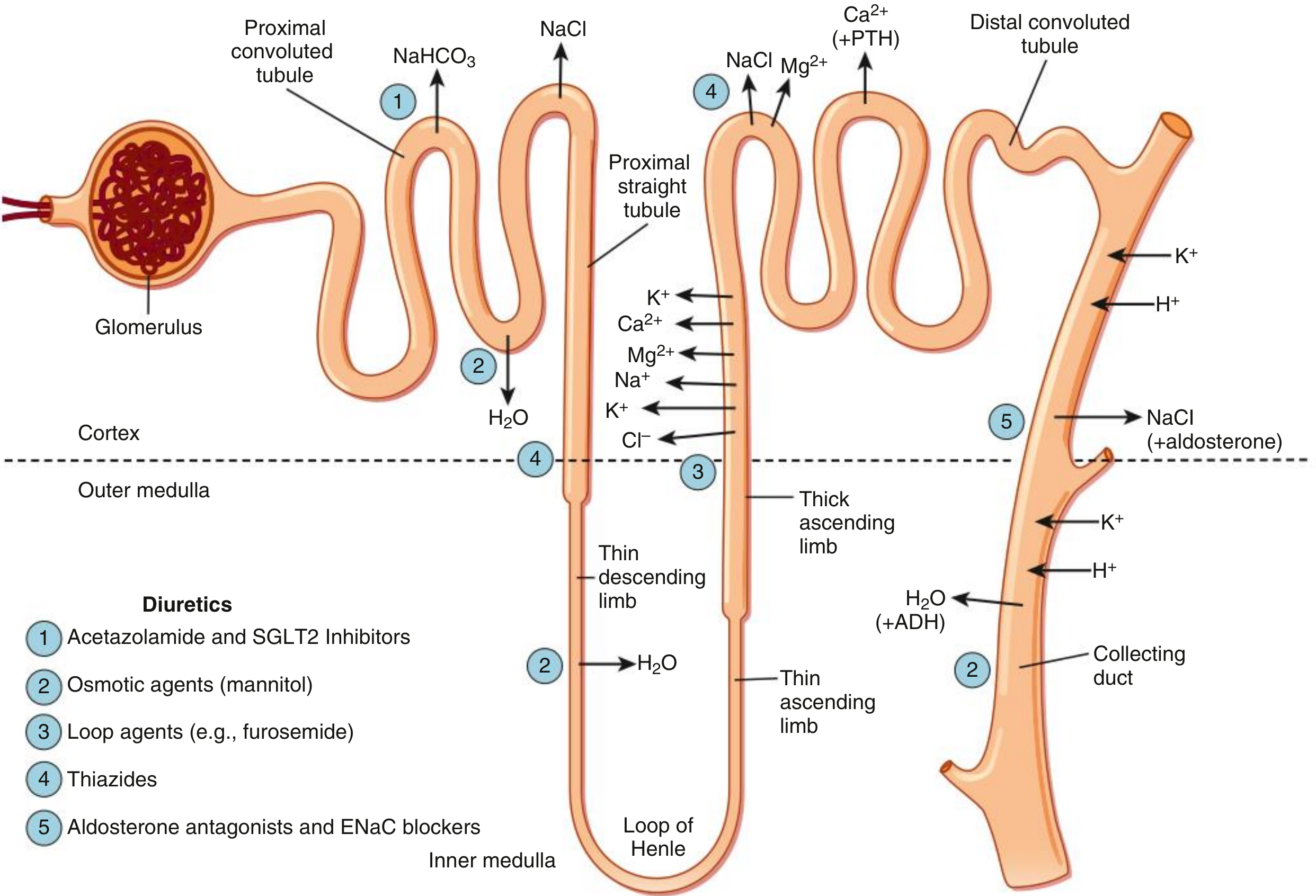
1. Carbonic Anhydrase Inhibitors (Site 1 - Proximal Convoluted Tubule)
Mechanism: Inhibit carbonic anhydrase in the PCT, reducing NaHCO₃ reabsorption. This produces a bicarbonate-rich urine and mild natriuresis. They are among the weakest diuretics because downstream segments compensate by reabsorbing the extra Na⁺.
| Drug | Notes |
|---|---|
| Acetazolamide | Oral; also used for glaucoma, altitude sickness, epilepsy |
| Methazolamide | Primarily used for glaucoma |
| Dorzolamide | Topical ophthalmic use only |
Key effect: Cause hyperchloremic metabolic acidosis (lose HCO₃⁻). Self-limiting due to acidosis.
2. Osmotic Diuretics (Site 2 - PCT + Descending Limb + Collecting Duct)
Mechanism: Freely filtered at the glomerulus but not reabsorbed. They osmotically retain water in the tubular lumen throughout the nephron, preventing passive water reabsorption.
| Drug | Notes |
|---|---|
| Mannitol | IV only; used for cerebral edema, raised IOP, oliguric renal failure |
| Isosorbide | Used for glaucoma |
| Glycerin | Oral |
| Urea | IV; used for cerebral edema |
Key effect: Expand plasma volume before diuresis - contraindicated in pulmonary edema/anuria.
3. Loop Diuretics (Site 3 - Thick Ascending Limb of Loop of Henle)
Mechanism: Competitively inhibit the Na⁺-K⁺-2Cl⁻ (NKCC2) co-transporter on the apical membrane of the thick ascending limb. This is the most potent class - can excrete up to 20-25% of filtered Na⁺. They also inhibit the medullary concentration gradient, reducing water reabsorption even in the presence of ADH, and enhance free water clearance.
| Drug | Notes |
|---|---|
| Furosemide (Frusemide) | Prototype; oral bioavailability ~40-79%; short-acting (<3 hrs) |
| Bumetanide | Higher oral bioavailability than furosemide |
| Torsemide | Higher oral bioavailability; longer-acting |
| Ethacrynic acid | Greater ototoxic risk; reserved for patients allergic to sulfonamides |
Key effects: Hypokalemia, hypomagnesemia, hypocalcemia, ototoxicity, hyperuricemia, metabolic alkalosis. Furosemide also acts as a venodilator (reduces preload acutely via prostaglandin release).
Clinical use: First choice for pulmonary edema, acute heart failure, severe edema, hypertensive urgency, hypercalcemia.
4. Thiazide and Thiazide-like Diuretics (Site 4 - Distal Convoluted Tubule)
Mechanism: Inhibit the NaCl (NCC) co-transporter in the distal convoluted tubule, where ~5% of filtered Na⁺ is reabsorbed. Less potent than loop diuretics. They decrease free water clearance (can cause dilutional hyponatremia) and retain calcium (useful in hypercalciuria/nephrolithiasis).
Thiazides (benzothiadiazines):
| Drug | Half-life | Notes |
|---|---|---|
| Hydrochlorothiazide (HCTZ) | 6-15 hrs | Most widely used |
| Chlorothiazide | 6-12 hrs | Only IV thiazide available |
| Bendroflumethiazide | - | Used in UK |
Thiazide-like (not benzothiadiazines, but same mechanism):
| Drug | Notes |
|---|---|
| Chlorthalidone | Longer half-life (~40-60 hrs); preferred in hypertension |
| Metolazone | Retains efficacy at GFR <30 mL/min; useful in combination with loop diuretics |
| Indapamide | Additional vasodilatory properties |
Key effects: Hypokalemia, hyponatremia, hypercalcemia, hyperuricemia, hyperglycemia, hyperlipidemia, metabolic alkalosis. Lose efficacy at GFR < 30-40 mL/min (except metolazone/indapamide).
Clinical use: Hypertension (first-line), mild-moderate heart failure edema, hypercalciuria, nephrogenic diabetes insipidus, osteoporosis.
5. Potassium-Sparing Diuretics (Site 5 - Collecting Duct / Aldosterone-Sensitive Distal Nephron)
Weakest diuretics when used alone (~2% Na⁺ excretion). Main value is preventing K⁺ and Mg²⁺ loss when combined with loop or thiazide diuretics.
5a. Aldosterone (Mineralocorticoid) Receptor Antagonists
Mechanism: Competitively block aldosterone at the mineralocorticoid receptor in the principal cells of the collecting duct, reducing ENaC expression and Na⁺ reabsorption, thereby decreasing K⁺ secretion.
| Drug | Notes |
|---|---|
| Spironolactone | Steroidal; anti-androgenic side effects (gynecomastia, menstrual irregularity); proven mortality benefit in heart failure (RALES trial) |
| Eplerenone | Steroidal but more selective; fewer anti-androgenic effects |
| Finerenone | New non-steroidal MRA; used in CKD with T2 diabetes |
5b. ENaC (Epithelial Sodium Channel) Blockers
Mechanism: Directly block apical ENaC in the connecting tubule and cortical collecting duct, independent of aldosterone. Reduce Na⁺ reabsorption and dissipate the electrochemical gradient for K⁺ secretion.
| Drug | Notes |
|---|---|
| Amiloride | Used alone for hypertension; also used in Liddle syndrome |
| Triamterene | Often combined with HCTZ (Dyazide, Maxzide) |
Key effect of all K⁺-sparing: Hyperkalemia - avoid in renal impairment or with ACE inhibitors/ARBs.
6. SGLT2 Inhibitors (Site 1 - Proximal Convoluted Tubule)
Mechanism: Inhibit the sodium-glucose co-transporter 2 (SGLT2) in the PCT, preventing reabsorption of glucose and Na⁺. This causes glucosuria and mild natriuresis (osmotic diuresis). They also have hemodynamic and cardiorenal protective effects beyond simple diuresis.
| Drug | Notes |
|---|---|
| Empagliflozin | HFrEF, HFpEF, T2DM, CKD |
| Dapagliflozin | HFrEF, HFpEF, T2DM, CKD |
| Canagliflozin | T2DM, CKD |
| Ertugliflozin | T2DM |
7. Aquaretics (Water Diuretics - Vasopressin V2 Receptor Antagonists)
Mechanism: Selectively block V2 receptors on collecting duct cells, preventing aquaporin-2 insertion into the apical membrane. This causes excretion of free water without significant Na⁺ loss (electrolyte-sparing diuresis = "aquaresis"). These are classified separately because they cause water diuresis (solute-free water excretion), unlike all the above which cause solute diuresis.
| Drug | Receptor | Notes |
|---|---|---|
| Tolvaptan | V2 selective | Oral; FDA-approved for hypervolemic/euvolemic hyponatremia; limit 30 days (hepatotoxicity risk) |
| Conivaptan | V1a/V2 | IV only; FDA-approved for hyponatremia |
| Lixivaptan | V2 selective | Under investigation |
| Satavaptan | V2 selective | Under investigation |
Use: SIADH, dilutional hyponatremia in HF, cirrhosis with ascites, autosomal dominant polycystic kidney disease (tolvaptan).
8. Miscellaneous / Aquaretic-like (via ADH Antagonism)
These induce nephrogenic DI by interfering with ADH action on the collecting duct:
| Drug | Mechanism |
|---|---|
| Lithium | Inhibits adenylyl cyclase downstream of V2 receptor |
| Demeclocycline | Inhibits ADH action on the collecting duct (used in SIADH) |
| Amphotericin B | Reduces tubular water permeability (side effect) |
ANTIDIURETICS
Antidiuretics reduce urine output by promoting water reabsorption in the collecting duct.
1. Vasopressin (Antidiuretic Hormone, ADH) and Analogues
Physiology: Vasopressin is a nonapeptide secreted by the posterior pituitary in response to rising plasma osmolality (>280-285 mOsm/kg) or falling blood pressure. It acts via:
- V2 receptors (renal collecting duct) → activate adenylyl cyclase → insert aquaporin-2 → water reabsorption (antidiuretic effect)
- V1a receptors (vascular smooth muscle) → vasoconstriction
- V1b receptors (pituitary) → ACTH release
| Drug | Key Features |
|---|---|
| Vasopressin (ADH) | IV or IM; t½ ~15 min; also used in esophageal variceal bleeding, septic shock (vasopressor) |
| Desmopressin (DDAVP) | Synthetic analogue (1-desamino-8-D-arginine vasopressin); t½ 1.5-2.5 hrs; antidiuretic:pressor ratio 4000× greater than vasopressin; minimal V1 activity; available IV, SC, intranasal, oral, sublingual |
Pharmacokinetics of Desmopressin:
- Intranasal spray: 10 mcg/spray; bioavailability ~3-4%
- Oral: bioavailability <1%; taken fasting for better absorption
- SC dose: 1-4 mcg every 12-24 hrs
Clinical Uses of Desmopressin:
- Central (pituitary) diabetes insipidus - treatment of choice
- Nocturnal enuresis
- Hemophilia A (mild-moderate) - increases factor VIII
- von Willebrand disease (type 1)
- Uremic coagulopathy
- Bleeding due to platelet dysfunction
Toxicity: Water intoxication (hyponatremia) - can cause seizures/coma with overdose. Vasopressin (not desmopressin) can cause coronary ischemia.
2. Other Antidiuretic Mechanisms
| Drug/Agent | Mechanism | Use |
|---|---|---|
| Carbamazepine | Potentiates ADH action on the collecting duct; also stimulates ADH release | Neurogenic DI; SIADH treatment |
| Chlorpropamide | Sulfonylurea; potentiates ADH action | Partial central DI (largely obsolete) |
| Clofibrate | Stimulates ADH secretion | Partial central DI (largely obsolete) |
| Indomethacin | Prostaglandin inhibition increases tubular sensitivity to ADH | Nephrogenic DI (adjunct) |
| Thiazides | Paradoxically reduce urine volume in DI by causing mild volume depletion → increased proximal tubular reabsorption | Nephrogenic and central DI |
| Amiloride | Blocks lithium entry into collecting duct cells via ENaC | Lithium-induced nephrogenic DI |
Quick Summary Table
| Class | Site of Action | Na⁺ Excretion | Key Drugs | Special Feature |
|---|---|---|---|---|
| Carbonic anhydrase inhibitors | PCT | Low | Acetazolamide | Metabolic acidosis |
| Osmotic diuretics | PCT, descending limb | Moderate | Mannitol | Expand plasma vol first |
| Loop diuretics | Thick ascending LoH | High (20-25%) | Furosemide, Torsemide | Most potent; hypoCa |
| Thiazides | DCT | Moderate (5-10%) | HCTZ, Chlorthalidone | HyperCa; lose effect at low GFR |
| K⁺-sparing | Collecting duct | Low (~2%) | Spironolactone, Amiloride | Hyperkalemia risk |
| SGLT2 inhibitors | PCT | Low-moderate | Empagliflozin | Cardio/renal protective |
| Aquaretics (vaptans) | Collecting duct | None (water only) | Tolvaptan, Conivaptan | Hyponatremia treatment |
| Antidiuretics | ||||
| ADH/Desmopressin | Collecting duct | - | DDAVP | Central DI, enuresis |
| Potentiators (carbamazepine, chlorpropamide) | Collecting duct | - | Carbamazepine | Partial central DI |
| Thiazides (paradoxical) | PCT (vol depletion) | - | HCTZ | Nephrogenic/central DI |
Sources: Comprehensive Clinical Nephrology, 7th Edition, p. 136; Braunwald's Heart Disease, 2-Vol Set, Chapter 50; Katzung's Basic and Clinical Pharmacology, 16th Edition, Chapter 37
This is a shared conversation. Sign in to Orris to start your own chat.