
Fatty acid synthesis
Reading File
Finding Sources
Finding Sources
Reading File
Reading File
Reading File
Reading File
Reading File
Reading File
Reading File
Reading File
Reading File
Reading File
Loading Image
Loading Image
Loading Image
I now have all the content I need for a comprehensive, well-illustrated answer. Let me compose the full response.
Fatty Acid Synthesis (De Novo Lipogenesis)
Fatty acid synthesis is a cytosolic, endergonic, reductive process that converts excess dietary carbohydrate (and protein) into long-chain fatty acids, primarily palmitate (16:0). It occurs mainly in the liver, lactating mammary gland, and to a lesser extent adipose tissue.
1. Overview & Location
- Compartment: Cytosol (contrast with β-oxidation, which is mitochondrial)
- Main substrate: Acetyl CoA
- Main product: Palmitate (C16:0)
- Cofactors required: NADPH, ATP, Mn²+, biotin (B7), HCO₃⁻ (CO₂ source), pantothenic acid (B5)
- Net equation for palmitate synthesis:
Acetyl-CoA + 7 Malonyl-CoA + 14 NADPH + 14 H⁺ → Palmitate + 7 CO₂ + 8 CoA + 14 NADP⁺ + 6 H₂O
- Lippincott Illustrated Reviews Biochemistry, 8th ed., p. 518
2. Step 1 - Getting Acetyl CoA into the Cytosol
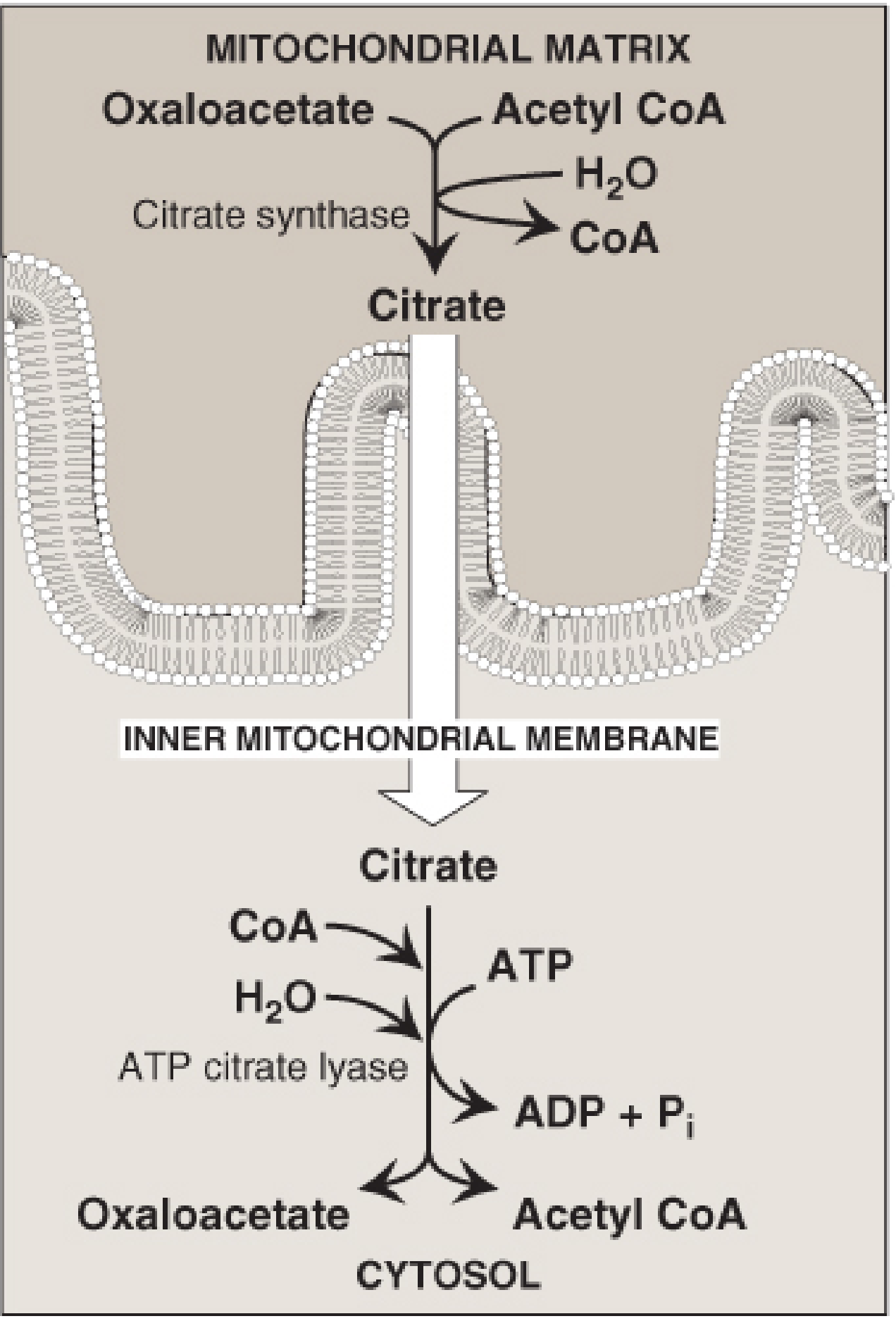
Acetyl CoA is generated in the mitochondria (from pyruvate by pyruvate dehydrogenase, or from amino acid catabolism), but CoA cannot cross the inner mitochondrial membrane. The workaround is the citrate shuttle:
- Mitochondrial acetyl CoA + OAA → Citrate (by citrate synthase)
- Citrate exits the mitochondria via the tricarboxylate transporter
- In the cytosol, ATP citrate lyase cleaves citrate back into OAA + acetyl CoA (requiring ATP)
This export of citrate is favored when the TCA cycle is inhibited by high ATP (isocitrate dehydrogenase is inhibited), causing citrate to accumulate. Cytosolic citrate thus serves as a "high-energy signal" that promotes fatty acid synthesis.
3. Step 2 - Acetyl CoA → Malonyl CoA (Rate-Limiting Step)
Enzyme: Acetyl CoA carboxylase (ACC)
Reaction:
Acetyl CoA + HCO₃⁻ + ATP → Malonyl CoA + ADP + Pᵢ
- Requires biotin (covalently bound to a lysyl residue of ACC) as a CO₂ carrier
- This is the rate-limiting and regulated step of the entire pathway
- The added CO₂ is immediately lost in the condensation step on FAS (it drives the reaction forward thermodynamically)
Basic Medical Biochemistry, 6th ed., p. 1122; Lippincott, 8th ed., p. 520
4. Step 3 - The Fatty Acid Synthase (FAS) Complex
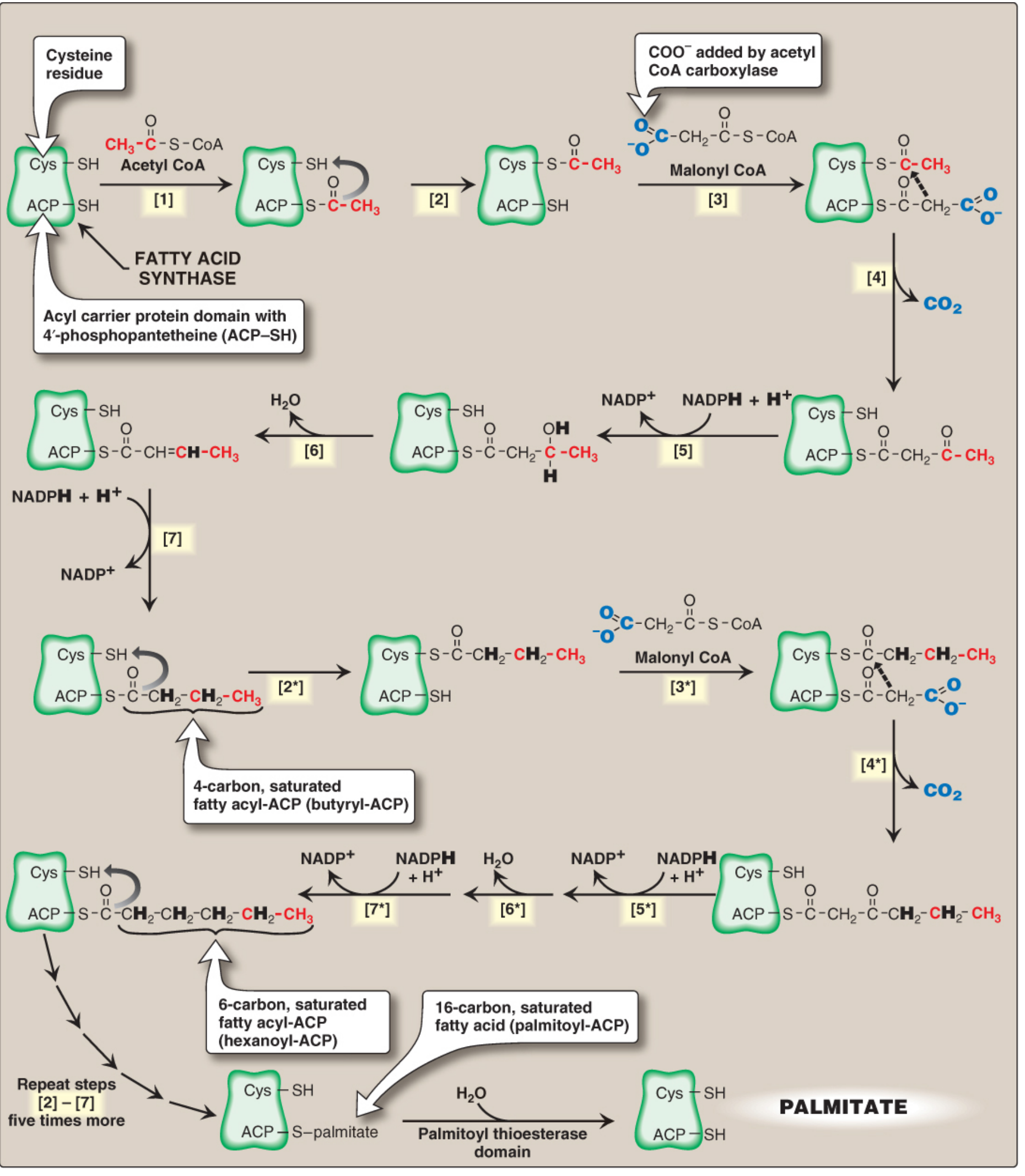
FAS is a homodimeric multifunctional enzyme - two identical polypeptide chains each containing 6 enzymatic domains plus an acyl carrier protein (ACP) domain. The ACP contains 4'-phosphopantetheine (from pantothenic acid/B5) with a free -SH group that carries the growing acyl chain. The complex is encoded by a single gene.
The Seven Reactions (per elongation cycle):
| Step | Enzyme Domain | Reaction |
|---|---|---|
| [1] | Malonyl/acetyl transacylase | Acetyl CoA loaded onto ACP -SH |
| [2] | Malonyl/acetyl transacylase | Acetyl group transferred to cysteine -SH |
| [3] | Malonyl/acetyl transacylase | Malonyl CoA loaded onto ACP -SH |
| [4] | β-ketoacyl-ACP synthase (condensing enzyme) | Acetyl + malonyl → acetoacetyl-ACP + CO₂ |
| [5] | β-ketoacyl-ACP reductase | Ketone → hydroxyl (uses 1 NADPH) |
| [6] | β-hydroxyacyl-ACP dehydratase | Dehydration → trans-Δ²-enoyl-ACP |
| [7] | Enoyl-ACP reductase | Double bond reduced (uses 1 NADPH) |
After step [7], the 4-carbon butyryl group is transferred back to the cysteine -SH, and the cycle repeats 6 more times. After 7 total cycles, a 16-carbon palmitoyl-ACP is released by the thioesterase domain.
Key points about the cycle:
- Each cycle adds 2 carbons (from malonyl CoA) and uses 2 NADPH
- 7 cycles → 14 carbons added to the initial 2-carbon acetyl primer = 16C palmitate
- The terminal 2 carbons (the ω-methyl end) come directly from the priming acetyl CoA; all others pass through malonyl CoA
- CO₂ released at step [4] was the same CO₂ added by ACC - it drives condensation forward
Harper's Illustrated Biochemistry, 32nd ed.; Lippincott, 8th ed., p. 524-526
5. NADPH Sources
Synthesis of one palmitate requires 14 NADPH. Sources:
| Source | Contribution |
|---|---|
| Pentose phosphate pathway (glucose 6-P dehydrogenase + 6-phosphogluconate dehydrogenase) | Major source; 2 NADPH per glucose-6-P |
| Malic enzyme (cytosolic, NADP⁺-dependent malate dehydrogenase): Malate → Pyruvate + CO₂ | Secondary source; regenerates NADPH while recycling OAA from citrate cleavage |
The OAA produced by ATP citrate lyase is reduced to malate (by cytosolic NADH-dependent malate dehydrogenase) and then oxidized/decarboxylated to pyruvate by malic enzyme, generating NADPH.
Lippincott, 8th ed., p. 527; Basic Medical Biochemistry, 6th ed., p. 1120
6. Regulation of Fatty Acid Synthesis
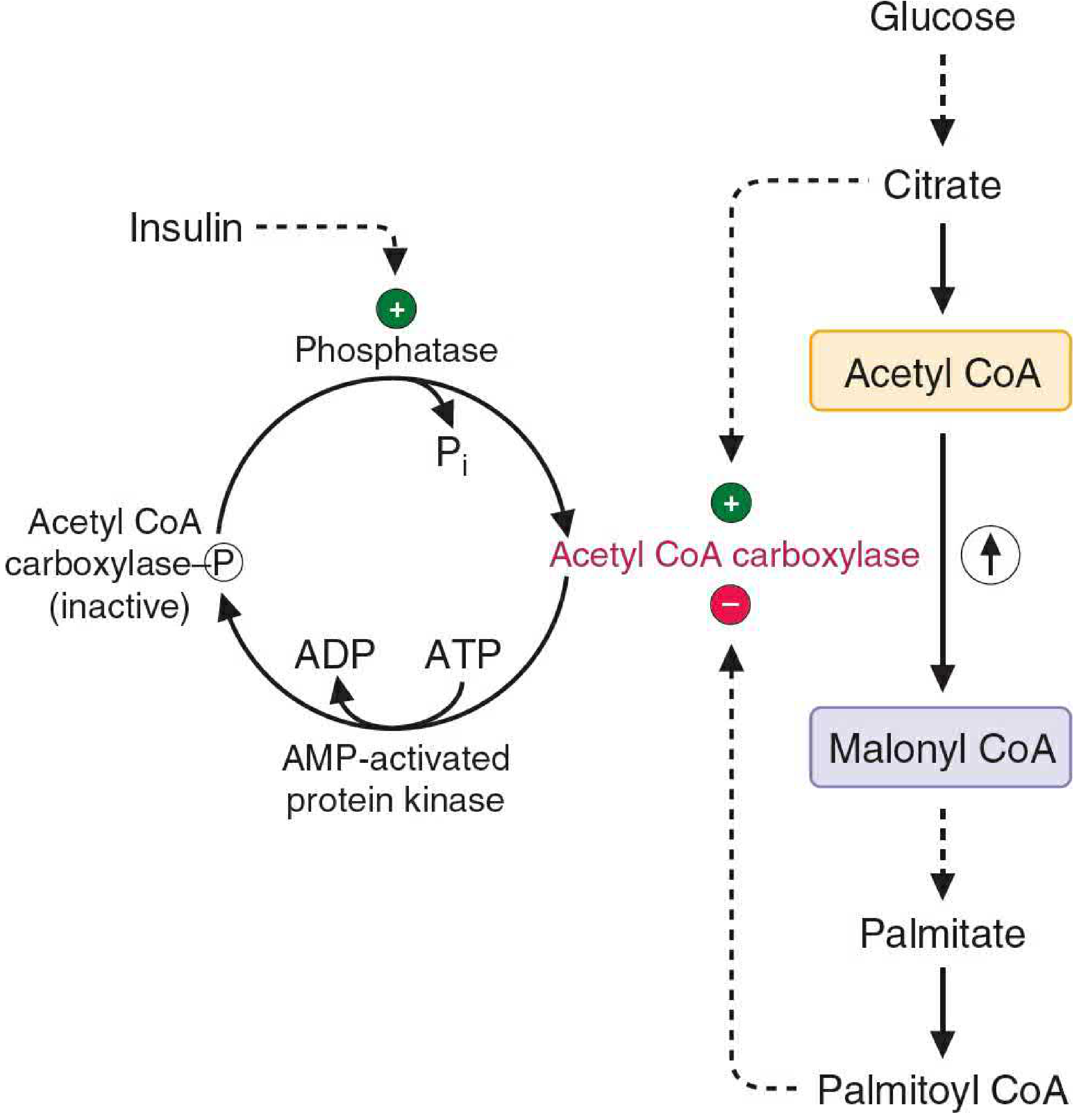
The key regulatory enzyme is Acetyl CoA Carboxylase (ACC), regulated at three levels:
A. Allosteric (short-term)
| Regulator | Effect | Mechanism |
|---|---|---|
| Citrate | Activates ACC | Causes inactive protomers to polymerize into active filaments |
| Palmitoyl CoA (end product) | Inhibits ACC | Causes depolymerization (product feedback inhibition) |
B. Covalent (short-term - phosphorylation/dephosphorylation)
| Signal | Kinase/Phosphatase | Effect on ACC |
|---|---|---|
| Low energy (↑AMP) | AMPK phosphorylates ACC | Inactive (↓synthesis) |
| Glucagon/Epinephrine | cAMP → PKA → AMPK kinase → AMPK phosphorylates ACC | Inactive |
| Insulin (fed state) | Insulin-stimulated phosphatase dephosphorylates ACC | Active (↑synthesis) |
C. Transcriptional (long-term)
| Signal | Transcription Factor | Effect |
|---|---|---|
| High glucose | ChREBP (carbohydrate response element-binding protein) | ↑ACC & FAS synthesis |
| Insulin | SREBP-1c (sterol regulatory element-binding protein-1c) | ↑ACC & FAS synthesis |
| High fat / low calorie diet | - | ↓ACC & FAS synthesis |
Clinical relevance: Metformin (type 2 diabetes drug) activates AMPK → phosphorylates and inactivates ACC, and decreases SREBP-1c → lowers triglyceride synthesis and plasma TAG levels.
Lippincott, 8th ed., p. 520-522; Basic Medical Biochemistry, 6th ed., p. 1122-1123
7. Elongation & Desaturation Beyond Palmitate
Palmitate (C16:0) is the primary product but can be further modified:
- Elongation: Occurs in the smooth ER (and mitochondria to a minor extent). Elongases add 2-carbon units from malonyl CoA to extend fatty acids beyond C16. This produces stearate (C18:0) and longer-chain fatty acids.
- Desaturation: Desaturase enzymes in the ER insert double bonds. Humans have Δ9, Δ6, and Δ5 desaturases but lack Δ12 and Δ15 desaturases.
- Δ9-desaturase converts stearate (18:0) → oleate (18:1, Δ9)
- Essential fatty acids (linoleate 18:2, Δ9,12 and α-linolenate 18:3, Δ9,12,15) must come from the diet because humans cannot introduce double bonds beyond C9 from the methyl end
- Arachidonic acid (20:4, Δ5,8,11,14) is synthesized from linoleate and is the precursor to eicosanoids (prostaglandins, thromboxanes, leukotrienes)
Lippincott, 8th ed., p. 530-534; Harper's Illustrated Biochemistry, 32nd ed.
8. Summary Table
| Feature | Fatty Acid Synthesis | β-Oxidation |
|---|---|---|
| Location | Cytosol | Mitochondrial matrix |
| Carrier | ACP (4'-phosphopantetheine) | CoA |
| Hydrogen carrier | NADPH | NADH, FADH₂ |
| Intermediate | D(-)-β-hydroxy | L(+)-β-hydroxy |
| Key enzyme | Acetyl CoA carboxylase (ACC) | Carnitine acyltransferase I |
| Regulation by insulin | Activated | Inhibited |
| Primer | Acetyl CoA (2C) | Acyl-CoA |
| Carbon donor | Malonyl CoA | - |
| Primary product | Palmitate (C16) | Acetyl CoA |
Key Mnemonics
Reactions on FAS: "Can Mike Dance For Every Song?" - Condensation, Malonyl loading, Dehydration, First reduction (ketoreductase), Enoyl reduction, and the Start (transacylase)
Essential fatty acids (cannot be synthesized): Linoleic acid (18:2, ω-6) and α-Linolenic acid (18:3, ω-3) - the "LiLy" acids
Sources: Lippincott Illustrated Reviews: Biochemistry, 8th ed., pp. 518-534 | Harper's Illustrated Biochemistry, 32nd ed. | Basic Medical Biochemistry: A Clinical Approach, 6th ed., pp. 1119-1127
This is a shared conversation. Sign in to Orris to start your own chat.