
Occupational Disease Stone Crusher Worker a) Likely disease features c) Workplace prevention d) Role of occupational health services & legislation. b) Etiology & 10 marks
silicosis stone crusher workers occupational disease etiology prevention legislation India
silicosis chest X-ray nodular opacities pneumoconiosis
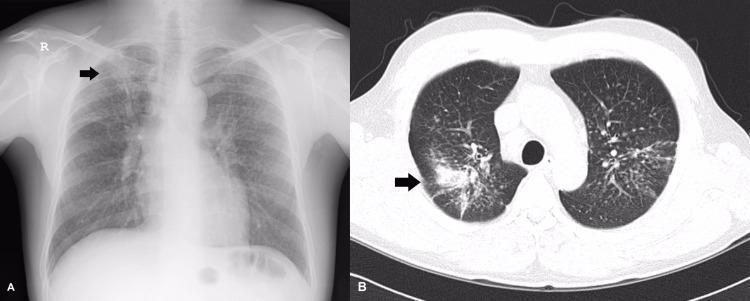
This composite medical image displays a chest radiograph (A) and an axial thin-section computed tomography (CT) scan (B) demonstrating occupational lung disease, specifically silicosis. (A) The posterior-anterior chest X-ray reveals diffuse, bilateral, ill-defined small nodular opacities with a predilection for the upper and middle lung zones. A prominent large opacity is noted in the right upper lobe (black arrow), suggesting Progressive Massive Fibrosis (PMF). (B) The axial CT scan at the level of the upper lobes confirms the presence of diffuse, multiple rounded centrilobular nodules. Significant findings include a large conglomerated mass in the right upper lobe (black arrow) and smaller areas of coalescing nodules in the left upper lobe. These radiological features are characteristic of complicated silicosis, where individual silicotic nodules merge into larger masses of fibrous tissue. The distribution is typically upper-lobe dominant, reflecting the common pattern seen in pneumoconiosis and sarcoidosis.
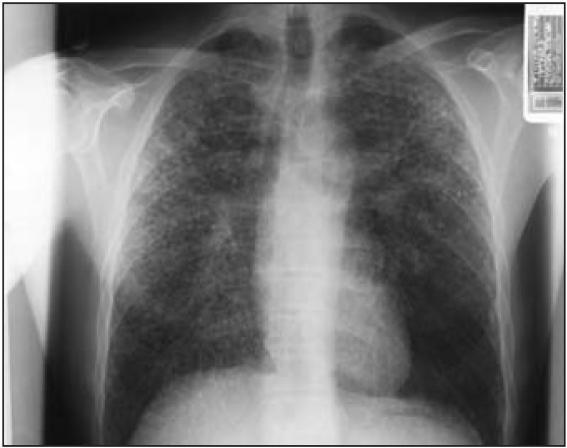
This diagnostic image is a postero-anterior (PA) chest X-ray demonstrating a diffuse, extensive, and bilateral regular-nodular infiltrate throughout both lung fields. The opacities are characterized by small, rounded nodules, many measuring between 1.5 mm and 10 mm (ILO classification q/r). There is a high profusion of these small opacities (3/3) distributed from the apices to the bases, with visible coalescence of smaller opacities into larger conglomerates, particularly in the upper lobes. No significant pleural abnormalities, effusions, or large isolated opacities are visually apparent. The mediastinal and cardiac silhouettes appear within normal limits on this projection. This radiographic pattern is highly suggestive of interstitial lung disease or pneumoconiosis, serving as a key educational example for recognizing occupational lung disease patterns such as silicosis or berylliosis.
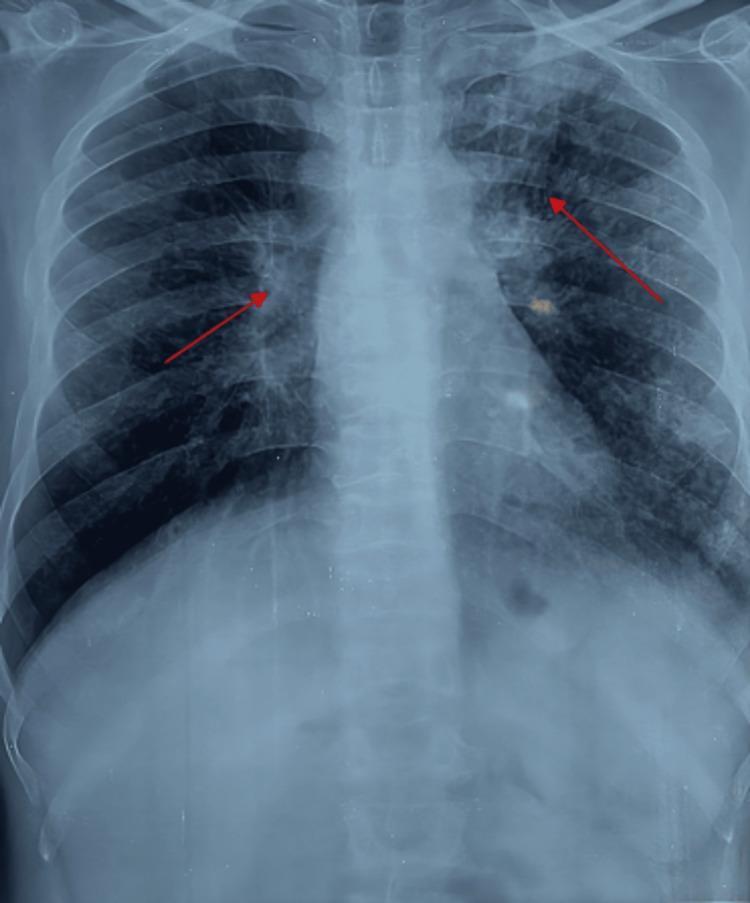
This diagnostic image is a postero-anterior (PA) chest X-ray demonstrating advanced interstitial lung disease. The bilateral lung fields show diffuse, small, rounded nodular opacities, with a clear predilection for the upper and middle zones. Large, irregular areas of consolidation are visible in both upper lobes, consistent with progressive massive fibrosis (PMF), accompanied by volume loss and architectural distortion. The hilar regions appear symmetrically enlarged, suggestive of hilar lymphadenopathy. Linear fibrotic opacities are scattered throughout the parenchyma, and subtle apical pleural thickening is noted. Red arrows highlight specific areas of coalescing nodularity in the mid-to-upper zones. While the cardiac silhouette and mediastinal borders are within normal limits, they are partially obscured by the extensive pulmonary infiltrates. This radiographic pattern is highly characteristic of complicated silicosis or pneumoconiosis, often necessitating clinical correlation for superimposed infections like tuberculosis.
Occupational Disease in Stone Crusher Workers: Silicosis
a) Likely Disease Features (Clinical Picture)
Types of Silicosis
| Type | Exposure Duration | Onset |
|---|---|---|
| Chronic (Classic) | >10 years, low-to-moderate dust | Gradual, 10-20 yrs after first exposure |
| Accelerated | 5-10 years, heavy exposure | Within 5 years |
| Acute | Very heavy, few months-5 yrs | Weeks to 5 years; mimics alveolar proteinosis |
Symptoms
- Early: Insidious onset - irritant cough, exertional dyspnea, chest pain; often the worker remains asymptomatic with an abnormal CXR
- Progressive: Dyspnea at rest, productive cough (from chronic bronchitis due to dust), wheeze and chest tightness
- Advanced: Progressive respiratory failure, cor pulmonale, finger clubbing typically absent; hemoptysis is rare and should raise suspicion for TB or malignancy
- Systemic symptoms (fever, weight loss) suggest complicating infection
Chest X-Ray (CXR) Features
- Small rounded opacities (1-10 mm, ILO "q" and "r" type) predominating in upper lung zones
- Hilar lymphadenopathy (sometimes appears before parenchymal shadows)
- "Eggshell" calcification of hilar nodes (seen in up to 20% of cases) - pathognomonic
- Progressive Massive Fibrosis (PMF): large conglomerate opacities (ILO categories A, B, C) in upper lobes with compensatory emphysema at the bases
Lung Function
- Restrictive pattern is typical (reduced TLC, FVC)
- Airflow obstruction (reduced FEV1/FVC) may coexist, especially with dust-related bronchitis or smoking
- In simple silicosis, lung function may be near-normal despite radiographic abnormality
Complications
- Silico-tuberculosis - the most important complication; silicotics are 2-3x more susceptible to TB (M. tuberculosis AND non-tuberculous mycobacteria)
- Progressive Massive Fibrosis (PMF) - may progress even after cessation of exposure
- Lung cancer - crystalline silica is classified as a Group 1 carcinogen (IARC)
- Autoimmune diseases - scleroderma (Erasmus syndrome), rheumatoid arthritis, SLE (Caplan's syndrome - rheumatoid nodules + pneumoconiosis)
- COPD/emphysema - from combined dust and tobacco exposure
- Cor pulmonale - in advanced disease
- Spontaneous pneumothorax
Key clinical note: Silicosis is progressive and irreversible - no treatment can reverse established fibrosis. The disease often progresses even after removal from exposure.
- Park's Textbook of Preventive and Social Medicine, p. 4666-4672
- Fishman's Pulmonary Diseases and Disorders, p. 1067-1069
b) Etiology
Causative Agent
- Free crystalline silica (SiO2) - primarily as quartz (the most abundant form in the earth's crust), also cristobalite and tridymite
- "Free silica" distinguishes it from silicates (e.g., asbestos, talc)
- Silica content in different rock formations: sandstone and granite contain 20-100% free silica
Why Stone Crusher Workers are at Risk
Particle Size - The Critical Factor
- Most hazardous particle size: 0.5 to 5.0 microns (aerodynamic diameter)
- These particles bypass the mucociliary escalator, reach the alveoli, and are engulfed by macrophages
- Particles >5 µm are trapped in upper airways; particles <0.5 µm may not deposit efficiently
Pathogenesis (Step-by-Step)
- Respirable quartz particles (0.5-5 µm) are inhaled and reach the alveoli
- Alveolar macrophages engulf the particles - but cannot destroy crystalline silica
- Silica particles damage the macrophage phagolysosomal membrane via reactive oxygen species (ROS)
- Macrophage undergoes apoptosis/necrosis - releases silica, cytokines (TNF-α, IL-1β), and growth factors (TGF-β)
- This triggers a cycle of macrophage recruitment, death, and re-release of silica
- Fibroblast activation and collagen deposition are stimulated
- Result: Dense nodular fibrosis - the pathological hallmark - nodules of 3-4 mm in diameter with concentric "onion-skin" laminated collagen and a central hyaline core, surrounded by a rim of lymphocytes and macrophages
- Particles block lymph channels → lymphadenopathy
- Silica also impairs macrophage ability to kill M. tuberculosis → explains susceptibility to silico-TB
Factors Determining Disease Severity
| Factor | Higher Risk |
|---|---|
| Free silica content of dust | Higher % silica (quartz > granite > coal) |
| Particle size | 0.5-3 µm range |
| Dust concentration | Higher ambient concentration |
| Duration of exposure | Longer years of work |
| Individual susceptibility | Genetic factors, smoking, pre-existing lung disease |
- Fishman's Pulmonary Diseases and Disorders, p. 986-992
- Harrison's Principles of Internal Medicine 22E, p. 2280
- Park's Textbook of Preventive and Social Medicine, p. 4655-4666
c) Workplace Prevention
1. Engineering Controls (Primary - Most Effective)
- Substitution: Replace silica-containing abrasives with less hazardous materials where possible (e.g., steel shot instead of silica sand for blasting)
- Process enclosure: Completely enclose dust-generating processes (crushers, conveyors, screens)
- Wet methods (hydroblasting/wet drilling): Applying water at the point of dust generation suppresses airborne particles - the single most practical measure in stone crushing
- Local exhaust ventilation (LEV): Hood-and-duct systems capturing dust at source
- Remote operation: Operating crushers from enclosed cabs with filtered air; remote-controlled machinery
- Isolation: Separating the crushing area from workers' rest areas
2. Administrative Controls
- Job rotation to limit individual exposure time
- Dust monitoring: Regular air sampling for respirable crystalline silica (target: NIOSH recommends ≤50 µg/m³ as 8-h TWA; OSHA PEL 100 µg/m³)
- Housekeeping: Wet-sweeping instead of dry-sweeping; vacuum with HEPA filters
- Restricting access to dusty areas
- Banning dry processes wherever wet alternatives are feasible
3. Personal Protective Equipment (PPE)
- Respiratory protection: Half-face or full-face respirators with N95 (P100) filters or powered air-purifying respirators (PAPRs); N95 minimum for silica work
- Appropriate fit-testing and maintenance of respirators
- Note: PPE is the last line of defense, not a substitute for engineering controls
4. Education and Training
- Workers must understand silicosis risk, symptoms, and the importance of using controls
- Supervisors trained in dust control practices
- Awareness campaigns in local languages for informal workers
Exposure Limit Standards
| Standard | PEL for Respirable Crystalline Silica |
|---|---|
| OSHA (USA) | 50 µg/m³ (8-h TWA, revised 2016) |
| NIOSH Recommended | 50 µg/m³ |
| India (Factories Act) | 0.1 mg/m³ (approximately 100 µg/m³) |
- Fishman's Pulmonary Diseases and Disorders, p. 1124-1134
d) Role of Occupational Health Services and Legislation
Occupational Health Services (OHS) - Roles
1. Pre-placement Medical Examination
- Baseline chest X-ray (ILO B-reader standard), spirometry, and symptom history
- Identify pre-existing conditions that increase risk (pre-existing lung disease, TB, immunodeficiency)
- Establish a baseline for future comparison
2. Periodic Medical Surveillance (most important ongoing role)
- Regular chest X-rays (every 1-2 years; annually after 10 years of exposure)
- Periodic spirometry (PFT) every 1-3 years
- Tuberculin skin test (TST) or IGRA for TB screening - silicotics require annual TB testing
- Symptom questionnaire (cough, dyspnea, sputum)
- Aggregate analysis of plant-wide health data to assess adequacy of controls
- Workers who develop disease should be removed from further silica exposure
3. Health Promotion and Education
- Worker education about dust hazards and prevention
- Smoking cessation counseling (synergistic effect with silica)
4. Sentinel Event Response
- Detection of a single case of silicosis is a "sentinel health event" - triggers a full workplace hazard assessment
- Investigate and protect all co-workers at risk
5. Treatment and Rehabilitation
- No disease-modifying treatment; symptomatic management (bronchodilators for obstruction, oxygen for hypoxemia)
- Anti-TB treatment for silico-tuberculosis (longer regimens required)
- Whole-lung lavage in acute silicosis for symptomatic relief
- Disability assessment and compensation guidance
6. Record-Keeping and Reporting
- Maintain individual and aggregate health records
- Notify relevant authorities as required by law
Legislation (India-focused)
| Legislation | Relevance to Silicosis/Stone Crushers |
|---|---|
| Factories Act, 1948 | Made silicosis a notifiable disease; mandates dust control, medical examination, and safe working conditions in factories |
| Mines Act, 1952 | Made silicosis a notifiable occupational disease in mining; requires dust suppression, ventilation, and periodic medical examination |
| Workmen's Compensation Act, 1923 | Provides compensation to workers disabled by silicosis; recognizes silicosis as a scheduled occupational disease |
| Environment Protection Act, 1986 | Controls ambient dust pollution from stone crushing units |
| Building and Other Construction Workers Act, 1996 | Provides welfare and safety provisions for construction workers exposed to silica |
| Occupational Safety, Health and Working Conditions Code, 2020 | Consolidates earlier labor laws; mandates hazard identification, risk assessment, and health surveillance |
International/WHO Framework
- ILO/WHO Global Programme for the Elimination of Silicosis (GPES): Targets silicosis elimination by 2030 as part of the joint ILO/WHO programme
- IARC Classification: Crystalline silica (quartz) inhaled from occupational sources is a Group 1 carcinogen
- ILO International Classification of Radiographs of Pneumoconioses - standardized B-reader system for CXR interpretation
Recent Judicial Developments (India, 2024-2025)
- The National Green Tribunal (NGT) to monitor silica-prone industries
- The National Human Rights Commission (NHRC) to oversee compensation schemes
- State governments to establish mandatory screening and relief programs
Summary Table
| Dimension | Key Points |
|---|---|
| Disease | Silicosis (chronic pneumoconiosis) |
| Agent | Crystalline silica (quartz), 0.5-5 µm particles |
| Pathology | Nodular fibrosis 3-4 mm, "onion-skin" nodules, PMF |
| CXR | Snow-storm pattern, upper lobe nodules, eggshell calcification |
| Complications | Silico-TB, PMF, lung cancer, cor pulmonale, autoimmune disease |
| Prevention | Wet methods, enclosure, LEV, PPE, substitution |
| Legislation (India) | Factories Act 1948, Mines Act 1952, WC Act 1923 |
| OHS Role | Screening, surveillance, sentinel event response, compensation |
| Prognosis | Incurable; progressive even after cessation of exposure |
Sources: Park's Textbook of Preventive & Social Medicine (p. 4638-4672); Fishman's Pulmonary Diseases and Disorders (pp. 986-1141); Harrison's Principles of Internal Medicine 22E (p. 2280); Springer Nature - Silicosis prevalence in India (2024)
Pdf format
ls -la /tmp/workspace/ 2>/dev/null || mkdir -p /tmp/workspace && ls -la /tmp/workspace/
mkdir -p /tmp/workspace/silicosis-pdf && python3 << 'EOF' from reportlab.lib.pagesizes import A4 from reportlab.lib.styles import getSampleStyleSheet, ParagraphStyle from reportlab.lib.units import cm from reportlab.lib import colors from reportlab.platypus import (SimpleDocTemplate, Paragraph, Spacer, Table, TableStyle, HRFlowable, KeepTogether) from reportlab.lib.enums import TA_CENTER, TA_LEFT, TA_JUSTIFY doc = SimpleDocTemplate( "/tmp/workspace/silicosis-pdf/Silicosis_Stone_Crusher_Workers.pdf", pagesize=A4, rightMargin=2*cm, leftMargin=2*cm, topMargin=2.5*cm, bottomMargin=2.5*cm, title="Occupational Disease in Stone Crusher Workers - Silicosis", author="Orris Medical AI" ) styles = getSampleStyleSheet() W = A4[0] - 4*cm # usable width # Custom styles title_style = ParagraphStyle('Title', parent=styles['Title'], fontSize=18, textColor=colors.HexColor('#1a3a5c'), spaceAfter=6, alignment=TA_CENTER, fontName='Helvetica-Bold') subtitle_style = ParagraphStyle('Subtitle', parent=styles['Normal'], fontSize=11, textColor=colors.HexColor('#4a4a4a'), spaceAfter=12, alignment=TA_CENTER, fontName='Helvetica-Oblique') h1_style = ParagraphStyle('H1', parent=styles['Heading1'], fontSize=13, textColor=colors.white, spaceBefore=14, spaceAfter=6, fontName='Helvetica-Bold', backColor=colors.HexColor('#1a3a5c'), leftIndent=-0.3*cm, rightIndent=-0.3*cm, borderPad=6) h2_style = ParagraphStyle('H2', parent=styles['Heading2'], fontSize=11, textColor=colors.HexColor('#1a3a5c'), spaceBefore=10, spaceAfter=4, fontName='Helvetica-Bold', borderPad=2) h3_style = ParagraphStyle('H3', parent=styles['Heading3'], fontSize=10, textColor=colors.HexColor('#2c5f8a'), spaceBefore=8, spaceAfter=3, fontName='Helvetica-Bold') body_style = ParagraphStyle('Body', parent=styles['Normal'], fontSize=9.5, leading=14, spaceAfter=5, alignment=TA_JUSTIFY, fontName='Helvetica') bullet_style = ParagraphStyle('Bullet', parent=styles['Normal'], fontSize=9.5, leading=13, spaceAfter=3, leftIndent=14, fontName='Helvetica', bulletIndent=4) note_style = ParagraphStyle('Note', parent=styles['Normal'], fontSize=9, leading=12, spaceAfter=4, backColor=colors.HexColor('#fff8e1'), borderPad=6, leftIndent=6, rightIndent=6, fontName='Helvetica-Oblique', textColor=colors.HexColor('#5d4037')) source_style = ParagraphStyle('Source', parent=styles['Normal'], fontSize=8, textColor=colors.HexColor('#777777'), spaceAfter=2, fontName='Helvetica-Oblique') story = [] # ── TITLE ────────────────────────────────────────────────────────────── story.append(Spacer(1, 0.3*cm)) story.append(Paragraph("Occupational Disease in Stone Crusher Workers", title_style)) story.append(Paragraph("SILICOSIS — A Comprehensive Review", subtitle_style)) story.append(HRFlowable(width="100%", thickness=2, color=colors.HexColor('#1a3a5c'))) story.append(Spacer(1, 0.3*cm)) # ── SECTION a) DISEASE FEATURES ────────────────────────────────────── story.append(Paragraph("a) Likely Disease Features (Clinical Picture)", h1_style)) story.append(Spacer(1, 0.2*cm)) story.append(Paragraph("<b>Types of Silicosis</b>", h2_style)) types_data = [ [Paragraph('<b>Type</b>', body_style), Paragraph('<b>Exposure</b>', body_style), Paragraph('<b>Onset</b>', body_style)], [Paragraph('Chronic (Classic)', body_style), Paragraph('>10 years, low-moderate dust', body_style), Paragraph('Gradual; 10–20 yrs after 1st exposure', body_style)], [Paragraph('Accelerated', body_style), Paragraph('5–10 years, heavy exposure', body_style), Paragraph('Within 5 years of exposure', body_style)], [Paragraph('Acute', body_style), Paragraph('Months–5 years, very heavy dust', body_style), Paragraph('Weeks–5 yrs; mimics alveolar proteinosis', body_style)], ] types_table = Table(types_data, colWidths=[3.5*cm, 5*cm, 7*cm]) types_table.setStyle(TableStyle([ ('BACKGROUND', (0,0), (-1,0), colors.HexColor('#1a3a5c')), ('TEXTCOLOR', (0,0), (-1,0), colors.white), ('FONTNAME', (0,0), (-1,0), 'Helvetica-Bold'), ('FONTSIZE', (0,0), (-1,-1), 9), ('ROWBACKGROUNDS', (0,1), (-1,-1), [colors.HexColor('#f0f4f8'), colors.white]), ('GRID', (0,0), (-1,-1), 0.4, colors.HexColor('#c0cdd8')), ('ALIGN', (0,0), (-1,-1), 'LEFT'), ('VALIGN', (0,0), (-1,-1), 'MIDDLE'), ('TOPPADDING', (0,0), (-1,-1), 5), ('BOTTOMPADDING', (0,0), (-1,-1), 5), ('LEFTPADDING', (0,0), (-1,-1), 6), ])) story.append(types_table) story.append(Spacer(1, 0.3*cm)) story.append(Paragraph("<b>Symptoms</b>", h2_style)) symptoms = [ ("<b>Early:</b>", "Insidious onset — irritant cough, exertional dyspnoea, chest pain. Worker may be asymptomatic with an abnormal chest X-ray."), ("<b>Progressive:</b>", "Dyspnoea at rest, productive cough (from chronic bronchitis from dust ± smoking), wheeze and chest tightness."), ("<b>Advanced:</b>", "Progressive respiratory failure, cor pulmonale. Hemoptysis is rare and should raise suspicion for TB or malignancy. Finger clubbing is NOT a typical feature."), ("<b>Systemic:</b>", "Fever and weight loss suggest complicating infection (TB) or neoplasia."), ] for label, text in symptoms: story.append(Paragraph(f"• {label} {text}", bullet_style)) story.append(Spacer(1, 0.2*cm)) story.append(Paragraph("<b>Chest X-Ray (CXR) Features — 'Snow-Storm' Appearance</b>", h2_style)) cxr_points = [ "Small rounded opacities (1–10 mm, ILO 'q' and 'r' type) predominating in <b>upper lung zones</b>", "Hilar lymphadenopathy — may appear before parenchymal shadows", "<b>'Eggshell' calcification</b> of hilar lymph nodes (in ~20% of cases) — pathognomonic of silicosis", "Progressive Massive Fibrosis (PMF): large conglomerate opacities (ILO A, B, C) in upper lobes with compensatory emphysema at the bases", "HRCT more sensitive: confirms centrilobular nodules, subpleural deposits, and early PMF", ] for pt in cxr_points: story.append(Paragraph(f"• {pt}", bullet_style)) story.append(Spacer(1, 0.2*cm)) story.append(Paragraph("<b>Lung Function Tests</b>", h2_style)) story.append(Paragraph( "Typically a <b>restrictive pattern</b> (reduced TLC, FVC, DLCO). Airflow obstruction (reduced FEV1/FVC ratio) " "may coexist, especially with dust-related bronchitis or tobacco smoking. In simple silicosis, lung function " "may remain near-normal despite obvious radiographic abnormality.", body_style)) story.append(Spacer(1, 0.2*cm)) story.append(Paragraph("<b>Complications</b>", h2_style)) complications = [ "<b>Silico-tuberculosis</b> — The most important complication; 2–3× increased susceptibility to M. tuberculosis and NTM. Sputum rarely shows AFB; post-mortems may show pure silicosis. Radiological distinction from TB is difficult.", "<b>Progressive Massive Fibrosis (PMF)</b> — Disease progresses even after cessation of exposure.", "<b>Lung cancer</b> — Crystalline silica is IARC Group 1 carcinogen; 2× increased lung cancer risk.", "<b>Autoimmune diseases</b> — Scleroderma (Erasmus syndrome), SLE, rheumatoid arthritis; Caplan's syndrome (RA + pneumoconiotic nodules).", "<b>COPD/Emphysema</b> — Synergistic effect with cigarette smoking.", "<b>Cor pulmonale</b> — In advanced disease due to chronic hypoxia.", "<b>Spontaneous pneumothorax</b> — Due to sub-pleural bulla formation.", ] for c in complications: story.append(Paragraph(f"• {c}", bullet_style)) story.append(Spacer(1, 0.2*cm)) story.append(Paragraph( "⚠ Key Fact: Silicosis is PROGRESSIVE and IRREVERSIBLE — no treatment can reverse established fibrosis. " "Disease often progresses even after removal from exposure.", note_style)) story.append(Spacer(1, 0.1*cm)) story.append(Paragraph("Sources: Park's Textbook of Preventive & Social Medicine, p.4666; Fishman's Pulmonary Diseases & Disorders, p.1067–1069", source_style)) # ── SECTION b) ETIOLOGY ────────────────────────────────────────────── story.append(Paragraph("b) Etiology", h1_style)) story.append(Spacer(1, 0.2*cm)) story.append(Paragraph("<b>Causative Agent</b>", h2_style)) story.append(Paragraph( "<b>Free crystalline silica (SiO₂)</b>, primarily as <b>quartz</b> (most abundant mineral in Earth's crust), " "also cristobalite and tridymite. 'Free silica' is distinguished from silicates (e.g., asbestos, talc). " "Silica content in rock varies: sandstone and granite contain 20–100% free silica.", body_style)) story.append(Spacer(1, 0.2*cm)) story.append(Paragraph("<b>Why Stone Crusher Workers are at Highest Risk</b>", h2_style)) story.append(Paragraph( "Stone crushing involves <b>direct mechanical disruption of silica-bearing rock</b>, generating enormous quantities " "of respirable dust. Operations including blasting, drilling, primary crushing, secondary crushing, screening, and " "conveying all release fine silica particles directly into the worker's breathing zone. Stone crushers rank among " "the highest-risk occupations for silicosis globally (CDC/NIOSH data: 'Crushing and grinding machine operators' " "feature in Top 10 silicosis mortality occupations).", body_style)) story.append(Spacer(1, 0.2*cm)) story.append(Paragraph("<b>Critical Particle Size</b>", h2_style)) story.append(Paragraph( "Particles of <b>0.5–5.0 microns (aerodynamic diameter)</b> are the most dangerous. They bypass the " "mucociliary escalator, penetrate to the alveoli, and are engulfed by macrophages. " "Particles >5 µm are trapped in upper airways; particles <0.5 µm may not deposit efficiently.", body_style)) story.append(Spacer(1, 0.2*cm)) story.append(Paragraph("<b>Pathogenesis (Step-by-Step)</b>", h2_style)) path_steps = [ "Respirable quartz particles (0.5–5 µm) are inhaled and reach the alveoli.", "Alveolar macrophages engulf the particles — but CANNOT destroy crystalline silica.", "Silica damages the phagolysosomal membrane via reactive oxygen species (ROS) generation.", "Macrophage apoptosis/necrosis occurs — releases silica, pro-inflammatory cytokines (TNF-α, IL-1β) and fibrogenic growth factors (TGF-β).", "Vicious cycle: released silica is re-engulfed by newly recruited macrophages, perpetuating inflammation.", "TGF-β activates fibroblasts → collagen deposition → progressive fibrosis.", "Pathological hallmark: <b>Dense 'onion-skin' silicotic nodules</b> (3–4 mm) with central hyaline collagen core, surrounded by a rim of macrophages and lymphocytes.", "Lymph channel blockage → hilar lymphadenopathy.", "Silica also impairs macrophage killing of M. tuberculosis → predisposition to silico-TB.", ] for i, step in enumerate(path_steps, 1): story.append(Paragraph(f"{i}. {step}", bullet_style)) story.append(Spacer(1, 0.2*cm)) story.append(Paragraph("<b>Factors Determining Disease Severity</b>", h2_style)) factor_data = [ [Paragraph('<b>Factor</b>', body_style), Paragraph('<b>Higher Risk</b>', body_style)], [Paragraph('Free silica content of dust', body_style), Paragraph('Higher % silica (quartz > granite > coal)', body_style)], [Paragraph('Particle size', body_style), Paragraph('0.5–3 µm range is most hazardous', body_style)], [Paragraph('Dust concentration', body_style), Paragraph('Higher ambient airborne concentration', body_style)], [Paragraph('Duration of exposure', body_style), Paragraph('Longer years of work in dusty environment', body_style)], [Paragraph('Individual susceptibility', body_style), Paragraph('Genetic factors, smoking, pre-existing lung disease', body_style)], ] factor_table = Table(factor_data, colWidths=[7*cm, 8.5*cm]) factor_table.setStyle(TableStyle([ ('BACKGROUND', (0,0), (-1,0), colors.HexColor('#1a3a5c')), ('TEXTCOLOR', (0,0), (-1,0), colors.white), ('FONTNAME', (0,0), (-1,0), 'Helvetica-Bold'), ('FONTSIZE', (0,0), (-1,-1), 9), ('ROWBACKGROUNDS', (0,1), (-1,-1), [colors.HexColor('#f0f4f8'), colors.white]), ('GRID', (0,0), (-1,-1), 0.4, colors.HexColor('#c0cdd8')), ('ALIGN', (0,0), (-1,-1), 'LEFT'), ('VALIGN', (0,0), (-1,-1), 'MIDDLE'), ('TOPPADDING', (0,0), (-1,-1), 5), ('BOTTOMPADDING', (0,0), (-1,-1), 5), ('LEFTPADDING', (0,0), (-1,-1), 6), ])) story.append(factor_table) story.append(Spacer(1, 0.1*cm)) story.append(Paragraph("Sources: Fishman's Pulmonary Diseases & Disorders p.986–992; Harrison's Principles of Internal Medicine 22E p.2280; Park's PSM p.4655–4666", source_style)) # ── SECTION c) WORKPLACE PREVENTION ───────────────────────────────── story.append(Paragraph("c) Workplace Prevention", h1_style)) story.append(Spacer(1, 0.2*cm)) story.append(Paragraph( "Prevention is the <b>ONLY effective intervention</b> since silicosis has no cure. " "A hierarchy of controls is applied, starting with the most effective:", body_style)) story.append(Spacer(1, 0.1*cm)) story.append(Paragraph("<b>1. Engineering Controls (Primary — Most Effective)</b>", h2_style)) eng_controls = [ "<b>Substitution:</b> Replace silica-containing abrasives with less hazardous materials where possible (e.g., steel shot instead of silica sand for blasting).", "<b>Process enclosure:</b> Completely enclose dust-generating processes — crushers, conveyors, screens — to contain dust at the source.", "<b>Wet methods (hydroblasting / wet drilling):</b> Applying water at the point of dust generation; the single most practical measure in stone crushing. Suppresses airborne particles by agglomeration.", "<b>Local exhaust ventilation (LEV):</b> Hood-and-duct systems capturing dust at point of generation before it disperses.", "<b>Remote / automated operation:</b> Operating crushers from enclosed, filtered-air cabins; remote-controlled or automated machinery reduces direct exposure.", "<b>Isolation:</b> Separate the crushing zone from workers' rest areas, canteens, and administrative spaces.", ] for c in eng_controls: story.append(Paragraph(f"• {c}", bullet_style)) story.append(Spacer(1, 0.15*cm)) story.append(Paragraph("<b>2. Administrative Controls</b>", h2_style)) admin_controls = [ "<b>Job rotation</b> to limit individual exposure time below the permissible threshold.", "<b>Air monitoring:</b> Regular sampling for respirable crystalline silica (target: ≤50 µg/m³ as 8-h TWA per NIOSH/OSHA 2016 standard; India: ≤100 µg/m³ per Factories Act).", "<b>Housekeeping:</b> Wet-sweeping instead of dry-sweeping; vacuum with HEPA filters; no compressed air blow-down.", "<b>Restricting access</b> to dusty areas to authorised workers only.", "<b>Banning dry processes</b> wherever wet alternatives are feasible.", "<b>Work scheduling:</b> Avoid dusty operations in confined spaces; schedule during periods of maximum ventilation.", ] for c in admin_controls: story.append(Paragraph(f"• {c}", bullet_style)) story.append(Spacer(1, 0.15*cm)) story.append(Paragraph("<b>3. Personal Protective Equipment (PPE) — Last Line of Defence</b>", h2_style)) ppe_points = [ "Half-face or full-face respirators with N95/P100 (HEPA) filters, or powered air-purifying respirators (PAPRs).", "N95 minimum for any work generating silica dust.", "Fit-testing mandatory; trained use and regular maintenance of respirators essential.", "PPE is supplementary — never a substitute for engineering and administrative controls.", ] for p in ppe_points: story.append(Paragraph(f"• {p}", bullet_style)) story.append(Spacer(1, 0.15*cm)) story.append(Paragraph("<b>4. Education and Training</b>", h2_style)) edu_points = [ "Workers must understand silicosis risk, early symptoms, and the importance of using controls.", "Supervisors trained in dust control practices and monitoring.", "Awareness campaigns in local languages for informal and migrant workers.", "Emphasize that silicosis is incurable but 100% preventable.", ] for e in edu_points: story.append(Paragraph(f"• {e}", bullet_style)) story.append(Spacer(1, 0.15*cm)) story.append(Paragraph("<b>Permissible Exposure Limits (PEL) for Respirable Crystalline Silica</b>", h2_style)) pel_data = [ [Paragraph('<b>Standard / Authority</b>', body_style), Paragraph('<b>PEL (8-h TWA)</b>', body_style)], [Paragraph('OSHA USA (revised 2016)', body_style), Paragraph('50 µg/m³', body_style)], [Paragraph('NIOSH Recommended', body_style), Paragraph('50 µg/m³', body_style)], [Paragraph('India — Factories Act', body_style), Paragraph('≤0.1 mg/m³ (~100 µg/m³)', body_style)], ] pel_table = Table(pel_data, colWidths=[9*cm, 6.5*cm]) pel_table.setStyle(TableStyle([ ('BACKGROUND', (0,0), (-1,0), colors.HexColor('#1a3a5c')), ('TEXTCOLOR', (0,0), (-1,0), colors.white), ('FONTNAME', (0,0), (-1,0), 'Helvetica-Bold'), ('FONTSIZE', (0,0), (-1,-1), 9), ('ROWBACKGROUNDS', (0,1), (-1,-1), [colors.HexColor('#f0f4f8'), colors.white]), ('GRID', (0,0), (-1,-1), 0.4, colors.HexColor('#c0cdd8')), ('ALIGN', (0,0), (-1,-1), 'LEFT'), ('VALIGN', (0,0), (-1,-1), 'MIDDLE'), ('TOPPADDING', (0,0), (-1,-1), 5), ('BOTTOMPADDING', (0,0), (-1,-1), 5), ('LEFTPADDING', (0,0), (-1,-1), 6), ])) story.append(pel_table) story.append(Spacer(1, 0.1*cm)) story.append(Paragraph("Source: Fishman's Pulmonary Diseases & Disorders, p.1124–1134", source_style)) # ── SECTION d) OHS & LEGISLATION ───────────────────────────────────── story.append(Paragraph("d) Role of Occupational Health Services & Legislation", h1_style)) story.append(Spacer(1, 0.2*cm)) story.append(Paragraph("<b>Role of Occupational Health Services (OHS)</b>", h2_style)) story.append(Paragraph("<b>1. Pre-placement Medical Examination</b>", h3_style)) story.append(Paragraph( "Baseline chest X-ray (ILO B-reader standard), spirometry, TB skin test / IGRA, and full symptom history " "before the worker begins silica-exposed work. Establishes a reference for future comparisons and identifies " "pre-existing conditions that increase risk.", body_style)) story.append(Paragraph("<b>2. Periodic Medical Surveillance (Most Important Ongoing Role)</b>", h3_style)) surveillance = [ "Chest X-ray every 1–2 years (annually after 10 years of exposure), read using ILO classification.", "Spirometry (PFT) every 1–3 years to detect restrictive or obstructive changes.", "TB screening (IGRA or TST) annually — silicotics have 2–3× increased TB susceptibility.", "Symptom questionnaire at each visit (cough, dyspnoea, sputum production).", "Aggregate analysis of plant-wide data every 1–3 years to assess adequacy of prevention activities.", "Workers who develop silicosis should be removed from further silica exposure.", ] for s in surveillance: story.append(Paragraph(f"• {s}", bullet_style)) story.append(Paragraph("<b>3. Health Promotion and Education</b>", h3_style)) story.append(Paragraph( "Worker education about dust hazards, early warning signs, and proper PPE use. Smoking cessation counselling " "(tobacco smoking has a synergistic harmful effect with silica exposure).", body_style)) story.append(Paragraph("<b>4. Sentinel Event Response</b>", h3_style)) story.append(Paragraph( "Detection of a single case of silicosis is a <b>'sentinel health event'</b>. It must trigger a full " "workplace hazard assessment, identification of all co-workers at risk, and a review of engineering controls. " "Failure to respond constitutes a breach of duty of care.", body_style)) story.append(Paragraph("<b>5. Treatment, Rehabilitation and Compensation Guidance</b>", h3_style)) treatment = [ "No disease-modifying treatment exists; symptomatic management with bronchodilators, oxygen therapy for hypoxaemia.", "Anti-TB treatment for silico-tuberculosis (longer regimens may be needed; drug resistance monitoring).", "Whole-lung lavage in acute silicosis for symptomatic relief.", "Disability assessment and guidance for workers' compensation claims.", "Vocational rehabilitation for workers who must change occupation.", ] for t in treatment: story.append(Paragraph(f"• {t}", bullet_style)) story.append(Paragraph("<b>6. Record-Keeping and Reporting</b>", h3_style)) story.append(Paragraph( "Maintain individual medical records and aggregate workplace health data. Notify relevant authorities " "(Factories Inspector, DGMS) of confirmed cases as required by law.", body_style)) story.append(Spacer(1, 0.2*cm)) story.append(Paragraph("<b>Legislation (India)</b>", h2_style)) leg_data = [ [Paragraph('<b>Legislation</b>', body_style), Paragraph('<b>Relevance to Silicosis / Stone Crushers</b>', body_style)], [Paragraph('Factories Act, 1948', body_style), Paragraph('Silicosis is a <b>notifiable disease</b>; mandates dust control, medical examinations, and safe conditions in factories', body_style)], [Paragraph('Mines Act, 1952', body_style), Paragraph('Silicosis is a <b>notifiable occupational disease</b> in mines; requires dust suppression, ventilation, and periodic medical examination', body_style)], [Paragraph("Workmen's Compensation Act, 1923", body_style), Paragraph('Provides compensation to workers disabled by silicosis; recognises silicosis as a scheduled occupational disease', body_style)], [Paragraph('Environment Protection Act, 1986', body_style), Paragraph('Controls ambient dust pollution from stone crushing units; regulates environmental silica exposure', body_style)], [Paragraph('Building & Other Construction Workers Act, 1996', body_style), Paragraph('Welfare and safety provisions for construction workers exposed to silica dust', body_style)], [Paragraph('OSH & Working Conditions Code, 2020', body_style), Paragraph('Consolidates earlier labour laws; mandates hazard identification, risk assessment, and health surveillance', body_style)], ] leg_table = Table(leg_data, colWidths=[5.5*cm, 10*cm]) leg_table.setStyle(TableStyle([ ('BACKGROUND', (0,0), (-1,0), colors.HexColor('#1a3a5c')), ('TEXTCOLOR', (0,0), (-1,0), colors.white), ('FONTNAME', (0,0), (-1,0), 'Helvetica-Bold'), ('FONTSIZE', (0,0), (-1,-1), 8.5), ('ROWBACKGROUNDS', (0,1), (-1,-1), [colors.HexColor('#f0f4f8'), colors.white]), ('GRID', (0,0), (-1,-1), 0.4, colors.HexColor('#c0cdd8')), ('ALIGN', (0,0), (-1,-1), 'LEFT'), ('VALIGN', (0,0), (-1,-1), 'TOP'), ('TOPPADDING', (0,0), (-1,-1), 5), ('BOTTOMPADDING', (0,0), (-1,-1), 5), ('LEFTPADDING', (0,0), (-1,-1), 6), ])) story.append(leg_table) story.append(Spacer(1, 0.2*cm)) story.append(Paragraph("<b>International Framework</b>", h2_style)) intl = [ "<b>ILO/WHO Global Programme for the Elimination of Silicosis (GPES):</b> Joint programme targeting silicosis elimination by 2030.", "<b>IARC:</b> Crystalline silica (quartz) inhaled from occupational sources is classified as a Group 1 carcinogen.", "<b>ILO International Classification of Radiographs of Pneumoconioses:</b> Standardised B-reader system for CXR interpretation in occupational health surveillance.", ] for i in intl: story.append(Paragraph(f"• {i}", bullet_style)) story.append(Spacer(1, 0.2*cm)) story.append(Paragraph("<b>Recent Judicial Development (India, 2024)</b>", h2_style)) story.append(Paragraph( "In August 2024, the <b>Supreme Court of India</b> ruled that failure to prevent silicosis violates <b>Article 21</b> " "(Right to Life with Dignity) of the Constitution. The Court directed the National Green Tribunal (NGT) to monitor " "silica-prone industries and the National Human Rights Commission (NHRC) to oversee compensation schemes. " "This landmark ruling converted silicosis prevention from an aspirational to a <b>legally enforceable constitutional obligation</b>.", body_style)) # ── SUMMARY TABLE ───────────────────────────────────────────────────── story.append(Paragraph("Summary Reference Table", h1_style)) story.append(Spacer(1, 0.2*cm)) summary_data = [ [Paragraph('<b>Dimension</b>', body_style), Paragraph('<b>Key Points</b>', body_style)], [Paragraph('Disease', body_style), Paragraph('Silicosis (chronic pneumoconiosis)', body_style)], [Paragraph('Causative agent', body_style), Paragraph('Crystalline silica (SiO₂ / quartz), 0.5–5 µm particles', body_style)], [Paragraph('Pathology', body_style), Paragraph("'Onion-skin' nodular fibrosis 3–4 mm; PMF in advanced cases", body_style)], [Paragraph('CXR hallmark', body_style), Paragraph("'Snow-storm' pattern; upper lobe nodules; eggshell calcification of hilar nodes", body_style)], [Paragraph('Key complications', body_style), Paragraph('Silico-TB, PMF, lung cancer (IARC Group 1), cor pulmonale, autoimmune disease', body_style)], [Paragraph('Prevention', body_style), Paragraph('Wet methods, process enclosure, LEV, substitution, PPE (N95+)', body_style)], [Paragraph('Legislation (India)', body_style), Paragraph('Factories Act 1948, Mines Act 1952, WC Act 1923, OSH Code 2020', body_style)], [Paragraph('OHS role', body_style), Paragraph('Pre-placement & periodic screening, surveillance, sentinel event response, compensation', body_style)], [Paragraph('Prognosis', body_style), Paragraph('Incurable; progressive even after cessation of silica exposure', body_style)], ] summary_table = Table(summary_data, colWidths=[4.5*cm, 11*cm]) summary_table.setStyle(TableStyle([ ('BACKGROUND', (0,0), (-1,0), colors.HexColor('#1a3a5c')), ('TEXTCOLOR', (0,0), (-1,0), colors.white), ('FONTNAME', (0,0), (-1,0), 'Helvetica-Bold'), ('FONTSIZE', (0,0), (-1,-1), 9), ('ROWBACKGROUNDS', (0,1), (-1,-1), [colors.HexColor('#f0f4f8'), colors.white]), ('GRID', (0,0), (-1,-1), 0.4, colors.HexColor('#c0cdd8')), ('ALIGN', (0,0), (-1,-1), 'LEFT'), ('VALIGN', (0,0), (-1,-1), 'TOP'), ('TOPPADDING', (0,0), (-1,-1), 5), ('BOTTOMPADDING', (0,0), (-1,-1), 5), ('LEFTPADDING', (0,0), (-1,-1), 6), ])) story.append(summary_table) story.append(Spacer(1, 0.3*cm)) story.append(HRFlowable(width="100%", thickness=1, color=colors.HexColor('#c0cdd8'))) story.append(Spacer(1, 0.1*cm)) story.append(Paragraph( "References: Park's Textbook of Preventive & Social Medicine (pp. 4638–4672) | " "Fishman's Pulmonary Diseases & Disorders (pp. 984–1141) | " "Harrison's Principles of Internal Medicine 22E (p. 2280) | " "Murray & Nadel's Textbook of Respiratory Medicine | " "Springer Nature: Silicosis prevalence in India (2024)", source_style)) doc.build(story) print("PDF created successfully") EOF