
Broad spectrum Antimicrobial example
broad spectrum antimicrobials examples clinical pharmacology
Broad-Spectrum Antimicrobials
Key Examples by Drug Class
1. Carbapenems (Widest spectrum - "last resort")
| Drug | Coverage |
|---|---|
| Imipenem/Cilastatin | Gram+, Gram-, anaerobes, some ESBL-producers |
| Meropenem | Similar to imipenem; better CNS penetration |
| Ertapenem | Similar but lacks Pseudomonas/Acinetobacter coverage |
| Doripenem | Anti-pseudomonal, hospital use |
- Mechanism: Beta-lactam - inhibits penicillin-binding proteins (cell wall synthesis)
- Carbapenems are the broadest of all beta-lactams
- Used in sepsis, nosocomial infections, and antimicrobial stewardship "reserve" agents
2. Extended-Spectrum Penicillins
| Drug | Notes |
|---|---|
| Ampicillin | Classic broad-spectrum; active against Gram- organisms beyond penicillin G |
| Amoxicillin | Oral; similar to ampicillin |
| Piperacillin-Tazobactam (Pip-Tazo) | Extended spectrum including Pseudomonas + anaerobes |
| Ticarcillin-Clavulanate | Anti-pseudomonal |
- Sherris & Ryan: "Broad-spectrum: ampicillin, amoxicillin - similar to natural penicillins, but more active against Gram-negative organisms"
3. Cephalosporins (Later Generations)
| Generation | Examples | Coverage |
|---|---|---|
| 3rd Gen | Ceftriaxone, Cefotaxime, Ceftazidime | Broad Gram- coverage |
| 4th Gen | Cefepime | Gram+ and Gram-, including Pseudomonas |
| 5th Gen | Ceftaroline | MRSA + Gram- |
| Novel | Cefiderocol | Siderophore cephalosporin; covers MDR Gram- including carbapenem-resistant organisms |
- Generally, higher generations = broader Gram-negative coverage, sometimes at the expense of some Gram-positive activity
4. Fluoroquinolones
| Drug | Key Use |
|---|---|
| Ciprofloxacin | Gram- focus; best anti-pseudomonal quinolone |
| Levofloxacin | Broad; excellent respiratory coverage ("respiratory quinolone") |
| Moxifloxacin | Broad; adds anaerobic coverage; no Pseudomonas |
- Mechanism: Inhibit DNA gyrase (Gram-) and topoisomerase IV (Gram+)
5. Tetracyclines
| Drug | Notes |
|---|---|
| Doxycycline | Gram+, Gram-, atypicals, rickettsiae |
| Tetracycline | Classic; broad including chlamydiae |
| Minocycline | Also active against MRSA in some settings |
| Tigecycline | Glycylcycline; very broad including MRSA, VRE, and many MDR organisms |
- Sherris & Ryan: "Tetracyclines...are broad-spectrum agents that inhibit a wide range of Gram-positive and Gram-negative bacteria"
6. Chloramphenicol
- Classic example of a broad-spectrum antibiotic
- Active against Gram+, Gram-, chlamydiae, rickettsiae, spirochetes, anaerobes
- Mechanism: Binds 50S ribosomal subunit, inhibits peptidyl transferase
- Largely restricted today due to risk of aplastic anemia (idiosyncratic) and dose-related bone marrow suppression
- Lippincott: "A broad-spectrum antibiotic... restricted to life-threatening infections for which no alternatives exist"
7. Aminoglycosides
| Drug | Notes |
|---|---|
| Gentamicin | Gram-negative bacilli including Pseudomonas |
| Tobramycin | Strong anti-pseudomonal |
| Amikacin | Broader resistance profile; reserved for MDR organisms |
| Streptomycin | TB + plague |
- Often combined with beta-lactams for synergy against Gram- and enterococcal infections
8. Trimethoprim-Sulfamethoxazole (TMP-SMX)
- Broad spectrum: Gram+, Gram-, Pneumocystis jirovecii (fungal-like)
- Mechanism: Sequential blockade of folate synthesis pathway
- Uses: UTI, PCP prophylaxis/treatment, MRSA skin infections, Stenotrophomonas
9. Macrolides
| Drug | Notes |
|---|---|
| Azithromycin | Gram+, atypicals (Mycoplasma, Chlamydia, Legionella), some Gram- |
| Clarithromycin | Similar; also H. pylori |
| Erythromycin | Classic, narrower than azithromycin |
Summary Table
| Class | Prototype Example | Gram+ | Gram- | Anaerobes | Atypicals |
|---|---|---|---|---|---|
| Carbapenems | Imipenem | ✓ | ✓✓ | ✓ | - |
| Extended Penicillins | Pip-Tazo | ✓ | ✓✓ | ✓ | - |
| 3rd/4th Gen Cephalosporins | Ceftriaxone, Cefepime | ✓ | ✓✓ | - | - |
| Fluoroquinolones | Ciprofloxacin | ✓ | ✓✓ | ± | ✓ |
| Tetracyclines | Doxycycline | ✓ | ✓ | - | ✓✓ |
| Chloramphenicol | Chloramphenicol | ✓ | ✓ | ✓ | ✓ |
| Aminoglycosides | Gentamicin | ± | ✓✓ | - | - |
| TMP-SMX | Co-trimoxazole | ✓ | ✓ | - | ✓ |
| Macrolides | Azithromycin | ✓ | ± | - | ✓✓ |
Clinical Uses of Broad-Spectrum Agents
- Empiric therapy - when pathogen is unknown and culture results are pending
- Sepsis / septic shock - early broad coverage saves lives
- Polymicrobial infections - Fournier's gangrene, peritonitis, diabetic foot infections
- Immunocompromised patients - who are at risk from a wide range of organisms
Stewardship note: Broad-spectrum use carries risks - disruption of normal flora, Clostridioides difficile infection (CDI), and selection of resistant organisms (e.g., MRSA, ESBL-producers, carbapenem-resistant Enterobacteriaceae). Harrison's Principles emphasizes de-escalation to narrow-spectrum targeted therapy once culture results are available.
- Sherris & Ryan's Medical Microbiology, 8e
- Lippincott Illustrated Reviews: Pharmacology
Create a diagram
A clear medical education diagram titled "Broad-Spectrum Antimicrobials" showing a central circle labeled "Broad-Spectrum Antimicrobials" with branches radiating outward to labeled drug classes: Carbapenems (Imipenem, Meropenem, Ertapenem), Extended-Spectrum Penicillins (Ampicillin, Amoxicillin, Pip-Tazo), Cephalosporins 3rd-4th Gen (Ceftriaxone, Cefepime, Ceftaroline), Fluoroquinolones (Ciprofloxacin, Levofloxacin, Moxifloxacin), Tetracyclines (Doxycycline, Tigecycline), Chloramphenicol, Aminoglycosides (Gentamicin, Amikacin), TMP-SMX, and Macrolides (Azithromycin, Clarithromycin). Below each class, a small colored bar indicates coverage: Gram-positive (blue), Gram-negative (red), Anaerobes (green), Atypicals (orange). Clean white background, professional medical textbook style, color-coded, easy to read.
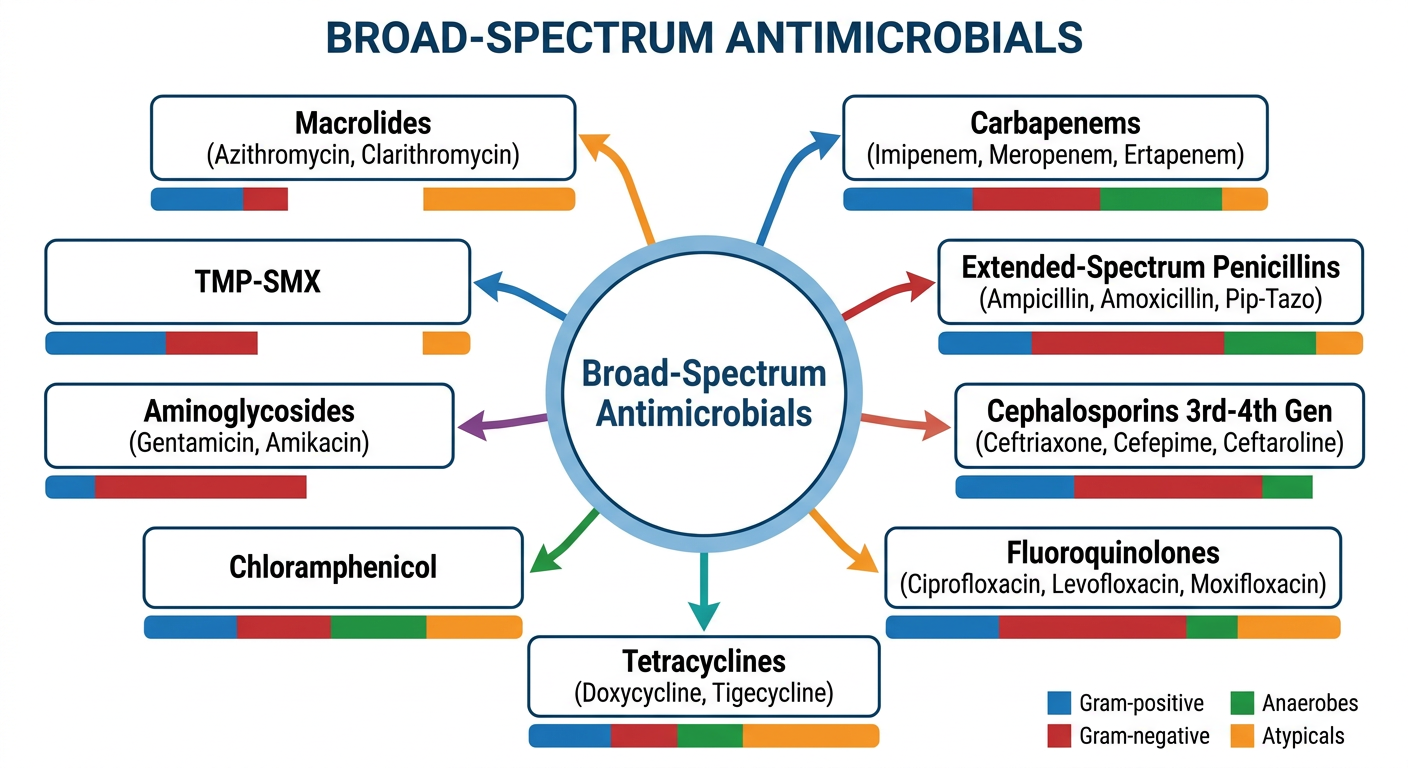
- Blue - Gram-positive
- Red - Gram-negative
- Green - Anaerobes
- Orange - Atypicals