
Write a notes on Pharmacology of Ephedrine
Reading File
Now let me search the medical library for ephedrine pharmacology content in parallel.
Finding Sources
Finding Sources
Good findings. Now let me read the key sections in parallel - from Goodman & Gilman, Morgan & Mikhail (Anesthesia), Barash Clinical Anesthesia, and Katzung:
Reading File
Reading File
Reading File
Finding Sources
Excellent content retrieved. Now let me get additional content from Katzung and Rosen's Emergency Medicine for completeness, and search for an image:
Reading File
Finding Sources
Searching Images
ephedrine structure sympathomimetic adrenergic receptor mechanism
I now have rich, comprehensive content from multiple authoritative textbooks. Let me fetch the structural image from Katzung that was found earlier:
Loading Image
Finding Sources
I now have comprehensive content from multiple authoritative sources. Let me compile the complete pharmacology notes on Ephedrine.
Pharmacology of Ephedrine
1. Introduction and Source
Ephedrine is a naturally occurring alkaloid derived from the plant Ephedra sinica (also known as Ma Huang in traditional Chinese medicine). It is a non-catecholamine sympathomimetic amine and one of the oldest sympathomimetic drugs. Only l-ephedrine and racemic ephedrine are used clinically.
- Goodman & Gilman's The Pharmacological Basis of Therapeutics, p. 1855
2. Chemical Structure
Ephedrine has a phenylethylamine backbone - like amphetamine - but with an additional hydroxyl (OH) group on the beta carbon and a methyl group on the alpha carbon. Crucially, unlike catecholamines (e.g., epinephrine), it lacks catechol ring hydroxyl groups, making it:
- Orally bioavailable
- Resistant to COMT and MAO degradation
- Longer-acting
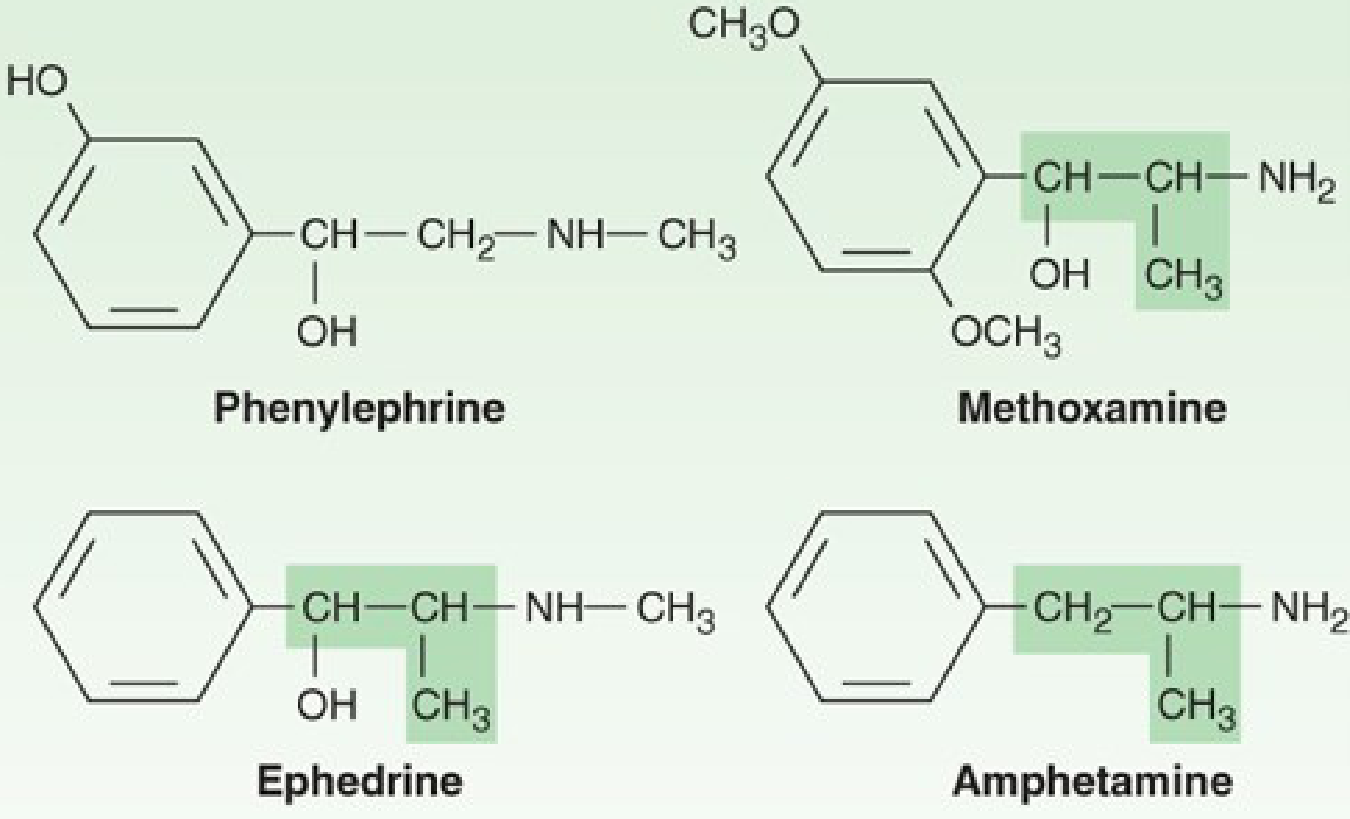
3. Mechanism of Action
Ephedrine is a mixed-acting sympathomimetic - it has both direct and indirect actions, with the indirect action predominating.
Indirect (Primary) Mechanism
- Ephedrine undergoes endocytosis into presynaptic postganglionic adrenergic nerve terminals (alpha and beta)
- Inside the nerve terminal, it displaces norepinephrine (NE) from synaptic vesicles
- The released NE then activates postsynaptic alpha and beta adrenoceptors
- Drugs that block uptake into adrenergic nerves (e.g., cocaine) and drugs that deplete NE stores (e.g., reserpine) attenuate ephedrine's effects
Direct (Secondary) Mechanism
-
Ephedrine is also a direct agonist at alpha and beta adrenergic receptors
-
Direct beta-adrenoceptor stimulation limits the hypertensive effect produced by alpha-receptor activation
-
Barash, Cullen, and Stoelting's Clinical Anesthesia, 9e, p. 970
-
Goodman & Gilman's, p. 1857
4. Pharmacological Effects
Cardiovascular System
- Increases heart rate, cardiac output, contractility, and systemic vascular resistance (SVR)
- Net effect: rise in systolic and diastolic blood pressure
- Effects mimic epinephrine but are less potent and have a longer duration of action
Respiratory System
- Activates beta-2 adrenergic receptors in bronchial smooth muscle → bronchodilation
- Used historically as a bronchodilator in asthma (now largely superseded by selective beta-2 agonists)
Urogenital System
- Stimulation of alpha-adrenergic receptors in bladder neck smooth muscle → increases urinary outflow resistance
- Used in urinary stress incontinence; conversely can cause urinary retention, particularly in men with BPH
CNS
-
Ephedrine is a potent CNS stimulant
-
Crosses the blood-brain barrier and promotes release of noradrenaline and dopamine in the CNS (including substantia nigra)
-
Raises minimum alveolar concentration (MAC) of anesthetic gases
-
At high doses: anxiety, insomnia, tremor
-
Goodman & Gilman's, p. 1862; Morgan & Mikhail's Clinical Anesthesiology, 7e, p. 451; ROSEN's Emergency Medicine, p. 2958
5. Pharmacokinetics (ADME)
| Parameter | Details |
|---|---|
| Administration | Oral, intravenous (IV), intramuscular (IM) |
| Absorption | Well absorbed orally; effective after oral administration |
| Distribution | Crosses the blood-brain barrier (CNS stimulant) |
| Metabolism | NOT metabolized by COMT or MAO (lacks catechol ring); minimal hepatic metabolism |
| Elimination | Excreted largely unchanged in urine |
| Half-life (t½) | 3 to 6 hours |
| Duration of action | Several hours (much longer than epinephrine) |
- Goodman & Gilman's, p. 1862
6. Tachyphylaxis
A clinically important feature of ephedrine is the development of tachyphylaxis with repeated dosing:
-
Repeated administration depletes presynaptic NE stores rapidly
-
Ephedrine is then released from synaptic vesicles as a "false neurotransmitter", which has minimal adrenergic activity
-
This is in contrast to epinephrine, which acts directly on receptors and does NOT develop tachyphylaxis
-
To offset tachyphylaxis, subsequent doses must be incrementally increased
-
Morgan & Mikhail's, p. 451; Barash's Clinical Anesthesia, p. 970
7. Clinical Uses
| Indication | Notes |
|---|---|
| Hypotension during anesthesia | Most common clinical use intraoperatively; treats acute hypotension with bradycardia |
| Spinal/neuraxial anesthesia-induced hypotension | Particularly in obstetric patients (though phenylephrine now preferred - see below) |
| Bronchospasm / Asthma | Historical use; now replaced by selective beta-2 agonists |
| Urinary stress incontinence | Due to alpha-1 stimulation at bladder neck |
| Nasal decongestant | Topical or oral use for nasal congestion |
| CNS stimulant / performance enhancement | Used in herbal preparations (Ma Huang); banned in sports since 2003 |
Dosing (IV):
-
Adults: Bolus of 2.5 to 10 mg IV
-
Children: 0.1 mg/kg IV bolus
-
Available as 25 mg/mL or 50 mg/mL ampules
-
Morgan & Mikhail's, p. 451
Ephedrine vs. Phenylephrine in Obstetrics
For many years, ephedrine was the preferred vasopressor in obstetric anesthesia because, unlike direct alpha-1 agonists, it did not decrease uterine blood flow in animal studies. However, phenylephrine is now widely preferred in obstetric neuraxial anesthesia due to:
- Faster onset and shorter duration (easier titration)
- Fewer adverse effects on fetal pH compared to ephedrine
- Morgan & Mikhail's, p. 451
8. Adverse Effects / Untoward Effects
| Adverse Effect | Mechanism |
|---|---|
| Hypertension | Excessive alpha/beta stimulation |
| Tachycardia / palpitations | Beta-1 stimulation |
| Insomnia, anxiety, tremor | CNS stimulation |
| Urinary retention | Alpha-1 stimulation at bladder neck (especially with BPH) |
| Tachyphylaxis | Depletion of presynaptic NE stores |
| Stroke, MI, death | In susceptible patients, especially with cardiovascular disease |
Usual or higher-than-recommended doses can cause significant adverse effects in patients with unrecognized underlying cardiovascular disease.
9. Contraindications / Cautions
- Hypertension
- Coronary artery disease / ischemic heart disease
- Benign prostatic hyperplasia (risk of urinary retention)
- Concurrent use with MAO inhibitors (risk of hypertensive crisis)
- Patients on cocaine or reserpine (altered response)
- Hyperthyroidism
10. Drug Interactions
| Drug | Interaction |
|---|---|
| Cocaine | Blocks NE reuptake transporter → blocks ephedrine uptake into nerves → attenuates effect |
| Reserpine | Depletes vesicular NE stores → attenuates indirect effect |
| MAO inhibitors | Impaired NE degradation → potentiates pressor response, risk of hypertensive crisis |
| Beta-blockers | Blunt cardiac/bronchodilatory effects |
| General anesthetics (halothane) | Increased risk of arrhythmias |
11. Legal and Regulatory Status
- The FDA banned dietary supplements containing ephedra alkaloids due to cardiovascular risks (heart attack, stroke, death) - ROSEN's Emergency Medicine, p. 2554
- The Combat Methamphetamine Epidemic Act of 2005 regulates the sale of ephedrine (used as a precursor in methamphetamine synthesis)
- Ephedrine and pseudoephedrine can be chemically converted to methamphetamine
- Ephedrine is banned in all sports competitions since 2003 (World Anti-Doping Agency)
- ROSEN's Emergency Medicine, p. 2560
12. Comparison: Ephedrine vs. Epinephrine
| Feature | Ephedrine | Epinephrine |
|---|---|---|
| Type | Non-catecholamine | Catecholamine |
| Mechanism | Mixed (indirect + direct) | Direct only |
| Catechol ring | Absent | Present |
| Oral bioavailability | Good | Poor (degraded by COMT/MAO) |
| Duration of action | Hours (3-6 h t½) | Minutes |
| Potency | Less potent | More potent |
| CNS effects | Marked stimulant | Minimal |
| Tachyphylaxis | Yes (with repeat dosing) | No |
| Receptor profile | α, β1, β2 | α, β1, β2 |
Key Summary
- Ephedrine is a non-catecholamine, mixed-acting sympathomimetic acting on alpha and beta adrenoceptors
- Its predominant mechanism is indirect - displacement of NE from presynaptic vesicles
- Cardiovascular effects resemble epinephrine but are less potent and longer-lasting
- The hallmark pharmacological limitation is tachyphylaxis due to NE depletion
- Primary clinical use is vasopressor during anesthesia, particularly for hypotension with bradycardia
- Regulated due to potential for misuse, cardiovascular toxicity, and use in drug manufacture
Sources:
- Goodman & Gilman's The Pharmacological Basis of Therapeutics (p. 1855-1870)
- Morgan & Mikhail's Clinical Anesthesiology, 7e (p. 451)
- Barash, Cullen, and Stoelting's Clinical Anesthesia, 9e (p. 970)
- ROSEN's Emergency Medicine Concepts and Clinical Practice (p. 2554-2560)
- Katzung's Basic and Clinical Pharmacology, 16e (Figure 9-5)
This is a shared conversation. Sign in to Orris to start your own chat.