
In glycogenolysis, it is started from pyruvate and goes to glucogen. Is it right? Like, first it will form pyruvate and the end product will be glycogen in glucogenolysis. Can you explain me?
Reading File
Now let me search the medical library for glycogenolysis and gluconeogenesis content.
Finding Sources
Finding Sources
Reading File
Reading File
Reading File
Now let me also fetch the gluconeogenesis section and a diagram image for clarity.
Reading File
Loading Image
Now I have everything needed for a thorough answer. Let me also grab the gluconeogenesis diagram.
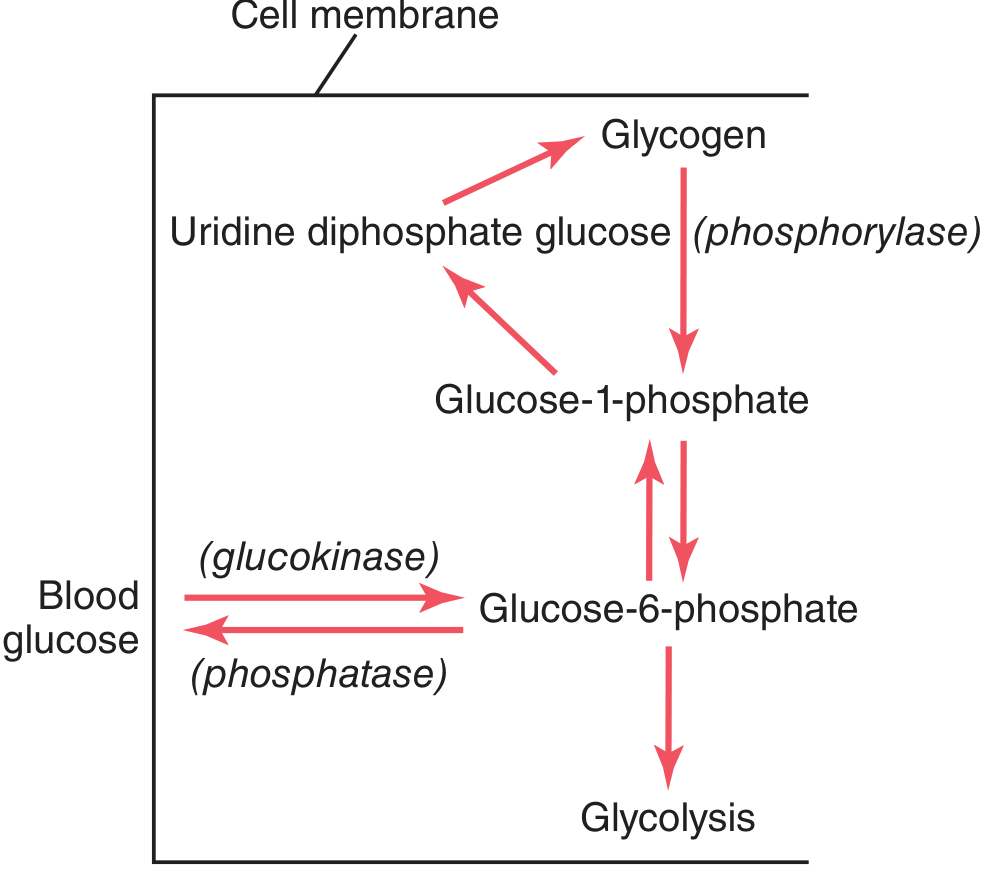
Great question, and the short answer is: No, that description is not correct. You are mixing up three different pathways. Let me untangle them clearly.
The Three Pathways You Need to Separate
| Pathway | Starting Point | End Product | Where |
|---|---|---|---|
| Glycogenolysis | Glycogen | Glucose (blood) | Liver & muscle |
| Glycogenesis | Glucose | Glycogen | Liver & muscle |
| Gluconeogenesis | Pyruvate (+ other precursors) | Glucose | Liver (mainly) |
1. Glycogenolysis - "Lysis of Glycogen"
Direction: Glycogen → Glucose
Glycogenolysis is the breakdown of stored glycogen to release glucose. It does NOT start from pyruvate and does NOT end at glycogen - those are reversed.
As Guyton and Hall puts it:
"Glycogenolysis means the breakdown of the cell's stored glycogen to re-form glucose in the cells."
- Guyton and Hall Textbook of Medical Physiology
Step-by-step:
- Glycogen is the starting material (stored in liver and muscle).
- The enzyme glycogen phosphorylase cleaves glucose units off the glycogen chain one by one using phosphorylation (adding inorganic phosphate, Pi).
- This produces glucose-1-phosphate.
- Glucose-1-phosphate is converted to glucose-6-phosphate (by phosphoglucomutase).
- In the liver (and kidney), glucose-6-phosphatase removes the phosphate, releasing free glucose into the blood.
- In muscle, there is no glucose-6-phosphatase, so glucose-6-phosphate goes directly into glycolysis for energy - muscle cannot release glucose into the blood.
Hormones that trigger glycogenolysis:
- Glucagon (low blood sugar) - acts on liver
- Epinephrine (stress/fight-or-flight) - acts on liver and muscle
Both work by activating glycogen phosphorylase through a cAMP cascade.
2. Glycogenesis - "Genesis of Glycogen"
Direction: Glucose → Glycogen
This is the synthesis of glycogen from glucose. It is essentially the reverse of glycogenolysis (but uses different enzymes):
Glucose → Glucose-6-phosphate → Glucose-1-phosphate → UDP-glucose → Glycogen
Key enzyme: Glycogen synthase
3. Gluconeogenesis - "New Glucose"
Direction: Pyruvate (and other non-carbohydrates) → Glucose
THIS is the pathway that starts from pyruvate. As stated in Basic Medical Biochemistry:
"Gluconeogenesis, the process by which glucose is synthesized from noncarbohydrate precursors, occurs mainly in the liver under fasting conditions. Starting with pyruvate, most of the steps of gluconeogenesis are simply reversals of those of glycolysis."
- Basic Medical Biochemistry: A Clinical Approach, 6e
Precursors for gluconeogenesis:
- Pyruvate (from glycolysis, alanine, lactate)
- Lactate (from red blood cells, muscle - the Cori cycle)
- Glycerol (from fat breakdown)
- Certain amino acids (glucogenic amino acids, especially alanine and glutamine)
Key steps (the 3 bypass reactions):
- Pyruvate → Oxaloacetate (by pyruvate carboxylase) → PEP (by PEPCK)
- Fructose-1,6-bisphosphate → Fructose-6-phosphate (by FBPase-1)
- Glucose-6-phosphate → Glucose (by glucose-6-phosphatase, liver only)
Summary - Your Correction
| What you said | What is actually correct |
|---|---|
| Glycogenolysis starts from pyruvate | Pyruvate is a starting point of gluconeogenesis, not glycogenolysis |
| Glycogenolysis ends at glycogen | Glycogenolysis breaks down glycogen - glycogen is the START, not the end |
| End product is glycogen | The end product of glycogenolysis is glucose (or glucose-6-phosphate in muscle) |
The pathway you described (pyruvate → glycogen) does not exist as a single pathway. The closest real sequence would be: pyruvate → glucose (via gluconeogenesis) → glycogen (via glycogenesis). But these are two separate pathways, not one.
- Biochemistry, 8th ed - Lippincott Illustrated Reviews (Glycogenolysis section, p.382)
- Guyton and Hall Textbook of Medical Physiology (Glycogenolysis section, p.834)
- Basic Medical Biochemistry: A Clinical Approach, 6e (Gluconeogenesis section, p.1007-1011)
This is a shared conversation. Sign in to Orris to start your own chat.