
Head to toe findings in both hypoyhyroidism and hyperthyroidism
I'll look up the medical library skill first, then pull comprehensive findings for both conditions.
Reading File
Now let me run parallel searches for both conditions simultaneously.
Finding Sources
Finding Sources
Finding Sources
Finding Sources
Good finds. Now let me read the most comprehensive sources in parallel.
Reading File
Reading File
Reading File
Excellent data. Now let me get more details on hyperthyroidism signs and the Tintinalli hypothyroidism figure content, plus search for a comprehensive hyperthyroidism signs section.
Finding Sources
Reading File
Reading File
Now let me get the comprehensive hyperthyroidism signs section from Tietz.
Reading File
Loading Image
I now have rich, comprehensive data from multiple authoritative textbooks. Let me also fetch the Graves disease / hyperthyroidism clinical image.
Loading Image
Loading Image
I now have comprehensive data from multiple authoritative textbooks. Let me compile the full head-to-toe comparison.
Head-to-Toe Findings: Hypothyroidism vs. Hyperthyroidism
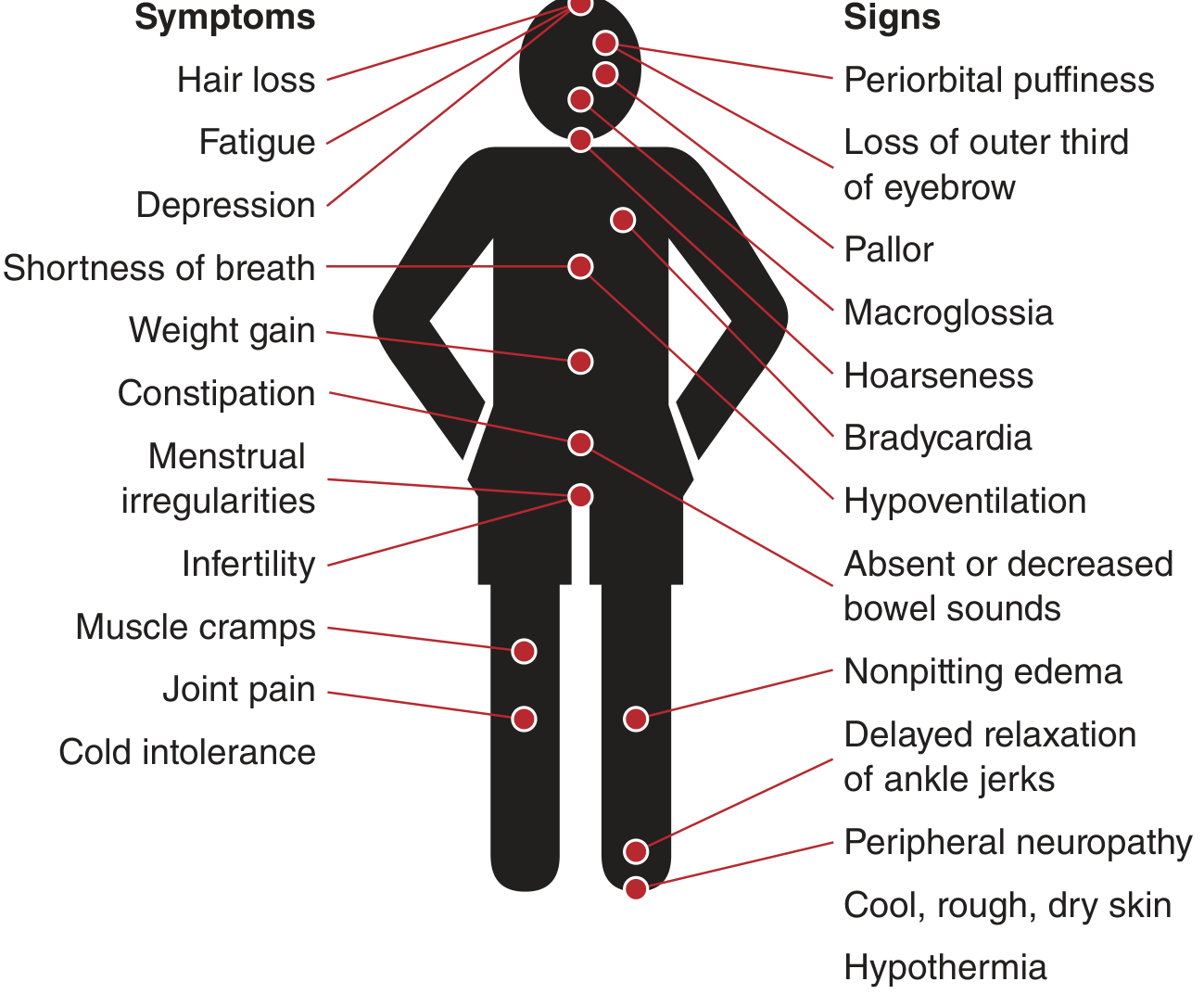
Here is the classic diagram of hypothyroidism signs and symptoms from Tintinalli's Emergency Medicine:
HEAD & FACE
| Region | Hypothyroidism | Hyperthyroidism |
|---|---|---|
| General facies | Dull, expressionless, puffy ("myxedema facies") | Alert, anxious, "staring" expression |
| Eyes | Periorbital puffiness / non-pitting edema | Exophthalmos (proptosis), lid lag, lid retraction, periorbital edema (Graves-specific) |
| Eyebrows | Loss of outer 1/3 of eyebrow (Hertoghe's sign) | Normal or thinned |
| Skin of face | Pale, cool, dry, coarse; facial bloating | Warm, moist, flushed; melasma of cheeks possible |
| Hair | Coarse, brittle, sparse; diffuse alopecia | Fine, soft ("downy"), diffuse non-scarring alopecia |
| Tongue/mouth | Macroglossia (enlarged tongue) | Normal |
| Voice | Hoarseness (infiltration of vocal cords) | Normal |
| Hearing | Sensorineural hearing loss in severe cases | Normal |
NECK
| Region | Hypothyroidism | Hyperthyroidism |
|---|---|---|
| Thyroid | Goiter may be present (firm/granular/tender depending on cause); or small/impalpable | Diffuse goiter (Graves), nodular goiter (Plummer), or single toxic nodule |
| Lymph nodes | Normal | Usually normal |
CARDIOVASCULAR
| Finding | Hypothyroidism | Hyperthyroidism |
|---|---|---|
| Heart rate | Bradycardia | Tachycardia; palpitations |
| Blood pressure | Diastolic hypertension (50% increased peripheral vascular resistance); 20-40% have HTN | Systolic hypertension; widened pulse pressure |
| Cardiac output | Decreased (30-50% reduction in resting cardiac output) | Increased (high-output state) |
| Rhythm | Normal or bradycardia | Atrial fibrillation (common, especially in elderly) |
| Heart sounds | Distant (pericardial effusion); low voltage on ECG | Prominent, hyperdynamic; increased S1 |
| Other | Angina, pericardial effusion, cardiomyopathy, CHF in severe disease | Cardiac hypertrophy, pulmonary hypertension, CHF, angina (in pre-existing IHD) |
RESPIRATORY
| Finding | Hypothyroidism | Hyperthyroidism |
|---|---|---|
| Breathing | Hypoventilation; pleural effusions | Exertional dyspnea, decreased exercise tolerance |
| Airway | Upper airway obstruction from glottic/vocal cord edema, macroglossia | Normal |
| Chest exam | Decreased breath sounds if pleural effusion | Generally normal |
ABDOMEN / GASTROINTESTINAL
| Finding | Hypothyroidism | Hyperthyroidism |
|---|---|---|
| Bowel sounds | Absent or decreased (constipation) | Increased (hyperdefecation); shortened small bowel transit |
| Stools | Constipation | Frequent loose stools (not usually true diarrhea) |
| Nausea/vomiting | Uncommon | Can precede thyrotoxic crisis |
| Weight | Weight gain (decreased appetite paradoxically) | Weight loss (increased basal metabolic rate) |
| Liver | Normal | Mild aminotransferase elevation; in severe cases marked hepatic dysfunction |
REPRODUCTIVE / ENDOCRINE
| Finding | Hypothyroidism | Hyperthyroidism |
|---|---|---|
| Menstruation | Menorrhagia (heavy periods); infertility | Oligomenorrhea or amenorrhea |
| Lactation | Galactorrhea (elevated prolactin from TRH) | Not typical |
| Libido/fertility | Decreased; infertility | Decreased libido; reduced fertility |
| Adrenal | Normal cortisol (primary) or decreased (secondary hypothyroidism) | Normal |
MUSCULOSKELETAL
| Finding | Hypothyroidism | Hyperthyroidism |
|---|---|---|
| Muscles | Myopathy, muscle cramps, weakness, stiffness | Proximal myopathy, weakness |
| Joints | Arthralgia, joint stiffness | Arthralgia |
| Wrists | Carpal tunnel syndrome | Normal |
| Bones | Normal in adults | Increased bone turnover; osteoporosis risk long-term |
| Acropachy | - | Thyroid acropachy (Graves only): digital clubbing, soft-tissue swelling of hands/feet, periosteal reaction of long bones (~0.1-1%) |
SKIN & APPENDAGES
| Finding | Hypothyroidism | Hyperthyroidism |
|---|---|---|
| Texture | Cool, rough, dry, coarse; thickened | Warm, moist, smooth, velvety |
| Color | Pallor; yellowish tinge (carotenemia) | Palmar erythema; facial flushing; bronzed/melanoderma |
| Sweating | Decreased (anhidrosis) | Hyperhidrosis (excessive sweating) |
| Nails | Brittle; Ragged nails | Plummer's nails - onycholysis (distal separation), concave plate shape (~5%) |
| Vitiligo | - | Present in 7% of Graves disease patients |
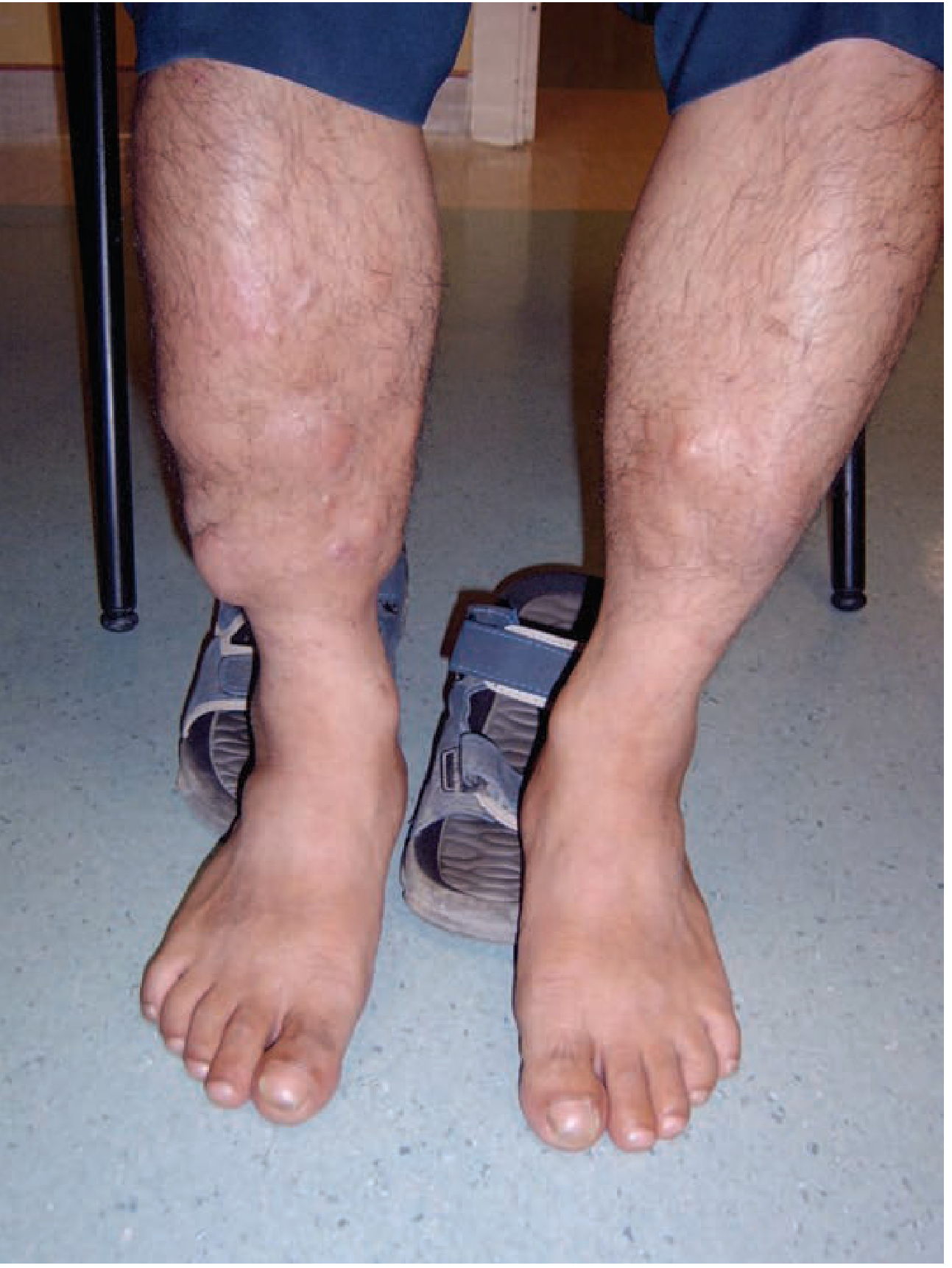
| Edema | Non-pitting myxedema (glycosaminoglycan deposition in subcutaneous tissue) - seen at ankles, hands, face | Pretibial myxedema (Graves-specific): bilateral localized glycosaminoglycan plaques below knees, nodular/plaque/elephantiasic forms |
Photo - Thyroid acropachy and pretibial myxedema in Graves disease:
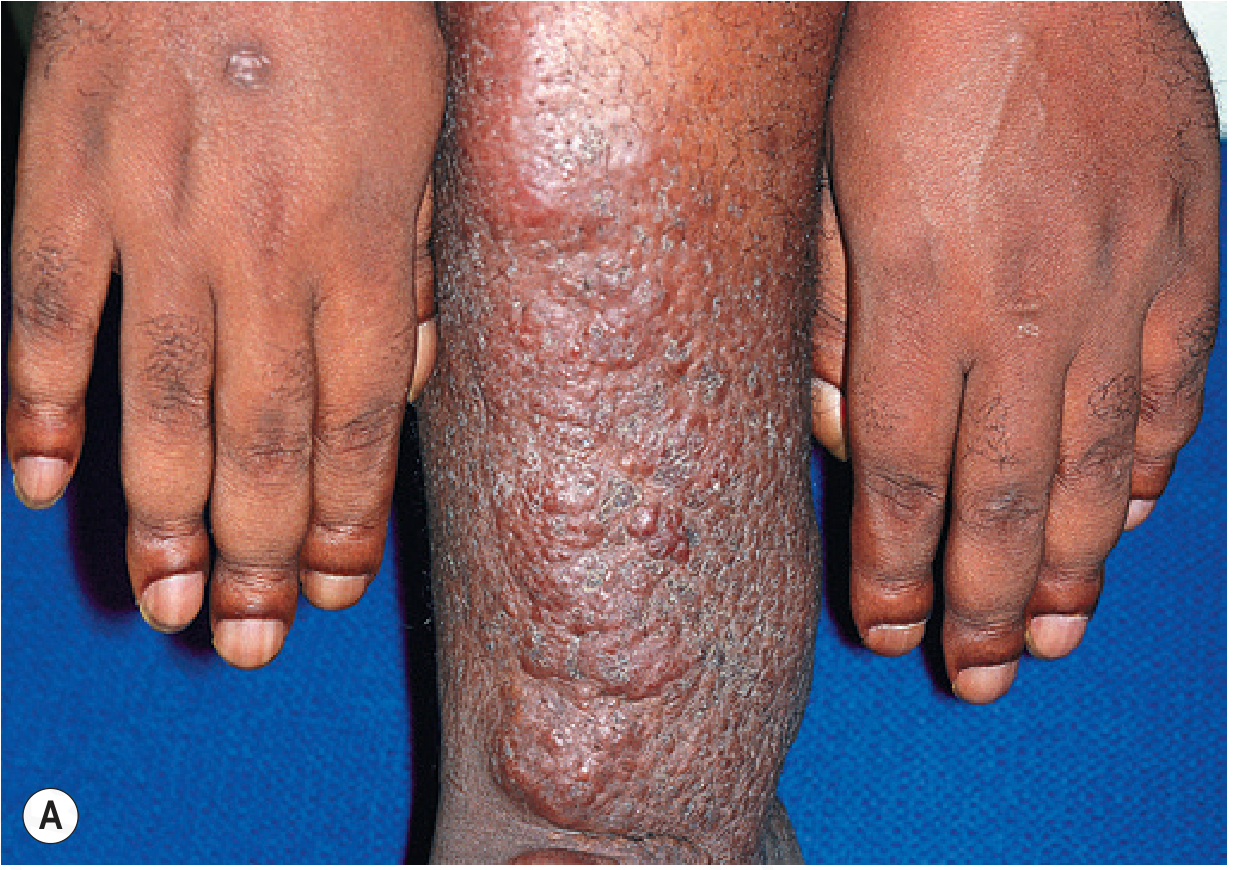
Photo - Non-pitting myxedema (hypothyroidism):
NEUROLOGICAL / PSYCHIATRIC
| Finding | Hypothyroidism | Hyperthyroidism |
|---|---|---|
| Mental state | Fatigue, lethargy, depression, cognitive impairment, psychosis ("myxedema madness") | Anxiety, irritability, emotional lability, hyperactivity |
| Speech | Slow, monotonous | Normal or pressured |
| Reflexes | Hyporeflexia; delayed relaxation of deep tendon reflexes (ankle jerk) - hallmark sign | Hyperreflexia |
| Tremor | None | Fine postural tremor of hands (most evident in hands, but can occur elsewhere) |
| Peripheral nerves | Peripheral neuropathy, paresthesias | Mild peripheral neuropathy |
| Seizures | Rare (in myxedema crisis) | Rare; embolic stroke from AF |
| Myopathy | Slow movements; pseudomyotonia | Proximal weakness |
LOWER LIMBS / PERIPHERAL
| Finding | Hypothyroidism | Hyperthyroidism |
|---|---|---|
| Ankle jerks | Delayed relaxation phase (at least 2x the contraction phase) - classic sign | Brisk / hyperreflexia |
| Edema | Non-pitting myxedema at ankles | Pretibial myxedema (Graves); peripheral edema from CHF |
| Temperature | Cool peripheries | Warm peripheries |
KEY DISTINGUISHING FEATURES AT A GLANCE
| Feature | Hypothyroidism | Hyperthyroidism |
|---|---|---|
| Temperature tolerance | Cold intolerance | Heat intolerance |
| Metabolism | Slow (weight ↑, fatigue, constipation) | Fast (weight ↓, diarrhea, sweating) |
| Heart | Slow (bradycardia, low output) | Fast (tachycardia, AF, high output) |
| CNS | Slow (lethargy, delayed reflexes) | Hyperactive (tremor, brisk reflexes) |
| Skin | Cold, dry, rough | Warm, moist, smooth |
| Hair | Coarse, brittle | Fine, silky, thin |
| Unique signs | Loss of outer eyebrow, macroglossia, delayed ankle jerk, myxedema | Exophthalmos, pretibial myxedema, thyroid acropachy, Plummer's nails (all mainly Graves) |
Sources: - Tintinalli's Emergency Medicine, p. 1489 | - Tietz Textbook of Laboratory Medicine (7th ed.), p. 2320-2322 | - Andrews' Diseases of the Skin (Dermatology), p. 582 | - Tietz Box 57.4 and Box 57.5
This is a shared conversation. Sign in to Orris to start your own chat.