
Stye
Reading File
Finding Sources
Searching the Web
stye hordeolum clinical features treatment 2024
Reading File
Reading File
Searching Images
stye hordeolum eyelid
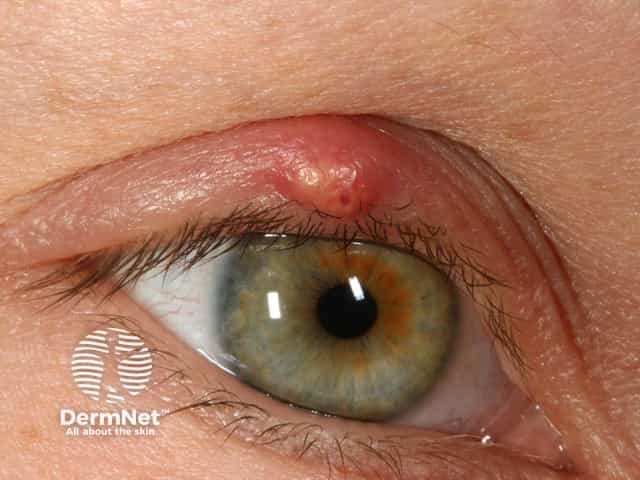
Stye (Hordeolum)
A stye (hordeolum) is an acute, painful abscess of the eyelid caused by bacterial infection, almost always Staphylococcus aureus.
Types
| External Hordeolum | Internal Hordeolum | |
|---|---|---|
| Gland involved | Follicle of eyelash + glands of Zeis (sebaceous) or Moll (sweat) | Meibomian glands |
| Location | At the lash line / eyelid margin | Posterior tarsal conjunctival surface (inner eyelid) |
| Appearance | Small pustule visible at lid margin | Pustule on inner surface of tarsal plate |
Clinical Features
- Pain, edema, and erythema of the eyelid
- Localized swelling that may come to a point (pustule)
- Usually self-limited
- Differentiation from chalazion: a chalazion is a painless, non-mobile lipogranulomatous nodule (blocked meibomian gland, no infection); an early chalazion can look identical to an internal hordeolum

Treatment
- Warm compresses — 10 minutes, 4–5 times/day; encourages spontaneous drainage
- Topical antibiotics — erythromycin or bacitracin ointment twice daily × 7–10 days; alternatively moxifloxacin or gatifloxacin drops
- Eyelash removal — removing the offending eyelash can be considered for external hordeolum
- Systemic antibiotics — if significant surrounding cellulitis develops
- Incision & drainage — refer to ophthalmologist if no improvement within 48 hours, or if abscess does not respond to conservative care
- Recurrent chalazion in same spot — warrants investigation to exclude underlying carcinoma
Key Points
- Most styes resolve without specific treatment given warm compress support
- Do not squeeze or rupture — risk of spreading infection
- Watch for spreading erythema beyond the lid → preseptal/orbital cellulitis, which requires systemic antibiotics and urgent evaluation
— Goldman-Cecil Medicine, §391; Tintinalli's Emergency Medicine, §241
This is a shared conversation. Sign in to Orris to start your own chat.