
Write the short note or epilepsy
Reading File
Now let me search the medical library for epilepsy content in parallel with a PubMed search.
Finding Sources
Searching PubMed
epilepsy classification management
Good. Now let me read the most comprehensive epilepsy sections from the textbook in parallel.
Reading File
Reading File
Let me get the core epilepsy definition/classification/treatment sections now.
Finding Sources
Finding Sources
Let me read the comprehensive epilepsy section from Neuroanatomy and the Frameworks for Internal Medicine for a well-rounded short note.
Reading File
Reading File
Let me get the definition and core clinical details from a dedicated epilepsy section.
Reading File
Finding Sources
Let me get the EEG and clinical features of epilepsy sections, plus pathophysiology.
Reading File
Finding Sources
I now have enough rich content to write a thorough short note on epilepsy. Let me also fetch the seizure type classification image.
Loading Image
Finding Sources
Let me read the pharmacology section on epilepsy etiology and treatment:
Reading File
Reading File
I now have comprehensive information to write a well-structured, detailed short note on epilepsy. Let me compile this.
Short Note on Epilepsy
Definition
Epilepsy is a disease of the brain defined by any of the following conditions (ILAE operational definition):
- At least two unprovoked (or reflex) seizures occurring more than 24 hours apart
- One unprovoked seizure with a probability of further seizures of at least 60% over the next 10 years (similar to the recurrence risk after two unprovoked seizures)
- Diagnosis of an epilepsy syndrome
A seizure itself is a transient occurrence of signs and/or symptoms due to abnormal, excessive, or synchronous neuronal activity in the brain. Epilepsy is distinguished from isolated provoked seizures (e.g., due to hypoglycemia, drug toxicity, or fever), which do not by themselves constitute epilepsy.
- Kaplan & Sadock's Comprehensive Textbook of Psychiatry, p. 2071
- Lippincott Illustrated Reviews: Pharmacology, p. 633
Epidemiology
- Affects approximately 1-2% of the world population - one of the most common serious neurological disorders
- Approximately 1-1.5% of children will have a nonfebrile seizure at some time in their life
- Febrile seizures occur in up to 4% of infants and toddlers; some ethnic groups show much higher rates (up to 20% in Guamanians)
- Seizures can begin at any age, from the prenatal/perinatal period through late adolescence and adulthood
Etiology
Epilepsy can arise from:
| Category | Examples |
|---|---|
| Genetic | Channelopathies, inherited epilepsy syndromes (Dravet, Lennox-Gastaut) |
| Structural | Head injury, stroke, brain tumor, cortical dysplasia, mesial temporal sclerosis |
| Metabolic | Hypoglycemia, electrolyte disturbances, uremia, hepatic failure |
| Infectious | Meningitis, encephalitis, neurocysticercosis |
| Immune | Autoimmune encephalitis |
| Unknown | The most common category - no identifiable cause in most cases |
The primary focus (a small population of abnormally firing neurons) is the origin of the epileptic discharge. Focal areas can be triggered by physiological changes - altered blood gases, pH, electrolytes, and blood glucose - or by environmental factors such as sleep deprivation, alcohol, and stress.
Precipitating factors include: illicit drug use, head injury, hypoglycemia, meningeal infection, alcohol withdrawal, flashing lights, intense exercise, loud music, and strong emotions.
- Lippincott Illustrated Reviews: Pharmacology, p. 633
Pathophysiology
The core mechanism involves an imbalance between excitatory (glutamate) and inhibitory (GABA) neurotransmission, leading to abnormal, excessive neuronal synchrony. In focal epilepsy, a small "epileptic focus" of hyperexcitable neurons generates abnormal discharges that may:
- Remain local (focal seizure without spread)
- Propagate to adjacent cortex (focal with secondary generalization)
- In generalized epilepsy, involve both hemispheres from onset via thalamocortical circuits
Key mechanisms include:
- Increased sodium or calcium channel activity
- Impaired GABA-mediated inhibition
- Enhanced glutamate receptor activity (NMDA, AMPA)
- Abnormal neuronal networks (e.g., from cortical dysplasia or mesial temporal sclerosis)
Classification (ILAE 2017)
Seizures are classified by site of origin, etiology, electrophysiological correlation, and clinical presentation.
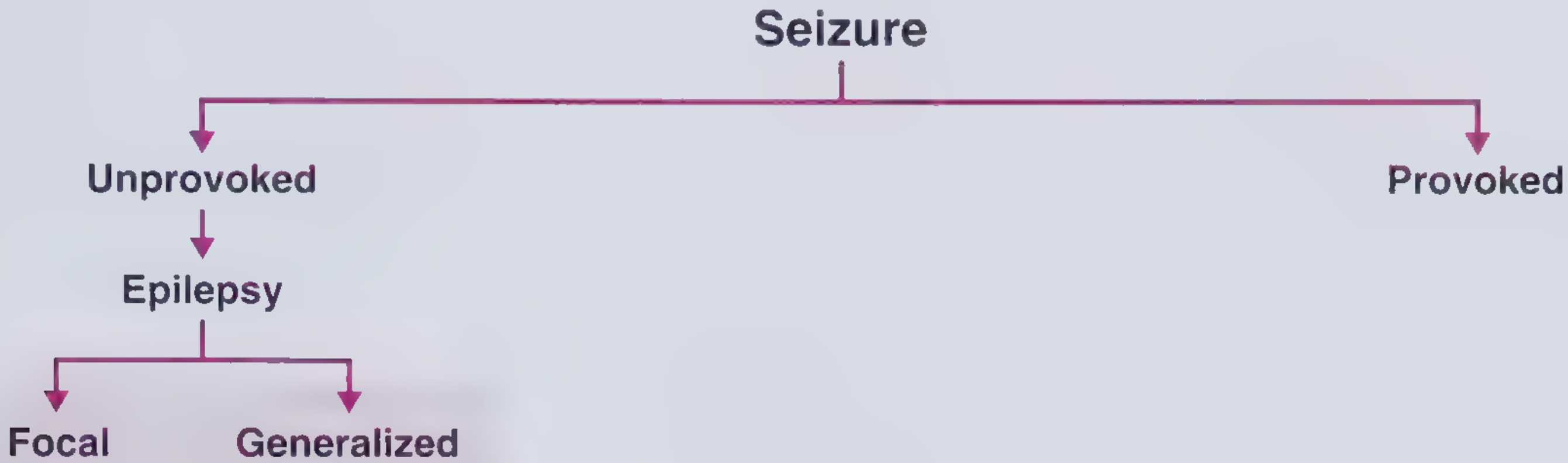
1. Focal Onset Seizures
Arise in a network limited to one hemisphere. Consciousness may or may not be impaired.
- Aware (previously "simple partial") - patient remains conscious
- Impaired awareness (previously "complex partial") - altered consciousness
- Motor onset: automatisms, atonic, clonic, epileptic spasms, hyperkinetic, myoclonic, tonic
- Non-motor onset: autonomic, behavioral arrest, cognitive, emotional, sensory
- Focal to bilateral tonic-clonic (secondary generalization)
2. Generalized Onset Seizures
Involve both hemispheres simultaneously with loss of consciousness from the start.
- Motor: tonic-clonic, clonic, tonic, myoclonic, myoclonic-tonic-clonic, myoclonic-atonic, atonic, epileptic spasms
- Non-motor (absence): typical, atypical, myoclonic, eyelid myoclonia
3. Unknown Onset Seizures
When onset cannot be determined.
- Kaplan & Sadock's Comprehensive Textbook of Psychiatry, p. 2072; Frameworks for Internal Medicine, p. 559
Clinical Features
Focal Seizures
- Depend on the area of cortex involved (motor, sensory, visual, autonomic, etc.)
- May have an aura (a simple partial seizure that precedes more complex symptoms)
- Todd's paralysis - postictal focal weakness lasting minutes to hours after a motor seizure
- Automatisms - semi-purposeful repetitive behaviors (lip smacking, hand fumbling) in temporal lobe epilepsy
Generalized Tonic-Clonic (Grand Mal)
- Tonic phase: sustained muscle contraction, loss of consciousness, may cry out, apnea
- Clonic phase: rhythmic jerking movements
- Postictal phase: confusion, drowsiness, headache lasting minutes to hours
Absence Seizures (Petit Mal)
- Brief (5-30 sec) lapses of consciousness, often with eyelid fluttering
- No postictal confusion
- Characteristic 3 Hz spike-and-wave on EEG
- Predominantly in children
Myoclonic Seizures
- Brief, sudden muscle jerks, usually bilateral
- Often occur on waking (e.g., in juvenile myoclonic epilepsy)
Status Epilepticus
- A seizure lasting >5 minutes, or two or more seizures without full recovery between them
- A neurological emergency requiring immediate treatment
Common Epilepsy Syndromes
Organized by age of onset:
-
Neonatal: Benign familial neonatal epilepsy, Ohtahara syndrome, early myoclonic encephalopathy
-
Infancy: West syndrome (infantile spasms + hypsarrhythmia), Dravet syndrome
-
Childhood: Childhood absence epilepsy, benign childhood epilepsy with centrotemporal spikes (Rolandic epilepsy), Lennox-Gastaut syndrome
-
Adolescence/Adult: Juvenile myoclonic epilepsy, juvenile absence epilepsy, temporal lobe epilepsy
-
Kaplan & Sadock's Comprehensive Textbook of Psychiatry, pp. 2072-2074
Diagnosis
EEG (Key Investigation)
- Most helpful laboratory test in suspected epilepsy
- Epileptiform activity (spikes and sharp waves) is the only EEG finding with strong correlation with epilepsy
- Only ~2% of people without epilepsy show epileptiform discharges; up to 90% of epilepsy patients show them depending on recording circumstances
- A normal interictal EEG does not exclude epilepsy
- Ictal EEG (recording during an actual seizure) is most definitive
- Provocative tests: hyperventilation (for absence), photic stimulation (for photosensitive epilepsy), sleep deprivation
Neuroimaging
- MRI is preferred - detects structural causes (tumors, cortical dysplasia, mesial temporal sclerosis, vascular malformations)
- CT is used acutely to rule out hemorrhage or mass lesion
- FDG-PET shows interictal hypometabolism at the seizure focus (useful in presurgical evaluation)
- Ictal SPECT (e.g., SISCOM) captures CBF increase at the seizure onset zone
Other Tests
-
Serum glucose, electrolytes, calcium, magnesium, renal and liver function tests
-
Prolactin levels (elevated after generalized tonic-clonic seizures)
-
Neuropsychological testing in surgical candidates
-
Bradley and Daroff's Neurology in Clinical Practice, pp. 576-577
Treatment
Antiseizure Medications (ASMs)
Overall long-term remission is achieved with ASMs in most epilepsy patients, though monotherapy is effective in fewer than half. Drug selection depends on seizure type, syndrome, patient factors (age, sex, comorbidities), and drug interactions.
| Drug | Mechanism | Main Indications |
|---|---|---|
| Carbamazepine | Na+ channel blockade | Focal seizures, GTC, trigeminal neuralgia |
| Valproate | Na+ channel block + GABA enhancement | Broad spectrum (all seizure types), 1st line for generalized |
| Phenytoin/Fosphenytoin | Na+ channel blockade | Focal, GTC, status epilepticus (acute) |
| Lamotrigine | Na+ channel blockade | Focal, generalized, absence; safe in pregnancy |
| Levetiracetam | SV2A ligand | Broad spectrum; IV available; safe in pregnancy |
| Ethosuximide | T-type Ca2+ channel block | Absence seizures only |
| Phenobarbital | GABA-A receptor enhancement | Broad spectrum; neonatal seizures |
| Benzodiazepines (lorazepam, diazepam, clonazepam) | GABA-A receptor enhancement | Acute/status epilepticus; diazepam rectally for clusters |
| Topiramate | Multiple mechanisms | Focal, GTC, migraine prophylaxis |
| Gabapentin/Pregabalin | Ca2+ channel (α2δ subunit) | Focal seizures, neuropathic pain |
| Oxcarbazepine | Na+ channel blockade | Focal seizures (less drug interactions than CBZ) |
Note on teratogenicity: Valproate carries the highest teratogenic risk. Levetiracetam and lamotrigine are considered the safest agents during pregnancy.
Carbamazepine should NOT be used for absence seizures - it may worsen them.
- Lippincott Illustrated Reviews: Pharmacology, pp. 633-648
Non-pharmacological Treatment
-
Lifestyle modification: avoiding sleep deprivation, abstaining from alcohol, stress reduction
-
Biofeedback / behavioral techniques for some patients
-
Epilepsy surgery: resection of the epileptic focus in drug-refractory focal epilepsy - offers excellent chance of seizure freedom. Requires comprehensive presurgical evaluation (EEG, MRI, video-EEG, neuropsychology, PET, SPECT).
-
Vagus nerve stimulation (VNS): for drug-refractory epilepsy not amenable to resection
-
Ketogenic diet: high-fat, low-carbohydrate diet - particularly effective in children with refractory epilepsy
-
Responsive neurostimulation (RNS) and deep brain stimulation (DBS): newer neuromodulation approaches
-
Frameworks for Internal Medicine, p. 559
Status Epilepticus Management
Status epilepticus is a medical emergency:
- 1st line: IV lorazepam (or diazepam IV/rectal, midazolam IM/buccal)
- 2nd line: IV fosphenytoin/phenytoin, levetiracetam, or valproate
- 3rd line (refractory): Anesthetic doses of propofol, midazolam, or thiopental with ICU monitoring
Prognosis
- Most patients achieve seizure remission with appropriate treatment
- ~30% are drug-refractory (fail two appropriate ASMs) - surgery should be considered
- Sudden Unexpected Death in Epilepsy (SUDEP) is a rare but serious complication, most common in young adults with uncontrolled generalized tonic-clonic seizures
- Gravid patients with epilepsy have a tenfold risk of death compared to pregnant women without epilepsy
- Psychiatric comorbidities (depression, anxiety) are common and significantly impact quality of life
Key Points Summary
| Feature | Detail |
|---|---|
| Definition | 2 unprovoked seizures >24 h apart, OR 1 seizure with >60% recurrence risk, OR epilepsy syndrome |
| Global prevalence | ~1-2% of population |
| Most common cause | Unknown (idiopathic); structural and genetic causes are next most common |
| Key investigation | EEG (epileptiform discharges in ~90% of cases); MRI brain |
| 1st-line broad-spectrum drug | Valproate (not in women of childbearing age due to teratogenicity) |
| Safest in pregnancy | Levetiracetam, lamotrigine |
| Drug NOT to give in absence | Carbamazepine (worsens absence seizures) |
| Status epilepticus 1st line | IV benzodiazepine (lorazepam) |
| Surgery indication | Drug-refractory focal epilepsy |
Sources: Bradley and Daroff's Neurology in Clinical Practice; Lippincott Illustrated Reviews: Pharmacology (16th ed.); Kaplan & Sadock's Comprehensive Textbook of Psychiatry; Frameworks for Internal Medicine
This is a shared conversation. Sign in to Orris to start your own chat.