
Vision loss with normal fundus approach in crisp
Reading File
Now let me search the library for this topic in parallel:
Finding Sources
Finding Sources
Finding Sources
Finding Sources
Finding Sources
Finding Sources
Excellent — I found the key sources. Let me read them all in parallel:
Reading File
Reading File
Reading File
Reading File
Now let me read the Adams & Victor section on the approach and get more from Bradley & Daroff:
Reading File
Reading File
Now I have comprehensive material. Let me also fetch the Harrison's fundus image:
Loading Image
I now have all the content needed for a crisp, comprehensive answer. Here it is:
Vision Loss with Normal Fundus — Approach
The classic teaching is: "The doctor sees nothing, and the patient sees nothing" — describing retrobulbar optic neuritis, where the lesion is behind the globe and the fundus appears entirely normal on examination.
Differential Diagnosis: Normal Fundus + Decreased Vision
(Wills Eye Manual)
| Category | Causes |
|---|---|
| Optic nerve | Retrobulbar optic neuritis, infiltrative optic neuropathy, toxic optic neuropathy (alcohol, tobacco, ethambutol, isoniazid), Leber hereditary optic neuropathy (LHON), posterior ischemic optic neuropathy |
| Retinal | Stargardt disease / fundus flavimaculatus, cone degeneration, rod monochromatism, cancer-associated retinopathy (CAR), melanoma-associated retinopathy (MAR) |
| Amblyopia | Deprivation, anisometropic, strabismic |
| Functional | Non-physiologic (functional) visual loss |
Step-by-Step Approach
Step 1 — Confirm True Visual Loss
- Measure corrected visual acuity (Snellen at 6m or Jaeger at 14 in)
- Pinhole test: improvement → refractive/media cause (cornea, lens, vitreous), not neurological
- (Adams & Victor): "If the acuity improves to near normal with a pinhole, one can conclude that the reduced vision relates to a refractive error or a defect in the optical media rather than a neurological cause."
Step 2 — Characterize the Visual Loss
| Feature | Points toward |
|---|---|
| Central / cecocentral scotoma | Optic nerve OR macula |
| Dyschromatopsia (red desaturation) | Optic nerve disease |
| Ocular pain on movement | Optic neuritis |
| Painless | Toxic/hereditary neuropathy, CAR, ischemic |
| Bilateral, symmetric | Toxic/nutritional, LHON, bilateral cortical |
| Photopsias | CAR, retinal dystrophy |
Step 3 — Examine the Afferent Pathway
- Relative Afferent Pupillary Defect (RAPD): present in unilateral or asymmetric optic nerve disease; absent in functional loss and symmetric disease
- Color vision testing (Ishihara, FM100 hue): disproportionately impaired in optic nerve disease vs. macular disease
- Visual field testing (confrontation / automated perimetry):
- Central scotoma → optic nerve or macula
- Altitudinal → ischemic optic neuropathy
- Bitemporal → chiasm
- Homonymous → retrochiasmal
Step 4 — Ophthalmic Investigations
| Test | Indication |
|---|---|
| OCT (macula + RNFL) | Detect subtle macular disease, early RNFL thinning in optic neuropathy even before disc pallor |
| Visual Evoked Potentials (VEP) | Delayed P100 → demyelinating optic neuropathy; low amplitude VEP → caution, can mimic retinal disease |
| Electroretinogram (ERG) | Absent/reduced → retinal dystrophies (CAR, cone dystrophy); normal → confirms optic nerve origin. Multifocal ERG for subtle macular dysfunction |
| Fluorescein angiography / fundus autofluorescence | Stargardt, subtle retinal dystrophy |
(Bradley & Daroff): "Multifocal ERG findings can be grossly abnormal even when ophthalmoscopic changes are absent or subtle."
Key Diagnoses in Detail
Retrobulbar Optic Neuritis
The archetypal cause of vision loss with a completely normal fundus.
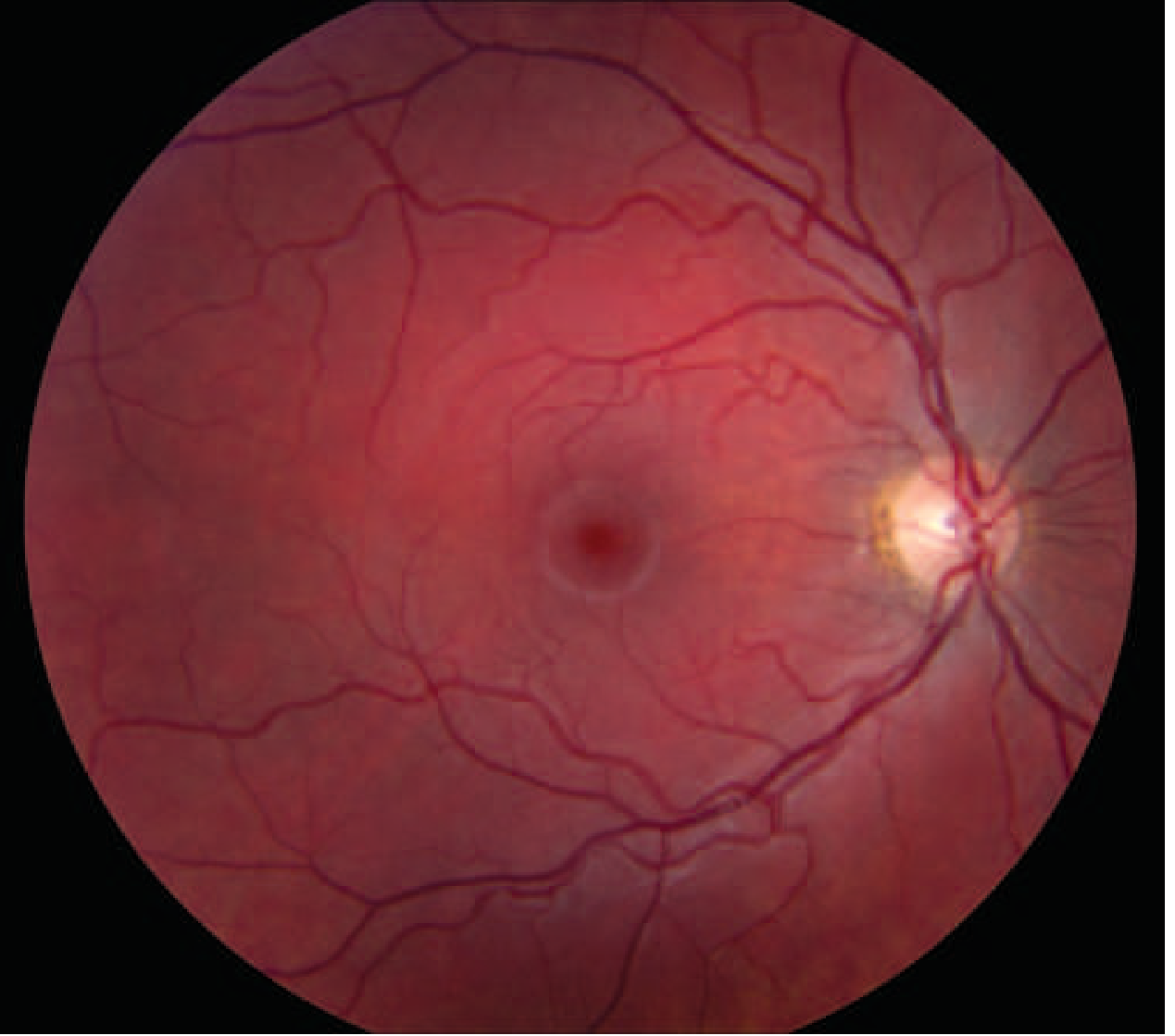
- Mean age 32 years; 77% female; 92% have ocular pain on eye movement
- Demyelinating event is retrobulbar → fundus normal initially; optic disc pallor develops over months
- Virtually all recover vision spontaneously; IV methylprednisolone speeds recovery but does not affect 6-month acuity
- ONTT: 50% develop clinically definite MS at 15 years
- Brain MRI mandatory — if ≥2 demyelinating plaques, initiate disease-modifying therapy
Posterior Ischemic Optic Neuropathy (PION)
- Rare; due to severe anemia + hypotension (cardiac/spinal surgery, major haemorrhage, dialysis)
- Fundus normal unless inflammation extends anteriorly to reach the globe
- Management: immediate transfusion + haemodynamic correction
Leber Hereditary Optic Neuropathy (LHON)
- Mitochondrial DNA mutation (most commonly m.11778G>A, m.3460G>A, m.14484T>C)
- Young men; painless, bilateral sequential subacute central visual loss
- Fundus may appear normal early; later disc pallor
- Later stages show circumpapillary telangiectasias (sometimes) but early fundus can be completely normal
Toxic / Nutritional Optic Neuropathy
- Agents: ethambutol, isoniazid, chloramphenicol, alcohol (methanol, chronic), tobacco, deficiency states (B12, folate, thiamine)
- Bilateral central/cecocentral scotomas; fundus normal early
- Stop offending agent + nutritional correction
Cancer-Associated Retinopathy (CAR)
- Paraneoplastic, most often small cell lung cancer
- Autoantibodies against recoverin → photoreceptor dysfunction
- Photopsias, ring scotoma, impaired dark adaptation; fundus initially normal; ERG extinguished or severely reduced
Stargardt Disease / Cone Dystrophy
- Juvenile-onset macular dystrophy; fundus may look normal or near-normal early despite severe central acuity loss
- Fundus autofluorescence / multifocal ERG abnormal before visible fundus changes
Functional (Non-organic) Visual Loss
- Consider when: inconsistent acuity, no RAPD, normal VEP, normal ERG, non-physiological field pattern (tubular fields, spiral fields)
- Prism test, fogging test, OKN drum testing useful to unmask preserved function
Summary Algorithm
Vision loss + Normal Fundus
         ↓
  Pinhole test
  ├── Improves → Refractive/media cause
  └── No improvement → Neurological workup
              ↓
        RAPD present?
        ├── YES → Optic nerve disease
        │         (neuritis, toxic, ischemic, LHON)
        │         → VEP, MRI, VF, OCT
        └── NO  → Bilateral optic/retinal or functional
                  → ERG (CAR, dystrophy), mfERG
                  → Consider functional loss
Sources:
- Wills Eye Manual, 8e — Normal Fundus With Decreased Vision
- Harrison's Principles of Internal Medicine 22e — Transient or Sudden Visual Loss (Ch. 34)
- Adams & Victor's Principles of Neurology 12e — Approach to the Problem of Visual Loss (Ch. 12)
- Bradley & Daroff's Neurology in Clinical Practice — Approach to the Patient with Visual Loss (Ch. 16)

Screenshot_20260513_095224_Chrome.jpg
What about this give me comprehensive answer
Finding Sources
Finding Sources
Finding Sources
Finding Sources
Reading File
Reading File
Reading File
Reading File
Reading File
Reading File
Finding Sources
Finding Sources
Finding Sources
I now have comprehensive material from all the key sources. Here is the full answer:
Normal Fundus + Vision Loss — The "Big 3" for Neurology Viva
The image framework is excellent. Here's the complete breakdown of each branch with everything you need for the viva.
PART 1: NORMAL FUNDUS + MONOCULAR VISION LOSS
Branch A — RAPD Present → Retrobulbar Optic Neuritis / PION
RAPD (Relative Afferent Pupillary Defect) = ipsilateral optic nerve lesion
Retrobulbar Optic Neuritis
| Feature | Detail |
|---|---|
| Classic quote | "The doctor sees nothing, and the patient sees nothing" |
| Age/sex | Mean 32 years; 77% female |
| Pain | 92% have pain on eye movement |
| Fundus | Normal — lesion is behind the globe |
| Recovery | Virtually all recover spontaneously |
| Treatment | IV methylprednisolone 250 mg q6h × 3 days → PO prednisone 1 mg/kg × 11 days (speeds recovery, does NOT change 6-month acuity) |
| MS risk | 50% develop clinically definite MS at 15 years (ONTT) |
| Key investigation | Brain MRI mandatory — if ≥2 plaques, start disease-modifying therapy |
Posterior Ischemic Optic Neuropathy (PION)
| Feature | Detail |
|---|---|
| Mechanism | Severe anemia + hypotension → posterior optic nerve infarction |
| Setting | Post-cardiac surgery, spinal surgery, GI bleed, renal dialysis |
| Fundus | Normal (disc swelling only if process extends anteriorly to reach globe) |
| Treatment | Emergency blood transfusion + haemodynamic resuscitation |
Key distinction from AION: In AION (anterior ischemic optic neuropathy) the fundus shows disc swelling — so AION is NOT in the "normal fundus" list.
Branch B — No RAPD, Transient → Amaurosis Fugax
| Feature | Detail |
|---|---|
| Definition | "Amaurosis" = to darken; "fugax" = fleeting — transient monocular blindness |
| Duration | 1–5 minutes; rarely up to 20–30 minutes |
| Symptoms | Sudden, painless; described as horizontal shade/curtain descending over eye; "visual blackout, dimming, blurring, graying" |
| Scintillations | Seldom reported (distinguishes from migraine) |
| Fundus | Normal (may rarely show Hollenhorst plaque — cholesterol embolus — glistening yellow-orange at bifurcation) |
| No RAPD | Because vision is fully restored; lesion is transient |
Causes — the hierarchy:
- Carotid atherosclerosis (most common) — emboli from ipsilateral ICA
- Cardioembolism — AF, valvular disease
- Retinal artery vasospasm / retinal migraine
- Hypoperfusion — severe ICA stenosis (also "bright-light amaurosis" — loss in bright light due to delayed photopigment regeneration)
- Others: hypercoagulable states, GCA (giant cell arteritis), hyperviscosity
Emboli types (viva favourite):
| Embolus | Appearance | Composition | Source |
|---|---|---|---|
| Hollenhorst plaque | Glistening orange-yellow, refractile | Cholesterol | Eroded atheroma, carotid |
| White plug | Dull grey-white, mobile | Platelet-fibrin | Carotid thrombus, cardiac |
| Calcific | Grey-white, non-refractile | Calcium | Calcific heart valve |
Workup: Carotid Doppler/CTA, echocardiogram, ECG (Holter), lipid/glucose, FBC, ESR/CRP (GCA exclusion), coagulation screen
Branch C — Functional/Psychogenic → VEP Normal
| Feature | Detail |
|---|---|
| No RAPD | Afferent pathway intact |
| Acuity | Inconsistent — varies between tests, monocular vs binocular |
| Visual fields | Non-physiological patterns: tubular (same size regardless of distance), spiral fields |
| VEP | Normal — the critical finding confirming intact visual cortex |
| ERG | Normal |
| OKN | Involuntary OKN response present despite claimed blindness |
| Special tests | Fogging test (blur good eye — patient "can't see" with the fogger), prism test, 4-dioptre prism test |
| Diagnosis | Diagnosis of exclusion after all organic causes ruled out |
Note: Functional visual loss is non-organic but real to the patient — do NOT call it malingering without evidence.
PART 2: NORMAL FUNDUS + BILATERAL VISION LOSS
The lesion must be at or behind the chiasm. Fundus appears normal because the optic disc changes (pallor, swelling) take weeks to months to develop — and post-chiasmal lesions cause no disc change at all (retrograde atrophy takes months).
Branch A — Bitemporal Hemianopia → Chiasmal Compression (Pituitary)
Anatomy: Crossed nasal fibres decussate at the optic chiasm. Compression from below = bitemporal hemianopia starting superiorly (superior fibres run inferiorly in chiasm).
Fundus: Normal (no disc swelling unless chronic — then slowly develops "band atrophy" of the optic nerve)
Causes of chiasmal compression:
| Cause | Notes |
|---|---|
| Pituitary adenoma (most common) | Suprasellar extension; prolactinoma, GH, ACTH, non-functional |
| Craniopharyngioma | Children and adults; calcification on imaging; suprasellar |
| Meningioma (tuberculum sellae) | Junctional scotoma if anterior compression |
| Glioma | Optic pathway glioma — children, NF-1 association |
| Aneurysm | Supraclinoid ICA, ACoA |
| Pituitary apoplexy | Acute haemorrhage into adenoma → sudden visual loss + headache + ophthalmoplegia + altered consciousness |
Viva points:
- Insidious onset — often missed because binocular overlap hides temporal field loss; test each eye separately
- Suprasellar lesion → upper temporal quadrants affected first (inferior nasal fibres cross more anteriorly)
- Junctional scotoma (anterior chiasm): ipsilateral central scotoma + contralateral superotemporal defect (von Willebrand knee fibres)
- Investigation: MRI pituitary with gadolinium; visual field perimetry; pituitary hormone profile
- Pituitary apoplexy = neurosurgical emergency; start IV hydrocortisone immediately
Branch B — Homonymous Hemianopia → Post-chiasmal Stroke
Anatomy: Any lesion from optic tract → LGN → optic radiations → visual cortex produces a contralateral homonymous defect. Fundus is always normal for post-chiasmal lesions.
Localisation by field defect pattern:
| Location | Field Defect | Notes |
|---|---|---|
| Optic tract | Incongruous HH | RAPD in eye with temporal field loss |
| Temporal lobe (Meyer's loop) | Superior quadrantic HH ("pie in the sky") | Temporal lobe epilepsy, tumours |
| Parietal lobe | Inferior quadrantic HH ("pie on the floor") | May have sensory neglect |
| Occipital cortex (PCA) | Dense congruous HH | Macular sparing (collaterals from MCA) |
| Bilateral occipital | Cortical blindness | → Anton syndrome |
Post-chiasmal key rule: Visual acuity in each eye is preserved (the macula has bilateral cortical representation) unless the lesion destroys the occipital pole.
Cause: Posterior cerebral artery (PCA) territory stroke is the most common cause of homonymous hemianopia.
Investigation: MRI DWI/FLAIR brain, MRA, carotid/vertebral imaging, cardiac workup
Branch C — Complete Blindness + Normal Pupils → Cortical Blindness (Anton Syndrome)
This is the most dramatic and viva-worthy entity.
Mechanism: Bilateral destruction of primary visual cortex (V1, calcarine cortex) — most commonly bilateral PCA territory infarction.
| Feature | Detail |
|---|---|
| Vision | Complete bilateral blindness |
| Pupils | Normal light reflex — the key distinguishing feature (pupillary reflex arc does NOT pass through visual cortex) |
| Fundus | Normal — no retinal or disc pathology |
| Anton Syndrome | Patient denies being blind and confabulates visual descriptions ("visual anosognosia") — may describe the room, walk into walls |
| Associated | Confusion, agitation, short-term memory loss (PCA infarct involves hippocampus), formed visual hallucinations (Bonnet syndrome), blindsight |
Anton Syndrome in detail:
- Patient blames poor vision on "dim lighting" or "not wearing glasses"
- Confabulates visual experiences — "I can see fine"
- Walks directly into objects without adjusting behaviour
- Reflects unawareness in thinking/speaking centres of the absence of visual cortex input
- May co-exist with Korsakoff-type memory dysfunction if bilateral hippocampal involvement
- (Localization in Clinical Neurology): "thalamic involvement in posterior circulation infarcts may be critical for the genesis of Anton syndrome in some patients"
Blindsight (Inverse Anton): Patient denies seeing anything but can react to visual stimuli — mediated by subcortical connections (optic tract → superior colliculus → pulvinar)
Causes of cortical blindness:
- Bilateral PCA stroke (most common) — thromboembolism, top-of-basilar syndrome
- PRES (posterior reversible encephalopathy syndrome) — hypertensive crisis, eclampsia, immunosuppressants
- Post-contrast/arteriography (transient)
- Hypoxic-ischemic encephalopathy (cardiac arrest)
- Trauma
- Migraine (transient), seizures (postictal)
- CJD — Heidenhain variant (visual onset)
- Posterior cortical atrophy (Alzheimer variant)
Diagnosis of cortical blindness:
- Absent ocular pathology
- Preserved pupillary light reflexes ← the key bedside test
- Normal optic fundi
- MRI: bilateral occipital infarcts/lesions
- VEP: absent or grossly abnormal (unlike functional blindness)
MASTER COMPARISON TABLE
| Retrobulbar ON | PION | Amaurosis Fugax | Functional | Chiasmal | Post-chiasmal | Cortical Blindness | |
|---|---|---|---|---|---|---|---|
| Laterality | Unilateral | Unilateral | Unilateral | Unilateral | Bilateral | Unilateral (HH) | Bilateral |
| Onset | Subacute days | Acute | Transient seconds–min | Variable | Insidious | Acute (stroke) | Acute |
| Pain | Yes (eye movement) | No | No | Variable | No | No | No |
| RAPD | Yes | Yes | No (transient) | No | No (bilateral) | No | No |
| Fundus | Normal | Normal | Normal | Normal | Normal | Normal | Normal |
| Pupils | Normal | Normal | Normal | Normal | Normal | Normal | Normal ← key |
| VEP | Delayed (P100) | Abnormal | Normal | Normal | Delayed | Abnormal | Absent |
| MRI | Optic nerve enhancement | FLAIR optic nerve | Carotid stenosis | Normal | Sellar mass | Occipital infarct | Bilateral occipital |
| Key test | MRI brain + orbit | MRI orbit | Carotid Doppler + echo | VEP normal | MRI pituitary + fields | MRI DWI | MRI DWI; pupil reflex |
ONE-LINE VIVA SUMMARIES
- Retrobulbar ON: Pain on eye movement + RAPD + normal fundus + delayed VEP → MS association
- PION: Perioperative anaemia/hypotension + sudden monocular loss + normal fundus → emergency transfusion
- Amaurosis fugax: Curtain descending over one eye × minutes + carotid disease → TIA equivalent; image carotids urgently
- Functional: Tubular fields + normal VEP + inconsistent acuity + no RAPD
- Bitemporal HH: Test each eye separately; check above/below, pituitary MRI, hormone profile
- Homonymous HH: Post-chiasmal = fundus always normal; localise by congruity and pattern
- Anton syndrome: Blind + normal pupils + denies blindness + normal fundus = bilateral occipital infarction
Sources: Harrison's Principles of Internal Medicine 22e (Ch. 34) · Adams & Victor's Principles of Neurology 12e (Ch. 12) · Bradley & Daroff's Neurology in Clinical Practice (Ch. 16) · Localization in Clinical Neurology 8e (Ch. 22) · Wills Eye Manual 8e

Screenshot_20260513_095546_Chrome.jpg
Screenshot_20260513_095224_Chrome.jpg
This are 2 different answers given by you
You're right to flag this — these are two different frameworks and they're not contradictory, they address different scopes. Let me reconcile them clearly:
Why They Look Different
| Answer 1 (Summary Algorithm) | Answer 2 (Big 3 Framework) | |
|---|---|---|
| Scope | Broad ophthalmology/neurology approach — ALL causes of normal fundus + vision loss | Focused neurology viva framework — the key diagnoses a neurologist must know |
| Context | Your first question: "Vision loss with normal fundus approach in crisp" | Your second question: expanding the "Big 3" diagram |
| Starting point | Starts with pinhole test (ophthalmology first step) | Starts already past pinhole — assumes neurological cause |
How They Fit Together — The Unified Framework
VISION LOSS + NORMAL FUNDUS
         ↓
    PINHOLE TEST
    ├── Improves → Refractive/media cause (STOP here — not neurological)
    └── No improvement ↓

    MONOCULAR?                        BILATERAL?
         ↓                                 ↓
    RAPD present?              What field pattern?
    ├─ YES → Optic nerve            ├─ Bitemporal HH → Chiasmal (pituitary)
    │   (neuritis, PION,            ├─ Homonymous HH → Post-chiasmal stroke
    │    toxic, LHON)               └─ Complete + normal pupils → Cortical (Anton)
    │   → VEP, MRI, OCT
    ├─ NO + transient → Amaurosis fugax
    └─ NO + persistent → Functional
         → VEP normal
The Key Reconciliation Points
1. Answer 1's "RAPD YES → optic nerve (neuritis, toxic, ischemic, LHON)"
= Answer 2's "RAPD present → Retrobulbar ON / PION" — same branch, Answer 2 just names the top 2 for viva purposes. Toxic and LHON are also included but less commonly tested in neurology viva.
2. Answer 1's "RAPD NO → bilateral optic/retinal or functional"
= Answer 2's bilateral section (chiasmal, post-chiasmal, Anton) plus functional — same territory, just reorganised by laterality.
3. The bilateral section in Answer 2 is entirely missing from Answer 1's algorithm — that's because Answer 1's algorithm was written for monocular emphasis. Answer 2 correctly adds the bilateral arm.
The Complete Single Algorithm (Reconciled)
Normal Fundus + Vision Loss
         ↓
  ┌─ PINHOLE improves → Refractive error / media (cornea, lens, vitreous)
  │
  └─ PINHOLE no change → Neurological cause
              ↓
    ┌─── MONOCULAR ──────────────────────────────────────┐
    │  RAPD present                                      │
    │  ├─ Subacute + pain → Retrobulbar optic neuritis   │
    │  ├─ Perioperative anaemia → PION                   │
    │  ├─ Painless + bilateral later → LHON              │
    │  └─ Symmetric + toxin exposure → Toxic ON          │
    │     → VEP (delayed P100), MRI orbit+brain, OCT     │
    │                                                    │
    │  No RAPD + TRANSIENT → Amaurosis fugax             │
    │     → Carotid Doppler, Echo, ECG                   │
    │                                                    │
    │  No RAPD + PERSISTENT → Functional/psychogenic     │
    │     → VEP NORMAL, tubular fields, inconsistent VA  │
    └────────────────────────────────────────────────────┘

    ┌─── BILATERAL ──────────────────────────────────────┐
    │  Bitemporal HH → Chiasmal compression              │
    │     → MRI pituitary, hormone profile               │
    │                                                    │
    │  Homonymous HH → Post-chiasmal stroke (PCA)        │
    │     → MRI DWI, carotid/cardiac workup              │
    │                                                    │
    │  Complete blindness + normal pupils → Cortical     │
    │     (Anton syndrome — denies blindness)            │
    │     → MRI bilateral occipital                      │
    │                                                    │
    │  Bilateral central scotomas + no RAPD              │
    │     → ERG (CAR, cone dystrophy, Stargardt)         │
    └────────────────────────────────────────────────────┘
Bottom line: The two answers are not contradictory. Answer 1 gives the ophthalmology-first approach (starting with pinhole). Answer 2 gives the neurology-viva-focused shortlist (starting past pinhole). For exams, you need both: start with pinhole → then apply the Big 3 framework for the neurological cases.
This is a shared conversation. Sign in to Orris to start your own chat.