
what are beta-lacta mases
Beta-lactamases are enzymes produced by bacteria that break down beta-lactam antibiotics (penicillins, cephalosporins, carbapenems, monobactams) by hydrolyzing the beta-lactam ring, rendering the antibiotic inactive. They are the most common mechanism of bacterial resistance to beta-lactam drugs.
Searching sources...
Reading File
Searching the Web
beta-lactamases classification mechanism of action 2025
Finding Sources
Finding Sources
Reading File
Finding Sources
Reading File
Finding Sources
Now I have comprehensive textbook material. Let me compile a thorough answer.
Beta-Lactamases
Beta-lactamases are bacterial enzymes that confer resistance to beta-lactam antibiotics by hydrolyzing the amide bond of the beta-lactam ring, permanently inactivating the drug before it can reach its target (penicillin-binding proteins, or PBPs). They are the single most important mechanism of resistance to beta-lactam antibiotics in gram-negative bacteria.
Mechanism of Action
Beta-lactam antibiotics normally work by mimicking the D-Ala-D-Ala terminus of peptidoglycan precursors and irreversibly binding to PBPs, blocking cell wall synthesis. Beta-lactamases counteract this by attacking the beta-lactam ring:
- Serine beta-lactamases (Classes A, C, D): Use an active-site serine residue in a two-step reaction - acylation (covalent attachment of the antibiotic to the serine) followed by deacylation (hydrolysis releases the inactivated antibiotic and regenerates the enzyme).
- Metallo-beta-lactamases (Class B): Use one or two zinc ions at the active site to coordinate a water molecule that directly hydrolyzes the ring - no covalent intermediate, which is why these are NOT inhibited by classical beta-lactamase inhibitors.
Classification (Ambler Molecular Classes)
From Henry's Clinical Diagnosis and Management by Laboratory Methods (Table 58.1):
| Ambler Class | Active Site | Category | Examples | Key Features |
|---|---|---|---|---|
| A | Serine | ESBLs | CTX-M, SHV, TEM | Resistant to penicillins, 1st-3rd gen cephalosporins, aztreonam; inhibited by clavulanic acid, tazobactam, sulbactam |
| A | Serine | Carbapenemases | KPC, IMI, SME | Hydrolyze carbapenems; inhibited by avibactam and boronic acid; found in K. pneumoniae, E. coli |
| B | Metallo (zinc) | Carbapenemases (MBLs) | NDM, VIM, IMP, GIM, SPM-1 | Strongest carbapenem hydrolyzers; NOT inhibited by standard inhibitors (including avibactam); inhibited by EDTA; do NOT inactivate aztreonam |
| C | Serine | AmpC | ACC, FOX, LAT, MOX | Resistant to cephamycins (cefoxitin) AND beta-lactamase inhibitors; susceptible to carbapenems unless co-resistance present; inducible by beta-lactams |
| D | Serine | OXA carbapenemases | OXA-48, OXA-23 | Weak carbapenem hydrolysis; inhibited by oxacillin/temocillin; NOT inhibited by EDTA or boronic acid |
Clinically Important Types
1. Extended-Spectrum Beta-Lactamases (ESBLs)
- Derived from TEM and SHV penicillinases by point mutations, or the CTX-M family (now most common globally)
- Hydrolyze penicillins, all cephalosporins, and aztreonam
- Inhibited by clavulanic acid, sulbactam, and tazobactam
- Produced mainly by Enterobacteriaceae (especially E. coli, K. pneumoniae)
- Treatment: carbapenems remain the gold standard
2. AmpC Beta-Lactamases
- Class C, typically chromosomally encoded and inducible
- Produced by "SPACE" organisms: Serratia, Pseudomonas, Acinetobacter, Citrobacter, Enterobacter
- NOT inhibited by clavulanic acid, tazobactam, or sulbactam
- Resistant to cephamycins (cefoxitin)
3. Carbapenemases (KPC, NDM, VIM, IMP, OXA)
- Hydrolyze carbapenems - the last-resort beta-lactams
- KPC (Klebsiella Pneumoniae Carbapenemase): Class A, inhibited by avibactam; found in K. pneumoniae and other Enterobacteriaceae
- NDM (New Delhi Metallo-beta-lactamase): Class B MBL, resistant to virtually all beta-lactams; NOT inhibited by avibactam
- OXA-48: Class D, carbapenem-resistant K. pneumoniae; partially inhibited by avibactam
Beta-Lactamase Inhibitors
From Katzung's Basic and Clinical Pharmacology, 16th Ed.:
| Inhibitor | Class Covered | Combinations Used |
|---|---|---|
| Clavulanic acid | Class A | Amoxicillin-clavulanate, ticarcillin-clavulanate |
| Sulbactam | Class A | Ampicillin-sulbactam |
| Tazobactam | Class A | Piperacillin-tazobactam |
| Avibactam | Class A, C, some D (OXA-48) | Ceftazidime-avibactam, ceftolozane-avibactam |
| Vaborbactam | Class A, C | Meropenem-vaborbactam |
| Relebactam | Class A, C (similar to avibactam) | Imipenem-cilastatin-relebactam |
None of these inhibit Class B metallo-beta-lactamases. NDM-producing organisms are therefore extremely difficult to treat.
Genetic Transmission
Beta-lactamase genes can be:
- Chromosomal (intrinsic, often inducible - e.g., AmpC in Enterobacter)
- Plasmid-encoded (transferable by conjugation between organisms - e.g., TEM/SHV/CTX-M ESBLs, KPC, NDM)
The plasmid-mediated spread is what makes ESBLs and carbapenemases such major public health threats.
Summary: Beta-lactamases are the primary defense bacteria use against beta-lactam antibiotics. The clinical response has been to develop inhibitor combinations, but the emergence of metallo-beta-lactamases (NDM, VIM, IMP) that resist all current inhibitors represents an ongoing therapeutic crisis in infectious disease.
- Katzung's Basic and Clinical Pharmacology, 16th Edition, p. 1318-1337
- Henry's Clinical Diagnosis and Management by Laboratory Methods, Table 58.1 (Beta-Lactamase Classification)
is MOA of penicillin G and amoxicillin are same?
Yes, penicillin G and amoxicillin share the same core mechanism of action - both inhibit bacterial cell wall synthesis by binding to penicillin-binding proteins (PBPs) and blocking transpeptidation. They differ mainly in spectrum, acid stability, and pharmacokinetics.
Searching sources...
Finding Sources
Finding Sources
Finding Sources
Finding Sources
Reading File
Reading File
Finding Sources
Finding Sources
Finding Sources
Reading File
Reading File
Yes - same MOA, different spectrum and pharmacokinetics. Here is the full picture:
Penicillin G vs. Amoxicillin: Same MOA?
Short answer: Yes. Both are beta-lactam antibiotics and share an identical mechanism of action. They differ in their antibacterial spectrum, acid stability, route of administration, and oral bioavailability.
Shared Mechanism of Action
From Lippincott Illustrated Reviews: Pharmacology:
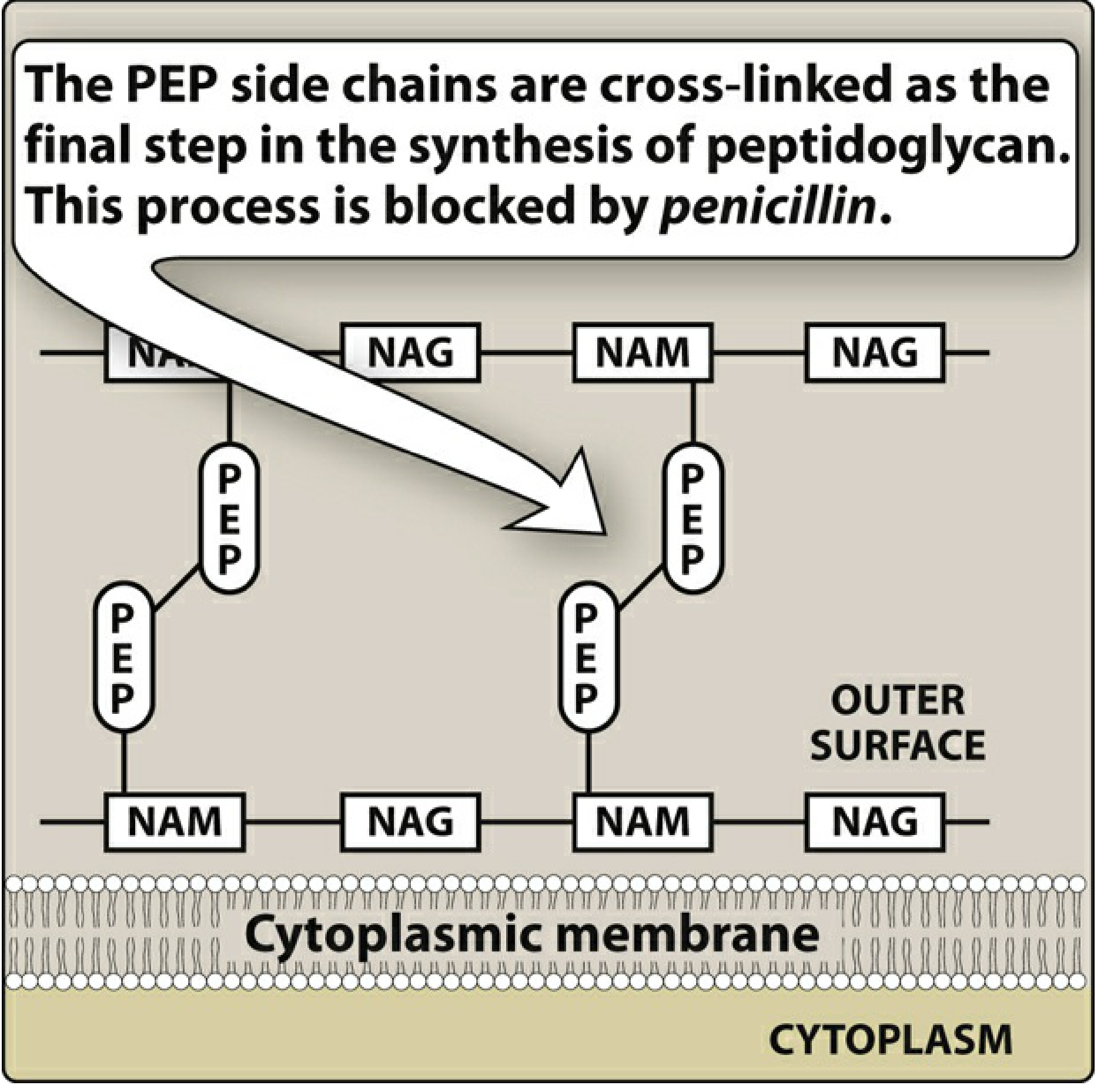
"Penicillins interfere with the last step of bacterial cell wall synthesis, which is the cross-linking of adjacent peptidoglycan strands by a process known as transpeptidation. Since penicillins structurally resemble the terminal portion of the peptidoglycan strand (D-Ala-D-Ala), they compete for and bind to enzymes called penicillin-binding proteins (PBPs), which catalyze transpeptidase and facilitate cross-linking."
This applies to all penicillins - including penicillin G and amoxicillin.
Step-by-step:
- The beta-lactam ring mimics the D-Ala-D-Ala terminus of the peptidoglycan precursor
- PBPs (which are transpeptidases, carboxypeptidases) bind the drug covalently
- Cross-linking of peptidoglycan strands is blocked
- The cell wall becomes structurally weak
- Osmotic lysis and bacterial cell death follow (bactericidal effect)
Where They Differ
| Feature | Penicillin G | Amoxicillin |
|---|---|---|
| Class | Natural penicillin | Aminopenicillin (semisynthetic) |
| MOA | Inhibit PBPs / block transpeptidation | Identical |
| Spectrum | Narrow - mainly gram-positive, spirochetes, some gram-negative (Neisseria) | Broader - gram-positive + gram-negative (H. influenzae, E. coli, Listeria, Enterococci) |
| Acid stability | Acid-labile (destroyed by gastric acid) | Acid-stable |
| Route | Parenteral (IV/IM) primarily; penicillin V used orally | Oral (well absorbed); also IV |
| Food effect | Absorption reduced by food | Food does NOT interfere |
| Oral bioavailability | Poor | Excellent - peaks 2-2.5x higher than ampicillin |
From Lippincott: The antibacterial spectrum is determined by the ability to cross the bacterial peptidoglycan cell wall and reach PBPs in the periplasmic space, which depends on size, charge, and hydrophobicity of the specific drug. Amoxicillin's amino group allows better penetration through outer membrane porins of gram-negative bacteria, explaining its broader spectrum.
Why Amoxicillin Has a Broader Spectrum
The key structural difference is the amino group (-NH₂) on the alpha carbon of amoxicillin's side chain. This:
- Makes it more hydrophilic
- Allows better penetration through gram-negative outer membrane porin channels
- Extends activity to organisms like H. influenzae, E. coli, Enterococcus faecalis, Listeria
Penicillin G lacks this and cannot efficiently penetrate gram-negative outer membranes.
Summary
| Penicillin G | Amoxicillin | |
|---|---|---|
| MOA | PBP inhibition, block cell wall transpeptidation | Same |
| Effect | Bactericidal | Same |
| Spectrum | Narrow (gram-positive) | Wider (gram-positive + some gram-negative) |
| Use | IV/IM - serious infections (syphilis, meningitis, endocarditis) | Oral - community infections (otitis, sinusitis, UTI, H. pylori) |
Both are hydrolyzed and inactivated by beta-lactamases, so neither has intrinsic activity against beta-lactamase-producing organisms unless combined with an inhibitor (e.g., amoxicillin-clavulanate).
- Lippincott Illustrated Reviews: Pharmacology, p. 942-943
- Goodman & Gilman's Pharmacological Basis of Therapeutics, p. 1170, 753
- Katzung's Basic and Clinical Pharmacology, 16th Ed.
rntcp guidelines of treatment for drug resistant tb
India's RNTCP (now called National TB Elimination Programme, NTEP) follows WHO-aligned guidelines for drug-resistant TB. MDR-TB is treated with longer regimens including bedaquiline, linezolid, and fluoroquinolones. The 2022 updates moved toward all-oral regimens phasing out injectables.
Searching sources...
Finding Sources
Searching the Web
RNTCP NTEP drug resistant TB treatment guidelines India 2024 2025
The official November 2024 NTEP guidelines PDF is available. Let me extract the key content from it alongside textbook content.
Reading Web Page
https://tbcindia.mohfw.gov.in/wp-content/uploads/2025/01/Nat…
Finding Sources
Reading Web Page
https://www.scribd.com/document/853094554/National-Guideline…
Reading File
Finding Sources
Searching the Web
NTEP India 2024 DR-TB BPaLM regimen shorter longer 9 month eligibility WHO group drugs
I now have comprehensive information from the official NTEP November 2024 guidelines and supporting sources. Here is the complete answer:
NTEP (RNTCP) Guidelines: Treatment of Drug-Resistant TB (November 2024)
Note: RNTCP was renamed the National TB Elimination Programme (NTEP) in 2020. The most current guidelines are the National Guidelines for Management of Drug Resistant TB, November 2024, published by the Central TB Division, MoHFW, Government of India. India aims to eliminate TB by 2025, 5 years ahead of the global SDG target.
Key 2024 Updates
The National Technical Expert Group (NTEG) under NTEP made three landmark changes:
- Introduced BPaLM (6-month all-oral regimen) under programmatic conditions countrywide (approved September 2024)
- Bdq and Dlm extended to all age groups (including children), given unmet need
- Linezolid replaces ethionamide in the 9-11 month shorter oral MDR/RR-TB regimen
Classification of Drug-Resistant TB
| Type | Definition |
|---|---|
| RR-TB | Rifampicin-resistant TB (any resistance to rifampicin) |
| MDR-TB | Resistant to both isoniazid (H) + rifampicin (R) |
| Pre-XDR-TB | MDR/RR-TB + additional resistance to any fluoroquinolone (FQ) |
| XDR-TB | MDR/RR-TB + resistance to FQ + at least one of bedaquiline or linezolid |
Treatment Regimens
Regimen 1: BPaLM - 6-Month All-Oral Regimen (PREFERRED for eligible MDR/RR-TB)
| Drug | Abbreviation | Dose | Duration |
|---|---|---|---|
| Bedaquiline | Bdq | 400 mg OD (Wks 1-2), then 200 mg TIW (Wks 3-26) | 26 weeks |
| Pretomanid | Pa | 200 mg OD | 26 weeks |
| Linezolid | Lzd | 600 mg OD | 26 weeks |
| Moxifloxacin | Mfx | 400 mg OD | 26 weeks |
Pyridoxine (Vit B6) co-administered: 50 mg (16-29 kg), 100 mg (>30 kg) - to prevent linezolid-induced neuropathy.
Eligibility for BPaLM:
- MDR/RR-TB (pulmonary, confirmed)
- No prior exposure to Bdq, Pa, or Lzd for >1 month
- No resistance to Bdq, Pa, or Dlm detected
- Age ≥14 years (pretomanid safety data not established below this)
- Not pregnant (pretomanid contraindicated in pregnancy)
Extension criteria: Duration can be extended to 39 weeks in selected patients based on clinical and bacteriological response.
Regimen 2: BPaL - 6-Month Regimen (for Pre-XDR-TB / FQ-resistant MDR-TB)
| Drug | Dose | Duration |
|---|---|---|
| Bedaquiline | 400 mg OD (Wks 1-2), then 200 mg TIW | 26 weeks |
| Pretomanid | 200 mg OD | 26 weeks |
| Linezolid | 600 mg OD | 26 weeks |
- Used when moxifloxacin cannot be given (FQ resistance or intolerance)
- Based on NIX-TB trial: 90% treatment success in Pre-XDR-TB
- Linezolid 1200 mg (original NIX-TB dose) replaced with 600 mg in NTEP due to lower toxicity while maintaining efficacy (ZeNix trial)
Regimen 3: 9-11 Month Shorter Oral Bedaquiline-Containing Regimen
Used when BPaLM is not eligible (e.g., FQ-susceptible MDR/RR-TB without extensive disease, in patients where BPaLM cannot be given).
Composition: Bdq-Lzd-Cfz-Z-Lfx based individualized regimen over 9-11 months
- Linezolid (Lzd) replaces ethionamide (Eto) - 2024 key update
- 2 months of Lzd (600 mg) used as alternative to 4 months of Eto
Eligibility for 9-11 month regimen:
- MDR/RR-TB without prior SLD exposure for >1 month
- No FQ resistance
- No extensive pulmonary disease
- No severe extra-pulmonary TB
Regimen 4: Longer All-Oral Regimen (≥18 months)
For patients NOT eligible for shorter regimens (XDR-TB, treatment failure, extensive pulmonary disease, special populations). Individualized regimen based on WHO priority drug grouping:
| WHO Group | Drugs | Priority |
|---|---|---|
| Group A | Levofloxacin/Moxifloxacin, Bedaquiline, Linezolid | Always include all 3 if possible |
| Group B | Clofazimine, Cycloserine/Terizidone | Add next |
| Group C | Ethambutol, Delamanid, Pyrazinamide, Imipenem-cilastatin, Amikacin, Ethionamide/Prothionamide, PAS | Add to complete regimen |
Injectable agents (kanamycin, capreomycin) are no longer recommended - meta-analysis showed worse outcomes and toxicity.
Special Population: Children (<14 years)
- BPaLM: Pretomanid not yet cleared for <14 years
- Bedaquiline and Delamanid approved for all age groups (2024 update)
- Alternative: BDLLfxC (Bdq + Dlm + Lzd + Levofloxacin + Clofazimine) - 6-month regimen for children ineligible for BPaLM
Pregnancy
- Pretomanid is contraindicated
- Longer individualized oral regimen used
- Avoid injectables
HIV co-infection
- Manage drug-drug interactions: Bdq and antiretrovirals (esp. efavirenz, lopinavir - QTc prolongation risk)
- BPaLM can be used with close monitoring
Diagnosis for DR-TB (2024 Updates)
- CBNAAT (GeneXpert MTB/RIF): First-line rapid test - detects RR-TB
- CBNAAT MTB/XDR test: Approved 2024 - detects resistance to H, FQ, SLI (second-line injectables), and Eto simultaneously
- Line Probe Assay (LPA): For detecting H and FQ resistance
- Liquid culture + DST: Confirmatory and for full resistance profiling
- Baseline LC-DST for Bdq, Lzd, Pa, Dlm, Z, Mfx recommended at follow-up
Monitoring During Treatment
| Parameter | Frequency |
|---|---|
| Sputum smear + culture | Monthly (bacteriological conversion by month 2) |
| ECG (QTc monitoring) | Baseline, then monthly - for Bdq, Mfx, Dlm (QTc risk) |
| CBC + LFT + RFT | Baseline, then monthly |
| Vision/optic nerve | Monthly - for Lzd (optic neuritis risk) |
| Peripheral neuropathy | Monthly - Lzd |
| Audiometry | If SLIs used (now rare) |
Key drug toxicities to monitor:
| Drug | Key ADR |
|---|---|
| Bedaquiline | QTc prolongation, hepatotoxicity |
| Pretomanid | QTc prolongation, peripheral neuropathy |
| Linezolid | Peripheral neuropathy (81%), myelosuppression (48%) |
| Moxifloxacin | QTc prolongation |
| Delamanid | QTc prolongation |
| Clofazimine | Skin discoloration, GI, QTc |
Treatment Outcomes (NTEP Definitions)
| Outcome | Definition |
|---|---|
| Cured | Treatment completed + bacteriological confirmation (negative sputum) |
| Treatment completed | Completed treatment, no failure, no sputum available |
| Treatment failed | Positive sputum at month 5 or later |
| Lost to follow-up | Interrupted ≥2 consecutive months |
| Sustained treatment success | No relapse at 12 months post-treatment |
Summary of Regimen Selection
MDR/RR-TB confirmed
        |
        ├─ Eligible for BPaLM? (age ≥14, not pregnant, no FQ resistance, no prior Bdq/Pa/Lzd)
        │         ↓ YES
        │    BPaLM × 26 weeks (PREFERRED)
        │
        ├─ FQ resistant (Pre-XDR-TB)?
        │         ↓ YES
        │    BPaL × 26 weeks
        │
        ├─ Not eligible for above, eligible for shorter oral regimen?
        │         ↓ YES
        │    9-11 month Bdq-containing regimen (Lzd replaces Eto)
        │
        └─ XDR-TB / treatment failure / ineligible above?
                  ↓
         Longer individualized oral regimen ≥18 months
         (WHO Group A+B+C priority)
- NTEP National Guidelines for Management of DR-TB, November 2024 (official PDF, Central TB Division, MoHFW India)
- Harrison's Principles of Internal Medicine 22E (2025), Table 183-4 / 186-4 - WHO drug classification and MDR-TB regimens
- Murray & Nadel's Textbook of Respiratory Medicine - BPaL regimen evidence (Nix-TB trial)
This is a shared conversation. Sign in to Orris to start your own chat.