
Furuncle in axilla treatment
Reading File
Finding Sources
Finding Sources
Searching PubMed
furuncle boil treatment management
Good results. Now let me read the most relevant sections — particularly from Textbook of Family Medicine, Goldman-Cecil Medicine, Rosen's Emergency Medicine, and the Sherris Microbiology furuncle/carbuncle section.
Reading File
Reading File
Reading File
Reading File
Now let me get the antibiotic table from Rosen's and the MRSA/recurrence management details:
Reading File
Finding Sources
Reading File
Reading File
I now have comprehensive information to provide a thorough answer. Let me also fetch the treatment algorithm image from Rosen's.
Loading Image
Here is a comprehensive treatment guide for a furuncle (boil) in the axilla:
Furuncle (Boil) in the Axilla — Treatment
Definition & Pathophysiology
A furuncle is a deep-seated abscess of a hair follicle, sebaceous gland, or sweat gland. The axilla is a classic site due to friction, moisture, hair follicles, and apocrine glands. The causative organism is almost always Staphylococcus aureus — with CA-MRSA now accounting for the majority of cases in many regions.
Step 1: Local Measures (Early/Non-fluctuant Stage)
- Warm/hot compresses applied several times daily — promote pointing and spontaneous drainage
- Many small furuncles will rupture and drain spontaneously without intervention
- Keep the area clean; antiseptic soap reduces autoinoculation
Step 2: Incision & Drainage (I&D) — Primary Treatment When Fluctuant
I&D is the cornerstone of treatment for any fluctuant furuncle.
Procedure steps:
- Analgesia — local infiltration with bupivacaine ring block (25G needle); allow ≥20 min. Procedural sedation or oral analgesia (ibuprofen + acetaminophen ± oxycodone ± low-dose diazepam) may be added
- Skin prep with povidone-iodine
- Single incision across the abscess along skin tension lines (smaller scar)
- Blunt dissection with a small clamp to disrupt loculations
- Irrigation of the cavity
- Loose packing with gauze (optional; evidence for packing is limited — may increase pain). Remove after 2–4 days
The axilla presents a special challenge — it is listed as an anatomically difficult area to drain, which may warrant antibiotic coverage more readily than other sites. — Rosen's Emergency Medicine, 10e
Ultrasound guidance (high-frequency linear probe) improves diagnostic accuracy when fluctuance is uncertain, distinguishing abscess (hypoechoic with posterior acoustic enhancement) from cellulitis (cobblestoning pattern).
Step 3: Antibiotic Therapy
When to Give Antibiotics
Antibiotics should be considered when:
- Furuncle is not yet fluctuant
- Surrounding cellulitis or lymphadenitis is present
- Systemic signs (fever, malaise)
- Immunocompromise, diabetes, or other comorbidities
- Multiple lesions or recurrent infection
- Difficult-to-drain location (the axilla qualifies)
- History of or suspected MRSA
- Poor response to I&D alone
Recent RCTs show antibiotics after I&D reduce treatment failure and recurrence (NNT ~7–26); patients with MRSA, fever, or MRSA as causative organism derive the most benefit.
Antibiotic Choices (Oral)
| Drug | Dose | Coverage |
|---|---|---|
| TMP-SMX (first-line for MRSA) | 160/800 mg (1 DS tab) BID × 5–7 days | MSSA ✓, MRSA ✓ |
| Doxycycline | 100 mg BID × 5–7 days | MSSA ✓, MRSA ✓ |
| Clindamycin | 300–450 mg TID | MSSA ✓, MRSA ± (check local D-test) |
| Cephalexin | 500 mg QID | MSSA ✓, MRSA ✗ |
| Dicloxacillin | 250–500 mg QID (empty stomach) | MSSA ✓, MRSA ✗ |
Duration: 5–7 days post-I&D (guided by clinical response). — Goldman-Cecil Medicine
For confirmed or likely MRSA, TMP-SMX or doxycycline are preferred. Clindamycin is acceptable only after ruling out inducible resistance (D-zone test). — Rosen's Emergency Medicine
Step 4: Wound Culture
- Not routine for uncomplicated furuncles
- Recommended for: recurrent infections, treatment failure, or if considering dual antibiotic coverage (to tailor therapy)
- Rapid PCR MRSA assays (~90 min) available and useful
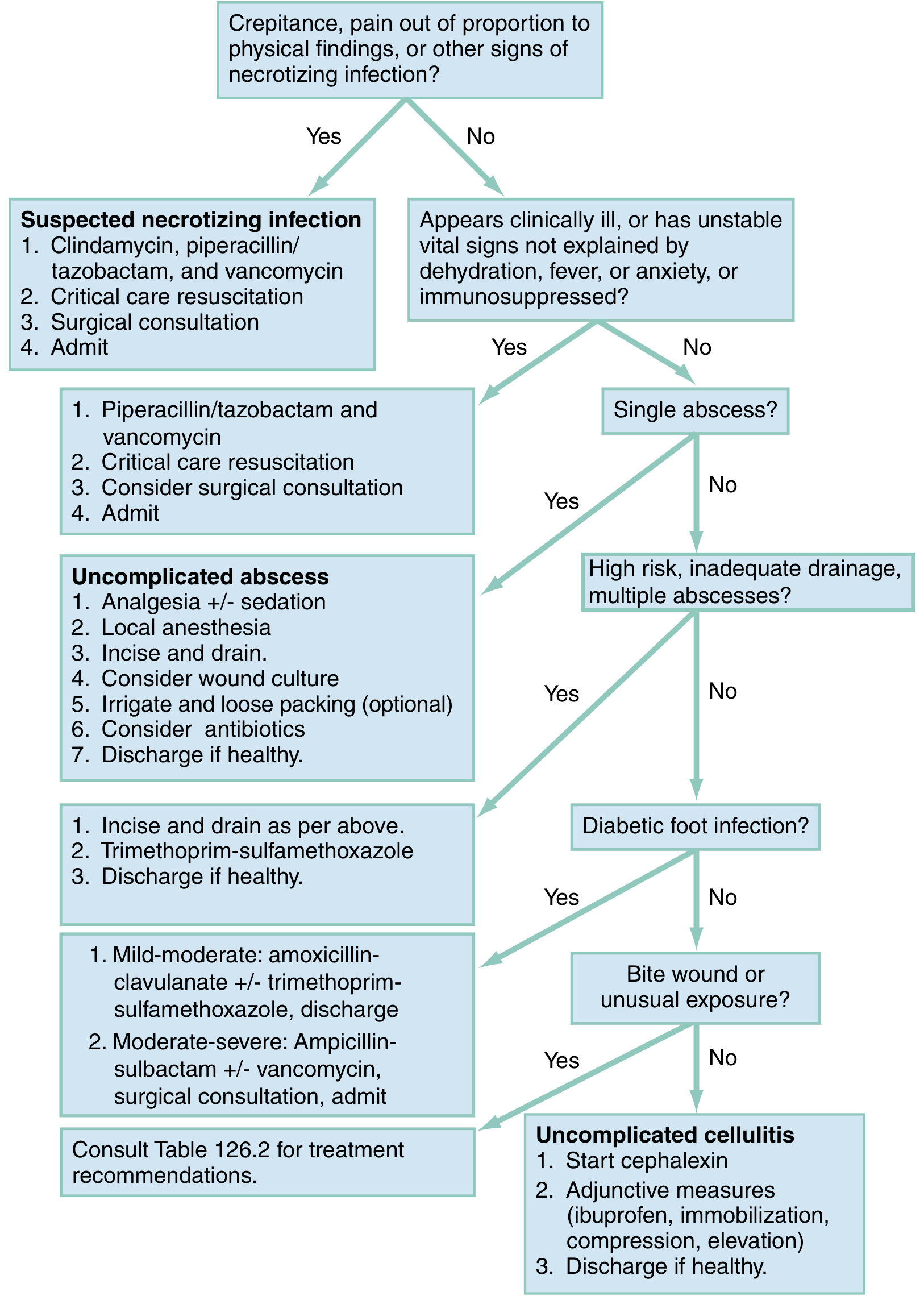
Treatment Algorithm
Special Considerations for Axillary Furuncles
| Factor | Implication |
|---|---|
| Recurrence | Common — check for nasal S. aureus carriage (anterior nares); address predisposing factors |
| Diabetes / immunosuppression | Higher risk of spread → lower threshold for antibiotics and admission |
| CA-MRSA prevalence | If community MRSA rate is high, start TMP-SMX empirically after I&D |
| Hidradenitis suppurativa | Consider if recurring abscesses in axilla/groin/perineum — requires different management (dermatology referral) |
| Carbuncle formation | If multiple interconnecting furuncles coalesce → carbuncle; requires surgical drainage ± resection and systemic antibiotics |
Chronic/Recurrent Furunculosis
- Screen for nasal carriage of S. aureus and consider decolonization:
- Mupirocin 2% nasal ointment × 5 days
- Chlorhexidine body wash
- Rule out diabetes, HIV, or neutrophil dysfunction
- Chronic furunculosis is associated with immune suppression but acquired immunity is minimal
Disposition
- Discharge home after I&D of uncomplicated furuncle
- Admit if: systemic sepsis, extensive cellulitis, immunocompromised host, failed outpatient therapy, or need for IV antibiotics (vancomycin for severe MRSA)
Sources:
- Textbook of Family Medicine, 9e
- Rosen's Emergency Medicine, 10e
- Goldman-Cecil Medicine, International Edition
- Sherris & Ryan's Medical Microbiology, 8e
This is a shared conversation. Sign in to Orris to start your own chat.