

IMG-20260606-WA0009.jpg
Itching and this rash when on sunlight
Reading File
The image shows a sun-exposed forearm with small red papules/wheals and mild erythema - this is consistent with a photodermatosis. The main differentials are polymorphic light eruption (PMLE), solar urticaria, or a phototoxic/photoallergic reaction. Let me search the medical library for a thorough answer.
Searching sources...
Finding Sources
Finding Sources
Searching PubMed
polymorphic light eruption treatment management
Finding Sources
Finding Sources
Reading File
Reading File
Reading File
Finding Sources
Reading File
Reading File
I found a directly relevant image. Let me fetch it along with the PMLE treatment section.
Loading Image
Reading File
Finding Sources
Finding Sources
Reading File
I now have a thorough picture. Here is the complete answer:
Most Likely Diagnosis: Polymorphous Light Eruption (PMLE)
The rash on your forearm - small red papules on a background of erythema, appearing on sun-exposed skin and causing itching - is a classic presentation of Polymorphous Light Eruption (PMLE), also called "benign summer light eruption." This is the most common photodermatosis worldwide.
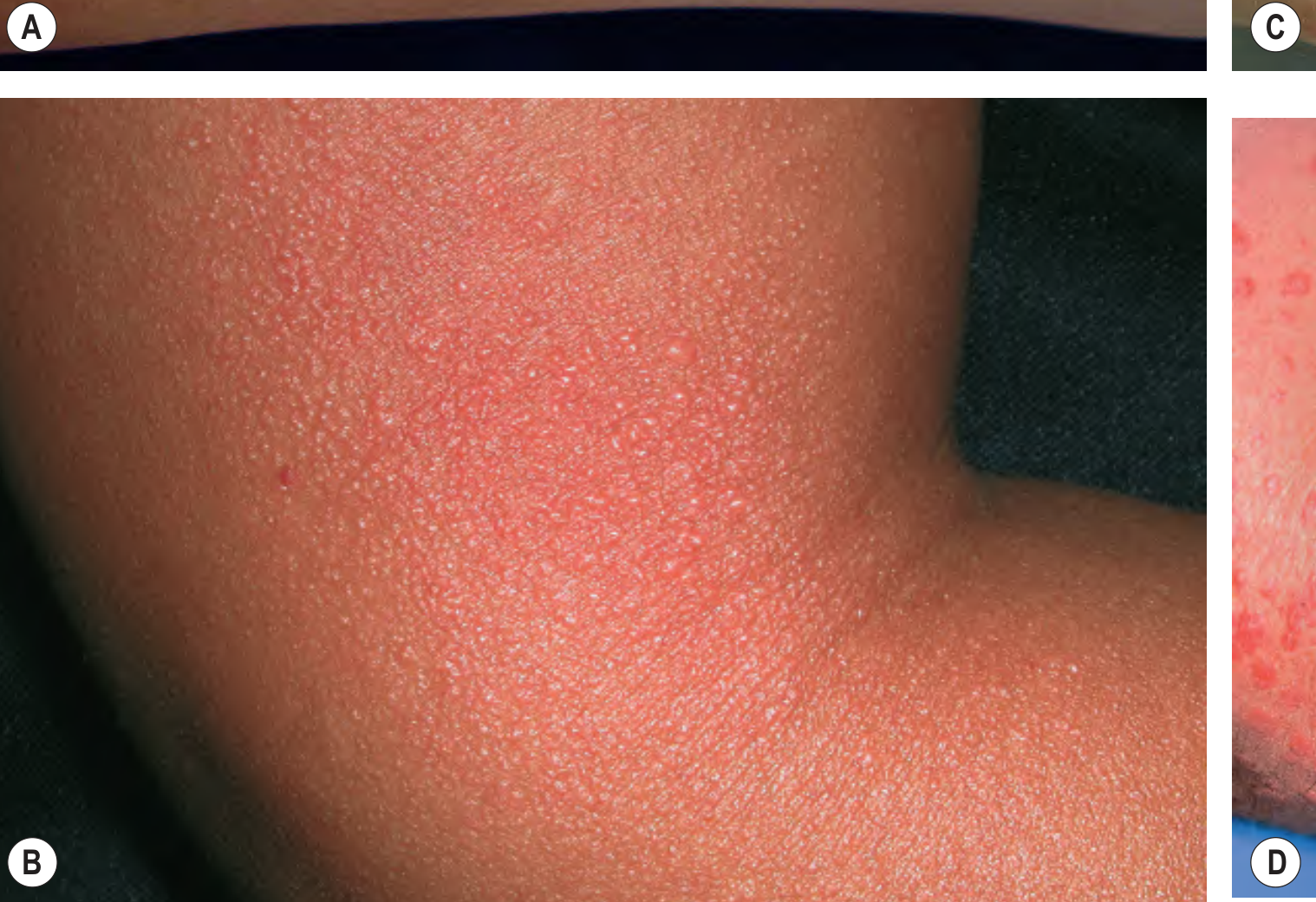
Compare your photo to the textbook image below (panel B shows pinhead-sized papules on a forearm, essentially identical to your presentation):
What is PMLE?
PMLE is a delayed-type hypersensitivity (DTH) immune reaction to UV radiation (mainly UVB and UVA) triggering an immune response against altered skin proteins. It is NOT an allergy to the sun in the classic sense - the skin overreacts immunologically to UV exposure.
Who gets it: Up to 10-22% of the population in temperate climates. Women more than men. Most common onset in the 2nd-3rd decade of life.
Typical Features (all matching your photo)
| Feature | Your case |
|---|---|
| Location | Sun-exposed forearm - yes |
| Morphology | Small pink/red papules and wheals - yes |
| Symptom | Itching - yes |
| Timing | Appears after sun exposure - yes |
| Distribution | Patchy, not all exposed skin affected - yes |
Other key clues from the textbooks:
- Lesions appear within minutes to hours of sun exposure
- They fade over 1 to a few days if you stay out of the sun
- The face is often spared (it adapts from constant daily exposure)
- It tends to be worse in spring/early summer and improves as the season progresses ("hardening")
- In people with darker skin phototypes, pinhead-sized papules like yours are the most common morphology
Other Conditions to Consider
| Condition | How it differs from your case |
|---|---|
| Solar urticaria | Wheals (hives) appear within 5-10 minutes and resolve in 1-2 hours - much faster course |
| Phototoxic reaction | Needs a sensitizing drug/plant contact; looks more like a severe sunburn |
| Photoallergic contact dermatitis | Needs a topical product (sunscreen, perfume) + sun; more eczema-like |
| Lupus erythematosus | Facial butterfly rash, systemic symptoms, positive ANA |
What to Do
Immediate self-care:
- Stay out of direct sunlight and cover the arm - the rash should fade within 1-3 days
- Apply a cool compress to reduce itching
- An over-the-counter antihistamine (e.g., cetirizine, loratadine) helps with itch
- A mild topical corticosteroid (1% hydrocortisone cream) can reduce redness and itch
Prevention for future sun exposure:
- Apply a broad-spectrum SPF 50+ sunscreen (covering UVA + UVB) 30 minutes before going out
- Wear sun-protective clothing (long sleeves, hat)
- Avoid peak sun hours (10 AM - 2 PM)
If it keeps recurring every season:
See a dermatologist. Options include:
- Narrowband UVB phototherapy (NB-UVB): 2-3 sessions per week for 15 sessions in spring to "harden" the skin - effective for several months
- Short course of oral prednisone (0.5-1 mg/kg) for flares or before a sunny holiday
- Hydroxychloroquine for prevention in recurrent/persistent cases
When to See a Doctor Urgently
- If the rash spreads to covered areas (not just sun-exposed skin)
- If you develop a butterfly-shaped facial rash, joint pain, or fatigue (could suggest lupus)
- If blisters form or the skin becomes very painful
- If it doesn't improve after a few days away from the sun
Disclaimer: This is educational information based on your description and image. It is not a clinical diagnosis. Please see a dermatologist or your doctor for a formal assessment, especially if this is a recurring problem or if you are taking any medications that could cause photosensitivity.
- Dermatology 2-Volume Set 5e, pp. 1864-1865 (PMLE section)
- Andrews' Diseases of the Skin, p. 1363 (Photosensitivity)
This is a shared conversation. Sign in to Orris to start your own chat.