
Cardiac cycle
The Cardiac Cycle
Initiation
Overview Diagram (Costanzo Physiology)
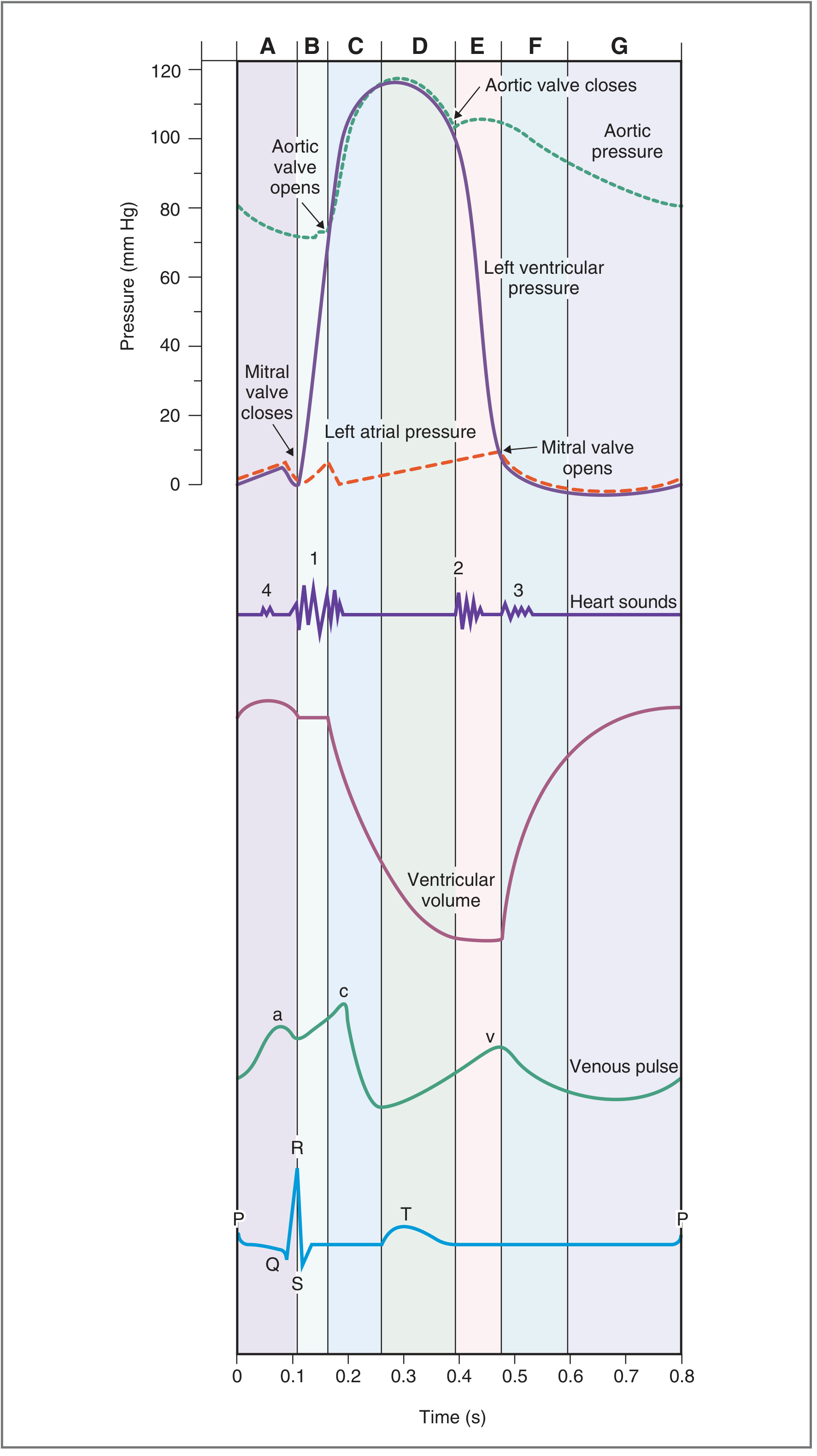
The Seven Phases (Costanzo Classification)
| Phase | Name | ECG Event | Valves | Heart Sound | Key Events |
|---|---|---|---|---|---|
| A | Atrial Systole | P wave / PR interval | Mitral open | S4 (if present) | Atria contract; final ~20% of ventricular filling |
| B | Isovolumetric Ventricular Contraction | QRS complex | Mitral closes | S1 | Ventricular pressure rises sharply; all valves closed; volume constant |
| C | Rapid Ventricular Ejection | ST segment | Aortic valve opens | - | Most of stroke volume ejected; ventricular volume drops rapidly |
| D | Reduced Ventricular Ejection | T wave | - | - | Ejection slows; ventricular volume reaches minimum (ESV) |
| E | Isovolumetric Ventricular Relaxation | After T wave | Aortic valve closes | S2 | Ventricular pressure falls; all valves closed; volume constant |
| F | Rapid Ventricular Filling | - | Mitral valve opens | S3 (if present) | Ventricles fill passively; volume rises rapidly |
| G | Reduced Ventricular Filling (Diastasis) | - | - | - | Slow filling; pressure equalizes between atrium and ventricle |
Detailed Phase-by-Phase Description
Phase A - Atrial Systole
Phase B - Isovolumetric Ventricular Contraction
Phase C - Rapid Ventricular Ejection
Phase D - Reduced Ventricular Ejection
Phase E - Isovolumetric Ventricular Relaxation
Phase F - Rapid Ventricular Filling
Phase G - Reduced Ventricular Filling (Diastasis)
Pressure and Volume Key Values (Left Heart at Rest)
| Parameter | Approximate Value |
|---|---|
| End-diastolic volume (EDV) | ~120-130 mL |
| End-systolic volume (ESV) | ~50 mL |
| Stroke volume (EDV - ESV) | ~70-80 mL |
| Ejection fraction (SV/EDV) | ~55-65% |
| Peak LV systolic pressure | ~120 mmHg |
| LV diastolic pressure | ~5-12 mmHg |
| Aortic diastolic pressure | ~80 mmHg |
| Duration at HR 72 bpm | ~0.83 s |
ECG-to-Mechanical Event Correlations
| ECG Event | Mechanical Correlate |
|---|---|
| P wave | Atrial depolarization → atrial contraction begins |
| PR interval | AV nodal delay (allows atrial emptying before ventricular contraction) |
| QRS complex | Ventricular depolarization → isovolumetric contraction begins |
| ST segment | Ventricular plateau (depolarized); rapid ejection occurring |
| T wave | Ventricular repolarization → ejection slowing, then aortic valve closes |
Heart Sounds Summary
| Sound | Timing | Cause | Clinical Note |
|---|---|---|---|
| S1 ("lub") | Start of ventricular systole | Closure of mitral + tricuspid valves | Heard best at apex (mitral) or lower left sternal border (tricuspid) |
| S2 ("dub") | End of ventricular systole | Closure of aortic + pulmonic valves | A2 before P2; splits with inspiration |
| S3 | Early diastole (rapid filling) | Sudden deceleration of filling blood | Normal in youth; pathological in adults (ventricular failure) |
| S4 | Late diastole (atrial kick) | Atrial contraction against stiff ventricle | Always pathological in adults; heard in LVH, hypertension |
Effect of Heart Rate on Cycle Duration
Jugular Venous Pulse Waves
- a wave: atrial contraction (end of diastole)
- c wave: tricuspid valve closure / bulging into atrium at start of systole
- v wave: atrial filling against a closed tricuspid valve during ventricular systole
- Guyton and Hall Textbook of Medical Physiology
- Costanzo Physiology, 7th Edition
- Medical Physiology (Boron & Boulpaep)
- Morgan & Mikhail's Clinical Anesthesiology, 7e
Create a visual study guide or poster diagram of the 7 cardiac cycle phases
Medical study poster: "The 7 Phases of the Cardiac Cycle" - a clean, professional physiology diagram with a dark navy blue background and bright colors. At the top, a bold white title "THE CARDIAC CYCLE - 7 Phases". Below the title, a horizontal timeline bar divided into two main sections: "SYSTOLE" (highlighted in warm red/orange) covering phases B, C, D and "DIASTOLE" (highlighted in cool blue) covering phases E, F, G, A. The main body contains 7 color-coded phase cards arranged in a circular/sequential flow (like a clock going A→B→C→D→E→F→G→A), each card with: Phase A - ATRIAL SYSTOLE - purple card: "P wave on ECG | Mitral valve OPEN | Atria contract | Final ventricular filling | S4 heart sound" Phase B - ISOVOLUMETRIC VENTRICULAR CONTRACTION - red card: "QRS complex | Mitral valve CLOSES → S1 | All valves CLOSED | Volume constant | Pressure rises sharply" Phase C - RAPID VENTRICULAR EJECTION - orange card: "ST segment | Aortic valve OPENS | Most stroke volume ejected | LV pressure peaks ~120 mmHg | Volume drops fast" Phase D - REDUCED VENTRICULAR EJECTION - yellow card: "T wave | Aortic valve still open | Ejection slows | ESV reached (~50mL) | Aortic pressure starts falling" Phase E - ISOVOLUMETRIC VENTRICULAR RELAXATION - green card: "After T wave | Aortic valve CLOSES → S2 | All valves CLOSED | Volume constant | Pressure falls rapidly" Phase F - RAPID VENTRICULAR FILLING - teal card: "Mitral valve OPENS | Passive ventricular filling | Volume rises fast | S3 heart sound | Low pressure" Phase G - REDUCED VENTRICULAR FILLING (DIASTASIS) - blue card: "Mitral still open | Minimal flow | Pressure equalizes | Quiet period | Ends with next P wave" Below the circular flow, a simplified Wiggers diagram strip showing: aortic pressure curve, left ventricular pressure curve, and ECG trace (P-QRS-T) aligned with the phases A through G marked with vertical dashed lines. Bottom row: a quick reference table showing Heart Sounds: S1=Mitral closes (B), S2=Aortic closes (E), S3=Rapid filling (F), S4=Atrial kick (A). Key volumes: EDV=130mL, ESV=50mL, SV=80mL, EF=60%. Clean medical education style, white text on colored cards, clear arrows showing cycle direction, bold phase letters.
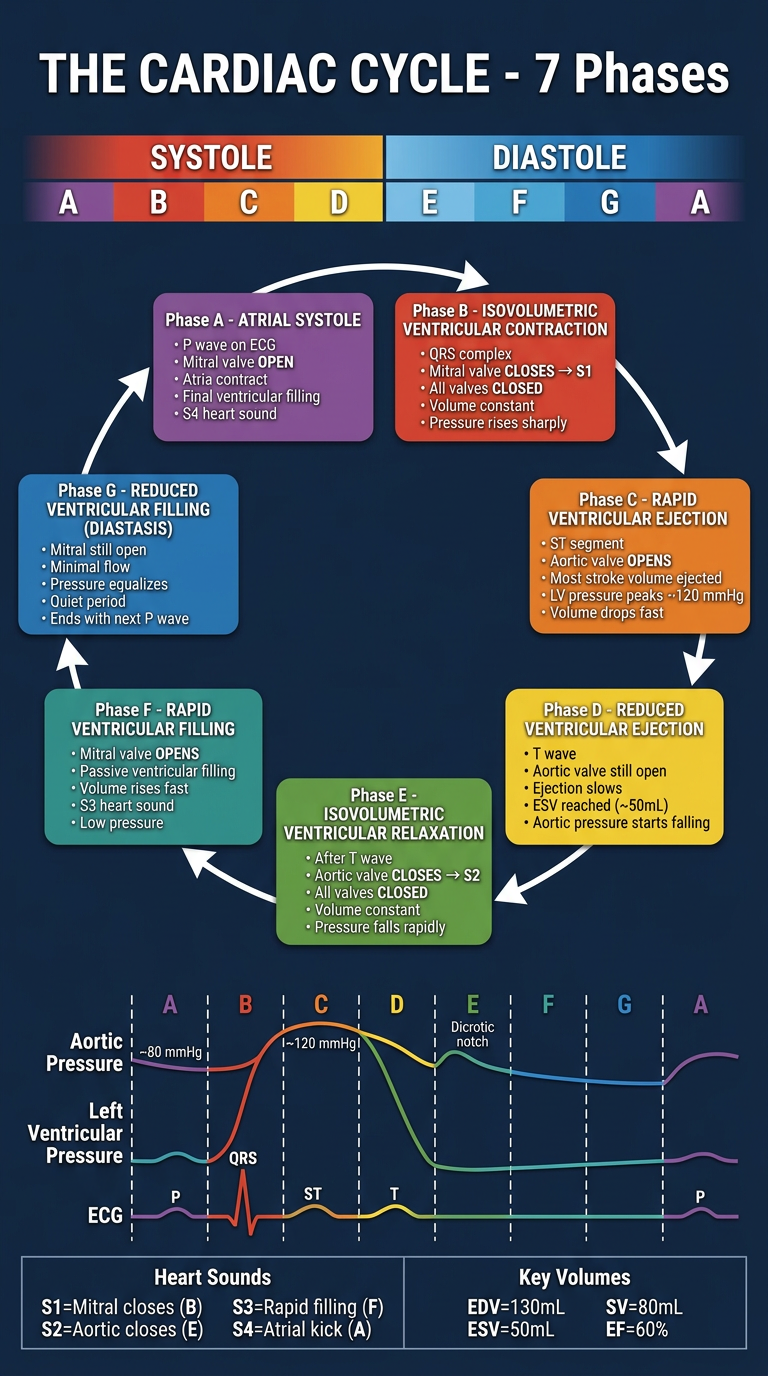
- 7 color-coded phase cards (A through G) arranged in sequential flow with phase names, ECG correlates, valve events, and key pressures/volumes
- Systole vs. Diastole division clearly marked
- Wiggers-style diagram strip at the bottom aligning aortic pressure, LV pressure, and ECG with the phases
- Heart sounds quick reference (S1-S4) and key volume values (EDV, ESV, SV, EF)
- A (Atrial systole) → B (Isovolumetric contraction, S1) → C (Rapid ejection) → D (Reduced ejection) → E (Isovolumetric relaxation, S2) → F (Rapid filling, S3) → G (Diastasis) → back to A
prepare me the course of glossopharyngeal nerve using flowchart
Professional medical anatomy flowchart poster on a deep navy blue background titled "GLOSSOPHARYNGEAL NERVE (CN IX) - Course & Distribution" in large bold white text at the top. The flowchart flows TOP to BOTTOM with color-coded boxes connected by thick arrows. Layout is a central vertical spine with branches going left and right. --- TOP SECTION: NUCLEI (dark purple boxes) --- Three purple boxes side by side labeled: 1. "NUCLEUS AMBIGUUS (Rostral Medulla)" - Motor nucleus - Branchial Efferent (BE) 2. "INFERIOR SALIVATORY NUCLEUS (Medulla)" - Parasympathetic - General Visceral Efferent (GVE) 3. "NUCLEUS TRACTUS SOLITARIUS" - Taste (SA) + Visceral Afferent (GVA) | "SPINAL NUCLEUS of CN V" - Somatic Afferent (GSA) Arrow DOWN labeled "Nerve fibers exit brainstem DORSOLATERAL to inferior olive" --- GANGLIA BOX (orange) --- "SUPERIOR GANGLION + INFERIOR (PETROSAL) GANGLION" - Located at Jugular Foramen - Cell bodies of afferent neurons Arrow DOWN labeled "Exits skull via JUGULAR FORAMEN" --- JUGULAR FORAMEN (bright yellow box) --- "JUGULAR FORAMEN - Exits skull with CN X (Vagus) and CN XI (Accessory)" Arrow DOWN --- DESCENT IN NECK (teal box) --- "Descends between INTERNAL JUGULAR VEIN and INTERNAL CAROTID ARTERY - Deep to styloid process and styloid muscles - Passes between internal and external carotid arteries - Curves around lateral border of STYLOPHARYNGEUS muscle" From this box, THREE branches diverge LEFT and RIGHT with arrows: BRANCH LEFT 1 (red box): "TYMPANIC BRANCH (Jacobson's Nerve) - Enters middle ear via tympanic canaliculus - Forms TYMPANIC PLEXUS on promontory of middle ear - Sensory: middle ear, mastoid air cells, pharyngotympanic tube mucosa - Continues as LESSER PETROSAL NERVE → OTIC GANGLION (below foramen ovale) - Postganglionic via AURICULOTEMPORAL NERVE (V3) → PAROTID GLAND (secretomotor)" BRANCH RIGHT 1 (green box): "CAROTID SINUS BRANCH (Nerve of Hering) - To carotid bifurcation - CAROTID SINUS: baroreceptor (blood pressure) - CAROTID BODY: chemoreceptor (O2/CO2) - Reflexes: respiratory + cardiovascular via vagal nucleus connection" BRANCH LEFT 2 (blue box): "MUSCULAR BRANCH - STYLOPHARYNGEUS muscle (only muscle supplied by CN IX) - Only branchial efferent branch - Derived from 3rd pharyngeal arch" BRANCH RIGHT 2 (purple box): "PHARYNGEAL BRANCHES - Joins vagus + sympathetic to form PHARYNGEAL PLEXUS - Sensory: mucosa of oropharynx, palatine tonsils - Afferent limb of GAG REFLEX" Arrow DOWN from teal box: --- TERMINAL DISTRIBUTION (gold box) --- "Passes DEEP TO HYOGLOSSUS MUSCLE - Reaches posterior tongue and palatine tonsil region" Two final branches: LEFT (pink box): "TONSILLAR BRANCHES - Sensory: palatine tonsils, soft palate, fauces" RIGHT (orange box): "LINGUAL BRANCHES - TASTE: posterior 1/3 of tongue (Special Afferent - SA) - GENERAL SENSATION: posterior 1/3 of tongue, vallate papillae (GSA)" --- BOTTOM SUMMARY TABLE --- A clean white table with 4 columns: "Fiber Type | Component | Distribution | Function" Row 1: BE | Branchial Efferent | Stylopharyngeus | Elevates pharynx/larynx during swallowing Row 2: GVE (para) | Preganglionic → Otic ganglion | Parotid gland via auriculotemporal | Salivary secretion Row 3: GVA | Visceral Afferent | Carotid body & sinus | Chemo/baroreception reflexes Row 4: GSA | General Somatic | Post. tongue, tonsil, pharynx, middle ear | Touch, pain, temperature Row 5: SA | Special Afferent (Taste) | Posterior 1/3 tongue | Taste sensation All boxes have white text, clean sans-serif font. Arrows are bright white with arrowheads. Color coding legend at bottom right corner. Clean medical education style, no clutter.
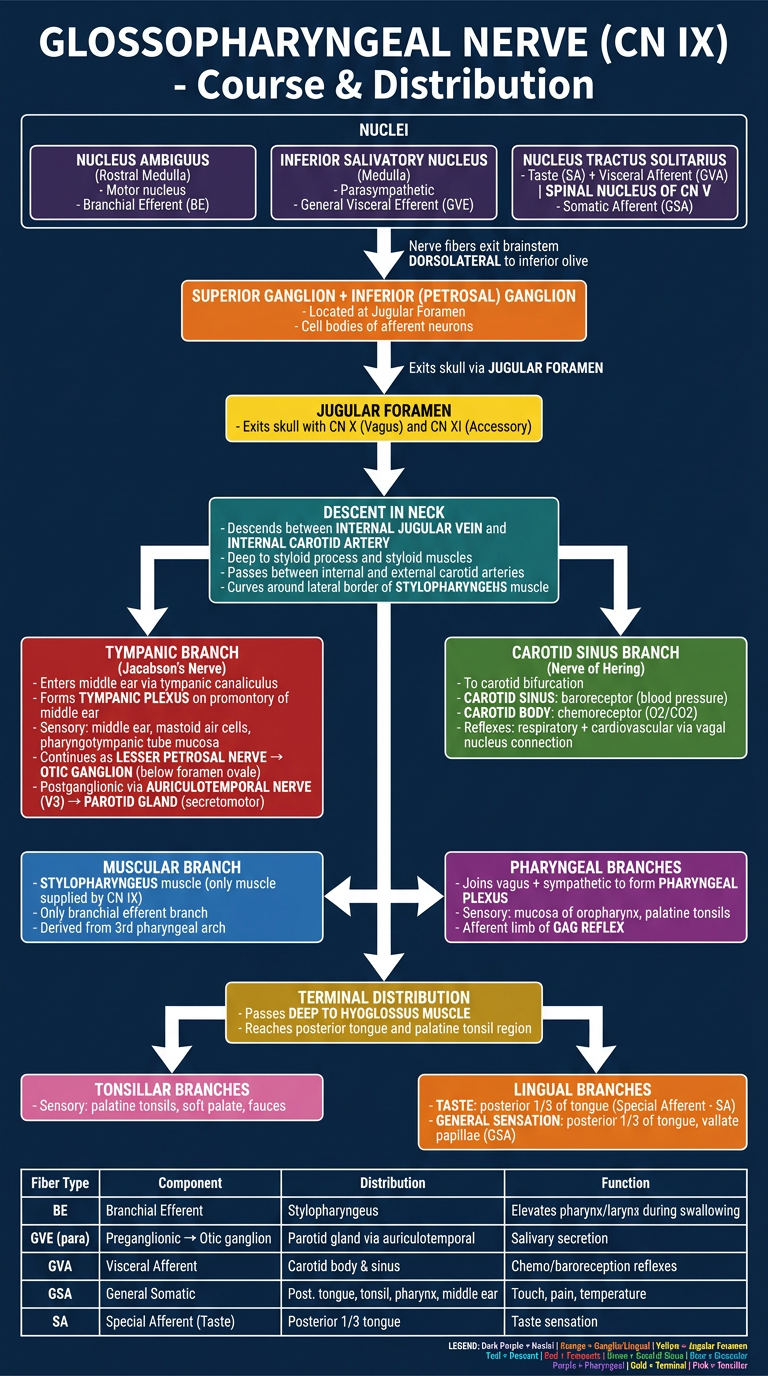
Course of the Glossopharyngeal Nerve (CN IX)
Fiber Types (5 components)
| Fiber | Type | Function |
|---|---|---|
| BE | Branchial Efferent | Motor to stylopharyngeus |
| GVE | General Visceral Efferent (parasympathetic) | Secretomotor to parotid gland |
| GVA | General Visceral Afferent | Carotid body & sinus reflexes |
| GSA | General Somatic Afferent | Sensation - posterior tongue, tonsil, pharynx, middle ear |
| SA | Special Afferent (taste) | Taste from posterior 1/3 of tongue |
Step-by-Step Course
- Nucleus ambiguus (rostral) - motor origin
- Inferior salivatory nucleus - parasympathetic preganglionic origin
- Nucleus tractus solitarius - receives taste and visceral afferents
- Spinal trigeminal nucleus - receives somatic pain/temperature
Branches & Their Distribution
| Branch | Where Given Off | Distribution |
|---|---|---|
| Tympanic nerve (Jacobson's nerve) | At jugular foramen | Middle ear mucosa, mastoid air cells, pharyngotympanic tube; continues as lesser petrosal nerve → otic ganglion → parotid gland via auriculotemporal nerve (V3) |
| Carotid sinus branch (Nerve of Hering) | In neck | Carotid sinus (baroreceptor) and carotid body (chemoreceptor); mediates cardiorespiratory reflexes |
| Muscular branch | In neck | Stylopharyngeus - the ONLY muscle supplied by CN IX (3rd pharyngeal arch derivative) |
| Pharyngeal branches | In neck | Joins vagus + sympathetics to form pharyngeal plexus; sensory to oropharynx; afferent limb of gag reflex |
| Tonsillar branches | Terminal | Sensory to palatine tonsils, soft palate, fauces |
| Lingual branches | Terminal | Taste (SA) + general sensation (GSA) from posterior 1/3 of tongue and vallate papillae |
Key Anatomical Relationships
- Deep to styloid process and styloid muscles in the upper neck
- Between internal and external carotid arteries as it descends
- Curves around lateral border of stylopharyngeus
- Deep to hyoglossus to reach tongue base
Clinical Correlate
preprepare the same for spinal accessory nerve and hypoglossal nerve
Professional medical anatomy flowchart poster, dark navy blue background. Title at top in large bold white text: "SPINAL ACCESSORY NERVE (CN XI) - Course & Distribution" Subtitle below: "Fiber Type: Branchial Efferent (BE) only - Pure MOTOR nerve" The flowchart flows TOP to BOTTOM with color-coded boxes and thick white arrows. --- BOX 1 (dark purple, top center) --- "NUCLEUS - SPINAL ACCESSORY NUCLEUS Upper 5 segments of Cervical Spinal Cord (C1-C5) Motor neurons in anterior horn (lateral group) NOT in the brainstem" White arrow DOWN labeled "Rootlets exit LATERAL surface of spinal cord" --- BOX 2 (indigo) --- "ASCENDING THROUGH SPINAL CANAL Rootlets join and ascend within the spinal canal Pass posterior to the dentate ligament Enter cranial cavity through FORAMEN MAGNUM" White arrow DOWN labeled "Enters posterior cranial fossa" Note box to the right (small, gray): "CRANIAL ROOT: A few rootlets from caudal medulla oblongata join briefly but immediately re-join CN X (vagus) → supplies pharyngeal muscles via vagus. NOT considered true CN XI." --- BOX 3 (teal) --- "POSTERIOR CRANIAL FOSSA Crosses posterior cranial fossa Joins with cranial rootlets briefly" White arrow DOWN labeled "Exits skull" --- BOX 4 (bright orange, wide) --- "JUGULAR FORAMEN Exits skull with CN IX (glossopharyngeal) and CN X (vagus) [Note: most posterior of the three]" White arrow DOWN --- BOX 5 (green) --- "DESCENT IN NECK - PHASE 1 Descends medial to internal jugular vein (IJV) Emerges between IJV and internal carotid artery Passes ANTERIOR BORDER of STERNOCLEIDOMASTOID (SCM) Relation to IJV: passes anterior to it in 70%, posterior in 27%, through it in 3% of cases" BRANCH LEFT (red box): "BRANCH TO SCM Motor branches to undersurface of SCM Arise ~4 cm below mastoid tip insertion Nerve pierces SCM (82%) or passes posterior to it (18%) ↓ INNERVATES: Sternocleidomastoid muscle" --- BOX 6 (blue) --- "POSTERIOR TRIANGLE OF NECK After SCM, nerve continues OBLIQUELY downward Crosses posterior triangle within investing layer of cervical fascia Lies between fascia crossing SCM and trapezius SUPERFICIAL location → vulnerable to injury Receives proprioceptive contributions from C2, C3 (cervical plexus)" White arrow DOWN --- BOX 7 (gold) --- "TRAPEZIUS MUSCLE Reaches anterior border of trapezius ~2-4 cm above clavicle, passes under/pierces trapezius Continues on DEEP SURFACE of trapezius ↓ INNERVATES: Trapezius muscle (upper, middle, lower fibres)" --- BOTTOM SECTION: Two side-by-side summary boxes --- LEFT (red): "MUSCLES INNERVATED 1. STERNOCLEIDOMASTOID (SCM) - Ipsilateral head rotation - Contralateral head tilt - Neck flexion 2. TRAPEZIUS - Shoulder elevation - Scapular retraction/rotation - Arm abduction above 90°" RIGHT (orange): "CLINICAL: CN XI INJURY 'Eleventh Nerve Syndrome': • Shoulder drooping • Inability to fully abduct shoulder (>90°) • Aberrant scapular rotation (winging) • Dull aching shoulder pain • Atrophy of trapezius Cause: neck dissection, posterior triangle surgery Test: shrug shoulder + abduct arm against resistance" At very bottom, a small note box: "Sources: Gray's Anatomy for Students | Cummings Otolaryngology | Bradley & Daroff's Neurology" All boxes white text, clean sans-serif font, clear labeled arrows, professional medical education style.
Professional medical anatomy flowchart poster, dark navy blue background. Title at top in large bold white text: "HYPOGLOSSAL NERVE (CN XII) - Course & Distribution" Subtitle: "Fiber Type: General Somatic Efferent (GSE) only - Pure MOTOR nerve" The flowchart flows TOP to BOTTOM with color-coded boxes and thick white arrows. --- BOX 1 (dark purple, top center) --- "NUCLEUS - HYPOGLOSSAL NUCLEUS Location: Ventrolateral floor of 4th ventricle (medulla oblongata) Landmark: Forms HYPOGLOSSAL TRIGONE on floor of 4th ventricle Near the central canal, ventrolateral region Receives bilateral corticobulbar (upper motor neuron) input" White arrow DOWN labeled "Rootlets exit from anterior surface of medulla" --- BOX 2 (indigo) --- "BRAINSTEM EXIT Multiple rootlets exit from PREOLIVARY SULCUS (Anterolateral surface of medulla, between pyramid and inferior olive) Rootlets cross posterior cranial fossa laterally" White arrow DOWN labeled "Exits skull" --- BOX 3 (bright orange) --- "HYPOGLOSSAL CANAL Exits skull through HYPOGLOSSAL CANAL (Occipital bone, above foramen magnum) [NOT through jugular foramen - unlike CN IX, X, XI]" White arrow DOWN labeled "Enters neck - runs with C1 nerve fibres" --- BOX 4 (teal) --- "UPPER NECK - INITIAL COURSE Emerges deep to internal jugular vein (IJV) Courses around vagal ganglion Picks up C1 nerve root fibres (hitchhike on CN XII)" BRANCH RIGHT (yellow box): "C1 FIBRES (hitchhiking) Not true CN XII fibres - C1 spinal nerve fibres Leave CN XII at carotid bifurcation level as: SUPERIOR ROOT OF ANSA CERVICALIS (Descendens Hypoglossi) → Joins cervical plexus branches (C2, C3) → Forms ANSA CERVICALIS (loop) → Innervates: Strap muscles (infrahyoid) • Sternohyoid • Sternothyroid • Omohyoid" White arrow DOWN --- BOX 5 (green) --- "MID NECK - DESCENT Passes LATERAL to internal and external carotid arteries Curves around carotid bifurcation heading anteriorly Passes INFERIOR to greater horn of HYOID BONE Deep to posterior belly of digastric and stylohyoid muscles" White arrow DOWN --- BOX 6 (blue) --- "ANTERIOR NECK - FORWARD COURSE Courses SUPERIORLY after hyoid Runs SUPERFICIAL to hyoglossus muscle (Compare: CN IX ran DEEP to hyoglossus) Under the sublingual gland Passes medial to mylohyoid" White arrow DOWN --- BOX 7 (gold, terminal) --- "TONGUE - TERMINAL DISTRIBUTION Branches to innervate IPSILATERAL tongue muscles: INTRINSIC MUSCLES (all 4): • Superior longitudinal • Inferior longitudinal • Transverse • Vertical EXTRINSIC MUSCLES (3 of 4): • Hyoglossus (depresses, retracts) • Styloglossus (retracts, elevates) • Genioglossus (protrudes tongue - MOST IMPORTANT) [NOT palatoglossus - supplied by CN X via pharyngeal plexus]" --- BOTTOM SECTION: Two side-by-side summary boxes --- LEFT (red): "CLINICAL: CN XII INJURY / PALSY UMN lesion: Tongue deviates AWAY from lesion side LMN lesion: Tongue deviates TOWARD lesion side (+ wasting/fasciculations) Key test: Ask patient to protrude tongue - observe deviation Effects: • Dysarthria (slurred speech) • Dysphagia (difficulty swallowing) • Ipsilateral tongue atrophy + fasciculations (LMN) • Bilateral: anarthria, severe dysphagia" RIGHT (orange): "SURGICAL VULNERABILITY • Most vulnerable at: near greater horn of hyoid • During: Level I & II neck dissection • Near: ranine veins (rich venous plexus) • Risk: 0.42% in neck dissection series Management of transection: primary neurorrhaphy or cable grafting Remember: CN XII runs SUPERFICIAL to hyoglossus (CN IX runs DEEP)" Small note at very bottom: "Sources: Gray's Anatomy for Students | Cummings Otolaryngology | Scott-Brown's ORL | Bradley & Daroff's Neurology" All boxes white text, clean sans-serif font, clear labeled arrows, professional medical education style.
prepare it a little faster
Medical anatomy flowchart poster, dark navy background. Title: "SPINAL ACCESSORY NERVE (CN XI) - Course & Distribution". Pure motor nerve - Branchial Efferent only. Vertical flowchart top to bottom with color boxes and arrows: BOX 1 purple: "SPINAL ACCESSORY NUCLEUS | Anterior horn C1-C5 spinal cord | NOT in brainstem" Arrow: "Rootlets exit lateral surface of spinal cord → ascend in spinal canal" BOX 2 indigo: "ASCENDS IN SPINAL CANAL | Posterior to dentate ligament | Enters skull via FORAMEN MAGNUM" Small side note gray: "Cranial root (caudal medulla) joins briefly then merges with CN X → not true CN XI" BOX 3 orange: "JUGULAR FORAMEN | Exits skull with CN IX and CN X | Most posterior of the three" BOX 4 green: "DESCENT IN NECK | Between IJV and internal carotid artery | Reaches anterior border of SCM | Relation to IJV: anterior 70%, posterior 27%, through 3%" Branch LEFT red: "BRANCH TO SCM | Motor to sternocleidomastoid | ~4 cm below mastoid tip | Pierces SCM in 82%" BOX 5 blue: "POSTERIOR TRIANGLE | Oblique downward course | Within investing cervical fascia | Superficial → vulnerable to injury | C2/C3 proprioceptive contributions" BOX 6 gold: "TRAPEZIUS MUSCLE | Enters 2-4 cm above clavicle | Runs on deep surface | Innervates all 3 parts of trapezius" Bottom two boxes side by side: LEFT red: "MUSCLES: SCM (head rotation/tilt) + TRAPEZIUS (shoulder elevation, scapular rotation, arm abduction >90°)" RIGHT orange: "CN XI PALSY - Eleventh Nerve Syndrome: shoulder drop, inability to abduct arm, scapular winging, trapezius atrophy. Test: shrug against resistance" Clean white text, bold labels, professional style.
Medical anatomy flowchart poster, dark navy background. Title: "HYPOGLOSSAL NERVE (CN XII) - Course & Distribution". Pure motor nerve - General Somatic Efferent only. Vertical flowchart top to bottom with color boxes and arrows: BOX 1 purple: "HYPOGLOSSAL NUCLEUS | Floor of 4th ventricle, medulla | Forms hypoglossal trigone | Bilateral corticobulbar input" Arrow: "Rootlets exit preolivary sulcus (between pyramid and olive)" BOX 2 indigo: "HYPOGLOSSAL CANAL | Exits occipital bone via hypoglossal canal | NOT jugular foramen | Picks up C1 nerve fibres" Branch RIGHT yellow: "C1 FIBRES (hitchhiking) | Leave at carotid bifurcation | = Superior root of ANSA CERVICALIS | → Strap muscles: sternohyoid, sternothyroid, omohyoid" BOX 3 teal: "UPPER NECK | Deep to IJV | Curves around vagal ganglion | Lateral to carotid arteries" BOX 4 green: "MID NECK | Curves around carotid bifurcation anteriorly | Passes inferior to greater horn of HYOID | Deep to posterior belly of digastric + stylohyoid" BOX 5 blue: "FORWARD & UPWARD COURSE | SUPERFICIAL to hyoglossus muscle (key landmark) | Under sublingual gland | Medial to mylohyoid" BOX 6 gold: "TONGUE - TERMINAL BRANCHES | INTRINSIC (all 4): superior/inferior longitudinal, transverse, vertical | EXTRINSIC (3 of 4): genioglossus, hyoglossus, styloglossus | NOT palatoglossus (= CN X)" Bottom two boxes side by side: LEFT red: "CN XII LMN PALSY: tongue deviates TOWARD lesion side + wasting + fasciculations. Dysarthria + dysphagia. UMN: deviates AWAY." RIGHT orange: "SURGICAL RISK: vulnerable near greater horn of hyoid (Level I/II neck dissection). Superficial to hyoglossus. Ranine veins nearby." Clean white text, bold labels, professional style.