
Rejection in lung transplant and it's treatment full details for md exam
lung transplant rejection types hyperacute acute chronic pathophysiology classification
Harrison's Principles of Internal Medicine, Twenty First Edition
Page 8150
lung transplant rejection treatment management immunosuppression
Harrison's Principles of Internal Medicine, Twenty First Edition
Page 8150
lung transplant rejection histology bronchiolitis obliterans imaging

Hugging Face pmc clinical VQA raw
Page 0
Lung Transplant Rejection — Complete MD Exam Review
Overview
Classification of Rejection
| Type | Timing | Mechanism | Key Feature |
|---|---|---|---|
| Hyperacute | Minutes–hours | Preformed antibodies (AMR) | Fulminant graft failure |
| Acute Cellular (ACR) | Days–weeks (most common in year 1) | T-cell mediated | Lymphocytic perivascular infiltrate |
| Antibody-Mediated (AMR) | Variable | Donor-specific antibodies (DSA) | Neutrophilic vasculitis + C4d deposition |
| Chronic (CLAD) | Months–years | Mixed T-cell + antibody | BOS or RAS phenotype |
1. Hyperacute Rejection
Pathophysiology
- Caused by preformed donor-specific antibodies (DSA) against HLA or ABO antigens
- Antibodies bind donor endothelium → activate complement → neutrophil influx → microvascular thrombosis and hemorrhagic infarction
Clinical Features
- Occurs within minutes to hours of reperfusion
- Severe hypoxemia, white-out on CXR, rapid graft failure
- Rare due to pre-transplant crossmatch testing
Treatment
- Largely preventable by prospective crossmatch and ABO compatibility
- Once established: plasmapheresis, IVIG, retransplantation (prognosis very poor)
2. Acute Cellular Rejection (ACR)
Pathophysiology
- T-lymphocyte mediated (CD4+ and CD8+)
- Donor MHC molecules recognized by recipient T-cells (direct or indirect allorecognition)
- Lymphocytic infiltration of perivascular and peribronchial spaces
Timing & Risk Factors
- Most common in the first post-transplant year, but can occur anytime
- Triggered/augmented by: CMV infection, other viral infections, tapering immunosuppression
- ACR is a major risk factor for CLAD (Harrison's, p. 8150)
ISHLT Grading (A-grade: Vascular; B-grade: Airway)
| Grade | Description |
|---|---|
| A0 | No rejection |
| A1 | Minimal — scattered mononuclear cells around vessels |
| A2 | Mild — more prominent perivascular cuffing |
| A3 | Moderate — perivascular + alveolar involvement |
| A4 | Severe — diffuse perivascular, interstitial, alveolar infiltrates with necrosis |
| Grade | Description |
|---|---|
| B0 | No airway inflammation |
| B1R | Low-grade lymphocytic bronchiolitis |
| B2R | High-grade lymphocytic bronchiolitis |
| BX | Ungradeable |
Clinical Features
- Fever, malaise, dyspnea, decreased exercise tolerance
- Decline in FEV1 / FVC (≥10–15% drop from baseline)
- Hypoxemia, new infiltrates on CXR/CT
- May be asymptomatic (detected on surveillance bronchoscopy)
Diagnosis
- Transbronchial biopsy (TBBx) via bronchoscopy — gold standard
- BAL to exclude infection (always rule out before treating rejection)
- PFTs: obstructive pattern
- CT: ground-glass opacities, septal thickening
Treatment of ACR
- IV methylprednisolone 500–1000 mg/day × 3 days (pulse corticosteroids)
- Response rate ~80–90%
- Optimize baseline immunosuppression (ensure therapeutic tacrolimus levels)
- Add/increase mycophenolate mofetil (MMF)
- Antithymocyte globulin (ATG) — polyclonal T-cell depleting agent
- Total lymphoid irradiation (TLI)
- Photopheresis (extracorporeal photochemotherapy)
3. Antibody-Mediated Rejection (AMR)
Pathophysiology
- Mediated by donor-specific antibodies (DSA) against HLA Class I and II
- DSA bind endothelium → complement activation → C4d deposition → neutrophilic capillaritis
- Can be acute (early) or chronic
Histological Hallmarks (ISHLT 2016 Criteria)
- Neutrophilic capillaritis
- C4d deposition in alveolar capillaries (by immunofluorescence or immunohistochemistry)
- Circulating DSA (detected by Luminex single-antigen bead assay)
Clinical Features
- Acute: rapidly progressive respiratory failure, diffuse alveolar damage
- Chronic: contributes to CLAD
Treatment of AMR
| Therapy | Mechanism | Role |
|---|---|---|
| Plasmapheresis | Removes circulating DSA | First-line, rapid DSA reduction |
| IVIG (1–2 g/kg) | Fc receptor blockade, anti-idiotype antibodies | First-line, combined with plasmapheresis |
| Rituximab (anti-CD20) | Depletes B-cells | Prevents re-synthesis of DSA |
| Bortezomib | Proteasome inhibitor, depletes plasma cells | Refractory AMR |
| Eculizumab | Anti-C5, inhibits complement | Investigational/refractory |
| Carfilzomib | Next-generation proteasome inhibitor | Refractory cases |
4. Chronic Lung Allograft Dysfunction (CLAD)
Phenotypes
A. Bronchiolitis Obliterans Syndrome (BOS) — Most Common (~70%)
- Obstructive phenotype
- Fibro-inflammatory obliteration of small airways (bronchioles)
- FEV1 decline, air trapping on CT
B. Restrictive Allograft Syndrome (RAS) — ~30%
- Restrictive phenotype
- TLC and FVC decline
- Peripheral/upper lobe fibrosis on CT
- Worse prognosis than BOS
Pathophysiology of CLAD
- Repeated immunological injury → epithelial damage → aberrant repair
- Transforming growth factor-β (TGF-β) drives fibrogenesis
- Lymphocytic bronchiolitis (B2R ACR) and AMR are key precursors
- Non-immunological triggers: GERD, infections (CMV, Pseudomonas), primary graft dysfunction
BOS Staging (ISHLT)
| Stage | FEV1 (% of baseline) |
|---|---|
| BOS 0 | >90% |
| BOS 0-p (potential) | 81–90% and/or decline in FEF25–75 >25% |
| BOS 1 | 66–80% |
| BOS 2 | 51–65% |
| BOS 3 | ≤50% |
CT Findings in CLAD/BOS
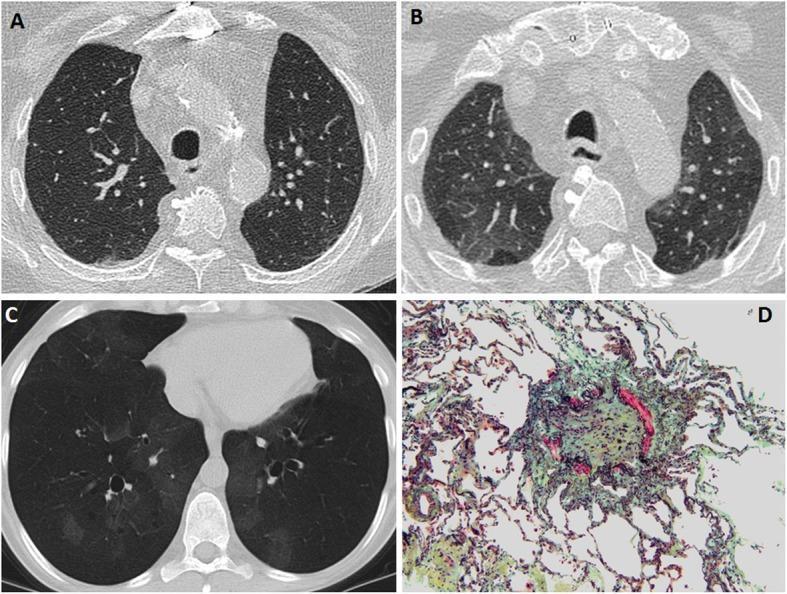
Treatment of CLAD/BOS
| Treatment | Details |
|---|---|
| Azithromycin | Anti-inflammatory, anti-fibrotic; macrolide immunomodulation; may stabilize/improve ~30% of BOS cases |
| Augmented immunosuppression | Pulse steroids, optimize tacrolimus/MMF |
| Photopheresis (ECP) | Effective in steroid-dependent/refractory CLAD |
| Antifungal/antiviral prophylaxis | Treat underlying triggers (CMV, Aspergillus) |
| GERD treatment | Fundoplication if aspiration is contributing |
| Montelukast | Adjunct — modest benefit |
| Pirfenidone | Investigated for RAS (anti-fibrotic) |
| Retransplantation | Only definitive option; controversial due to resource allocation and outcomes |
Maintenance Immunosuppression — The Triple Regimen
| Drug Class | Agent | Mechanism |
|---|---|---|
| Calcineurin inhibitor (CNI) | Tacrolimus (preferred) or Cyclosporine | Inhibits IL-2 transcription (blocks T-cell activation) |
| Antiproliferative | Mycophenolate mofetil (MMF) or Azathioprine | Inhibits purine synthesis → blocks lymphocyte proliferation |
| Corticosteroid | Prednisone (low-dose maintenance) | Broad anti-inflammatory and immunosuppressive |
Surveillance & Monitoring
| Tool | Purpose | Schedule |
|---|---|---|
| PFTs (spirometry) | Detect FEV1 decline (BOS staging) | Weekly early post-transplant, then monthly |
| Surveillance bronchoscopy + TBBx | Detect subclinical ACR | At 1, 3, 6, 12 months (program-dependent) |
| DSA monitoring | Detect AMR early | Every 3–6 months |
| CMV PCR | Detect and treat CMV-triggered rejection | Per protocol |
| CT chest | Characterize CLAD phenotype, exclude infection | As clinically indicated |
High-Yield Summary for MD Exam
| Feature | ACR | AMR | CLAD/BOS |
|---|---|---|---|
| Timing | Days–months | Variable | Months–years |
| Mechanism | T-cell | Donor-specific antibodies | Mixed/fibroproliferative |
| Histology | Lymphocytic perivascular infiltrate | Neutrophilic capillaritis + C4d | Obliterative bronchiolitis |
| Diagnosis | TBBx | TBBx + DSA + C4d | PFTs + CT (FEV1 <80% of baseline) |
| First-line treatment | IV methylprednisolone pulse | Plasmapheresis + IVIG | Azithromycin + augmented IS |
| Refractory treatment | ATG, photopheresis | Rituximab, bortezomib | ECP, retransplantation |
| Key risk factor | CMV infection | HLA sensitization | Prior ACR, GERD, infections |
- ACR graded on ISHLT A (vascular) and B (airway) scales — A2 and above requires treatment
- BOS is the most common form of chronic rejection; diagnosed by FEV1 <80% of baseline on two occasions ≥3 weeks apart with no reversible cause
- Always rule out infection before treating rejection (bronchoscopy + BAL)
- Azithromycin is unique — it has immunomodulatory properties and can stabilize or partially reverse BOS
- Lung transplant rejection rates are higher than other solid organs due to constant alloantigen exposure from the environment
- Retransplantation is the only definitive treatment for end-stage CLAD but remains controversial
Rejection in lung transplant and it's treatment full details for md exam
lung transplant rejection types hyperacute acute chronic pathophysiology classification ISHLT grading
Harrison's Principles of Internal Medicine, Twenty First Edition
Page 8150
lung transplant rejection treatment immunosuppression azithromycin photopheresis retransplantation
Bailey and Love's Short Practice of Surgery 28th Edition
Page 1666
lung transplant rejection bronchiolitis obliterans histology CT imaging
bronchiolitis obliterans syndrome lung transplant air trapping CT scan

Hugging Face pmc clinical VQA raw
Page 0
Lung Transplant Rejection — Complete MD Exam Guide
Why Lungs Are Uniquely Prone to Rejection
- Continuous exposure to inhaled environmental antigens and pathogens
- Rich resident lymphocyte population and dendritic cell network
- Direct airway communication with the outside world
- High MHC expression on bronchial epithelium and vascular endothelium
~50% of recipients have at least one acute rejection episode in year 1; ~50% develop chronic rejection by 5 years (Harrison's 21st ed., p. 8150). Greater immunosuppression is required compared to other solid organs, which significantly increases drug toxicity risk (Bailey & Love's, p. 1666).
Classification of Rejection
| Type | Onset | Mechanism | Key Pathology |
|---|---|---|---|
| Hyperacute | Minutes–hours | Preformed antibodies | Microvascular thrombosis, hemorrhagic infarction |
| Acute Cellular (ACR) | Days–months | T-cell mediated | Lymphocytic perivascular/peribronchial infiltrate |
| Antibody-Mediated (AMR) | Days–months | Donor-specific antibodies (DSA) | Neutrophilic capillaritis + C4d deposition |
| Chronic (CLAD) | Months–years | Mixed immune + fibroproliferative | Obliterative bronchiolitis or pleuroparenchymal fibrosis |
1. Hyperacute Rejection
Mechanism
- Preformed anti-HLA or anti-ABO antibodies in recipient bind donor endothelium
- Immediate complement activation → neutrophil influx → microvascular thrombosis → hemorrhagic infarction
- Essentially massive antibody-mediated destruction
Clinical Features
- Occurs within minutes to hours of reperfusion
- Catastrophic hypoxemia, bilateral white-out on CXR, graft failure on the table
- Essentially irreversible once established
Treatment & Prevention
| Approach | Details |
|---|---|
| Prevention | Prospective crossmatch, ABO compatibility testing before transplant |
| Plasmapheresis | Emergent removal of circulating antibodies |
| IVIG | Fc receptor blockade |
| Retransplantation | Only salvage option; prognosis extremely poor |
2. Acute Cellular Rejection (ACR)
Pathophysiology
- CD4+ and CD8+ T-lymphocytes recognize donor MHC via:
- Direct pathway: recipient T-cells recognize intact donor MHC on donor APCs
- Indirect pathway: recipient T-cells recognize processed donor peptides on self-APCs
- Activated T-cells release IL-2, IFN-γ → lymphocytic infiltration of perivascular and peribronchial tissue
- CMV infection is the strongest trigger — upregulates MHC expression and co-stimulatory molecules (Harrison's, p. 8150)
- ACR is a major independent risk factor for CLAD
Clinical Features
- Fever, malaise, dyspnea, decreased exercise tolerance
- Decline in FEV1 (≥10–15% from personal best)
- Hypoxemia, new bilateral infiltrates on CXR/CT
- Often asymptomatic — detected only on surveillance bronchoscopy
ISHLT Histological Grading of ACR
A-Grade: Perivascular Rejection
| Grade | Histology |
|---|---|
| A0 | No rejection |
| A1 (Minimal) | Scattered mononuclear cells around 3+ vessels; no eosinophils or endothelialitis |
| A2 (Mild) | Frequent perivascular cuffing (2–3 cell layers); eosinophils may be present |
| A3 (Moderate) | Dense perivascular infiltrate + extension into alveolar septa and air spaces |
| A4 (Severe) | Diffuse perivascular, interstitial, and alveolar infiltrates with necrosis and hyaline membranes |
A2 and above requires treatment. A1 may be treated depending on clinical context.
B-Grade: Lymphocytic Bronchiolitis (Airway Rejection)
| Grade | Histology |
|---|---|
| B0 | No airway inflammation |
| B1R (Low-grade) | Scattered mononuclear cells in bronchiolar submucosa |
| B2R (High-grade) | Dense mononuclear infiltrate with epithelial damage/necrosis |
| BX | Ungradeable (inadequate tissue) |
Diagnosis of ACR
| Investigation | Findings |
|---|---|
| Transbronchial biopsy (TBBx) | Gold standard — perivascular lymphocytic infiltrate |
| BAL | Rule out infection first (always) |
| PFTs | FEV1 decline ≥10–15% from baseline |
| CT chest | Ground-glass opacities, septal thickening, consolidation |
| CXR | Bilateral infiltrates, pleural effusion |
Treatment of ACR
First-Line
- IV methylprednisolone 500–1000 mg/day × 3 days — response rate ~80–90%
- Followed by oral prednisone taper
After Pulse Steroids
- Optimize baseline immunosuppression:
- Check/increase tacrolimus trough levels (target 10–15 ng/mL early)
- Maximize mycophenolate mofetil (MMF) dose
Steroid-Refractory ACR
| Agent | Mechanism |
|---|---|
| Antithymocyte globulin (ATG) | Polyclonal antibody — T-cell depletion |
| Total lymphoid irradiation (TLI) | Depletes lymphocytes in lymph nodes/spleen |
| Photopheresis (ECP) | Extracorporeal photochemotherapy — induces T-cell apoptosis |
| Rituximab | Anti-CD20 — B-cell depletion (if AMR component) |
3. Antibody-Mediated Rejection (AMR)
Pathophysiology
- Donor-specific antibodies (DSA) against HLA Class I and II (detected by Luminex single-antigen bead assay)
- DSA bind endothelium → activate complement cascade → C4d deposition in alveolar capillaries → neutrophilic capillaritis → microvascular injury (Harrison's, p. 8150)
- Can be de novo (post-transplant sensitization) or from pre-formed antibodies
ISHLT 2016 Diagnostic Criteria for AMR (all required):
- Allograft dysfunction (PGD, declining FEV1, or new infiltrates)
- DSA positivity (circulating anti-HLA antibodies)
- Histology: neutrophilic capillaritis ± diffuse alveolar damage
- C4d deposition in alveolar capillaries (immunofluorescence or IHC)
Treatment of AMR — Multimodal Strategy
| Therapy | Mechanism | Role |
|---|---|---|
| Plasmapheresis (5–10 sessions) | Removes circulating DSA | First-line; rapid DSA reduction |
| IVIG (1–2 g/kg) | Fc receptor blockade; anti-idiotype neutralization | First-line; combined with plasmapheresis |
| Rituximab (375 mg/m²) | Anti-CD20; depletes B-cells | Prevents DSA re-synthesis |
| Pulse corticosteroids | Broad immunosuppression | Adjunct |
| Bortezomib | Proteasome inhibitor; depletes long-lived plasma cells | Refractory AMR |
| Carfilzomib | Next-gen proteasome inhibitor | Refractory AMR |
| Eculizumab | Anti-C5; blocks terminal complement | Investigational/severe refractory |
| Tocilizumab | Anti-IL-6; reduces DSA production | Emerging evidence |
4. Chronic Lung Allograft Dysfunction (CLAD)
Two Major Phenotypes
| Feature | BOS (Bronchiolitis Obliterans Syndrome) | RAS (Restrictive Allograft Syndrome) |
|---|---|---|
| Frequency | ~70% of CLAD | ~30% of CLAD |
| Physiology | Obstructive (FEV1↓, FVC preserved) | Restrictive (TLC↓, FVC↓) |
| Histology | Obliterative bronchiolitis (fibrous luminal occlusion) | Pleuroparenchymal fibroelastosis (PPFE) |
| CT pattern | Air trapping, mosaic attenuation, bronchiectasis | Upper lobe fibrosis, pleural thickening |
| Prognosis | Poor | Worse than BOS |
BOS Staging (ISHLT)
| Stage | FEV1 (% of best post-transplant baseline) |
|---|---|
| BOS 0 | >90% |
| BOS 0-p (at risk) | 81–90% AND/OR FEF25–75 decline >25% |
| BOS 1 | 66–80% |
| BOS 2 | 51–65% |
| BOS 3 | ≤50% |
CT Findings in BOS / CLAD
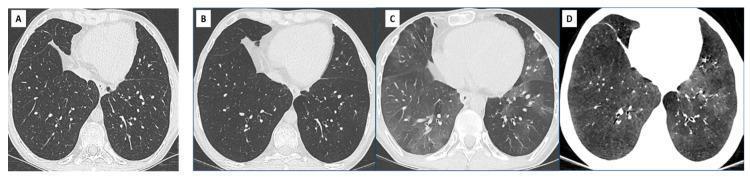
Pathogenesis of CLAD
Alloimmune injury (ACR, AMR)
     ↓
Epithelial and endothelial damage
     ↓
Aberrant repair → TGF-β↑, fibroblast activation
     ↓
Submucosal fibrosis → luminal obliteration (BOS)
OR
Pleuroparenchymal fibrosis (RAS)
- GERD with microaspiration (very important)
- CMV, Pseudomonas, Aspergillus infections
- Primary graft dysfunction (PGD)
- Air pollution exposure
Treatment of CLAD/BOS
| Treatment | Details |
|---|---|
| Azithromycin 250 mg 3×/week | Macrolide with immunomodulatory + anti-neutrophilic properties; stabilizes/improves ~30% of BOS cases; first-line |
| Augmented immunosuppression | Pulse steroids, optimize tacrolimus + MMF |
| Photopheresis (ECP) | Most evidence-based treatment for progressive BOS; stabilizes decline |
| mTOR inhibitors (Sirolimus/Everolimus) | Switch from CNI; some anti-fibrotic and anti-proliferative benefit |
| Montelukast | Leukotriene receptor antagonist; modest adjunct benefit |
| Pirfenidone | Anti-fibrotic; investigated particularly for RAS phenotype |
| GERD treatment | Fundoplication if microaspiration confirmed — can slow CLAD progression |
| Antimicrobial optimization | Treat CMV, Pseudomonas, Aspergillus aggressively |
| Retransplantation | Only definitive treatment; controversial due to resource allocation and inferior outcomes vs. primary transplant |
Maintenance Immunosuppression — Triple Therapy
| Pillar | Drug | Mechanism |
|---|---|---|
| Calcineurin inhibitor | Tacrolimus (preferred) or Cyclosporine | Blocks calcineurin → ↓IL-2 transcription → T-cell activation blockade |
| Antiproliferative | MMF (preferred) or Azathioprine | Inhibits inosine monophosphate dehydrogenase → ↓purine synthesis → blocks lymphocyte proliferation |
| Corticosteroid | Prednisolone (low-dose maintenance) | Broad anti-inflammatory; inhibits cytokine transcription |
- Basiliximab (anti-IL-2Rα/CD25) — most common; IL-2 receptor blockade
- ATG (antithymocyte globulin) — T-cell depletion; used in higher-risk patients
- Not universally applied; significant infection/malignancy risk limits use despite survival benefit (Bailey & Love's, p. 1666)
- Block mTOR → ↓T-cell and B-cell proliferation
- Used as CNI-sparing agents (nephroprotective)
- Some evidence for reducing CLAD progression
- Contraindicated early post-operatively — impairs bronchial anastomotic healing
Surveillance Protocol Post-Transplant
| Tool | Purpose | Timing |
|---|---|---|
| PFTs (spirometry) | FEV1 monitoring for BOS staging | Weekly early, then monthly |
| Surveillance bronchoscopy + TBBx | Detect subclinical ACR | 1, 3, 6, 12 months (program-dependent) |
| BAL | Infection exclusion at each bronchoscopy | With every bronchoscopy |
| DSA monitoring (Luminex) | Early AMR detection | Every 3–6 months |
| CMV PCR | CMV-triggered rejection prevention | Per protocol |
| CT chest | CLAD phenotyping, infection exclusion | As clinically indicated |
High-Yield Comparison Table
| Feature | ACR | AMR | CLAD/BOS |
|---|---|---|---|
| Timing | Days–months (peak: year 1) | Variable | Months–years |
| Mechanism | CD4/CD8 T-cells | DSA + complement | Mixed fibroproliferative |
| Histology | Perivascular lymphocytic infiltrate | Neutrophilic capillaritis + C4d | Obliterative bronchiolitis |
| Key marker | A-grade on TBBx | C4d + DSA | FEV1 <80% baseline |
| Gold standard Dx | Transbronchial biopsy | TBBx + DSA + C4d | PFTs + CT (exclusion of reversible cause) |
| First-line Rx | IV methylprednisolone pulse | Plasmapheresis + IVIG | Azithromycin + augmented IS |
| Refractory Rx | ATG, photopheresis | Rituximab, bortezomib | ECP, retransplantation |
| Key risk factor | CMV infection | Prior sensitization/HLA mismatch | Prior ACR, GERD, CMV, PGD |
Key Exam Points to Remember
- Always exclude infection before treating rejection — BAL at bronchoscopy is mandatory; infection and rejection can coexist and mimic each other
- ACR grade A2 and above always requires treatment; grade A1 may be observed or treated based on clinical context
- BOS is the most common chronic rejection form (~70% of CLAD); diagnosed by FEV1 <80% of best post-transplant value on two occasions ≥3 weeks apart
- Azithromycin is the cornerstone of BOS treatment due to its immunomodulatory (not just antimicrobial) properties
- Lungs require more aggressive immunosuppression than other solid organs, increasing risks of infection, nephrotoxicity, diabetes, hypertension, and malignancy
- CMV infection is the single most important trigger for ACR
- GERD/microaspiration is a key modifiable non-immunological risk factor for CLAD — fundoplication may slow progression
- mTOR inhibitors must be avoided immediately post-transplant (impair anastomotic healing) but have a role later as CNI-sparing/anti-fibrotic agents
- RAS phenotype carries a worse prognosis than BOS and does not respond as well to standard BOS therapies
- Retransplantation is the only definitive treatment for end-stage CLAD but outcomes are inferior to primary transplant