
Uncontrolled urination as soon as drinking water
Reading File
Finding Sources
Finding Sources
Searching PubMed
overactive bladder urge urinary incontinence
Reading File
Reading File
Finding Sources
Reading File
Finding Sources
Loading Image
Here is a thorough clinical breakdown of uncontrolled urination immediately after drinking water:
Urge Urinary Incontinence / Overactive Bladder (OAB)
The most likely cause of urinating immediately or very shortly after drinking is urge urinary incontinence (UUI) - the involuntary loss of urine associated with a strong, sudden urge to void. It is the hallmark symptom of Overactive Bladder (OAB).
What is happening?
The underlying mechanism is detrusor overactivity - involuntary contractions of the bladder (detrusor) muscle during the filling phase that the person cannot suppress. As per Goldman-Cecil Medicine:
"Detrusor overactivity usually manifests as urge incontinence, characterized by leakage that follows the abrupt onset or intensification of a desire to void and the leakage of a moderate to large amount of urine. Urinary frequency (>8 voids/day) and nocturia are also frequently present."
Drinking water rapidly stretches the bladder wall, which in OAB triggers these involuntary contractions before the bladder is anywhere near full capacity.
Differential Diagnosis
| Condition | Key Feature | Volume lost |
|---|---|---|
| Overactive Bladder (OAB) / Urge incontinence | Sudden strong urge, can't hold it | Moderate-large |
| Stress incontinence | Leaks with coughing, sneezing, exercise | Small spurts |
| Urinary tract infection (UTI) | Burning, frequency, cloudy urine | Small amounts |
| Diabetes insipidus (DI) | Huge urine volumes, extreme thirst | Very large |
| Diabetes mellitus | Polyuria, polydipsia, weight loss | Large |
| Neurogenic bladder | Neurological history (stroke, MS, Parkinson's, spinal injury) | Variable |
| Bladder outlet obstruction (men) | Prostate enlargement, weak stream | Variable |
| Interstitial cystitis | Pelvic pain + urgency | Small-moderate |
Red Flag Clues to Distinguish Causes
- Drinking triggers immediate uncontrollable urge within minutes → strong OAB/detrusor overactivity
- Passing huge volumes (liters per day, urine like water) → think Diabetes Insipidus or Diabetes Mellitus
- Burning or pain → UTI
- Happens only with physical effort (coughing, jumping) → Stress incontinence
- Neurological symptoms (weakness, numbness, prior stroke/spinal injury) → Neurogenic bladder
Risk Factors for OAB
- Older age (especially women >50, men >50 with prostate issues)
- Menopause (estrogen loss weakens pelvic structures)
- Obesity
- Neurological conditions (Parkinson's, stroke, MS, spinal cord injury)
- Diabetes (diuretic effect + nerve damage to detrusor muscle)
- Caffeine, alcohol, carbonated drinks, citrus (bladder irritants)
- Constipation
- Prior pelvic surgery
AUA/SUFU Management Algorithm
The following is the official AUA guideline-based algorithm for non-neurogenic OAB management:
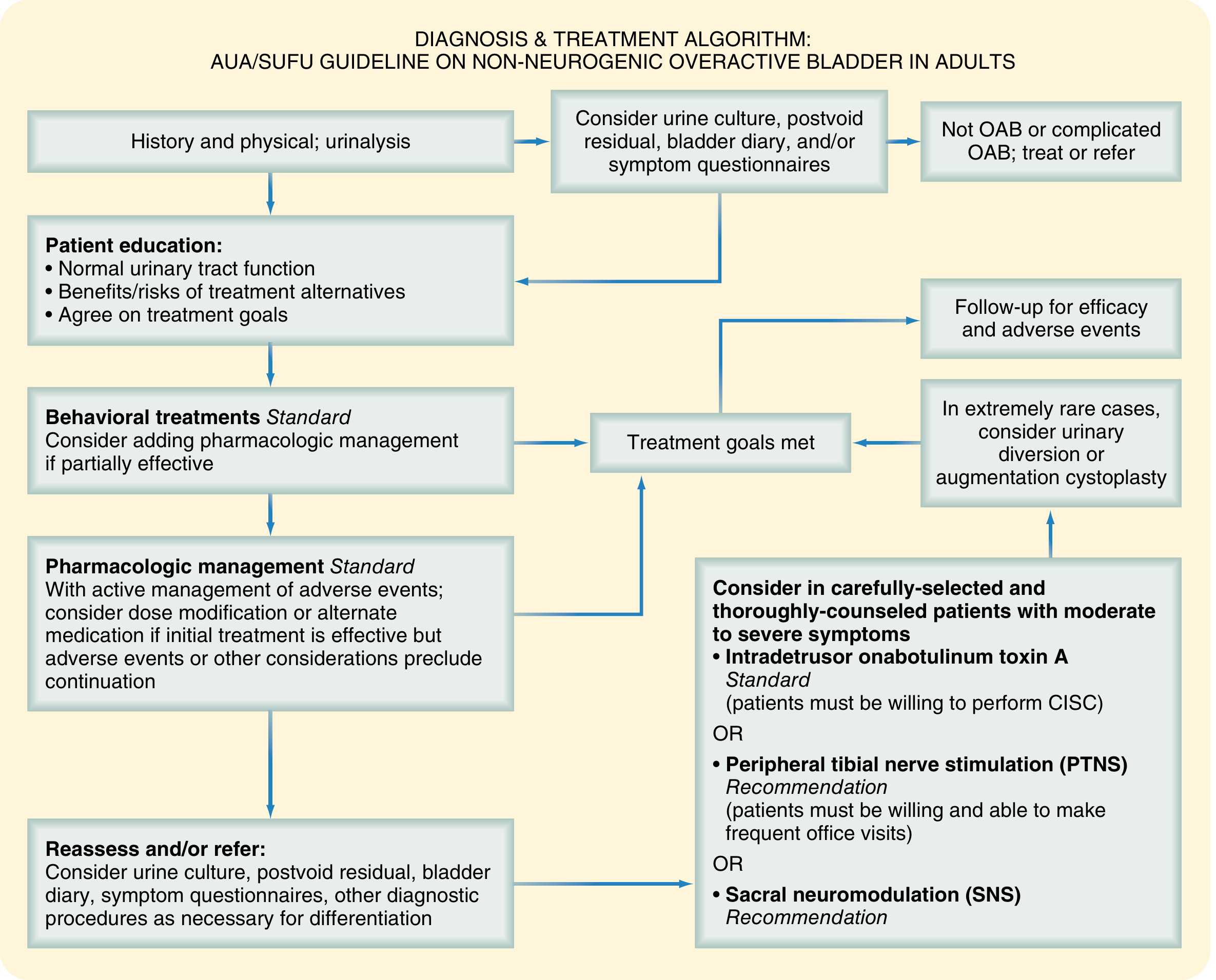
In summary, treatment goes in steps:
-
First line - Behavioral/lifestyle:
- Bladder training (scheduled voiding, urge suppression techniques)
- Fluid management: limit to ~2 L/day, avoid caffeine, alcohol, carbonated drinks, spicy/citrus foods
- Pelvic floor muscle training (Kegel exercises) and biofeedback
- Weight loss
-
Second line - Medications:
- Antimuscarinics (oxybutynin, tolterodine, solifenacin, trospium)
- Beta-3 agonists (mirabegron) - especially useful in elderly (fewer cognitive side effects)
-
Third line - Procedures (for refractory cases):
- Intradetrusor onabotulinumtoxin A (Botox injections)
- Peripheral tibial nerve stimulation (PTNS)
- Sacral neuromodulation (SNS/InterStim) - recommended after conservative + pharmacologic failure
When to See a Doctor Urgently
- Blood in the urine (hematuria)
- New neurological symptoms
- Significant weight loss + extreme thirst (may suggest DM or DI)
- Recurrent UTIs
- Inability to empty the bladder (retention)
- Recent pelvic surgery or radiation
Bottom line: Urinating as soon as water is drunk almost certainly represents Overactive Bladder with urge incontinence, driven by detrusor overactivity. It is very treatable. A urine culture, post-void residual measurement, and bladder diary are the first diagnostic steps. Behavioral therapy and pelvic floor exercises should be started immediately, with medications if needed. If the urine volumes are very large or there is extreme thirst, diabetes (mellitus or insipidus) must be ruled out.
(Sources: Goldman-Cecil Medicine; Sabiston Textbook of Surgery, AUA/SUFU Guidelines via Sabiston 2024; Campbell-Walsh-Wein Urology)
This is a shared conversation. Sign in to Orris to start your own chat.