


Make notes to write in exam
📘 Introduction to Biochemistry — Exam Notes
Q1. Define the Terms
| Term | Definition |
|---|---|
| Biochemistry | Study of chemistry of living organisms; deals with structure of tissues, cells, organelles and individual biomolecules |
| Cell | Basic, living, structural and functional unit of living organisms |
| Biomolecules | Molecules formed by elements C, H, O, N in living cells (e.g. carbohydrates, proteins, fats, nucleic acids, lipids) |
Q2. Aims, Objectives & Importance of Biochemistry
- Detailed study of structure & functions of biomolecules (carbohydrates, proteins, lipids, minerals, DNA)
- Study of various interactions of different biomolecules
- Study of nature and working of enzymes; study of different types of enzymes
- Study of energy transformations in living cells and organisms
- Heredity and variations possess rational molecular basis - studying this is a main aim
- Study of self-replication and duplication processes which maintain genetic continuity cell to cell
- Control diseases, abnormal deficiency, and treatment of deficiencies
- Study of metabolic abnormalities
- Understanding dynamic changes of cellular systems and corresponding need of nutrients
Q3. Define Biochemistry & State Significance in Pharmacy
- Deals with study of living system and its working
- Study of nature and working of molecules
- Diagnosis of various metabolic disorders
- Study of various deficiency diseases
- Helps in synthesizing new molecules
Q4. Parts/Components of Cell (Major Intracellular Organelles)
Cell Diagram Labels:
1. Nucleus
- Spherical, largest part of cell
- Contains: nuclear membrane, nucleoplasm, nucleoli, DNA
- Nuclear membrane is continuous with endoplasmic reticulum
- Functions:
- Controls all cellular activities
- Contains DNA, RNA and proteins
- RNA helps in protein synthesis
- DNA helps in production of chromosomes
- Marker enzyme = DNA polymerase (site of DNA to RNA synthesis)
2. Endoplasmic Reticulum (ER)
- Network of membrane continuous with nuclear membrane
- Functions:
- Provides surface area for chemical reactions
- Helps in synthesis of steroids, proteins
- Pathway for transporting various chemical substances
- Concentrates products of synthetic activities of cell
3. Ribosomes
- Tiny granules in cytoplasm + on surface of ER
- Contains special type of RNA
- Function: Main sites for protein synthesis
4. Lysosomes
- Membranous vesicles with powerful digestive enzymes
- Capable of breaking down many kinds of molecules
- Functions:
- Intracellular digestion
- Autolysis
- Phagocytosis
5. Golgi Apparatus
- 4 to 8 flattened bag-like channels stacked upon each other
- Located near the nucleus
- Functions:
- Intracellular sorting of proteins
- Packaging of secretory products
6. Mitochondria
- Small intracellular organelles = "Powerhouse of the cell"
- Bounded by inner folded + outer smooth membrane
- Inner surface has cristae covered with F₁ particles
- Functions:
- Main site for synthesis and storage of ATP
- Site of citric acid cycle, β-oxidation, urea cycle, ETS
- Contains special DNA; self-replicative
- Conversion and transfer of cellular energy
7. Cell Membrane (Plasma Membrane)
- Surrounds cell; separates it from external environment
- Composed of proteins, phospholipids, carbohydrates, minerals
- Functions:
- Transport of molecules in and out of cell
- Gives shape to cell and organelles
- Covers and protects cell
- Intracellular adhesion and communication
- Forms channels of ER
- Forms boundaries to cytoplasm
- Acts as physiological sieve
Q5. Physiology of Cell Wall
- Forms boundary of cell; contains organelles and protoplasm
- Composed of proteins, carbohydrates, phospholipids, minerals
- Acts as semipermeable membrane (sieve)
- Substances pass through depending on:
- i. Particle size
- ii. Concentration
- iii. Lipid solubility
- iv. Electrical charges
- v. Presence of carrier molecules
Q6. Why Lysosomes = "Suicide Bags"?
- Contain lytic enzymes capable of digesting cells and unwanted materials
- When lysosomes burst, lytic enzymes spill all over the cell
- Ruptures cell membrane/wall → induces cell death (autolysis)
- Hence called suicide bags / suicide packets / digestive apparatus
Q7. Why Mitochondria = "Powerhouse of Cell"?
- Tiny organelles present inside cell
- Involved in release of energy from food (cellular respiration)
- Generate energy-rich molecules ATP from cellular respiration
- Energy is stored in the form of ATP
- Main site for citric acid cycle, β-oxidation, urea cycle, ETS
- Hence called powerhouse/storehouse/energy coin of the cell
Q8. Stages of Cell Reproduction / Cell Division
- Prophase
- Metaphase
- Anaphase
- Telophase
Q9. Eukaryotic vs Prokaryotic Cells
| Eukaryotic Cell | Prokaryotic Cell |
|---|---|
| Cell wall absent | Cell wall present |
| True nucleus, nucleolus & nuclear membrane present | No true nucleus, nucleolus or nuclear membrane |
| Nuclear material bounded by nuclear membrane | Nuclear material is scattered |
| Contains mitochondria or chloroplasts | Mitochondria or chloroplasts absent |
| Capable of pinocytosis | Not capable of pinocytosis |
| Found in plants, animals, fungi, protozoa | Found in bacteria and blue-green algae |
⭐ Objective Questions (One-Liners for MCQs)
- Spherical and largest part of cell = Nucleus
- RNA helps in protein synthesis
- Ribosomes = main sites for protein synthesis
- Lysosomes = suicidal packets of cell
- Powerhouse/storehouse/energy coin of cell = Mitochondrion
- Mitochondria = main sites for synthesis and storage of ATP
- ATP = Adenosine Triphosphate
- Cell = basic, smallest, living, structural and functional unit of living organisms
- Tiny granules on surface of endoplasmic reticulum = Ribosomes
- Autolysis and phagocytosis = functions of Lysosomes
Tip for exam: Always remember the "nicknames" - Mitochondria = Powerhouse, Lysosomes = Suicide Bags, Ribosomes = Protein Factory, Nucleus = Control Center.
Generate a visual study poster on cell organelles
A detailed educational study poster titled "Cell Organelles" for biochemistry students. The poster shows a large labeled animal cell diagram in the center with all organelles clearly illustrated: Nucleus (labeled as "Control Center"), Mitochondria (labeled as "Powerhouse - makes ATP"), Ribosomes (labeled as "Protein Factory"), Endoplasmic Reticulum (rough and smooth, labeled), Golgi Apparatus (labeled as "Packaging & Sorting"), Lysosomes (labeled as "Suicide Bags - digestion"), Cell Membrane (labeled as "Physiological Sieve"), Cytoplasm, Nucleolus, Vacuole, Centriole. Each organelle has a small colored info box beside it with its key function written in bullet points. The poster uses bright educational colors - blue for nucleus, red for mitochondria, green for ribosomes, orange for Golgi, purple for lysosomes. At the bottom, a comparison table shows Eukaryotic vs Prokaryotic cells. Clean white background, bold headings, university textbook style, highly detailed and readable.
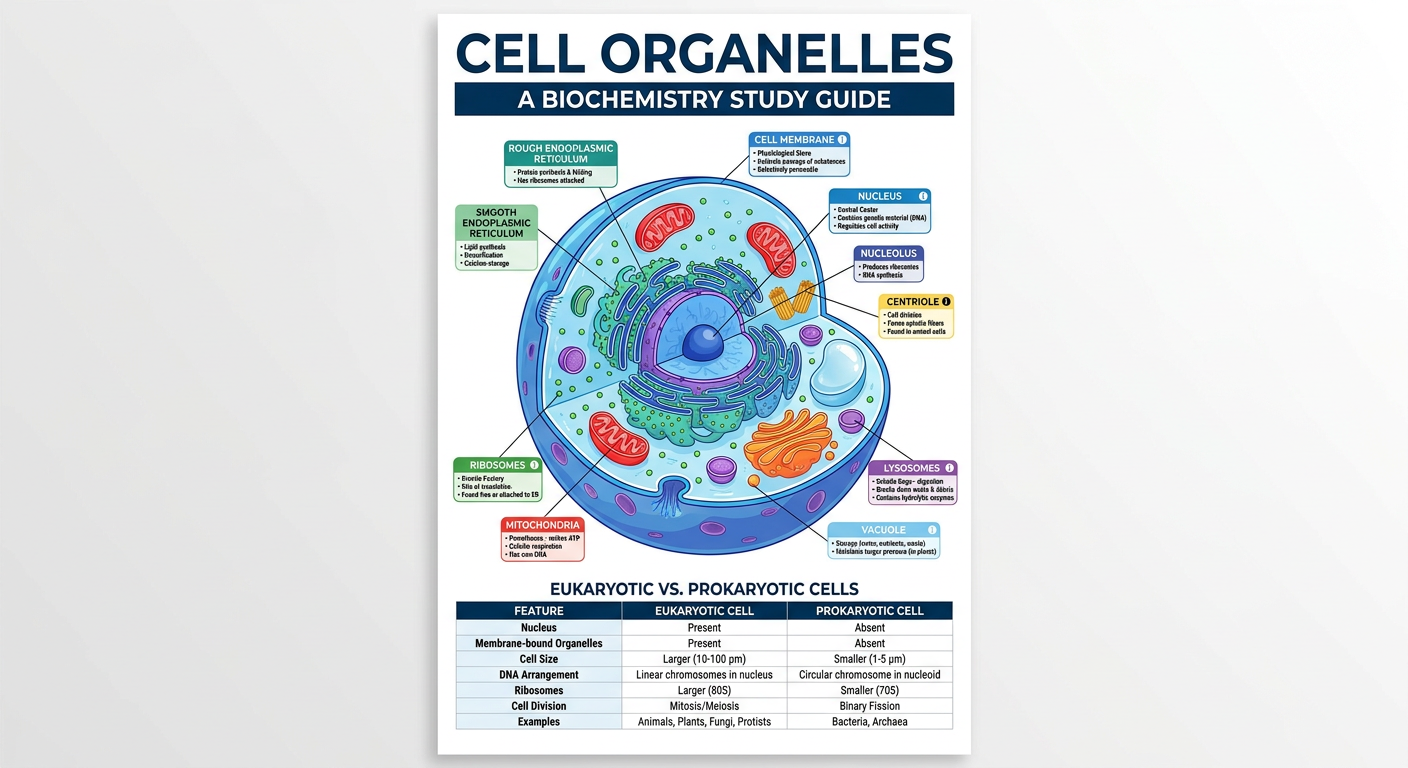
- Central cell diagram with all major organelles labeled
- Color-coded organelles for easy memorization
- Key nicknames highlighted (Powerhouse, Suicide Bags, Protein Factory)
- Function tags beside each organelle
- Eukaryotic vs Prokaryotic comparison at the bottom
Quick memory tricks from the poster:
| Organelle | Nickname | Remember |
|---|---|---|
| Mitochondria | Powerhouse | Makes ATP energy |
| Lysosomes | Suicide Bags | Lytic enzymes, autolysis |
| Ribosomes | Protein Factory | Site of protein synthesis |
| Nucleus | Control Center | Contains DNA, controls cell |
| Golgi Apparatus | Post Office | Packages & sorts proteins |