
Mechanism of short term memory
Reading File
Finding Sources
Finding Sources
Searching PubMed
"short-term memory"[MeSH Terms] AND "synaptic plasticity"[MeSH Terms]
Reading File
Reading File
Reading File
Reading File
Loading Image
Loading Image
Loading Image
Reading File
I now have all the content needed for a thorough, well-illustrated answer. Here is a comprehensive breakdown:
Mechanism of Short-Term Memory
Short-term memory (STM) - often used interchangeably with working memory - refers to the temporary retention of information over seconds to minutes, without the structural brain changes needed for long-term memory. It requires no new protein synthesis; instead, it relies on transient electrical and chemical events at synapses.
1. Overview and Capacity
STM is typified by holding 7 ± 2 discrete items (e.g., a phone number) for seconds to a few minutes. It is vulnerable to disruption - head trauma or electroconvulsive therapy (ECT) can erase it - while long-term memories formed years ago remain unaffected. This dissociation proves STM and LTM use fundamentally different neural bases.
(Neuroscience: Exploring the Brain, 5th Ed.)

2. Proposed Cellular Mechanisms (Guyton & Hall)
Two main mechanisms have been proposed:
A. Reverberating Neuronal Circuits
Nerve signals travel around and around a closed loop of reverberating neurons, maintaining activity as long as the person keeps thinking about the information. This sustained firing constitutes the temporary memory trace. When attention shifts, the circuit stops firing and the memory is lost.
B. Presynaptic Facilitation / Synaptic Transmitter Changes
Presynaptic facilitation or inhibition at synapses on terminal nerve fibrils can outlast the original stimulus for seconds to several minutes. Changes in the amount of neurotransmitter released - upward or downward - alter the ease of synaptic transmission without any permanent structural remodeling. This alone can sustain a short-term trace.
(Guyton and Hall Textbook of Medical Physiology)
3. The Aplysia Model - Molecular Cascade (Kandel / Guyton)
Much of what we know about the synaptic chemistry comes from Eric Kandel's work on Aplysia californica (a large sea snail), which is a classic model for short- to intermediate-term memory:
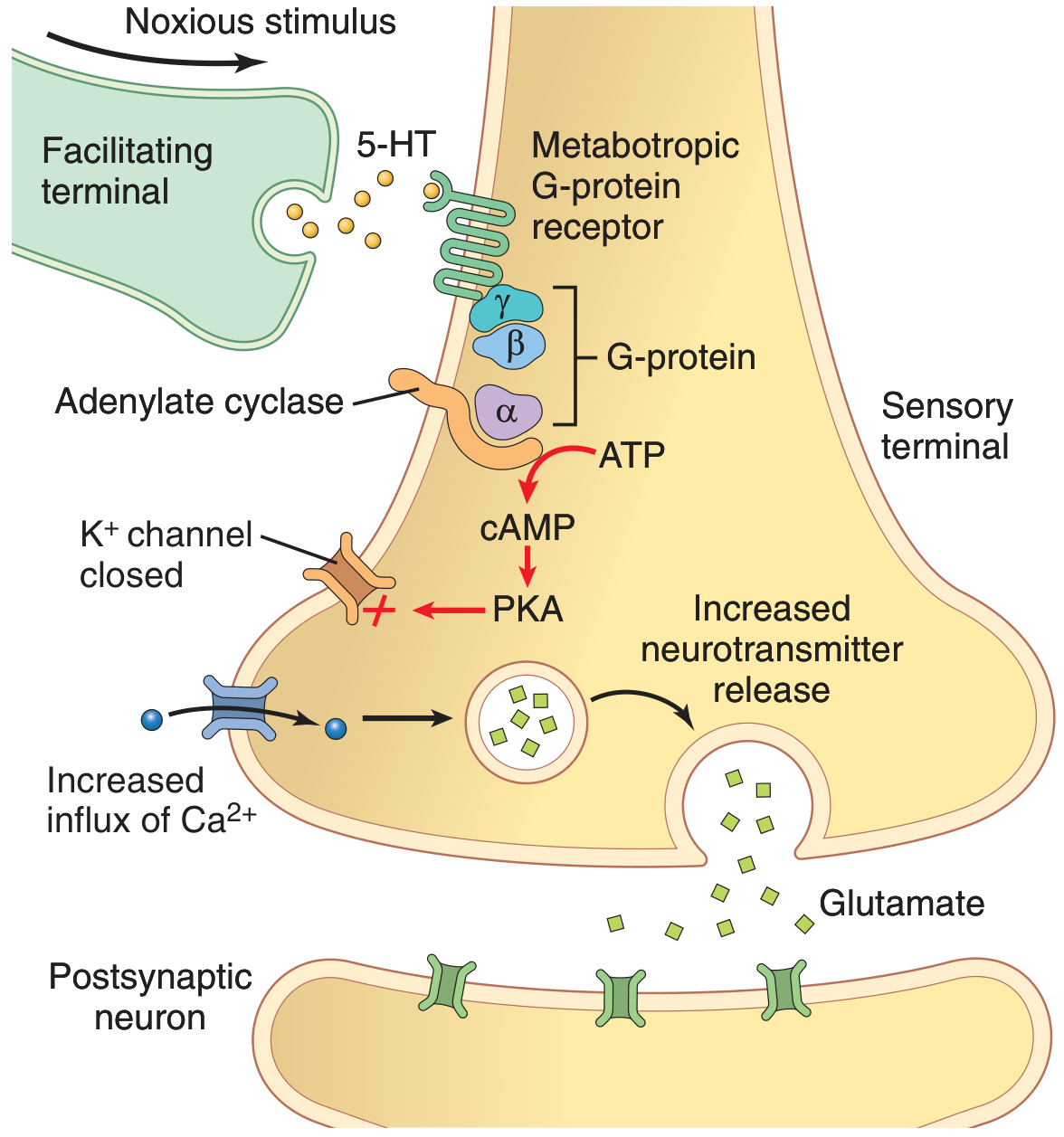
Sequence of events:
- A noxious stimulus activates a facilitating (modulatory) terminal, which releases serotonin (5-HT) onto the sensory terminal.
- 5-HT binds to a metabotropic G-protein-coupled receptor on the sensory terminal.
- The Gα subunit activates adenylate cyclase, converting ATP → cAMP.
- cAMP activates Protein Kinase A (PKA).
- PKA phosphorylates and closes K⁺ channels in the sensory terminal membrane.
- Closing K⁺ channels prolongs the action potential → more Ca²⁺ influx through voltage-gated Ca²⁺ channels.
- Increased Ca²⁺ triggers greater glutamate release into the synapse.
- The postsynaptic neuron is more strongly depolarized - the synapse is facilitated.
This entire cascade can last minutes to a few weeks without any new protein synthesis - the hallmark of short-term (and intermediate) memory.
(Guyton and Hall Textbook of Medical Physiology; Eric Kandel - Principles of Neural Science, 6th Ed.)
4. Working Memory and the Prefrontal Cortex
Kandel's framework identifies working memory as a distinct, active form of STM with two subsystems coordinated by a central executive:
| Subsystem | Function | Brain Region |
|---|---|---|
| Verbal/Phonological | Holds speech-based info; mental rehearsal of passwords, words | Posterior parietal cortex (storage); Broca's area (rehearsal) |
| Visuospatial | Holds mental images and spatial locations | Parietal, inferior temporal, occipital cortex (modulated by frontal/premotor) |
| Executive Control | Allocates attention; monitors/updates representations | Prefrontal cortex (PFC) |
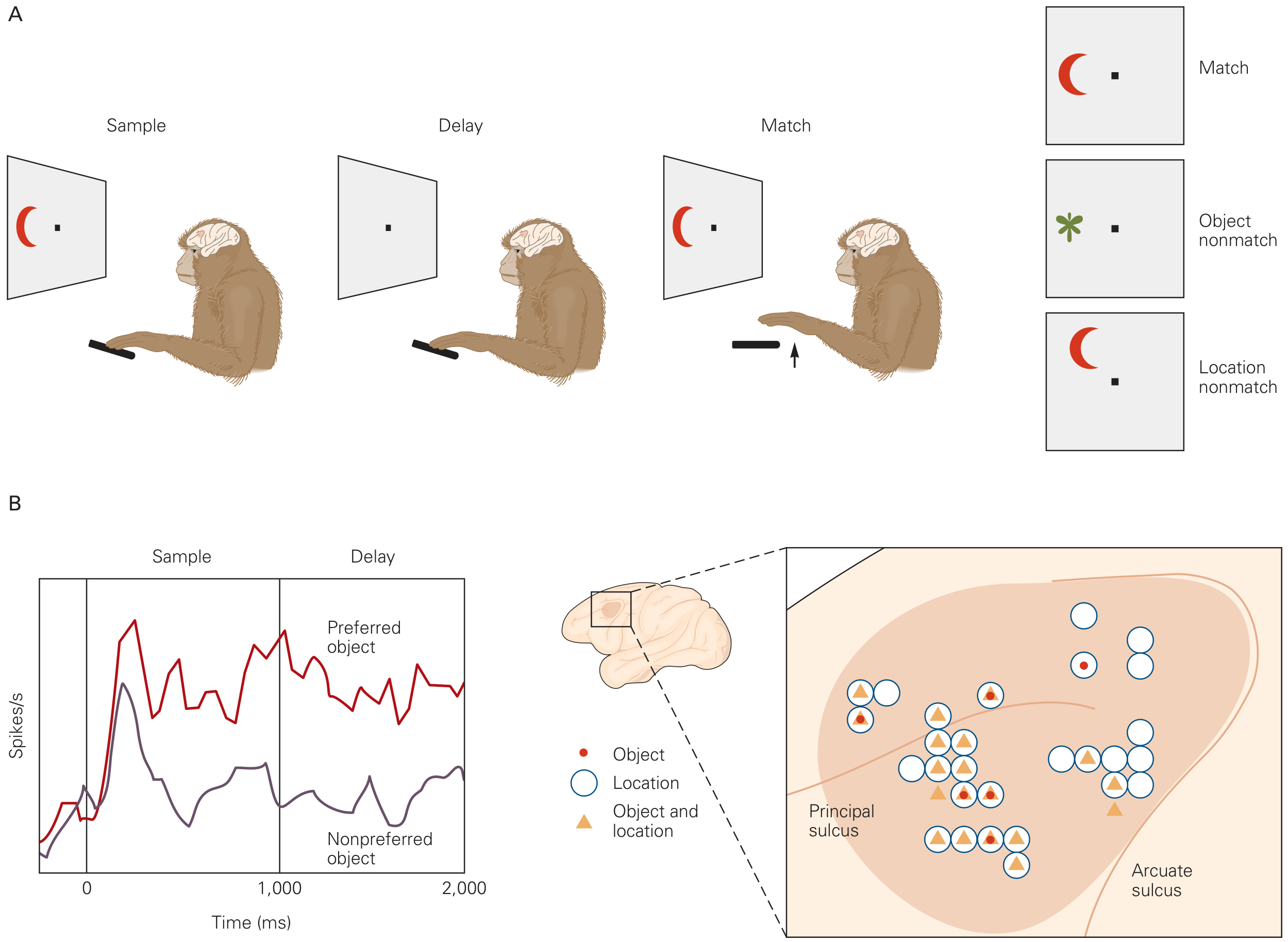
Single-cell recordings in primates show that prefrontal neurons maintain persistent firing during the delay period of a memory task - even when the stimulus is no longer present. This sustained neuronal activity IS the working memory trace.
- Ventrolateral PFC: mainly object representations
- Dorsolateral PFC: mainly spatial representations
- PFC also interacts with the striatum and receives dopaminergic input from midbrain, which modulates the strength of working memory representations.
(Principles of Neural Science, 6th Ed.)
5. Transfer from STM to Long-Term Memory
The famous case of H.M. (Henry Molaison) - who had bilateral hippocampal removal - demonstrated that:
- Working memory was intact (he could repeat a phone number for minutes)
- He could not transfer new information into long-term memory (anterograde amnesia)
This proved that the medial temporal lobe (hippocampus) is NOT needed for STM itself, but IS required for the consolidation of STM into LTM. STM and LTM are dissociable neural systems.
(Principles of Neural Science, 6th Ed.)
6. Summary Table
| Feature | Short-Term Memory |
|---|---|
| Duration | Seconds to a few minutes |
| Capacity | ~7 ± 2 items |
| Neural basis | Reverberating circuits; presynaptic facilitation |
| Key molecular players | cAMP, PKA, K⁺ channel closure, Ca²⁺, glutamate |
| Key brain region | Prefrontal cortex (working memory); no hippocampal dependence |
| Protein synthesis needed? | No |
| Vulnerability | Disrupted by trauma, ECT, distractors |
| Conversion to LTM | Requires hippocampus (consolidation) |
Sources:
- Guyton and Hall Textbook of Medical Physiology, Ch. 58
- Principles of Neural Science (Kandel), 6th Ed., Ch. 52
- Neuroscience: Exploring the Brain, 5th Ed., Ch. 24
This is a shared conversation. Sign in to Orris to start your own chat.