
Degenerative changes in spine lopostol means
Reading File
The term "lopostol" appears to be a misspelling or phonetic rendering. The likely intended term is listhesis (as in spondylolisthesis) or possibly lophosis/lordosis. Let me search the library now.
Finding Sources
Finding Sources
Searching the Web
degenerative changes spine "listhesis" OR "spondylolisthesis" meaning radiology
Now let me read the most relevant textbook sections:
Reading File
Reading File
I now have comprehensive information. Let me also fetch the diagram image from the THIEME Atlas:
Loading Image
The term "lopostol" appears to be a phonetic misspelling of "listhesis" (from spondylolisthesis) — a very common finding reported in spine radiology. Here is a comprehensive explanation:
Degenerative Changes in the Spine — Including "Listhesis"
What "Listhesis" Means
Spondylolisthesis (Greek: spondylos = vertebra, olisthesis = slipping) refers to the displacement/slippage of one vertebral body relative to the adjacent one. When caused by age-related wear and tear, it is called degenerative spondylolisthesis — the most common type in adults.
The Full Spectrum of Degenerative Spinal Changes
Degenerative spine changes are age-dependent and increase dramatically after age 30. The intervertebral disk, adjacent end plates, vertebral bodies, and ligaments are all affected. Here is what each term means:
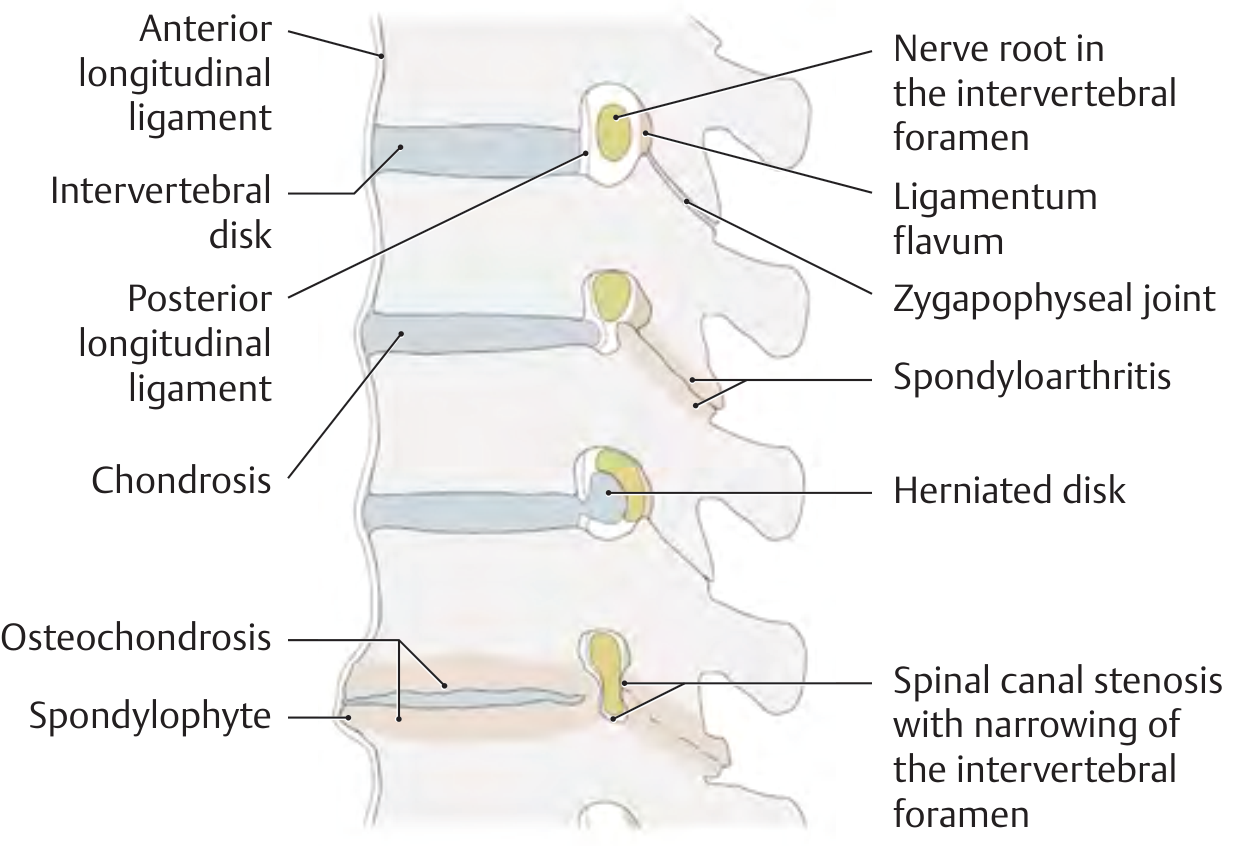
| Finding | What It Means |
|---|---|
| Degenerative disk disease | Loss of water from the nucleus pulposus → disk flattening, reduced height |
| Chondrosis | Fraying and cracking of the annulus fibrosus due to mechanical overload |
| Osteochondrosis | Reactive sclerosis (hardening) of vertebral end plates |
| Disk bulge | Symmetrical extension of disk tissue beyond the vertebral edge (not a herniation) |
| Disk protrusion | Focal extension of disk past the vertebral body border |
| Disk extrusion | Nucleus pulposus herniates through a torn annulus fibrosus |
| Spondylophyte / Osteophyte | Bony spurs at vertebral body margins — the body's attempt to stabilize the segment |
| Spondylarthrosis | Osteoarthritis of the facet (zygapophyseal) joints |
| Spinal canal stenosis | Narrowing of the vertebral canal from osteophytes, hypertrophied ligamentum flavum, and disk bulging |
| Spondylolisthesis (listhesis) | Slippage of one vertebra over another, most often L4 on L5 |
| Retrolisthesis | Posterior slippage of a vertebral body (backward, rather than forward) |
Degenerative Spondylolisthesis in Detail
- Results from deterioration of facet joints combined with disk height loss — the posterior elements can no longer resist forward shear forces
- Most common level: L4–L5
- Often associated with spinal stenosis (canal narrowing), causing:
- Low back pain
- Neurogenic claudication (leg pain/weakness with walking, relieved by sitting/bending forward)
- Nerve root compression/radiculopathy
- Graded I–IV by Meyerding classification based on percentage of slip
Key Points on Radiology Reports
When a radiology report says "degenerative changes with listhesis at L4–L5", it means:
- There are age-related wear changes at that spinal level AND
- The L4 vertebra has slipped forward (anterolisthesis) or backward (retrolisthesis) over L5
Sources: General Anatomy and Musculoskeletal System — THIEME Atlas of Anatomy; Bradley and Daroff's Neurology in Clinical Practice; Rosen's Emergency Medicine
This is a shared conversation. Sign in to Orris to start your own chat.