
Respiratory system ke baare me sab kuch janna hai roman aur english me
Reading File
Respiratory system ek broad medical topic hai. Main pahle textbook sections dhundta hun, saath me parallel searches karke comprehensive content laata hun.
Searching sources...
Finding Sources
Finding Sources
Reading File
Finding Sources
Finding Sources
Reading File
Reading File
Finding Sources
Reading File
Reading File
Reading File
Reading File
Reading File
Finding Sources
Reading File
Reading File
Ab mere paas kaafi content hai. Main ab images bhi fetch karta hun aur comprehensive answer deta hun.
Loading Image
Loading Image
Ab mere paas complete information hai. Main comprehensive answer likha hun:
Respiratory System (Shwasan Tantra) - Poori Jaankari
Parichay (Introduction)
Respiratory system (shwasan tantra) hamare body ka wo system hai jo bahar se oxygen (O₂) andar leta hai aur carbon dioxide (CO₂) bahar nikalta hai. Ye gas exchange ka kaam karta hai jo life ke liye zaruri hai.
- Ganong's Review of Medical Physiology ke anusar: "The structure of the respiratory system is uniquely suited to its primary function, the transport of gases in (O₂) and out (CO₂) of the body."
- Ek khaas baat: Lungs akele aise organ hain jo poora cardiac output receive karte hain.
Anatomy (Sanrachna) - Poori Structure
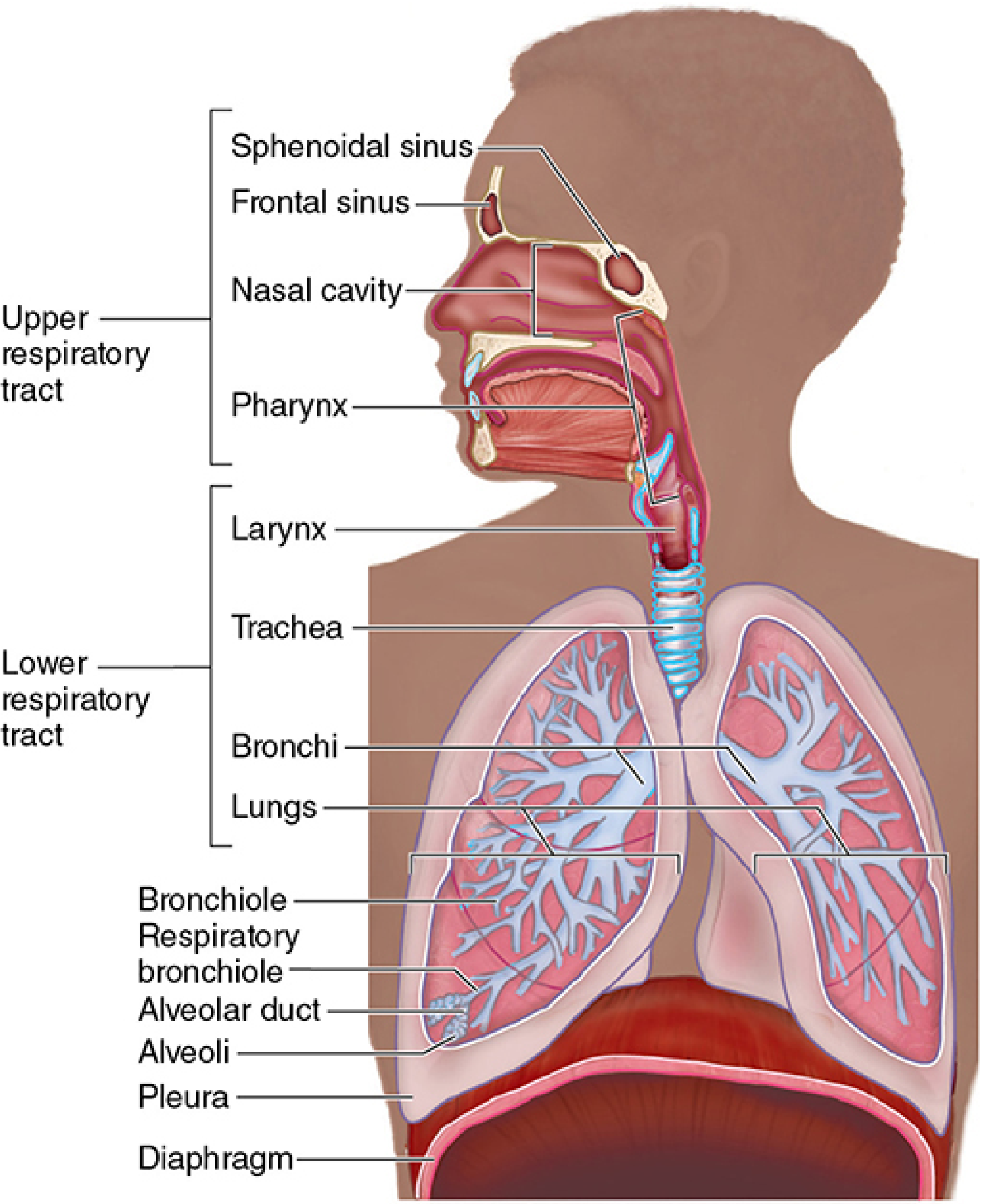
Respiratory system do bhaagon mein baanta hai:
1. Conducting Portion (Vayu Marg / Hawayi Rasta)
Ye portion hawa ko saaf karke, garam karke, aur nami dekar lungs tak pohonchaata hai. Isme gas exchange nahi hoti.
| Organ | Kaam |
|---|---|
| Nasal Cavity (Naak) | Hawa filter karna, garam karna, humid banana |
| Pharynx (Gala) | Naak aur trachea ko jodta hai |
| Larynx (Swarantantra) | Awaaz banana + epiglottis se food ko rok ke rakhtaa hai |
| Trachea (Tracheya/Saans ki nali) | 11 cm lambi nali, C-shaped cartilage rings |
| Bronchi | Trachea se do branches ban ke dono lungs mein jaati hain |
| Bronchioles | Bronchi ki chhhoti branches, diameter ≤ 1 mm |
| Terminal Bronchioles | Conducting zone ka aakhiri hissa |
2. Respiratory Portion (Gas Exchange Zone)
Yahan actual gas exchange hoti hai:
- Respiratory Bronchioles - Bronchioles ke aage
- Alveolar Ducts - Alveoli tak rasta
- Alveoli - Gas exchange ka actual jagah
Nasal Cavity (Naak ke andar) - Detail
Naak ke andar conchae (turbinate bones) hoti hain jo hawa mein turbulence create karti hain. Isse:
- Hawa ko garm kiya jata hai
- Hawa ko humid banaya jaata hai
- Mucus + IgA antibodies bacteria aur particles pakadti hain
Naak ki epithelium = Pseudostratified ciliated columnar epithelium (Respiratory epithelium)
Isme 5 types of cells hote hain:
- Ciliated columnar cells - Sabse zyada, 250-300 cilia
- Goblet cells - Mucin banate hain (mucus)
- Brush cells - Chemosensory (taste receptors jaisi)
- Small granule cells - APUD cells
- Basal cells - Stem cells
Larynx (Kanth / Gala)
- 4 cm × 4 cm ka chhota passage
- Thyroid, Cricoid, Arytenoid cartilages - Hyaline cartilage se bane (rigid)
- Epiglottis - Elastic cartilage, khaana neeche jaate waqt airway band karta hai
- Vocal folds (cords) - Awaaz ke liye vocalis muscle + elastic ligament
Trachea (Saans ki Nali)
- Pseudostratified ciliated columnar epithelium
- C-shaped hyaline cartilage rings - Structure maintain karte hain
- Peeche ka open part = Trachealis muscle (smooth muscle)
Bronchial Tree (Shwasan Vriksha)
Trachea se branching shuru hoti hai. 23 generations of branching hoti hai:
- Generation 1-2: Main bronchi
- Generation 3-16: Conducting zone - Bronchi → Bronchioles → Terminal bronchioles
- Generation 17-23: Respiratory zone - Gas exchange hoti hai
Ek important fact: Terminal bronchioles (generation 16) ka aggregate cross-sectional area ~180 cm² hai, jabki trachea ka sirf 2.5 cm² hai. Isliye yahan hawa ki speed bahut kam ho jaati hai.
Alveoli (Gas Exchange Units) - Sabse Important Part
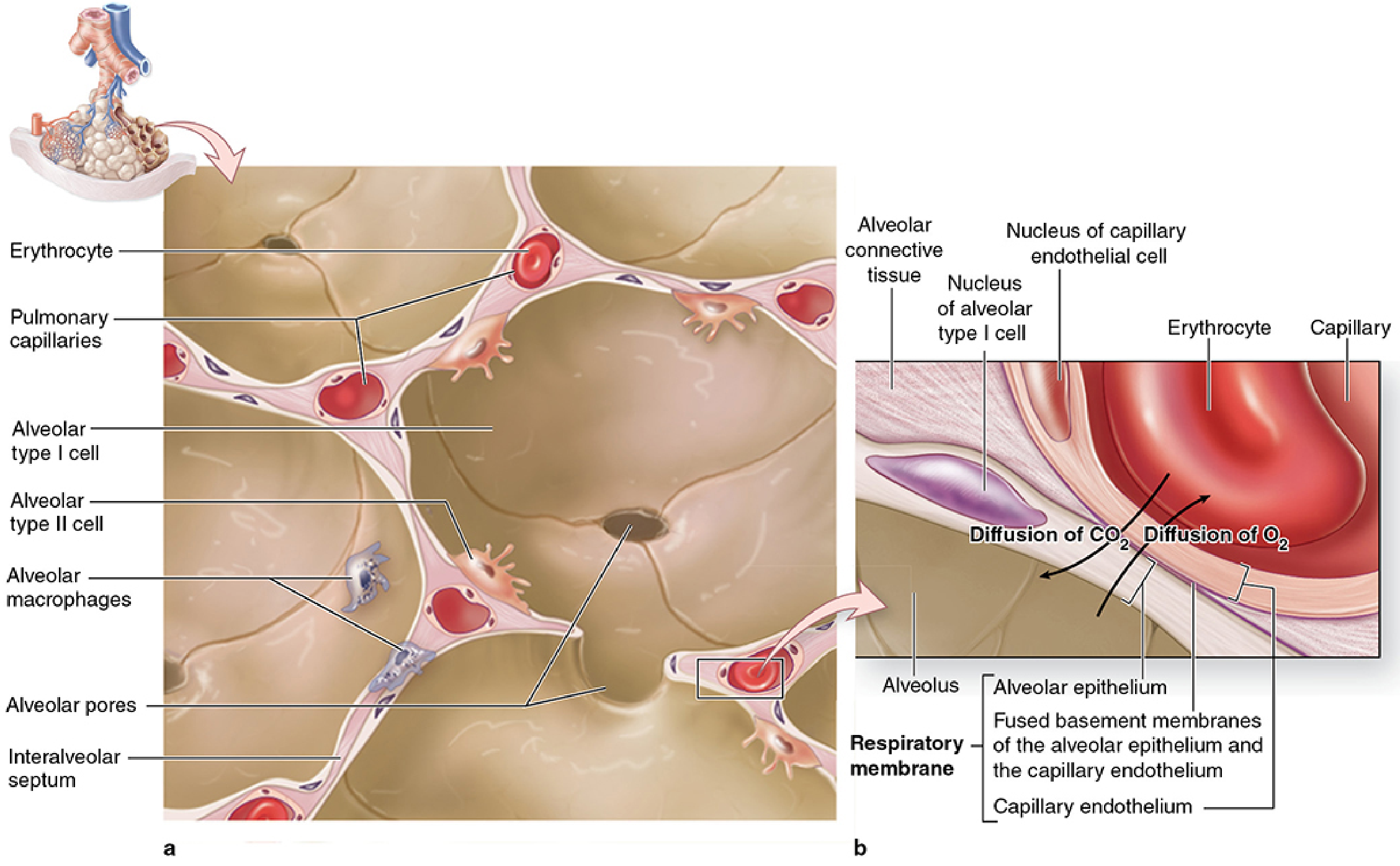
Key facts:
- Har adult lung mein approximately 200-300 million alveoli
- Total surface area = 50-100 m² (tennis court jitna!)
- Diameter = 75-300 μm
Alveoli ki Cells:
| Cell Type | Kaam |
|---|---|
| Type I Pneumocytes | 95% surface cover, thin cells, gas exchange allow karti hain |
| Type II Pneumocytes | Surfactant banati hain, type I cells ko regenerate kar sakti hain |
| Alveolar Macrophages | Phagocytosis - dust aur bacteria khaate hain |
Surfactant kya hai?
Type II cells surfactant banati hain (dipalmitoyl phosphatidylcholine - DPPC). Ye surface tension kam karta hai aur alveoli ko collapse hone se bachata hai. Premature babies mein surfactant nahi hota isliye unhe Respiratory Distress Syndrome (RDS) hota hai.
Blood-Air Barrier (Respiratory Membrane)
O₂ aur CO₂ in 3 layers se cross karti hain:
- Alveolar Type I cell (bahut patli)
- Fused basement membranes (alveolar + capillary)
- Capillary endothelial cell
Total thickness = sirf ~0.6 μm - Itni patli ki gases easily diffuse ho sakti hain!
Breathing Mechanics (Saans lena kaise hota hai?)
Inspiration (Saans Andar Lena)
- Diaphragm contract karta hai → neeche jaata hai → chest volume badhta hai
- External intercostal muscles contract karte hain → ribs upar jaati hain → anteroposterior diameter badhti hai
- Intrathoracic pressure kam hoti hai → hawa andar aati hai (negative pressure breathing)
Expiration (Saans Bahar Nikalna)
- Normal expiration = passive (muscles relax ho jaati hain)
- Forced expiration mein: Internal intercostal muscles + Abdominal muscles contract karte hain
Accessory muscles (Zyada mehnat wale saans mein):
- Scalene muscles
- Sternocleidomastoid
Lung Volumes (Fephe ka Volume)
| Volume | Normal Value | Matlab |
|---|---|---|
| Tidal Volume (TV) | 500 mL | Ek normal saans ka volume |
| Inspiratory Reserve Volume (IRV) | 3000 mL | Normal inspiration ke baad aur le sakte hain |
| Expiratory Reserve Volume (ERV) | 1100 mL | Normal expiration ke baad aur nikal sakte hain |
| Residual Volume (RV) | 1200 mL | Poori tarah nikaalne ke baad bhi jo rehta hai |
| Total Lung Capacity (TLC) | 5800 mL | Poori capacity |
| Vital Capacity (VC) | 4600 mL | Max in + max out |
| Functional Residual Capacity (FRC) | 2300 mL | RV + ERV |
Gas Exchange (Gas ki Adla-Badli)
Gas exchange partial pressure ke difference pe depend karti hai:
| Gas | Alveolar Air | Arterial Blood | Venous Blood |
|---|---|---|---|
| O₂ (PO₂) | 104 mmHg | 95 mmHg | 40 mmHg |
| CO₂ (PCO₂) | 40 mmHg | 40 mmHg | 46 mmHg |
- O₂ alveoli se blood mein jaata hai (high → low pressure)
- CO₂ blood se alveoli mein nikalta hai (high → low pressure)
Lung Pleura (Parda)
- Visceral pleura - Directly lung ko cover karti hai
- Parietal pleura - Chest wall ko line karti hai
- Dono ke beech pleural cavity hoti hai jisme thodi serous fluid hoti hai
- Ye friction kam karti hai aur negative pressure maintain karti hai
Pulmonary Circulation (Fephe ka Blood Flow)
- Pulmonary artery - Deoxygenated blood right ventricle se lungs mein laati hai
- Pulmonary veins - Oxygenated blood lungs se left atrium mein le jaati hain
- Low pressure system (Systemic se alag) - ~15 mmHg mean pressure
Non-Respiratory Functions (Gas Exchange ke Alawa Kaam)
Respiratory system sirf gas exchange nahi karti:
- Acid-Base Balance - CO₂ exhale karke blood pH regulate karna
- Voice Production - Vocal cords se awaaz
- Filtration - Blood se thrombi, bacteria filter karna
- Drug Metabolism - Kuch drugs lungs mein metabolize hoti hain (e.g., angiotensin I → angiotensin II by ACE enzyme)
- Warmth & Humidification - Inhaled air ko body temperature par laana
Respiratory Control (Saans ka Control)
Saans control karte hain:
- Medulla oblongata - Primary respiratory center (Dorsal + Ventral groups)
- Pons - Pneumotaxic center (saans ki rhythm)
- Peripheral chemoreceptors - Carotid + Aortic bodies (O₂ sense karte hain)
- Central chemoreceptors - Medulla mein (CO₂/H⁺ sense karte hain)
Normal breathing stimulus = CO₂ increase (hypercapnia), O₂ decrease secondary hai
Aam Respiratory Diseases
| Bimari | Type | Kya hota hai |
|---|---|---|
| Asthma | Obstructive | Bronchospasm, inflammation, reversible |
| COPD/Emphysema | Obstructive | Alveoli destroy, compliance badh jaati hai |
| Pneumonia | Infection | Alveoli fluid se bhar jaate hain |
| Pulmonary Fibrosis | Restrictive | Lungs stiff ho jaate hain, compliance kam |
| Pneumothorax | Trauma | Pleural cavity mein air aa jaati hai |
| Lung Cancer | Malignancy | Most common = non-small cell lung cancer |
Summary - Respiratory System ka Flow
Naak → Pharynx → Larynx → Trachea → Bronchi → Bronchioles →
Terminal Bronchioles → Respiratory Bronchioles → Alveolar Ducts → ALVEOLI
                                                                      ↕
                                                            O₂/CO₂ Exchange
                                                            (Blood-Air Barrier)
Key Point: Ek normal adult 12-20 breaths per minute leta hai, aur har breath mein ~500 mL hawa andar-bahar hoti hai = ~6-8 litres per minute ventilation.
Sources: Junqueira's Basic Histology 17e | Ganong's Review of Medical Physiology 26e | Medical Physiology (Boron & Boulpaep)
This is a shared conversation. Sign in to Orris to start your own chat.