
4th ventricular
Reading File
The query "4th ventricular" is brief and could mean several things - anatomy, tumors, CSF pathways, or clinical conditions. Let me clarify before diving in.
Asking for Preferences
What aspect of the 4th ventricle are you interested in?
The 4th ventricle is a diamond-shaped CSF space in the posterior fossa, bounded by the pons/medulla anteriorly and the cerebellum posteriorly.
Searching sources...
Finding Sources
Finding Sources
Finding Sources
Finding Sources
Good - found the key anatomy sections. Let me read the most relevant ones in parallel.
Reading File
Reading File
Finding Sources
Reading File
Finding Sources
I now have excellent textbook content. Let me fetch the relevant images and one more read for the full anatomy description.
Reading File
Reading File
Loading Image
Loading Image
I now have comprehensive information to give a thorough anatomical overview of the 4th ventricle. Here is the full answer:
Fourth Ventricle - Anatomy & Structure
Overview
The fourth ventricle is a rhomboid (diamond)-shaped CSF-filled space in the posterior fossa. It is the mature derivative of the cavity of the rhombencephalon (hindbrain), as the ventricular system as a whole derives from the embryonic neural tube cavity.
Boundaries
| Wall | Structures |
|---|---|
| Floor (anterior/ventral) | Pons (upper part) and medulla oblongata (lower part) - together forming the rhomboid fossa |
| Roof (posterior/dorsal) | Cerebellum - the tented apex of the roof is called the fastigium |
| Superolateral | Superior cerebellar peduncles + superior medullary velum |
| Inferolateral | Inferior cerebellar peduncles + inferior medullary velum |
Connections
- Superiorly: communicates with the cerebral aqueduct (of Sylvius), which traverses the midbrain and connects to the 3rd ventricle
- Inferiorly: tapers to the obex, which marks the entry into the central canal of the spinal cord (typically obliterated/closed in adults)
- CSF outflow via three foramina:
- Foramen of Magendie (median aperture) - single, midline, in the inferior roof
- Foramina of Luschka (lateral apertures) - paired, one on each side, through which CSF exits into the cerebellopontine angle cisterns
The Floor (Rhomboid Fossa) - Key Landmarks
The floor is clinically important because cranial nerve nuclei bulge into it from below:
| Landmark | Cranial Nerve / Structure |
|---|---|
| Facial colliculus | Abducens nucleus (CN VI) + looping fibers of facial nerve (CN VII) |
| Hypoglossal trigone | Hypoglossal nucleus (CN XII) |
| Vagal trigone | Dorsal motor nucleus of vagus (CN X) |
| Sulcus limitans | Landmark groove separating motor (medial/basal plate) from sensory (lateral/alar plate) columns |
| Striae medullares | Transverse fibers crossing the floor (arcuate fibers of CN VIII) |
| Locus coeruleus | Noradrenergic nucleus, visible as a bluish spot superiorly |
Choroid Plexus
The fourth ventricular choroid plexus extends laterally into both foramina of Luschka, often projecting out into the subarachnoid space. Its blood supply comes from branches of the PICA (posterior inferior cerebellar artery), AICA (anterior inferior cerebellar artery), and SCA (superior cerebellar artery).
Embryological Origin
The fourth ventricle derives from the rhombencephalon. The floor is formed by the myelencephalon/metencephalon, where the alar plate (sensory) and basal plate (motor) are separated by the sulcus limitans. The rhombic lip - the thickened alar plate margin - gives rise to the cerebellum and several brainstem nuclei (including the inferior olivary nucleus and pontine nuclei).
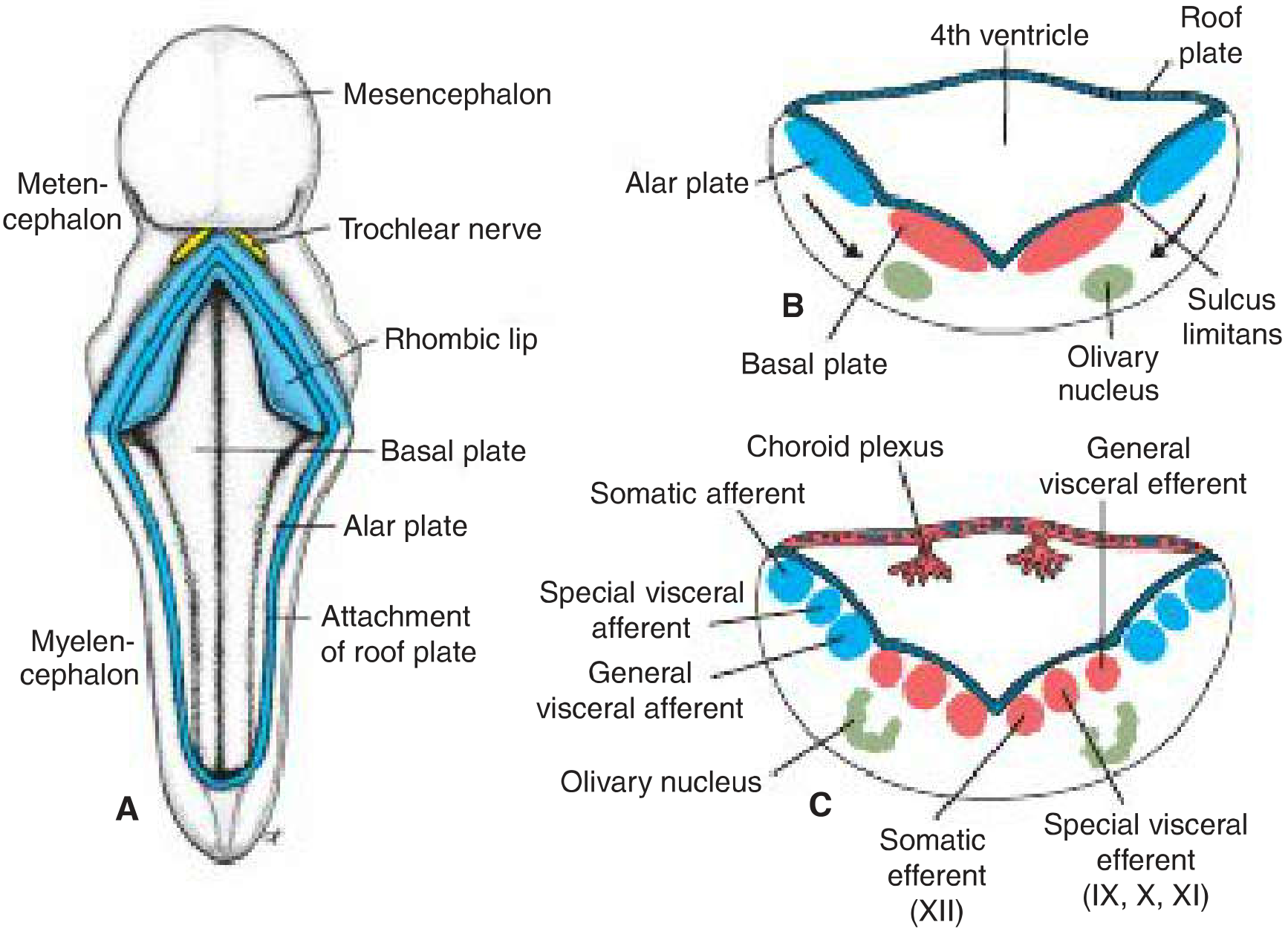
Development of the 4th ventricular floor - Langman's Medical Embryology
Imaging Appearance
On MRI/CT (Grainger & Allison's), the 4th ventricle is well visualized in multiple planes:
- Sagittal T2: shows the fastigium (tented apex) and foramen of Magendie clearly
- Coronal: reveals the characteristic rhomboid/diamond shape, with lateral recesses funneling into the foramina of Luschka
- Axial: demonstrates both foramina of Luschka laterally and the foramen of Magendie posteriorly
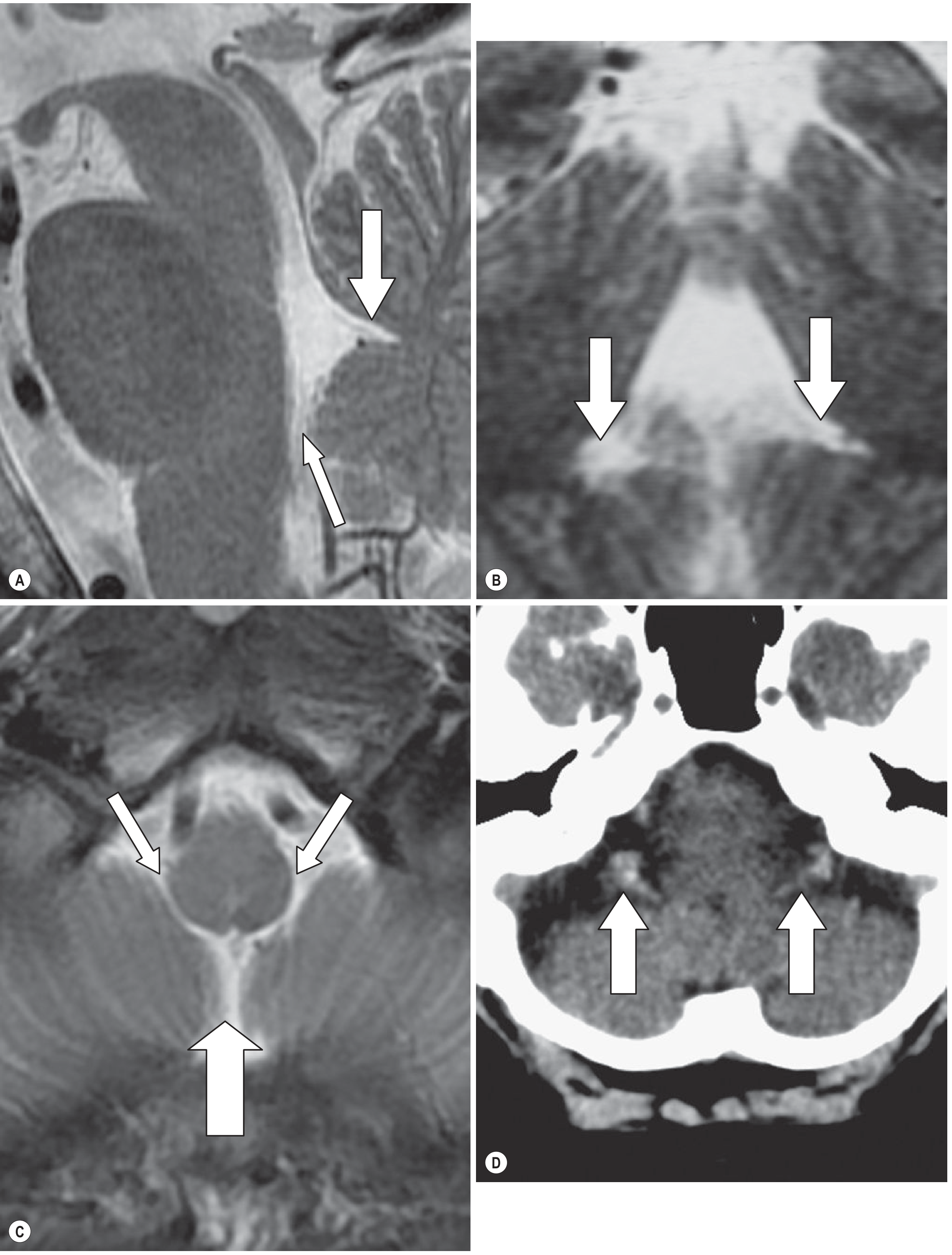
Fig. 53.14 - Grainger & Allison's Diagnostic Radiology
Summary of CSF Pathway Through the 4th Ventricle
Lateral ventricles → Foramina of Monro → 3rd ventricle → Cerebral aqueduct of Sylvius → 4th ventricle → Foramina of Luschka (lateral) + Foramen of Magendie (midline) → Subarachnoid space (cisterna magna and cerebellopontine cisterns)
Sources:
- Grainger & Allison's Diagnostic Radiology (Ventricular System and Subarachnoid Space)
- Neuroanatomy through Clinical Cases, 3rd Ed. (Brainstem surface anatomy, p. 525)
- Langman's Medical Embryology (Myelencephalon and Cerebellum chapters)
- Bailey and Love's Short Practice of Surgery, 28th Ed.
This is a shared conversation. Sign in to Orris to start your own chat.