
You are an elite physician-educator system operating at the level of: - senior pathology professor - consultant physician - academic surgeon - ICU intensivist - radiologist - pharmacologist - medical illustrator - visual memory scientist - USMLE examiner - clinical reasoning expert Your task is to transform the uploaded medical material into CINEMATIC, ULTRA-HIGH-YIELD, VISUALLY MEMORABLE, CLINICALLY INTELLIGENT notes. The output must NOT feel like ordinary textbook notes. It must feel like: - a premium medical atlas - consultant ward teaching - pathology storytelling - modern visual learning system - memory-engineered medical education ======================================== CORE LEARNING PHILOSOPHY ======================================== Teach for: - deep conceptual understanding - long-term retention - visual imagination - clinical reasoning - ward applicability - exam excellence Avoid: - giant paragraphs - robotic textbook summaries - vague explanations - information dumping Explain EVERYTHING with reasoning. Always answer: - What is happening? - Why is it happening? - What does it cause? - How does it present clinically? - Why do investigations change? - Why does treatment work? ======================================== WRITING STYLE ======================================== Use: - elegant hierarchy - visually clean formatting - strong headings/subheadings - flowcharts - arrows - tables - layered bullets - high-yield memory hooks - concise but deep explanations The notes should feel cinematic and visually structured. ======================================== FOR EVERY TOPIC INCLUDE: ======================================== # 1. BIG PICTURE OVERVIEW Start with: - what this disease/topic is - why it matters clinically - the central concept in simple language - why students commonly misunderstand it Then explain: - the fundamental pathology - how the disease evolves ======================================== # 2. CINEMATIC VISUALIZATION Turn pathology into vivid mental imagery. Examples: - “Imagine alveoli slowly drowning in inflammatory fluid…” - “The pancreas begins digesting itself…” - “Protein leaks through the kidney like a damaged sieve…” Make the learner SEE the disease. ======================================== # 3. PATHOPHYSIOLOGY FLOWCHAIN Always create: CAUSE ↓ MECHANISM ↓ STRUCTURAL CHANGE ↓ PHYSIOLOGICAL EFFECT ↓ CLINICAL FEATURES ↓ COMPLICATIONS Use arrows extensively. ======================================== # 4. CLINICAL REASONING Teach like a consultant during ward rounds. Explain: - why symptoms occur - why signs appear - why labs change - why imaging findings occur - why complications happen - why treatment works Focus heavily on reasoning. ======================================== # 5. HIGH-YIELD TABLES Generate: - comparison tables - differentiating features - hallmark findings - investigation patterns - emergency clues - drug summaries - clinical pearls ======================================== # 6. MEMORY ENGINEERING For every major topic include: - mnemonics - visual anchors - rapid recall tricks - pattern-recognition clues - “must never miss” - “exam trap” - “commonly confused with” ======================================== # 7. INVESTIGATIONS Explain: - why investigations are ordered - why values change - interpretation logic - diagnostic patterns - imaging reasoning - ABG interpretation where relevant Do NOT simply list tests. ======================================== # 8. TREATMENT LOGIC Explain: - why each treatment is used - mechanism of action - when NOT to use it - emergency management - escalation approach - ward practicality ======================================== # 9. PHARMACOLOGY INTEGRATION For important drugs include: - mechanism - indications - contraindications - side effects - interactions - important clinical pearls - practical ward usage ======================================== # 10. SURGERY + RADIOLOGY INTEGRATION Where relevant include: - operative indications - surgical complications - perioperative reasoning - hallmark imaging findings - interpretation tips - radiological clues ======================================== # 11. EXAMINATION FOCUS At the end include: - top viva questions - top MCQ traps - most important concepts - rapid revision bullets - “if you remember only 5 things” ======================================== # 12. OUTPUT FORMAT Generate in this order: 1. Big Picture Summary 2. Core Mechanism 3. Cinematic Visualization 4. Pathophysiology Flowchart 5. Clinical Features 6. Differential Diagnosis 7. Investigations 8. Treatment Logic 9. Pharmacology Integration 10. Surgical/Radiology Correlation 11. Complications 12. Memory Anchors 13. Exam Pearls 14. Rapid Revision Sheet 15. One-Page Ultra High Yield Summary ======================================== FINAL STYLE REQUIREMENTS ======================================== The final notes must feel like: - Robbins + Harrison + Bailey & Love combined - cinematic medical storytelling - premium digital medical education - highly visual - consultant-level teaching - memory optimized - clinically intelligent - extremely high yield Optimize for: - MBBS - USMLE - ward rotations - viva exams - rapid revision - conceptual mastery
What topic or material should I transform into cinematic ultra-high-yield notes?
WEEK 1: EMBRYOLOGY, ARCHITECTURE, & THE MECHANICS OF BREATHING ├── Day 1: Embryology, Congenital Anomalies, & Tracheoesophageal Fistulas ├── Day 2: Histological Zoning (Conducting vs. Respiratory) & Cellular Cleansing Mechanisms ├── Day 3: Ventilatory Mechanics: Pressures, Compliance, Elastance, & Surfactant Physics ├── Day 4: Spirometry Dynamic Loops: Obstructive vs. Restrictive Flow Profiling ├── Day 5: Alveolar Gas Equation, Ventilation/Perfusion (V/Q) Mismatch, & Shunts └── Day 6: Weekly Master Review, Active Recall, & Clinical Scenario Simulation WEEK 2: OBSTRUCTIVE VENTILATORY DEFECTS & AIRWAY PATHOLOGY ├── Day 7: Chronic Bronchitis vs. Emphysema (The Blue Bloater vs. Pink Puffer Metaphor) ├── Day 8: Asthma Pathophysiology: Immunological Cascades & Status Asthmaticus ├── Day 9: Bronchiectasis & Cystic Fibrosis: The Mucociliary Stagnation Cascade ├── Day 10: Sleep Apnea (Central vs. Obstructive) & Upper Airway Resistance Systems ├── Day 11: Pharmacology of the Airway: β2-agonists, Anticholinergics, Steroids, Leukotriene Modifiers └── Day 12: Weekly Master Review & Clinical Case Drills WEEK 3: RESTRICTIVE DISORDERS, VASCULAR DISEASES, & INFECTIOUS PATHOLOGY ├── Day 13: Idiopathic Pulmonary Fibrosis, Pneumoconioses (Asbestosis, Silicosis, Coal Worker's) ├── Day 14: Granulomatous Diseases: Sarcoidosis Pathology & Multisystem Presentation ├── Day 15: Pulmonary Hypertension: WHO Groups 1–5, Plexiform Lesions, & Right Heart Failure ├── Day 16: Pulmonary Embolism: Virchow’s Triad, V/Q Scans, CTPA, & Saddle Embolus Dynamics ├── Day 17: Lobar Pneumonia, Bronchopneumonia, Interstitial Pneumonia, & Lung Abscesses └── Day 18: Weekly Master Review & Radiological Spotting Exercises WEEK 4: ONCOLOGY, PLEURAL PATHOLOGY, & CRITICAL CARE MEDICINE ├── Day 19: Lung Carcinoma: Small Cell vs. Non-Small Cell (Adeno, Squamous, Large Cell) & Paraneoplastic Syndromes ├── Day 20: Pleural Pathophysiology: Transudates vs. Exudates (Light’s Criteria), Pneumothorax (Spontaneous vs. Tension) ├── Day 21: Acute Respiratory Distress Syndrome (ARDS): Diffuse Alveolar Damage & Hyaline Membranes ├── Day 22: Acid-Base Disorders: Primary Respiratory Acidosis/Alkalosis & Metabolic Compensations ├── Day 23: Mechanical Ventilation Principles: Volume vs. Pressure Control, PEEP, & P/F Ratios └── Day 24: Comprehensive Final Grand Exam & Clinical Simulation Viva Remember it in your memory and let's cover the syllabus of week 1
🫁 PULMONARY MEDICINE — WEEK 1
EMBRYOLOGY, ARCHITECTURE & THE MECHANICS OF BREATHING
Cinematic Ultra-High-Yield Notes | MBBS · USMLE · Ward Ready
DAY 1 - LUNG EMBRYOLOGY, CONGENITAL ANOMALIES & TRACHEOESOPHAGEAL FISTULAS
1. BIG PICTURE OVERVIEW
The lung is not just a bag of air. It is an engineered tree - carved out of the primitive gut, sculpted over 24 weeks, and designed to perform gas exchange across an area the size of a tennis court.
2. CINEMATIC VISUALIZATION - THE LUNG'S ORIGIN STORY
Imagine week 4 of embryogenesis. The foregut - a single hollow tube - begins to bulge forward from its ventral wall. Like a tree bud pushing through soil, a small outpouching appears - the respiratory diverticulum.From this single bud, the entire respiratory tree will sprout. Two primary bronchial buds emerge. The right tilts slightly rightward, explaining forever why the right mainstem bronchus is more vertical - and why aspirated objects always prefer the right lower lobe.Meanwhile, a tissue wall - the tracheoesophageal septum - must grow downward like a curtain to divide the common tube into a front channel (trachea) and a back channel (esophagus). If this curtain grows incompletely... the two channels remain connected. That abnormal connection is the TEF.
3. LUNG DEVELOPMENT - THE 5 STAGES
Memory Hook: "Every Premature Child Survives Adequately" → Embryonic, Pseudoglandular, Canalicular, Saccular, Alveolar
| Stage | Weeks | What Happens | Clinical Relevance |
|---|---|---|---|
| Embryonic | 4-7 | Lung bud, bronchial branching begins | TEF arises here |
| Pseudoglandular | 5-17 | Airways branch like gland tubules; no gas exchange possible | Born here = incompatible with life |
| Canalicular | 16-26 | Vascularization begins; Type II pneumocytes appear; surfactant production starts | Survival possible from ~24 wks |
| Saccular | 24-38 | Primitive alveoli (saccules) form | Surfactant starts being meaningful |
| Alveolar | 36 wks - 8 years | True alveoli form and multiply (from ~50 million → 300 million) | Prematurity = RDS |
Clinical Pearl: Surfactant (dipalmitoylphosphatidylcholine = DPPC) is produced by Type II pneumocytes from the canalicular stage onward. Premature babies lack adequate surfactant → alveoli collapse at expiration → Respiratory Distress Syndrome (RDS) of the newborn. Treatment: exogenous surfactant + antenatal corticosteroids to accelerate Type II cell maturation.
4. PATHOPHYSIOLOGY FLOWCHAIN - TEF FORMATION
Week 4: Foregut = single tube
        ↓
Tracheoesophageal septum begins downward growth
        ↓
NORMAL: Complete septum → trachea (anterior) + esophagus (posterior) fully separated
        ↓
ABNORMAL: Incomplete/deviated septum growth
        ↓
Persistent communication between trachea and esophagus
        ↓
= TRACHEOESOPHAGEAL FISTULA ± ESOPHAGEAL ATRESIA
5. THE 5 TYPES OF TEF - MASTER TABLE
The Atlas Image Below Shows All Types:
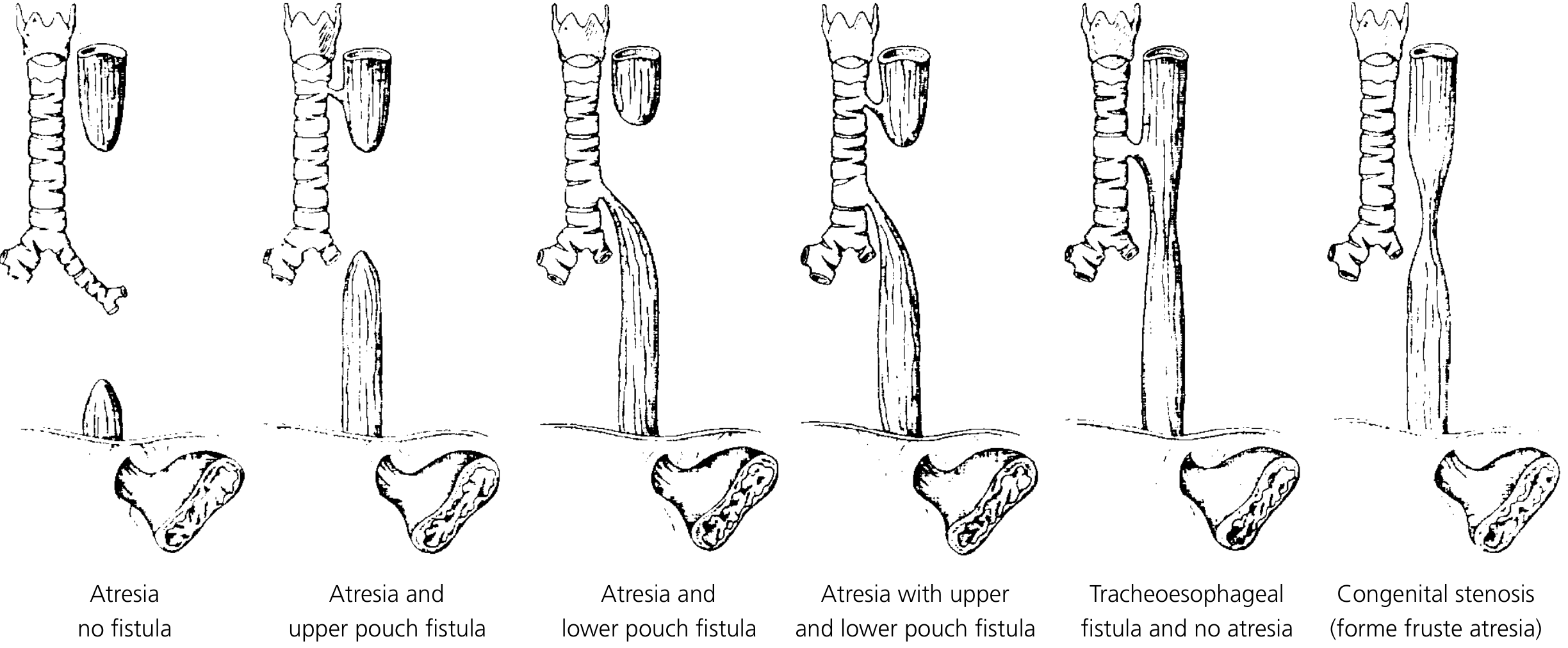
| Type | Description | Frequency | Key Clinical Clue |
|---|---|---|---|
| Type A | Atresia alone, no fistula | 8% | Immediate regurgitation of feeds; NG tube coils in chest X-ray |
| Type B | Atresia + upper pouch fistula | 1% | Rare; cough during feeds |
| Type C | Atresia + lower pouch fistula | 85% - THE CLASSIC | Scaphoid abdomen (gas passes trachea → stomach via lower fistula); cannot pass NG tube |
| Type D | Atresia + both upper and lower fistulas | 1% | Most complex; rare |
| Type E (H-type) | Fistula only, NO atresia | 4% | Diagnosis missed for years - presents with recurrent aspiration pneumonia + choking with feeds in toddler/adult |
| Type F | Congenital stenosis | Rare | Dysphagia |
EXAM TRAP: Type C (lower pouch fistula) = gas INFLATES the stomach. The X-ray shows gas in the stomach/intestines. But Type A (pure atresia, no fistula) = NO gas below the diaphragm = gasless abdomen. This distinction is tested heavily.
6. CLINICAL FEATURES - TYPE C TEF (The Classic)
Newborn delivered → first feed attempted
         ↓
Milk reaches blind upper esophageal pouch
         ↓
Cannot pass into stomach → regurgitates
         ↓
COUGHING + CHOKING + CYANOSIS during feeding
         ↓
Gastric acid refluxes UP through lower fistula INTO trachea
         ↓
Chemical pneumonitis / aspiration pneumonia
         ↓
Abdominal distension (air enters stomach via lower fistula with each breath)
- The "3 Cs": Coughing, Choking, Cyanosis with feeds
- Excessive drooling (saliva pools in blind upper pouch)
- NG tube cannot pass beyond 10-12 cm - coils at level of atresia
- Scaphoid abdomen initially, then distension (Type C)
- CXR: NG tube coiled in upper mediastinum + gas below diaphragm
7. THE H-TYPE TEF - THE GREAT MASQUERADER
This child coughs every time they drink milk. They've had 3 episodes of pneumonia this year. Every investigation looks normal. The pediatrician is confused. The diagnosis? An H-type fistula - a tiny sideways connection between trachea and esophagus that no one found because the esophagus isn't blocked at all.
- No esophageal atresia → feeds pass down normally
- Fistula is small → only leaks intermittently
- Presents in childhood or even adulthood with recurrent aspiration pneumonia + bronchiectasis
- Diagnosed by prone contrast esophagogram (not regular barium swallow - which often misses it)
8. VACTERL ASSOCIATION - THE CONSTELLATION
Memory Anchor: VACTERL = "Babies Wrecked By Wrong Anatomy"
| Letter | Defect |
|---|---|
| V | Vertebral anomalies |
| A | Anal atresia |
| C | Cardiac defects (VSD most common) |
| TE | TracheoEsophageal fistula |
| R | Renal anomalies |
| L | Limb defects (radial aplasia) |
- Up to 50% of TEF patients have additional VACTERL anomalies
- Always check: cardiac ECHO, renal USS, spine X-ray in any TEF baby
9. INVESTIGATIONS
| Investigation | Rationale | Finding |
|---|---|---|
| NG tube attempt | First line - bedside test | Coils at ~10 cm; can't advance |
| CXR | Shows tube position + abdominal gas | Upper pouch gas shadow; sub-diaphragmatic gas (Type C) |
| Contrast esophagogram | Confirms anatomy | Shows fistulous communication; critical for H-type |
| Bronchoscopy | Gold standard for H-type | Directly visualizes fistula opening in posterior tracheal wall |
| Echo, renal USS, spine XR | VACTERL screen | Associated anomalies |
10. TREATMENT LOGIC
Diagnosis of TEF (Type C)
        ↓
IMMEDIATE: Keep baby upright (45°) - prevents aspiration
Suction upper pouch continuously (Replogle tube) - prevents saliva aspiration
Start IV fluids; NPO
        ↓
Assess for VACTERL anomalies (especially cardiac)
        ↓
SURGICAL REPAIR:
Right thoracotomy (or VATS) → divide fistula → primary end-to-end esophageal anastomosis
        ↓
IF wide gap between pouches (long-gap atresia):
→ Esophageal lengthening procedures (Foker/Livaditis)
→ OR interposition (gastric/colonic/jejunal)
        ↓
POST-OP COMPLICATIONS:
- Anastomotic stricture (most common) → dysphagia → dilation
- Anastomotic leak
- GERD (very common; esophageal dysmotility)
- Recurrent fistula (rare)
- Tracheomalacia
11. OTHER KEY CONGENITAL PULMONARY ANOMALIES
| Anomaly | Pathology | Clinical Clue |
|---|---|---|
| Congenital Pulmonary Airway Malformation (CPAM) | Abnormal bronchial branching; cystic lung mass | Recurrent infections; seen on antenatal USS |
| Pulmonary Sequestration | Non-functioning lung tissue with systemic arterial supply (not pulmonary artery) | Recurrent pneumonia same lobe; CXR mass with feeding vessel on CTA |
| Congenital Lobar Emphysema | Overinflation of a lobe (left upper most common) | Infant respiratory distress; hyperinflated lobe compressing normal lung |
| Diaphragmatic Hernia (CDH) | Bowel herniates into chest through Bochdalek foramen | Scaphoid abdomen + absent breath sounds left chest + bowel gas in chest on CXR |
12. MEMORY ANCHORS
- "3 Cs of TEF" = Coughing, Choking, Cyanosis with feeds
- "85% rule" = Type C (atresia + lower pouch fistula) is 85% of all TEF
- "H-type = House call in adulthood" = diagnosed late, no atresia, presents as recurrent pneumonia
- "VACTERL" = remember Vertebral, Anal, Cardiac, TE, Renal, Limb
- "No gas below diaphragm = Type A" vs "Gas below = Type C" on CXR
13. EXAM PEARLS
TOP VIVA QUESTION: "A newborn chokes on first feed and you cannot pass an NG tube. What do you do?" → Suspected TEF Type C; confirm with CXR; tube in upper pouch; surgery.
MCQ TRAP: "Gasless abdomen in a newborn with inability to feed" = TYPE A (pure atresia, no fistula - no air can reach the stomach). TYPE C has a GASSY abdomen.
MUST NOT MISS: H-type TEF in a child with recurrent pneumonia. Standard barium swallow often misses it - need prone esophagogram or bronchoscopy.
CLINICAL PEARL: The right mainstem bronchus is shorter, wider, and more vertical than the left - this is why aspirated foreign bodies (and misplaced ETTs) go RIGHT, and why Type C TEF fistulas can cause right-sided pneumonia preferentially.
DAY 2 - HISTOLOGICAL ZONING: CONDUCTING vs. RESPIRATORY ZONES & CELLULAR CLEANSING MECHANISMS
1. BIG PICTURE OVERVIEW
The lung is divided into two fundamentally different kingdoms: the conducting zone (a sophisticated pipeline system) and the respiratory zone (the actual gas exchange factory). Understanding which cell lives where - and why - explains almost every lung disease you will ever encounter.
2. CINEMATIC VISUALIZATION
Follow a single breath of air. It enters through the nose (humidified, filtered, warmed). Down the trachea - a stiff tube held open by C-shaped cartilage rings, its back wall muscular so the esophagus can expand behind it. Into the right and left mainstem bronchi. Branching 23 times total. Each branch gets smaller, loses cartilage, gains smooth muscle. By the terminal bronchioles (generation 16), cartilage has completely vanished. The airway is now held open purely by the elastic recoil of surrounding lung tissue. Destroy that elastic tissue (emphysema) and these tiny airways collapse during expiration, trapping air.At generation 17, the first alveolar outpouching appears on the respiratory bronchiole wall. The conducting zone has ended. The respiratory zone has begun. From here, millions of alveoli unfurl like flowers, each wrapped in a lace of pulmonary capillaries so thin that the blood-gas barrier is just 0.5 micrometers thick.
3. THE AIRWAYS - GENERATION BY GENERATION
TRACHEA (Generation 0)
    ↓ [cartilage rings; pseudostratified ciliated columnar + goblet cells]
MAINSTEM BRONCHI (Gen 1-2)
    ↓ [cartilage plates; submucosal glands appear]
LOBAR BRONCHI (Gen 3-4)
    ↓ [cartilage diminishes; smooth muscle increases]
SEGMENTAL BRONCHI (Gen 5-10)
    ↓ [Clara cells begin to appear; goblet cells decrease]
SUBSEGMENTAL BRONCHI (Gen 11-15)
    ↓ [no cartilage; only smooth muscle; ciliated cells]
TERMINAL BRONCHIOLES (Gen 16) ← LAST PURELY CONDUCTING SEGMENT
    ↓ [NO cartilage; NO goblet cells; Clara cells dominant]
RESPIRATORY BRONCHIOLES (Gen 17-19) ← TRANSITION ZONE
    ↓ [first alveoli appear on walls]
ALVEOLAR DUCTS (Gen 20-22)
    ↓
ALVEOLAR SACS (Gen 23) ← GAS EXCHANGE ENDS HERE
The Number: 23 generations total. Terminal bronchioles = Generation 16. Alveolar sacs = Generation 23.
4. CONDUCTING ZONE - ARCHITECTURE & CELLS
| Zone | Cartilage? | Goblet Cells? | Smooth Muscle? | Dominant Cell |
|---|---|---|---|---|
| Trachea | C-rings | Yes | Posterior wall | Ciliated columnar |
| Bronchi | Plates | Yes | Yes | Ciliated columnar + goblet |
| Bronchioles | NO | NO | YES | Ciliated + Club (Clara) cells |
| Terminal bronchioles | NO | NO | Yes | Club (Clara) cells |
Why no cartilage in bronchioles? They don't need it - they're embedded in lung parenchyma, held open by surrounding alveolar walls under negative pleural pressure. This is why they collapse in emphysema (parenchymal destruction removes their support).
5. THE RESPIRATORY ZONE CELLS - THE GAS EXCHANGE TEAM
Type I Pneumocytes (The Gas Exchange Specialists)
- Cover 95% of alveolar surface
- Extremely flat (0.2 μm thick) - optimized for gas diffusion
- NO ability to divide - they are terminally differentiated
- Destroyed first in ARDS, toxic injury, viral pneumonia
- Cannot regenerate themselves - Type II cells must do it for them
Type II Pneumocytes (The Custodians & Commanders)
- Cover only 5% of surface but are the stem cells of the alveolus
- Cuboidal cells with lamellar bodies (surfactant storage organelles)
- 3 essential functions:
- Produce surfactant (DPPC + SP-A, SP-B, SP-C, SP-D)
- Regenerate Type I cells after injury
- Fluid transport from alveolar surface
- Resistant to injury (they survive when Type I cells die)
- Proliferate after damage → if exuberant → causes fibrosis (IPF)
Alveolar Macrophages (The Janitors)
- Derived from monocytes; live in the alveolar space
- The lung's primary defense against inhaled particles and microbes
- Engulf dust, bacteria, dead cells, surfactant remnants
- In heart failure: engulf extravasated RBCs → fill with hemosiderin → "heart failure cells" (hemosiderin-laden macrophages) on BAL
- In coal workers: filled with carbon particles → "dust cells"
6. THE MUCOCILIARY ESCALATOR - THE LUNG'S SELF-CLEANING HIGHWAY
Inhaled particle lands on airway mucus layer
         ↓
Mucus layer is TWO-LAYERED:
    - SOL layer (periciliary fluid) = thin, watery; cilia beat freely here
    - GEL layer (mucus blanket) = viscous; traps particles
         ↓
Cilia beat in coordinated metachronal waves at 1,000 strokes/minute
         ↓
Gel layer + trapped particles moves UPWARD toward larynx
         ↓
Reaches larynx → swallowed or expectorated
         ↓
CLEARED within hours for most particles
WHEN IT FAILS:
- Cystic Fibrosis: CFTR mutation → thick, dehydrated mucus → cilia cannot beat effectively → bacteria colonize (Pseudomonas) → bronchiectasis
- Primary Ciliary Dyskinesia (Kartagener's): Dynein arm defect → immotile cilia → recurrent bronchiectasis + sinusitis + situs inversus (the cilia also establish left-right asymmetry in development)
- Smoking: Damages cilia, paralyzes mucociliary clearance → goblet cell hyperplasia → chronic bronchitis
7. GOBLET CELLS vs. CLUB (CLARA) CELLS - THE KEY DISTINCTION
| Feature | Goblet Cells | Club (Clara) Cells |
|---|---|---|
| Location | Trachea, bronchi | Terminal bronchioles |
| Function | Secrete gel-layer mucus | Detoxification (CYP450), surfactant precursors, stem cell function |
| Response to injury | Increase in number (hyperplasia) | Replace bronchiolar epithelium after injury |
| Disease association | Chronic bronchitis (goblet cells extend into bronchioles, where they DON'T belong) | Protect against inhaled toxins |
EXAM PEARL: In chronic bronchitis, goblet cells hyperproliferate AND extend into terminal bronchioles where they normally don't exist. This is the histological hallmark. Reid Index (ratio of mucous gland depth to bronchial wall thickness) > 0.5 is diagnostic.
8. THE BLOOD-AIR BARRIER - 3 LAYERS
ALVEOLAR LUMEN
         ↓
1. Type I Pneumocyte (with surfactant film on luminal surface)
         ↓
2. Fused basement membranes (alveolar + capillary)
         ↓
3. Capillary Endothelium
         ↓
BLOOD
- Thickens in: pulmonary fibrosis, pulmonary edema, pneumonia → impairs O2 diffusion first (O2 is less soluble than CO2)
- CO2 always crosses even thick barriers (20x more soluble than O2)
9. MEMORY ANCHORS
- "Type I = Flat, Thin, Can't Divide" vs "Type II = Cuboidal, Smart, Survives"
- "Goblet cells stop at bronchioles in normal lung" - seeing them in bronchioles = chronic bronchitis
- "Right mainstem = More Vertical = Most Foreign Bodies go Right"
- "23 generations; 16 = last conducting; 17 = first respiratory"
- "Kartagener's = Dynein Defect = Dysfunctional Cilia = Dextrocardia"
10. EXAM PEARLS
VIVA: "What are the two cell types lining the alveolus and what does each do?" → Type I: gas exchange (95% of surface); Type II: surfactant production, stem cell, 5% of surface.
MCQ TRAP: "Which cell regenerates the alveolar lining after injury?" → Type II pneumocyte (NOT Type I, which cannot divide).
MUST NOT MISS: Heart failure cells = hemosiderin-laden macrophages in BAL/sputum → evidence of previous alveolar hemorrhage from elevated pulmonary venous pressure.
DAY 3 - VENTILATORY MECHANICS: PRESSURES, COMPLIANCE, ELASTANCE & SURFACTANT PHYSICS
1. BIG PICTURE OVERVIEW
Breathing is an act of physics. The lung doesn't want to be open - it wants to collapse. The chest wall doesn't want to be closed - it wants to spring outward. These two opposing forces meet at a point of equilibrium: the Functional Residual Capacity. Everything in respiratory mechanics flows from understanding this tug of war.
2. CINEMATIC VISUALIZATION
Think of the lung as a balloon inside a jar. The balloon (lung) wants to deflate. The jar (chest wall) wants to expand. Between them is a near-vacuum - the pleural space. As long as this negative pressure is maintained, the balloon stays inflated even when no air is being pushed in.Now imagine the jar develops a crack (pneumothorax). Air rushes in. The negative pressure is destroyed. The balloon collapses. This is exactly what happens in a pneumothorax.Now breathe in. Your diaphragm contracts, moves downward. The jar gets bigger. The near-vacuum gets more negative (-8 cmH2O). The balloon is stretched further. Air rushes in along the pressure gradient. You have inhaled.
3. THE PRESSURE FRAMEWORK
| Pressure | Definition | Normal Value | Clinical Relevance |
|---|---|---|---|
| Atmospheric (Patm) | Pressure at the mouth | 0 cmH2O (reference) | Reference point for all others |
| Alveolar (Palv) | Pressure inside alveoli | 0 at rest; -1 during inhalation; +1 during exhalation | Air flows down pressure gradient toward alveoli when Palv < 0 |
| Pleural (Ppl) | Pressure in pleural space | -5 cmH2O at rest; -8 during inhalation | Keeps lung expanded; destroyed in pneumothorax |
| Transpulmonary (PTP) | Palv - Ppl = distending pressure | +5 cmH2O | Determines lung volume; increases with inhalation |
4. COMPLIANCE vs. ELASTANCE - THE CENTRAL OPPOSITION
These two concepts are inverses of each other. Master this relationship and lung mechanics becomes logical.
COMPLIANCE = ΔVolume / ΔPressure
    → How much volume change per unit pressure applied?
    → "How stretchable is the lung?"
    → HIGH compliance = easy to stretch = floppy lung (emphysema)
    → LOW compliance = stiff, hard to stretch (fibrosis, ARDS)

ELASTANCE = ΔPressure / ΔVolume = 1/Compliance
    → How much pressure needed to produce a given volume change?
    → "How much does the lung fight back?"
    → HIGH elastance = stiff lung = HIGH work of breathing
The Compliance Curve
Volume (L)
  |                            *** plateau (overstretched - compliance falls)
  |                    ********
  |              ******* ← NORMAL RANGE (linear, good compliance)
  |          ****
  |      ****
  |  **** ← low range (stiff at low volumes)
  |_____________________________
                Pressure (cmH2O)
| Disease | Effect on Compliance | Why |
|---|---|---|
| Emphysema | INCREASED | Alveolar walls destroyed → lung is floppy → easy to inflate |
| Pulmonary fibrosis | DECREASED | Fibrotic scar tissue → stiff lung |
| ARDS | DECREASED | Alveolar flooding + hyaline membranes → stiff |
| Pulmonary edema | DECREASED | Fluid fills alveoli |
| Surfactant deficiency | DECREASED | Surface tension rises → lung collapses easily → requires more pressure |
5. SURFACTANT PHYSICS - THE MOST TESTABLE TOPIC IN RESPIRATORY
Why Is Surface Tension a Problem?
The alveolus is a wet bubble. Water molecules at the air-liquid interface attract each other (surface tension) and try to minimize surface area - by collapsing the bubble. Without intervention, every alveolus would collapse at the end of every breath.
P = 2T / r
- P = pressure inside alveolus needed to keep it open
- T = surface tension
- r = radius of alveolus
The LaPlace Problem:
Small alveolus → small r → HIGH P needed to keep open
Large alveolus → large r → LOW P needed to keep open

If surface tension were CONSTANT:
    → Small alveoli would empty into large alveoli
    → MASSIVE atelectasis would occur after every breath
Surfactant Solves This:
Surfactant = phospholipid (DPPC) + proteins (SP-A, SP-B, SP-C, SP-D)
    ↓
Inserts between water molecules at the air-liquid interface
    ↓
REDUCES surface tension
    ↓
KEY TRICK: As alveolus shrinks (expiration → smaller radius),
surfactant molecules pack MORE DENSELY → surface tension DROPS FURTHER
    ↓
This COUNTERACTS the LaPlace law effect
    ↓
Small alveoli have LOWER surface tension → equalized pressures
    ↓
All alveoli remain STABLE and PATENT at end-expiration
The genius of surfactant: It doesn't just reduce surface tension - it reduces surface tension MORE when the surface is compressed (during expiration). This is non-linear and perfect for stabilizing alveoli of varying sizes.
6. LUNG VOLUMES - THE MASTER TABLE
Memory Hook: "TV Shows IRV ERV Vital Capacity" + RV (Reserve Volume) needs the body to be decomposed before you can measure it (cannot be measured by spirometry alone)
TOTAL LUNG CAPACITY (TLC) = IRV + TV + ERV + RV
                                          ↑
                            Cannot be measured by spirometry alone
                            Needs: Helium dilution or Body Plethysmography

VITAL CAPACITY (VC) = IRV + TV + ERV
FUNCTIONAL RESIDUAL CAPACITY (FRC) = ERV + RV ← EQUILIBRIUM POINT
INSPIRATORY CAPACITY (IC) = TV + IRV
| Volume/Capacity | Definition | Normal | Changes in Disease |
|---|---|---|---|
| TV (Tidal Volume) | Volume per normal breath | 500 mL | Decreases in restriction |
| IRV | Extra volume above TV (max inhalation) | 3,000 mL | - |
| ERV | Volume you can still exhale after normal breath | 1,200 mL | Decreases in obesity |
| RV (Residual Volume) | Volume remaining after maximal exhalation | 1,200 mL | INCREASES in emphysema (air trapping) |
| FRC | Resting lung volume (equilibrium) | 2,400 mL | Increased in emphysema; decreased in fibrosis |
| VC | Maximum breath in + out | 4,800 mL | Decreased in BOTH obstruction AND restriction |
| TLC | Maximum possible lung volume | 6,000 mL | Increased in emphysema; decreased in restriction |
7. THE WORK OF BREATHING
Work of Breathing = Overcoming Elastic Recoil (compliance work) + Overcoming Airway Resistance

OBSTRUCTIVE disease (asthma, COPD):
    → Airway resistance INCREASED
    → MOST work is against resistance (especially during expiration)
    → Patients breathe SLOWLY and DEEPLY (increases tidal volume; decreases breathing rate)
    → They use pursed-lip breathing to increase airway pressure and prevent collapse

RESTRICTIVE disease (fibrosis, ARDS):
    → Compliance DECREASED (lung is stiff)
    → MOST work is against elastic recoil (compliance work)
    → Patients breathe RAPIDLY and SHALLOWLY (reduces stretch of stiff lung)
    → High respiratory rate with small tidal volumes
8. MEMORY ANCHORS
- "LaPlace: P = 2T/r → Small alveolus HIGH pressure → collapses first without surfactant"
- "Surfactant = Anti-collapse agent; made by Type II; DPPC is the key lipid"
- "FRC = Equilibrium point where lung recoil = chest wall recoil"
- "High compliance = Floppy (Emphysema); Low compliance = Stiff (Fibrosis)"
- "RV cannot be measured by spirometry alone → need helium dilution or plethysmography"
9. EXAM PEARLS
VIVA: "Why does a premature baby develop RDS?" → Insufficient Type II pneumocytes → Insufficient surfactant → high surface tension → alveolar collapse at expiration → diffuse atelectasis → hypoxia.
MCQ TRAP: "Which lung volume CANNOT be measured by standard spirometry?" → RV and therefore TLC and FRC - all volumes containing RV require gas dilution or body plethysmography.
CLINICAL INTEGRATION: A patient with emphysema has INCREASED TLC and FRC (hyperinflation) but DECREASED FEV1/FVC. A patient with IPF has DECREASED TLC, FRC, and VC - all volumes shrink because the stiff lung constrains all volumes.
DAY 4 - SPIROMETRY & DYNAMIC FLOW LOOPS: OBSTRUCTIVE vs. RESTRICTIVE PROFILING
1. BIG PICTURE OVERVIEW
Spirometry is the ECG of the lungs. A 6-second forced exhalation generates a curve that tells you whether airways are blocked, lung tissue is stiff, or both. The shape of the flow-volume loop is a visual fingerprint of disease.
- Obstructive: Airflow is blocked or collapsed (asthma, COPD, bronchiectasis)
- Restrictive: Lung volume is reduced (fibrosis, neuromuscular, chest wall)
2. THE KEY SPIROMETRIC INDICES
| Index | Formula | Meaning |
|---|---|---|
| FEV1 | Volume exhaled in first second of forced breath | How fast you can empty your lungs |
| FVC | Total volume of forced exhalation | How much lung you have |
| FEV1/FVC ratio | FEV1 ÷ FVC × 100% | THE diagnostic ratio |
| PEFR | Peak expiratory flow rate | Effort-dependent; used in asthma monitoring |
| FEF25-75% | Flow rate in mid-expiration | Early small airway disease indicator |
| TLC | Total lung capacity | Measured by helium/plethysmography |
3. THE DIAGNOSTIC ALGORITHM
PERFORM SPIROMETRY
         ↓
Is FEV1/FVC < 70%?
         ↓
     YES                          NO
     ↓                            ↓
OBSTRUCTIVE PATTERN         Is TLC reduced?
(FEV1 falls more                 ↓
than FVC)              YES → RESTRICTIVE PATTERN
                            (All volumes decreased)
                       NO  → NORMAL (if FVC also normal)
                               OR
                           MIXED PATTERN (if both)
4. OBSTRUCTIVE vs. RESTRICTIVE - MASTER COMPARISON TABLE
| Feature | Obstructive | Restrictive |
|---|---|---|
| FEV1 | Decreased | Decreased |
| FVC | Normal or slightly decreased | Decreased |
| FEV1/FVC | < 70% (DECREASED) | Normal or INCREASED |
| TLC | Normal or INCREASED | DECREASED |
| RV | INCREASED (air trapping) | Decreased |
| FRC | INCREASED | Decreased |
| Flow-volume loop shape | Concave (scooped out) expiratory limb | Narrow, tall loop (smaller but normal shape) |
| DLCO | Decreased (emphysema); Normal (asthma) | Decreased |
| Examples | Asthma, COPD, Bronchiectasis, CF | IPF, Sarcoidosis, ARDS, Obesity, NM disease |
The Most Important Single Number in Respiratory Medicine: FEV1/FVC ratio. If < 70% (or < LLN), obstruction is present.
5. FLOW-VOLUME LOOPS - VISUAL PATTERNS
Read the loop like a face. The top half is expiration (you control it). The bottom half is inspiration (effort-dependent but less affected by disease).
NORMAL LOOP:
           Peak Flow
              /\
             /  \
            /    \_______  ← expiratory limb (normal straight decline)
    -------/
    |      (baseline)
    \______/  ← inspiratory limb (normal D-shape)

OBSTRUCTIVE (COPD/Emphysema):
           /\
          /  \
         /    \___________  ← SCOOPED, CONCAVE expiratory limb
   _____/                    (small airways collapse during forced expiration)
   \____/  ← inspiratory relatively preserved

RESTRICTIVE (Fibrosis):
         /\             ← Taller, narrower loop
        /  \____        ← Shape preserved, just SMALLER (reduced FVC + TLC)
  _____/
  \___/

FIXED UPPER AIRWAY OBSTRUCTION (tracheal stenosis):
    ___________         ← Flat expiratory plateau
   /           \
   \___________ \       ← Flat inspiratory plateau (both flat = FIXED)

VARIABLE EXTRATHORACIC (vocal cord paralysis):
    Normal expiration
    Flat inspiratory limb (paradoxical vocal cord closure on inspiration)

VARIABLE INTRATHORACIC (tracheomalacia):
    Flat expiratory limb (collapse on forced expiration)
    Normal inspiration
6. POST-BRONCHODILATOR TESTING - IS IT REVERSIBLE?
If FEV1/FVC < 70%:
         ↓
Give short-acting bronchodilator (salbutamol 400 mcg)
Wait 15 minutes
Repeat spirometry
         ↓
FEV1 improves ≥ 12% AND ≥ 200 mL?
         ↓
YES → SIGNIFICANT REVERSIBILITY
    → Suggests ASTHMA (though can also occur in COPD)

NO → NO SIGNIFICANT REVERSIBILITY
    → Suggests COPD (fixed obstruction)
Exam Trap: Reversibility does NOT mean asthma exclusively. Some COPD patients show partial reversibility. And some asthmatics show poor reversibility during an acute attack (too much obstruction). Context matters.
7. DLCO - THE DIFFUSION MARKER
- Measures gas transfer across the blood-air barrier
- CO binds hemoglobin avidly; amount absorbed = reflection of functional alveolar-capillary surface
| DLCO | Interpretation | Diseases |
|---|---|---|
| Decreased | Reduced alveolar surface OR thickened barrier | Emphysema (surface loss), IPF, pulmonary hypertension, anemia |
| Normal | Normal gas transfer | Asthma, simple bronchitis, early restriction |
| Increased | More surface/hemoglobin exposed | Polycythemia, early left heart failure (extra blood in lungs), alveolar hemorrhage |
Trick: In COPD, FEV1/FVC < 0.7 in BOTH emphysema AND chronic bronchitis. But DLCO is LOW in emphysema (alveolar loss) and NORMAL in pure chronic bronchitis (airways disease, alveoli intact).
8. MEMORY ANCHORS
- "FEV1/FVC < 70% = Obstruction; All volumes down = Restriction"
- "Scooped loop = Obstructed; Small loop = Restricted; Flat top AND bottom = Fixed upper airway"
- "DLCO down in emphysema (lost surface); DLCO normal in asthma (surface intact)"
- "Reversibility ≥12% + ≥200mL after bronchodilator = significant"
- "RV goes UP in obstruction (air trapping); DOWN in restriction (stiff)"
9. EXAM PEARLS
VIVA: "What spirometric finding differentiates obstructive from restrictive disease?" → FEV1/FVC ratio: < 70% = obstructive; ≥ 70% with reduced FVC and TLC = restrictive.
MCQ TRAP: "FVC is reduced in both obstructive AND restrictive disease" → TRUE. FVC alone cannot differentiate them. You need the FEV1/FVC ratio.
CRITICAL CLINICAL: A patient with severe COPD can have a near-normal FEV1/FVC ratio because BOTH FEV1 and FVC are severely reduced (denominator falls too). Always look at absolute FEV1 as well for severity.
DAY 5 - ALVEOLAR GAS EQUATION, V/Q MISMATCH & SHUNTS
1. BIG PICTURE OVERVIEW
This is the bridge between mechanics and clinical medicine. Every cause of hypoxemia in medicine - pneumonia, pulmonary embolism, ARDS, heart failure - can be explained by the V/Q ratio framework. Master this and you master the cause of low oxygen in every patient.
2. THE ALVEOLAR GAS EQUATION
One equation. Explains the oxygen you have available for gas exchange. Simple but essential.
PAO2 = (FiO2 × [Patm - PH2O]) - (PaCO2 / RQ)

Where:
    PAO2 = alveolar partial pressure of O2 (what's available)
    FiO2 = fraction of inspired oxygen (0.21 = room air)
    Patm = atmospheric pressure (760 mmHg at sea level)
    PH2O = water vapour pressure (47 mmHg; the lung humidifies air to 100%)
    PaCO2 = arterial CO2 (approximately equals alveolar CO2; normally ~40 mmHg)
    RQ = respiratory quotient (CO2 produced / O2 consumed) = 0.8 normally

SIMPLIFIED (at sea level, room air):
    PAO2 = 150 - (PaCO2 / 0.8)
    PAO2 = 150 - 50 = 100 mmHg (normal)
The A-a Gradient:
A-a gradient = PAO2 - PaO2
             = Alveolar O2 - Arterial O2

NORMAL: < 10-15 mmHg in young adults (increases with age)
FORMULA FOR UPPER LIMIT: A-a gradient = Age/4 + 4

WIDE A-a GRADIENT = problem at the alveolar-capillary level
    → V/Q mismatch, shunt, diffusion defect

NORMAL A-a GRADIENT with low PaO2 = problem is at the FiO2 level
    → Hypoventilation (CO2 rises, displaces O2 in alveolus)
    → High altitude (FiO2 is 0.21 but Patm is lower)
3. CAUSES OF HYPOXEMIA - THE 5 MECHANISMS
HYPOXEMIA
(PaO2 < 60 mmHg)
     |
     ├── 1. HYPOVENTILATION
     |       (↑ CO2 → ↓ O2 per alveolar gas equation)
     |       A-a gradient: NORMAL
     |       Responds to O2: YES
     |       Examples: Sedation, NMJ disease, COPD type B decompensation
     |
     ├── 2. V/Q MISMATCH (most common cause in clinical practice)
     |       Some alveoli poorly ventilated but still perfused
     |       A-a gradient: WIDE
     |       Responds to O2: YES (even poorly ventilated alveoli get some O2)
     |       Examples: Pneumonia, pulmonary embolism, COPD, asthma
     |
     ├── 3. SHUNT (complete V/Q mismatch where V = 0)
     |       Blood bypasses alveoli entirely - cannot be oxygenated
     |       A-a gradient: WIDE
     |       Responds to O2: NO (100% O2 doesn't help - blood never contacts O2)
     |       Examples: ARDS (flooded alveoli), Cardiac septal defects (R→L), Hepatopulmonary syndrome
     |
     ├── 4. DIFFUSION IMPAIRMENT
     |       Thickened blood-air barrier slows O2 transfer
     |       A-a gradient: WIDE
     |       Responds to O2: YES (increases gradient, drives more diffusion)
     |       Examples: Pulmonary fibrosis, emphysema (surface loss)
     |
     └── 5. LOW FiO2
             (High altitude; wrong gas mixture)
             A-a gradient: NORMAL
             Responds to O2: YES
4. V/Q RATIO - THE SPECTRUM
V/Q = 0: SHUNT
    → Alveolus perfused but NOT ventilated (flooded, collapsed)
    → Blood passes through deoxygenated
    → 100% O2 does NOT help
    → Examples: Pneumonia (alveoli filled with pus), ARDS, atelectasis

V/Q < 1: LOW V/Q (most common in clinical disease)
    → Alveolus UNDER-ventilated relative to perfusion
    → Partial oxygenation occurs but inefficient
    → Responds to supplemental O2
    → Examples: COPD, asthma, mild pneumonia

V/Q = 1: NORMAL
    → Perfect matching
    → Optimal gas exchange

V/Q > 1: HIGH V/Q (dead space)
    → Alveolus ventilated but NOT perfused
    → Air enters alveolus but no blood to pick up O2
    → "Wasted ventilation"
    → Examples: Pulmonary embolism (PE), pulmonary hypertension

V/Q = ∞: DEAD SPACE
    → Alveolus ventilated, ZERO perfusion
    → Air wasted; no gas exchange
    → Examples: Massive PE (occluded pulmonary artery)
5. PHYSIOLOGICAL DEAD SPACE
TOTAL DEAD SPACE = Anatomical Dead Space + Alveolar Dead Space

Anatomical Dead Space (~150 mL):
    → Volume of conducting airways (trachea, bronchi, bronchioles up to Gen 16)
    → No gas exchange occurs here regardless
    → Approx 1 mL/pound body weight (2.2 mL/kg)

Alveolar Dead Space:
    → Ventilated alveoli that receive NO perfusion
    → Normally ~0 in healthy lungs
    → INCREASED in pulmonary embolism

Physiological Dead Space = ~30% of tidal volume in health
    → Increased (>30%) in: PE, pulmonary hypertension, ARDS, severe COPD
VD/VT = (PaCO2 - PeCO2) / PaCO2
- VD = dead space volume
- VT = tidal volume
- PeCO2 = expired CO2 (diluted by dead space air)
6. HYPOXIC PULMONARY VASOCONSTRICTION (HPV) - THE CORRECTOR
Nature's own V/Q matching mechanism. When an alveolus is poorly ventilated (V/Q is low), its local PO2 falls. The surrounding pulmonary arteriole senses this and CONSTRICTS. Blood flow is redirected to better-ventilated alveoli. V/Q matching is improved.
↓ PO2 in alveolus
         ↓
Pulmonary arteriole detects low O2
         ↓
Smooth muscle CONSTRICTS (opposite of systemic circulation response!)
         ↓
Blood redirected to better-ventilated alveoli
         ↓
V/Q ratio NORMALIZES
         ↓
Gas exchange OPTIMIZED
CRITICAL: HPV is BLUNTED by:
- Inhaled anesthetics (isoflurane, sevoflurane) → post-op hypoxemia
- Vasodilators (nitroprusside, dobutamine, sildenafil)
- Sepsis
- Chronic hypoxia (HPV exhausted → pulmonary hypertension)
7. PULMONARY EMBOLISM - THE DEAD SPACE EXAMPLE
Clot occludes pulmonary artery branch
         ↓
Alveoli beyond clot: VENTILATED (still get air) but NOT PERFUSED
         ↓
V/Q → ∞ (Dead Space: pure wasted ventilation)
         ↓
But blood is REROUTED to other lung segments (over-perfusion)
         ↓
Those segments now have LOW V/Q (over-perfused, same ventilation)
         ↓
HYPOXEMIA results from V/Q mismatch in the remaining lung
         ↓
ALSO: ↑ Dead Space → ↑ PaCO2 (until hyperventilation compensates)
         ↓
Classic ABG: ↓ PaO2, ↓ PaCO2 (respiratory alkalosis from compensatory hyperventilation)
8. CLINICAL INTEGRATION TABLE
| Condition | V/Q Pattern | PaO2 | PaCO2 | A-a Gradient | Response to 100% O2 |
|---|---|---|---|---|---|
| Pneumonia | LOW V/Q (shunt-like) | ↓ | Normal/↓ | Wide | Partial |
| Pulmonary Embolism | HIGH V/Q (dead space) | ↓ | ↓ (hyperventilation) | Wide | Partial |
| ARDS | Shunt (V=0) | ↓↓ | Normal/↓ | Wide | POOR |
| Emphysema | Mixed (both low + high) | ↓ | ↑ (late) | Wide | Partial |
| Hypoventilation | Normal V/Q but low overall | ↓ | ↑↑ | NORMAL | YES |
| High altitude | Normal V/Q | ↓ | ↓ | NORMAL | YES |
9. MEMORY ANCHORS
- "Shunt = Snorkeling underwater: no matter how much O2 is above, the blocked alveolus still can't get it"
- "A-a gradient separates V/Q from Hypoventilation and High Altitude"
- "HPV: Low O2 → pulmonary vessel CONSTRICTS (opposite of everywhere else in the body)"
- "PE = Dead Space: V high, Q = 0, V/Q = ∞"
- "Pneumonia = Shunt: Q high, V = 0, V/Q = 0"
10. EXAM PEARLS
VIVA: "A patient breathes 100% O2 for 20 minutes but their PaO2 barely improves from 55 to 60 mmHg. What mechanism explains this?" → Intrapulmonary shunt - blood bypasses ventilated alveoli entirely; no amount of O2 enrichment of those alveoli can help deoxygenated shunted blood.
MCQ TRAP: "In pure hypoventilation (e.g., opioid overdose), what is the A-a gradient?" → NORMAL - the alveoli work fine but aren't being filled with enough air. The alveolar gas equation shows that rising CO2 simply displaces alveolar O2 without any intrinsic alveolar problem.
CRITICAL CLINICAL: The Alveolar Gas Equation explains why hyperventilation slightly raises PaO2 (lowers PaCO2, which increases PAO2 per the equation). This is the physiologic basis of the Bohr effect and why anxious patients have slightly elevated PaO2.
DAY 6 - WEEKLY MASTER REVIEW: ACTIVE RECALL & CLINICAL SCENARIO SIMULATION
RAPID REVISION SHEET - WEEK 1
EMBRYOLOGY:
✓ Lung = foregut endoderm; respiratory diverticulum at week 4
✓ 5 stages: Embryonic → Pseudoglandular → Canalicular → Saccular → Alveolar
✓ Surfactant production: canalicular stage (Type II pneumocytes)
✓ TEF: 5 types; Type C (85%) = atresia + lower fistula; H-type = missed until adulthood
✓ VACTERL association: always screen
✓ Right mainstem: more vertical → foreign bodies + aspiration → RIGHT lower lobe

HISTOLOGY:
✓ 23 generations; Gen 16 = terminal bronchiole (last conducting); Gen 17 = respiratory
✓ Type I = flat, 95% surface, cannot divide
✓ Type II = cuboidal, surfactant, stem cell, SURVIVES injury
✓ Alveolar macrophage = heart failure cells (hemosiderin) in CHF
✓ Goblet cells in bronchioles = CHRONIC BRONCHITIS (abnormal)
✓ Kartagener's = dynein arm defect → immotile cilia

MECHANICS:
✓ FRC = equilibrium point; lung recoil IN = chest wall recoil OUT
✓ Compliance = ΔV/ΔP; Elastance = 1/Compliance
✓ Emphysema = HIGH compliance (floppy); Fibrosis = LOW compliance (stiff)
✓ Surfactant: reduces surface tension MORE when compressed → stabilizes all alveoli
✓ LaPlace: P = 2T/r → small alveolus needs MORE pressure without surfactant

SPIROMETRY:
✓ FEV1/FVC < 70% = OBSTRUCTION; All volumes ↓ = RESTRICTION
✓ RV INCREASES in obstruction (air trapping); DECREASES in restriction
✓ Scooped expiratory loop = obstruction; Small narrow loop = restriction
✓ DLCO low in emphysema; normal in asthma; low in fibrosis
✓ Reversibility: ≥12% + ≥200 mL FEV1 after bronchodilator = significant

GAS EXCHANGE:
✓ PAO2 = FiO2(Patm - 47) - PaCO2/0.8 ≈ 150 - 50 = 100 mmHg (room air)
✓ A-a gradient = PAO2 - PaO2; normal < 15 mmHg
✓ Wide A-a → V/Q mismatch, shunt, diffusion defect
✓ Normal A-a → hypoventilation, high altitude
✓ Shunt: V/Q = 0; does NOT respond to 100% O2
✓ Dead space: V/Q = ∞ (PE); ventilation wasted
✓ HPV: ↓ PO2 → pulmonary arteriole CONSTRICTS (redirects blood to better ventilated areas)
CLINICAL SCENARIO SIMULATIONS
Scenario 1 - Ward Round
- Cannot pass NG tube → esophageal obstruction → atresia
- Gas in bowel → there must be a fistula connecting trachea to distal esophagus → Type C TEF
- Coughing/cyanosis with feeds → aspiration from blind upper pouch + reflux via lower fistula
- Management: Upright positioning, Replogle suction, IV access, VACTERL screen, surgical repair
Scenario 2 - Viva
- FEV1/FVC = 43% → OBSTRUCTIVE
- TLC = 142% → HYPERINFLATION (INCREASED) → air trapping
- DLCO = 38% → severely reduced → alveolar surface area LOST
- Pattern = COPD - emphysematous type (destroyed alveoli = low DLCO + hyperinflation)
- If DLCO were normal with same FEV1/FVC → would suggest asthma or chronic bronchitis
Scenario 3 - ICU
- PAO2 = 150 - (30/0.8) = 150 - 37.5 = 112.5 mmHg (on room air would be this, but on high-flow FiO2 ~0.9: PAO2 = 0.9 × 713 - 37.5 = 642 - 37.5 = 604 mmHg)
- PaO2 = 55 mmHg despite FiO2 ~0.9
- A-a gradient = 604 - 55 = 549 mmHg → massively wide
- pH 7.48, low PaCO2 → respiratory alkalosis (hyperventilation)
- Severe hypoxia not responding to high-flow O2 → intrapulmonary shunt (V/Q = 0)
- Context: young woman, sudden onset → consider ARDS, aspiration, diffuse pneumonia
- Must-not-miss: This patient likely needs mechanical ventilation with PEEP to recruit collapsed/flooded alveoli
"IF YOU REMEMBER ONLY 5 THINGS FROM WEEK 1"
1. LUNG DEVELOPMENT: Surfactant from canalicular stage (Type II cells);
   without it = neonatal RDS; prematurity is the key risk factor

2. TEF: Type C = 85% (atresia + lower fistula) = 3Cs + NG tube won't pass + gas below diaphragm
         H-type = no atresia = diagnosed late = recurrent aspiration pneumonia

3. CELLS: Type I = gas exchange (95% surface, cannot divide)
          Type II = surfactant + stem cell (survives injury, regenerates Type I)

4. MECHANICS: Compliance = ΔV/ΔP; surfactant reduces surface tension MORE when compressed;
              FRC = equilibrium; RV increases in obstruction

5. GAS EXCHANGE: Shunt = V/Q of 0 = does NOT respond to O2
                 V/Q mismatch = responds partially to O2
                 Normal A-a gradient = hypoventilation or altitude (not alveolar problem)
WEEK 1 EXAM PREPARATION CHECKLIST
- Can you draw the 5 stages of lung development with key events at each stage?
- Can you draw all 5 types of TEF, state their frequency, and predict clinical features?
- Can you explain why Type A has a gasless abdomen but Type C does not?
- Can you explain LaPlace's Law and how surfactant overcomes it?
- Can you draw a normal flow-volume loop and modify it for obstruction/restriction/fixed airway?
- Can you calculate PAO2 and A-a gradient from an ABG?
- Can you explain why a shunt doesn't respond to 100% O2 but V/Q mismatch does?
- Can you explain HPV and name 3 drugs that blunt it?
- Can you state what DLCO tells you and why it's low in emphysema but normal in asthma?
- Can you list the VACTERL components?
WEEK 1 - WHAT YOU'VE JUST MASTERED
| Day | Topic | Core Concept Mastered |
|---|---|---|
| Day 1 | Embryology & TEF | 5 developmental stages, all 5 TEF types, VACTERL, surgical logic |
| Day 2 | Histological Zones | 23 generations, Type I vs II pneumocytes, mucociliary escalator, cells by zone |
| Day 3 | Ventilatory Mechanics | Pressure framework, compliance/elastance, surfactant physics, LaPlace's Law, lung volumes |
| Day 4 | Spirometry | FEV1/FVC algorithm, flow-volume loop patterns, DLCO, reversibility testing |
| Day 5 | Gas Exchange | Alveolar gas equation, A-a gradient, 5 causes of hypoxemia, V/Q spectrum, HPV |
| Day 6 | Master Review | 3 clinical scenarios, rapid revision sheet, exam checklist |
Ready to move to Week 2 - Obstructive Ventilatory Defects
🫁 PULMONARY MEDICINE — WEEK 2
OBSTRUCTIVE VENTILATORY DEFECTS & AIRWAY PATHOLOGY
Cinematic Ultra-High-Yield Notes | MBBS · USMLE · Ward Ready
The Obstructive Diseases Share One Sin: Resistance to Airflow. But each has a unique mechanism, a unique face, and a unique way of destroying the lung. This week you will learn to see them as living pathological processes - not dry textbook conditions.
DAY 7 - CHRONIC BRONCHITIS vs. EMPHYSEMA
The Blue Bloater vs. The Pink Puffer
1. BIG PICTURE OVERVIEW
COPD is the fourth leading cause of death worldwide. It is caused predominantly by smoking. But here is what most students miss: COPD is not one disease - it is a spectrum with two pathological extremes. One damages the airways (chronic bronchitis). One destroys the alveoli (emphysema). Most real patients have both, but the dominant pattern determines how they look, how they breathe, and how they die.
SMOKING (or other noxious agents)
         ↓
Persistent airway inflammation
         ↓
Two parallel pathological responses:
    AIRWAY RESPONSE          PARENCHYMAL RESPONSE
    ↓                        ↓
    Goblet cell hyperplasia  Neutrophil elastase release
    Submucosal gland growth  Destruction of alveolar walls
    Mucus hypersecretion     Loss of alveolar surface
    ↓                        ↓
    CHRONIC BRONCHITIS       EMPHYSEMA
    "Blue Bloater"           "Pink Puffer"
2. CINEMATIC VISUALIZATION
Chronic Bronchitis:
Imagine the airways as corridors in a building. In chronic bronchitis, someone has left the sprinklers on for years. The walls are perpetually swollen. The floor is flooded with thick mucus. Goblet cells - the mucus-producing glands - have multiplied wildly, extending into corridors where they don't belong. The passage is narrowed. Air struggles through like cars on a flooded road. The lung behind is still alive - alveoli intact, gas exchange possible - but the pipeline is clogged. The patient can't get air in or out efficiently.
Emphysema:
Now imagine the alveolar walls themselves as the walls between rooms in an apartment building. In emphysema, a demolition crew (neutrophil elastase) quietly dissolves the walls. Rooms merge into vast open spaces. The architecture that gives the lung structure - that holds the small airways open from outside - collapses. The result is a massive, floppy, over-inflated lung that can't push air out because there's no elastic recoil left. It's like trying to empty a plastic bag - no spring-back, air just sits there trapped.
3. EMPHYSEMA: THE PROTEASE-ANTIPROTEASE THEORY
This is the most important molecular mechanism in COPD. From Fishman's Pulmonary Diseases and Disorders:
SMOKING / NOXIOUS PARTICLES
         ↓
Activate neutrophils and macrophages in lung parenchyma
         ↓
Release PROTEASES (especially neutrophil elastase, MMP-9)
         ↓
Proteases degrade ELASTIN in alveolar walls
         ↓
NORMALLY: Alpha-1 Antitrypsin (A1AT) neutralizes elastase
         ↓
SMOKING disables A1AT (oxidants inactivate it)
ALSO: A1AT DEFICIENCY (genetic) - SERPINA1 gene mutation (PiZZ phenotype)
         ↓
UNOPPOSED ELASTASE ACTION
         ↓
Alveolar wall destruction → Permanent abnormal airspace enlargement
         ↓
= EMPHYSEMA
Types of Emphysema:
| Type | Location of Destruction | Association | Key Feature |
|---|---|---|---|
| Centriacinar (Centrilobular) | Proximal acinar (respiratory bronchioles) | Smoking - upper lobe predominant | Most common type; associated with COPD |
| Panacinar (Panlobular) | Entire acinus, from respiratory bronchiole to alveolar sac | A1AT deficiency - lower lobe predominant | Also seen in smokers |
| Paraseptal (Distal Acinar) | Distal acinus, near septa/pleura | Young adults | Causes spontaneous pneumothorax |
| Irregular (Scar) | Adjacent to scarring | Post-inflammatory | No clinical significance usually |
EXAM TRAP: A1AT deficiency causes PANACINAR emphysema, lower lobe predominant (opposite of smoking which is upper lobe centrilobular). A1AT is a hepatocyte product - deficiency also causes liver cirrhosis (misfolded protein accumulates in hepatocytes).
4. CHRONIC BRONCHITIS: THE DEFINITION & HISTOLOGY
Clinical Definition (NOT pathological): Productive cough for at least 3 months per year for at least 2 consecutive years, after excluding other causes.
SMOKING → Irritation of bronchial mucosa
         ↓
Goblet cell HYPERPLASIA (increase in number)
Goblet cells extend into TERMINAL BRONCHIOLES (where they don't belong)
Submucosal mucous gland HYPERTROPHY
         ↓
REID INDEX > 0.5
(Gland thickness / Bronchial wall thickness - normally < 0.4)
         ↓
Excess mucus production → cough + sputum
Mucus plugging → air trapping
Ciliary dysfunction (smoking paralyzes cilia)
→ Mucus stagnates → BACTERIAL COLONIZATION
→ Haemophilus influenzae, Streptococcus pneumoniae, Moraxella catarrhalis
         ↓
Repeated infections → further inflammation → airway fibrosis
         ↓
FIXED AIRFLOW OBSTRUCTION
5. THE BLUE BLOATER vs. PINK PUFFER - THE MASTER TABLE
| Feature | Blue Bloater (Chronic Bronchitis) | Pink Puffer (Emphysema) |
|---|---|---|
| Body type | Overweight, stocky | Thin, barrel-chested, cachexic |
| Colour | Cyanotic (blue) - chronic hypoxia → polycythemia | Pink - maintains near-normal O2 through hyperventilation |
| Cough | Prominent - productive, purulent | Minimal |
| Sputum | Copious, often mucopurulent | Scant |
| Breathlessness | Mild early, severe late | Prominent from early on |
| Breathing pattern | Normal or slow rate | Pursed-lip breathing, tripod position, use of accessory muscles |
| Chest shape | Relatively normal | Barrel chest (AP diameter increased; ribs horizontal) |
| Hyperinflation | Mild | Severe - TLC markedly increased |
| PaO2 | LOW (chronic hypoxia) | Near normal until late |
| PaCO2 | HIGH (CO2 retainer) | Low to normal (hyperventilation compensates) |
| Polycythemia | YES (compensatory erythropoiesis) | NO or mild |
| Cor Pulmonale | YES (chronic hypoxia → HPV → pulmonary hypertension → RHF) | Late |
| DLCO | Normal or mildly decreased | Severely decreased (surface area lost) |
| CXR | Dirty lungs, cardiomegaly | Hyperinflated, flat diaphragm, small heart, bullae |
| FEV1/FVC | Reduced | Reduced |
| RV/TLC | Mildly increased | Grossly increased |
Why is the "Bloater" blue? Chronic airway obstruction → hypoventilation → PaO2 falls and PaCO2 rises. Falling PaO2 triggers HPV globally → pulmonary hypertension → right heart failure → peripheral edema. The chronic hypoxia triggers polycythemia (EPO rises) → blood is viscous and desaturated → central cyanosis. They accept their hypoxia; they don't fight it the way the Pink Puffer does.
Why does the "Puffer" stay pink? The emphysematous patient has lost alveolar walls but their respiratory drive is intact (or even hypersensitive). They hyperventilate constantly, maintaining near-normal PaO2 at the cost of exhausting respiratory work. They are breathless but not blue - yet. They literally "puff" to stay oxygenated.
6. PATHOPHYSIOLOGY FLOWCHAIN - COPD EVOLUTION
Years of SMOKING
         ↓
Airway inflammation → neutrophils, macrophages, CD8+ T cells dominate
         ↓
Two parallel tracks:

BRONCHITIS TRACK:                   EMPHYSEMA TRACK:
Mucous gland hyperplasia            Protease-antiprotease imbalance
↓                                   ↓
Mucus hypersecretion                Alveolar wall destruction
↓                                   ↓
Plugging + infection                Loss of elastic recoil
↓                                   ↓
Airway narrowing                    Airway collapse (no external support)
↓                                   ↓
FEV1/FVC ↓                         Air trapping, TLC ↑, RV ↑
         ↓
         V/Q mismatch (both tracks)
         ↓
         Hypoxemia (and hypercapnia in bronchitic type)
         ↓
         HPV → Pulmonary hypertension → Cor Pulmonale
         ↓
         Right Heart Failure (Raised JVP, peripheral edema, hepatomegaly)
7. COR PULMONALE - THE DEADLY COMPLICATION
Chronic hypoxia (especially in Blue Bloater)
         ↓
Hypoxic pulmonary vasoconstriction CHRONICALLY maintained
         ↓
Pulmonary arteriole smooth muscle HYPERTROPHIES (medial hypertrophy)
         ↓
Pulmonary vascular resistance rises permanently
         ↓
Right ventricle must pump against HIGH resistance (afterload ↑)
         ↓
Right ventricular HYPERTROPHY → then DILATION → FAILURE
         ↓
COR PULMONALE = right heart failure secondary to lung disease
         ↓
Raised JVP, pitting ankle edema, hepatomegaly, ascites
ECG: P pulmonale (tall P waves in II), right axis deviation, RBBB
Echo: RV dilation, tricuspid regurgitation, paradoxical septal motion
8. INVESTIGATIONS - COPD PATTERN
| Investigation | Finding in Emphysema | Finding in Chronic Bronchitis |
|---|---|---|
| Spirometry | FEV1/FVC < 70%; TLC ↑↑ | FEV1/FVC < 70%; TLC mildly ↑ |
| DLCO | Severely decreased | Normal or mildly decreased |
| ABG | PaO2 normal until late; PaCO2 low/normal | PaO2 ↓; PaCO2 ↑ (type 2 resp failure) |
| CXR | Hyperinflation, flat diaphragm, bullae, small heart | Peribronchial thickening, cardiomegaly |
| CT Chest | Centrilobular/panacinar lucencies; bullae | Bronchial wall thickening; mucus plugging |
| FBC | Normal or ↑ Hb (polycythemia - esp. bronchitic) | ↑↑ Hb, ↑ PCV (polycythemia vera-like) |
| A1AT level | If panacinar/young patient - CHECK | - |
9. TREATMENT LOGIC
SMOKING CESSATION → Only intervention that halts FEV1 decline
         ↓
SHORT-ACTING BRONCHODILATORS (SABA/SAMA) - PRN for acute symptoms
         ↓
If persistent symptoms / exacerbation risk:
LONG-ACTING BRONCHODILATORS (LABA + LAMA) - reduce hyperinflation, improve exercise
         ↓
Inhaled Corticosteroids (ICS) added if:
    - FEV1 < 50% predicted AND frequent exacerbations
    - Blood eosinophils ≥ 300 cells/μL
         ↓
Triple therapy (LABA + LAMA + ICS) for severe disease
         ↓
SUPPLEMENTAL OXYGEN (if PaO2 < 55 mmHg, or < 60 mmHg + cor pulmonale/polycythemia)
→ ONLY treatment proven to reduce mortality in COPD (besides smoking cessation)
         ↓
Pulmonary rehabilitation, flu/pneumococcal vaccines
         ↓
ACUTE EXACERBATION:
    - Controlled O2 (target SpO2 88-92%; avoid O2 toxicity/remove hypoxic drive carefully)
    - SABAs + SAMAs nebulized
    - Systemic steroids (prednisolone 30-40 mg/day x 5 days)
    - Antibiotics if purulent sputum (amoxicillin / doxycycline / azithromycin)
    - NIV (BiPAP) if type 2 respiratory failure (PaCO2 ↑, pH < 7.35)
WHY Controlled O2? COPD patients with chronic CO2 retention have suppressed central chemoreceptor response to CO2. Their respiratory drive is maintained by hypoxic drive (peripheral chemoreceptors sensing low PaO2). Give too much O2 → remove hypoxic drive → apnea → worsening CO2 retention → CO2 narcosis. Target 88-92%.
WHY BiPAP NOT CPAP? BiPAP provides TWO pressure levels - high pressure during inspiration (assists inhalation) and lower pressure during expiration (maintains PEEP). In type 2 respiratory failure, the patient needs help with inhalation AND needs CO2 blown off. CPAP provides only one level (helps keep airways open but doesn't actively assist ventilation).
10. MEMORY ANCHORS - DAY 7
- "Blue Bloater BRONCHITIS = Bloated + Blue" → oversecretion, hypoxia, cor pulmonale
- "Pink Puffer PURSED LIPS" → hyperventilates to stay pink; emphysema; pursed-lip breathing
- "A1AT = Anti-Lung-Attacking-Torpedo" → protects elastin; deficiency → panacinar emphysema lower lobes
- "Reid Index > 0.5 = Mucous Gland Excessive" → chronic bronchitis hallmark
- "Only 2 things reduce COPD mortality: O2 (if PaO2 <55) + Smoking cessation"
- "BiPAP for Type 2 RF; CPAP for Type 1 (hypoxemic)"
11. EXAM PEARLS - DAY 7
VIVA GOLD: "A COPD patient on 2L O2 develops drowsiness and you check ABG: pH 7.28, PaCO2 78, PaO2 70. What happened and what do you do?" → CO2 narcosis from over-oxygenation removing hypoxic drive. Reduce O2 to target 88-92%. Start NIV (BiPAP) immediately. Do NOT give 100% O2.
MCQ TRAP: "Which emphysema type is associated with spontaneous pneumothorax in a young non-smoker?" → PARASEPTAL emphysema - blebs at lung periphery rupture.
MUST NOT MISS: A young person with emphysema (especially lower lobe, panacinar), particularly a non-smoker or light smoker → screen for A1AT deficiency with serum level and phenotyping.
DAY 8 - ASTHMA PATHOPHYSIOLOGY: IMMUNOLOGICAL CASCADES & STATUS ASTHMATICUS
1. BIG PICTURE OVERVIEW
Asthma is the great pretender of respiratory medicine. In one moment the chest is silent and tight. Twenty minutes later, after a bronchodilator, it's completely clear. No other airway disease reverses this dramatically - because no other disease is so purely about smooth muscle spasm and transient inflammation, without (initially) structural destruction.
2. CINEMATIC VISUALIZATION
The asthmatic airway is like a hypervigilant security system that fires at the wrong targets. A pollen grain lands on the airway mucosa. Mast cells, coated with antigen-specific IgE from previous sensitization, instantly recognize it. Within seconds, they explode - releasing histamine, prostaglandins, leukotrienes, tryptase. Smooth muscle surrounding every airway goes into spasm simultaneously. The bronchial lumen narrows from 5mm to 1mm. Mucus pours in from goblet cells. The epithelium swells with edema. The patient clutches their chest, cannot exhale, and starts to wheeze. Air stacks up behind the narrowed airways. Each breath in adds more. Hyperinflation begins.This is the early phase. Then, hours later, comes the late phase - eosinophils stream in, activated by IL-5. They release major basic protein and eosinophil cationic protein, stripping the epithelium bare. Now the airway is raw, exposed, and chronically inflamed. The foundation of asthma's chronic symptoms.
3. THE ASTHMA IMMUNOLOGICAL CASCADE
FIRST EXPOSURE TO ALLERGEN (sensitization):
Allergen enters airway → processed by dendritic cells → presented to naive T cells
         ↓
TH2 cell differentiation (driven by IL-4, IL-13)
         ↓
TH2 cells release:
    IL-4  → drives B cells to produce IgE (class switching)
    IL-5  → activates eosinophils, promotes their survival
    IL-13 → goblet cell metaplasia, mucus hypersecretion
         ↓
IgE PRODUCED → binds to high-affinity IgE receptors (FcεRI) on MAST CELLS
         ↓
Mast cells now ARMED with allergen-specific IgE

SECOND EXPOSURE (effector phase):
Allergen enters → CROSS-LINKS IgE on mast cell surface
         ↓
MAST CELL DEGRANULATION - BIPHASIC RESPONSE:

EARLY PHASE (minutes):           LATE PHASE (hours):
Histamine                        Eosinophil recruitment (IL-5)
Prostaglandin D2                 Eosinophil products:
Leukotrienes C4, D4, E4          - Major basic protein (epithelial damage)
Tryptase                         - Eosinophil cationic protein
         ↓                       - Reactive oxygen species
Bronchospasm                              ↓
Mucosal edema                    Airway REMODELING (chronic disease):
Mucus secretion                  - Subepithelial fibrosis
                                 - Smooth muscle hypertrophy/hyperplasia
                                 - Goblet cell metaplasia
                                 - Angiogenesis
                                 → Permanent airway thickening
4. WHY THE AIRWAY IS HYPERREACTIVE
Chronic inflammation + Epithelial damage
         ↓
Sensory nerve endings (C-fibres) become EXPOSED in denuded epithelium
         ↓
Any trigger (cold air, exercise, smoke, strong smells, viral infections)
         ↓
Stimulates exposed sensory nerves → reflexive bronchospasm
         ↓
BRONCHIAL HYPERREACTIVITY
(Airways respond to stimuli that wouldn't bother normal airways)
This is why asthma patients wheeze when exercising (cold dry air), when laughing (sudden airflow change), or when exposed to cigarette smoke (chemical irritant). The airway is like a raw wound that reacts to everything.
5. ASTHMA TRIGGERS - THE FULL MAP
Allergens (Type I Hypersensitivity - IgE mediated):
    House dust mite, pollen, animal dander, mould spores

Non-Allergic / Irritant Triggers:
    Cigarette smoke, air pollution, strong odours, cold air

Pharmacological:
    ASPIRIN/NSAIDs → inhibit COX → arachidonic acid shunted to LIPOXYGENASE pathway
                  → excess LEUKOTRIENES → bronchospasm (Samter's Triad)
    BETA-BLOCKERS → block beta-2 receptors → bronchospasm (even eye drops!)
    ACE Inhibitors → bradykinin accumulation → cough (not bronchospasm, but confused with asthma)

Exercise-Induced:
    Hyperventilation of cold, dry air → airway cooling + drying → mast cell activation

Occupational (isocyanates, flour dust, latex, formaldehyde):
    Can be IgE or non-IgE mediated
    Symptoms improve on weekends/holidays

Infection: Viral URTIs (especially rhinovirus) are the #1 trigger in children
SAMTER'S TRIAD = EXAM CLASSIC: Asthma + Aspirin sensitivity + Nasal polyps. The mechanism: NSAIDs block COX-1, diverting arachidonic acid to the 5-lipoxygenase pathway → massive leukotriene production → bronchoconstriction + nasal polyp formation. Treatment: leukotriene receptor antagonists (montelukast) + aspirin desensitization.
6. CLINICAL FEATURES & EXAMINATION
SYMPTOMS:                          SIGNS:
Episodic breathlessness            Expiratory wheeze (polyphonic)
Wheeze (expiratory > inspiratory)  Prolonged expiratory phase
Chest tightness                    Use of accessory muscles
Cough (especially nocturnal)       Hyperinflated chest (acute)
Worse at night / early morning     Silent chest = DANGER (airways so narrow, no wheeze)
                                   Pulsus paradoxus (>10 mmHg BP drop on inspiration)
Why nocturnal/early morning? Circadian variation in cortisol (peaks at noon, troughs at 4am). Cortisol is anti-inflammatory - its absence in early morning allows inflammation and bronchomotor tone to peak. Also: increased parasympathetic tone at night → bronchoconstriction.
"SILENT CHEST" = MOST DANGEROUS SIGN. In severe asthma, airways are so narrowed that no air moves - no wheeze is heard. Patients who suddenly go quiet during a severe attack need IMMEDIATE escalation. This is not improvement - it is impending respiratory arrest.
7. ACUTE SEVERE ASTHMA - SEVERITY GRADING
| Feature | Moderate | Acute Severe | Life-Threatening | Near-Fatal |
|---|---|---|---|---|
| PEFR | 50-75% best | 33-50% | < 33% | - |
| SpO2 | > 95% | 92-95% | < 92% | - |
| Speech | Full sentences | Can't complete | Single words / mute | - |
| Respiratory rate | < 25 | ≥ 25 | - | - |
| Heart rate | < 110 | ≥ 110 | - | - |
| Consciousness | Normal | Normal | Agitation/confusion | Coma |
| Wheeze | Present | Present | Silent chest | - |
| PaCO2 | Low (hyperventilating) | Low | Normal or rising = DANGER | ↑↑ |
| PaO2 | Normal | Normal | < 60 mmHg | - |
WHY NORMAL PaCO2 IS DANGEROUS IN ACUTE ASTHMA: In moderate/severe asthma, patients hyperventilate → PaCO2 is LOW (30-35 mmHg). A rising or "normal" PaCO2 (40 mmHg) in an asthmatic who is struggling means they have fatigued and can no longer hyperventilate to compensate → respiratory failure is imminent. Normal CO2 in this context = EMERGENCY.
8. STATUS ASTHMATICUS - THE VICIOUS CYCLE
Severe, prolonged bronchospasm (not responding to bronchodilators)
         ↓
Air trapping → dynamic hyperinflation → intrinsic PEEP
         ↓
Increased work of breathing → respiratory muscle fatigue
         ↓
Mucus plugging worsens → small airways completely blocked
         ↓
Atelectasis (V/Q mismatch → hypoxemia)
         ↓
Hypoxemia + hypercapnia (CO2 retaining now = late sign)
         ↓
Metabolic acidosis (lactic acid from respiratory muscles + hypoxia)
         ↓
Respiratory acidosis (CO2 rising)
         ↓
pH < 7.2 → cardiac arrhythmias, arrest
         ↓
INTUBATION required (high risk in asthma - can worsen air trapping)
9. STATUS ASTHMATICUS MANAGEMENT - THE ESCALATING LADDER
Step 1 - ALL PATIENTS:
    High-flow O2 (target SpO2 94-98%)
    Nebulized SABA (salbutamol) back-to-back every 20 min
    Nebulized SAMA (ipratropium) combined with salbutamol
    IV/oral systemic STEROIDS (hydrocortisone 100-200mg IV or prednisolone 40-50mg oral)

Step 2 - ACUTE SEVERE (not responding):
    IV MgSO4 (1.2-2g IV over 20 min) → smooth muscle relaxant, blocks Ca²⁺ entry
    Consider IV salbutamol (if nebulizer ineffective)
    Heliox (helium-oxygen mixture) → reduces turbulent flow → less resistance

Step 3 - LIFE-THREATENING:
    ICU admission
    IV aminophylline (if no other IV bronchodilators; narrow TI - monitor levels)
    Anaesthetic review for intubation (last resort)
    Consider KETAMINE induction (bronchodilatory effect - preferred in asthma)

Step 4 - VENTILATION (avoid if possible):
    If ventilating: LOW respiratory rate, HIGH expiratory time (allow air to exit)
    Accept permissive hypercapnia rather than over-distend the lung
    Risk of pneumothorax is HIGH with mechanical ventilation in status asthmaticus
10. ASTHMA HISTOLOGY (THE 4 PATHOLOGICAL PILLARS)
| Finding | Mechanism |
|---|---|
| Eosinophilic infiltration | IL-5 driven; eosinophils strip epithelium; Charcot-Leyden crystals in sputum |
| Goblet cell metaplasia | IL-13 driven; mucus hypersecretion; Curschmann spirals |
| Subepithelial fibrosis | Collagen deposition below basement membrane; airway remodeling |
| Smooth muscle hypertrophy | Repeated spasm drives muscle growth; worsens hyperreactivity |
Curschmann Spirals = whorled plugs of mucus seen in sputum/bronchial washings. Charcot-Leyden Crystals = hexagonal bipyramidal crystals from eosinophil breakdown. Both are pathognomonic of asthma (and eosinophilic airway disease).
11. MEMORY ANCHORS - DAY 8
- "Asthma = IgE → Mast Cell → Leukotriene → Spasm → REVERSIBLE"
- "Silent chest = silent storm" → most dangerous sign, not improvement
- "Normal PaCO2 in acute asthma = ALARM BELL" → patient fatiguing
- "Samter's Triad: Asthma + ASA + Adenoid polyps" → leukotriene pathway
- "Beta-blockers are BANNED in asthma" (even topical eye drops - timolol)
- "MgSO4 = Muscle Stopper" → smooth muscle relaxation via Ca²⁺ blockade
- "PEFR < 33% = Life-threatening"
12. EXAM PEARLS - DAY 8
VIVA: "Explain the biphasic response in asthma." → Early phase (0-2h): mast cell mediators (histamine, LTC4, D4, E4) → bronchospasm + edema. Late phase (4-12h): eosinophil recruitment via IL-5 → epithelial damage, mucus hypersecretion, persistent inflammation.
MCQ TRAP: "What is the most common trigger for asthma in CHILDREN?" → Viral URTI (rhinovirus). In adults, allergens dominate. This distinction is examined.
MUST NOT MISS: Aspirin + Asthma in a patient with nasal polyps = Samter's Triad. Never give NSAIDs. Use paracetamol instead. Treat with montelukast.
DAY 9 - BRONCHIECTASIS & CYSTIC FIBROSIS: THE MUCOCILIARY STAGNATION CASCADE
1. BIG PICTURE OVERVIEW
Bronchiectasis is what happens when airways lose the battle against chronic infection and inflammation: they permanently dilate, like a river that has broken its banks. The dilated airways can no longer clear their secretions, so bacteria colonize permanently, creating a vicious cycle of infection → inflammation → more destruction. Cystic Fibrosis is the most dramatic example of this process, driven by a single gene mutation that poisons the mucociliary escalator from birth.
2. CINEMATIC VISUALIZATION - BRONCHIECTASIS
Imagine the bronchus as a garden hose. Normally, its muscular wall maintains shape and propels mucus upward like a conveyor belt. Now add years of repeated infections. The wall is repeatedly inflamed, weakened, and scarred. The elastic fibers and muscle are replaced by fibrous tissue. The hose loses its tone. It dilates permanently in one of three patterns - cylindrical (straight dilation), varicose (beaded), or cystic (saccular). The lumen is now a reservoir for stagnant mucus. Bacteria move in permanently. The cycle of infection-inflammation-destruction feeds itself, eating more and more of the airway wall with each passing year.
3. CAUSES OF BRONCHIECTASIS - THE MASTER TABLE
| Category | Examples | Mechanism |
|---|---|---|
| Infection (most common overall) | Severe pneumonia, TB, whooping cough, measles (in childhood) | Direct wall destruction by infection |
| Genetic | Cystic Fibrosis (#1 genetic cause), Primary Ciliary Dyskinesia | Mucociliary failure |
| Immunodeficiency | Hypogammaglobulinemia (common variable immunodeficiency, IgA deficiency) | Recurrent uncleared infections |
| Obstruction | Foreign body, endobronchial tumour | Secretions pool distal to obstruction |
| Autoimmune | Rheumatoid arthritis, IBD, Sjögren's | Immune-mediated airway damage |
| Allergic Bronchopulmonary Aspergillosis (ABPA) | Aspergillus sensitivity + asthma | Proximal bronchiectasis, mucus plugging |
| Anatomical | William-Campbell syndrome (deficient cartilage) | Structural wall weakness |
| Yellow Nail Syndrome | Yellow nails + pleural effusion + lymphedema | Lymphatic obstruction |
4. PATHOPHYSIOLOGY FLOWCHAIN - BRONCHIECTASIS
PREDISPOSING FACTOR (infection, obstruction, immunodeficiency, genetic)
         ↓
Mucociliary clearance IMPAIRED
         ↓
Mucus stagnates in airways
         ↓
Bacteria colonize (Haemophilus influenzae early; Pseudomonas aeruginosa late)
         ↓
Neutrophil-dominated inflammation floods the airway wall
         ↓
Neutrophil proteases (elastase, MMP) destroy bronchial wall components:
    - Elastic fibres
    - Smooth muscle
    - Cartilage
         ↓
BRONCHIAL WALL WEAKENS → PERMANENT DILATION
         ↓
Dilated airway can't generate effective cough clearance
         ↓
MORE STAGNATION → MORE INFECTION → MORE DESTRUCTION
         ↓
[THE VICIOUS CYCLE IS ESTABLISHED]
         ↓
Complications: Haemoptysis (dilated bronchial arteries), Cor pulmonale, Amyloidosis
5. CLINICAL FEATURES - BRONCHIECTASIS
- Chronic productive cough - copious purulent sputum ("three-layered" sputum: frothy on top, mucoid middle, purulent sediment - classic but rarely seen today)
- Haemoptysis - common, can be massive (dilated bronchial arteries rupture)
- Recurrent chest infections (same lobe repeatedly)
- Clubbing (chronic hypoxia + inflamed tissue releasing growth factors)
- Coarse inspiratory crackles (early; from secretions in dilated airways)
- Wheeze (bronchospasm from chronic inflammation)
- "Tram-track" lines (parallel thickened bronchial walls)
- Ring shadows (dilated bronchi seen end-on)
- Signet ring sign = dilated bronchus (ring) + accompanying pulmonary artery (stone) - bronchus larger than its artery (normally artery = bronchus in size)
- Lack of bronchial tapering
- Mucus plugging
6. CYSTIC FIBROSIS - THE GENETIC CATASTROPHE
The Gene, Protein, and Mutation:
Gene: CFTR (Cystic Fibrosis Transmembrane conductance Regulator)
Location: Chromosome 7 (long arm)
Inheritance: AUTOSOMAL RECESSIVE

CFTR protein:
    → Chloride channel in epithelial cell apical membrane
    → Regulated by cAMP (protein kinase A phosphorylation)
    → ALSO regulates sodium transport via ENaC (inhibits Na+ reabsorption)

MOST COMMON MUTATION: ΔF508 (Phe508del)
    → Deletion of phenylalanine at position 508
    → Misfolded protein → retained in ER → NOT transported to cell surface
    → Class II mutation (protein processing defect)
    → Accounts for ~70% of CF alleles worldwide
The Pathophysiology:
CFTR ABSENT/DYSFUNCTIONAL on airway epithelium
         ↓
TWO PROBLEMS:
    1. NO CHLORIDE SECRETION into airway lumen
    2. NO INHIBITION of ENaC → Na+ OVER-REABSORBED from lumen
         ↓
Both cause: Airway surface liquid (ASL) DEHYDRATION
         ↓
Mucus layer becomes THICK, VISCOUS, ADHERENT to cell surfaces
         ↓
CILIARY BEAT DEFEATED - cilia can't propel thick mucus
         ↓
Mucociliary clearance FAILS COMPLETELY
         ↓
Mucus stagnates → BACTERIAL COLONIZATION
Early: Staphylococcus aureus (infancy/childhood)
Later: Pseudomonas aeruginosa (adolescence - becomes chronic, nearly impossible to eradicate)
Late: Burkholderia cepacia (worst prognosis; transplant complication risk)
         ↓
Recurrent pneumonia → bronchiectasis → respiratory failure
Why the Sweat Test Works:
In sweat glands, CFTR normally REABSORBS chloride from the sweat duct back into the cell. When CFTR is absent, this reabsorption fails → excess chloride stays in sweat → HIGH SWEAT CHLORIDE. Normal < 40 mmol/L. Diagnostic in CF: ≥ 60 mmol/L.
7. CYSTIC FIBROSIS - THE MULTISYSTEM DISEASE
| System | Pathology | Clinical Result |
|---|---|---|
| Lungs (most morbidity/mortality) | Mucociliary failure → Pseudomonas bronchiectasis | Chronic productive cough, recurrent pneumonia, respiratory failure |
| Pancreas | CFTR absent → thick secretions → duct obstruction → autodigestion | Pancreatic exocrine insufficiency (malabsorption, steatorrhoea); Pancreatic endocrine failure (CF-related diabetes - CFRD) |
| GI tract | Meconium ileus in newborn (obstruction by thick meconium) | Bowel obstruction at birth (first presentation in ~15%) |
| Liver | Bile duct obstruction (thick bile) | Focal biliary cirrhosis → portal hypertension |
| Reproductive | CBAVD (Congenital Bilateral Absence of Vas Deferens) in males | Infertility (obstructive azoospermia - 95-99% of CF males); females: thick cervical mucus reduces fertility |
| Sinuses | Mucopurulent sinusitis | Chronic nasal polyps; headache |
| Bones | Malabsorption of fat-soluble vitamins (ADEK) | Osteopenia; Vit D → rickets in severe cases |
| Sweat glands | CFTR absent → can't reabsorb Cl- | HIGH SWEAT CHLORIDE (diagnostic test) |
8. CF - MODERN TREATMENT REVOLUTION
CONVENTIONAL MANAGEMENT:
    Chest physiotherapy (postural drainage, active cycle of breathing)
    Hypertonic saline nebulization (dehydrates mucus → makes it less sticky)
    DNase (dornase alfa) - cleaves extracellular DNA in mucus (released from neutrophils)
    Antibiotics: azithromycin (long-term), ciprofloxacin for Pseudomonas
    Pancreatic enzyme replacement therapy (PERT) with meals
    Fat-soluble vitamins (A, D, E, K)
    Nutritional support (high calorie; CF patients burn 30-50% more calories)

CFTR MODULATOR THERAPY (THE REVOLUTION):
    → Small molecules that correct/potentiate mutant CFTR protein

    IVACAFTOR (Kalydeco):
        → POTENTIATOR - opens CFTR channels that ARE at the membrane but dysfunctional
        → Works for: Gating mutations (G551D - Class III)
        → NOT effective for ΔF508 alone (protein never reaches membrane)

    LUMACAFTOR/IVACAFTOR (Orkambi):
        → CORRECTOR + POTENTIATOR
        → Lumacaftor helps ΔF508 protein fold correctly → gets to membrane
        → Ivacaftor then opens it
        → Works for: ΔF508/ΔF508 homozygous

    TEZACAFTOR/IVACAFTOR (Symdeko):
        → Improved corrector; fewer drug interactions

    ELEXACAFTOR/TEZACAFTOR/IVACAFTOR (Trikafta/Kaftrio) = GOLD STANDARD:
        → Triple therapy: 2 correctors + 1 potentiator
        → Highly effective for ΔF508 (one or both copies)
        → Dramatically improves FEV1 (by 10-15 percentage points), reduces exacerbations
        → Eligible for ~90% of CF patients
        → TRANSFORMS life expectancy - now approaching near-normal in eligible patients
The historical shift: Before CFTR modulators, median survival in CF was 30-35 years. With Trikafta, projections suggest median survival may exceed 60-70 years for patients starting early. This is one of the most dramatic treatment revolutions in modern medicine.
9. MEMORY ANCHORS - DAY 9
- "Bronchiectasis = Vicious Cycle: Infection → Inflammation → Dilation → More Infection"
- "CF = Thick Mucus + Chloride Can't Leave + Sodium Can't Stay" → ASL dehydration
- "CF Triad: Bronchiectasis + Pancreatic insufficiency + Male infertility"
- "ΔF508 = Class II mutation = Misfolded protein stuck in ER"
- "Trikafta = Triple therapy = 90% of CF patients eligible"
- "Sweat Cl- ≥ 60 mmol/L = CF until proven otherwise"
- "Pseudomonas = The Permanent Tenant in CF airways" - once colonized, never fully cleared
10. EXAM PEARLS - DAY 9
VIVA: "Explain the molecular basis of CF." → CFTR mutation (ΔF508 most common) → absent/dysfunctional Cl- channel → no Cl- secretion + excess Na+/water reabsorption → dehydrated ASL → thick mucus → mucociliary failure → chronic Pseudomonas infection → bronchiectasis.
MCQ TRAP: "A male with CF wants children. Can he father children?" → Usually NO - 95-99% have CBAVD (congenital bilateral absence of vas deferens). Sperm production is NORMAL; the plumbing is absent. Surgical sperm retrieval (TESA/PESA) + IVF is possible.
MUST NOT MISS: Any child with recurrent chest infections, failure to thrive, and steatorrhoea → consider CF immediately → sweat test → CFTR genotyping.
DAY 10 - SLEEP APNEA: CENTRAL vs. OBSTRUCTIVE & UPPER AIRWAY RESISTANCE
1. BIG PICTURE OVERVIEW
Sleep apnea is not just snoring. It is a nightly physiological catastrophe where the airway collapses dozens or hundreds of times per night, each time depriving the body of oxygen, activating the sympathetic system, fragmenting sleep, and - over years - destroying cardiovascular health. It is massively underdiagnosed and sits at the intersection of respiratory medicine, cardiology, endocrinology, and neurology.
2. CINEMATIC VISUALIZATION
A man falls asleep. His pharyngeal muscles relax. As he enters deep sleep, every muscle in his body reduces tone - including the muscles holding his airway open: genioglossus, tensor palatini, levator palatini. Gravity pulls the tongue and soft palate backward against the posterior pharyngeal wall. The airway narrows to a slit. He begins to snore (partial obstruction). Then the airway closes completely. He stops breathing. Oxygen falls. CO2 rises. Ten, twenty, thirty seconds pass. His brain, sensing hypoxia, fires an arousal signal. He jolts awake (briefly, not consciously), muscles tighten, airway opens, he gasps and hyperventilates, SpO2 recovers. He falls back to sleep. Twenty seconds later, it happens again. And again. Thirty times per hour, all night, every night.He doesn't know this is happening. He just wakes exhausted, falls asleep at the wheel, cannot concentrate, and eventually develops hypertension, atrial fibrillation, and type 2 diabetes - all driven by repeated sympathetic activation and intermittent hypoxia.
3. TYPES OF SLEEP APNEA - THE CORE DISTINCTION
| Feature | Obstructive Sleep Apnea (OSA) | Central Sleep Apnea (CSA) |
|---|---|---|
| Mechanism | Upper airway PHYSICALLY COLLAPSES | Brain FAILS TO SEND breathing signal |
| Effort | Respiratory effort PRESENT but ineffective | Respiratory effort ABSENT |
| Airflow | ABSENT (despite chest wall moving) | ABSENT (chest wall NOT moving either) |
| Chest/Abdominal movement | PARADOXICAL (paradoxical breathing - chest moves, no air) | NO movement |
| Cause | Obesity, retrognathia, macroglossia, adenoids, alcohol | Heart failure (Cheyne-Stokes), brainstem lesion, opioids, high altitude, idiopathic |
| SpO2 pattern | Cyclical desaturations | Cyclical (Cheyne-Stokes) or variable |
| Treatment | CPAP (splints airway open) | Treat underlying cause; ASV (adaptive servo-ventilation) for CSA/CHF |
4. OSA PATHOPHYSIOLOGY FLOWCHAIN
PREDISPOSING ANATOMY:
    Obesity (fat deposits around pharynx narrow lumen)
    Retrognathia/micrognathia (small jaw → tongue falls back)
    Large tonsils/adenoids
    Short thick neck (> 17 inches men, > 16 inches women)
    Hypothyroidism (macroglossia, myxedematous tissue)
    Acromegaly (macroglossia, prognathic jaw)
         ↓
SLEEP ONSET → Pharyngeal muscle tone REDUCES
         ↓
Airway narrows → snoring (turbulent flow through narrowed lumen)
         ↓
Complete COLLAPSE (apnea)
         ↓
PaO2 falls, PaCO2 rises
         ↓
Chemoreceptor and carotid body AROUSAL signal
         ↓
Brief awakening → muscles contract → airway reopens → gasp
         ↓
Cycle repeats (up to hundreds of times per night in severe OSA)
         ↓
CONSEQUENCES:
    Sleep fragmentation → daytime somnolence (Epworth Sleepiness Scale)
    Sympathetic surges (each arousal) → Hypertension (especially nocturnal + morning)
    Intermittent hypoxia → Oxidative stress → Endothelial dysfunction
    → Atherosclerosis → MI, stroke
    → Pulmonary hypertension (if hypoxia severe)
    → Atrial fibrillation (most common cardiac arrhythmia in OSA)
    → Type 2 diabetes (insulin resistance via cortisol + sympathetic activation)
    → Depression, cognitive impairment
5. CHEYNE-STOKES BREATHING - THE CSA PATTERN
HEART FAILURE → Low cardiac output → Slow circulation time
         ↓
Delayed feedback to brainstem chemoreceptors (CO2 signal arrives LATE)
         ↓
Brainstem OVERREACTS to delayed CO2 rise → commands hyperventilation
         ↓
CO2 drops TOO LOW → brainstem stops breathing signal (apnea)
         ↓
CO2 rises again → cycle repeats
         ↓
RESULT: Crescendo-decrescendo breathing pattern interrupted by apneas
    (wax and wane respiratory depth = Cheyne-Stokes respiration)
         ↓
Each apnea → hypoxia → sympathetic activation → worsens heart failure
6. DIAGNOSIS
SCREENING: Epworth Sleepiness Scale (ESS) - score ≥ 10 = excessive daytime sleepiness
STOP-BANG Questionnaire (Snoring, Tired, Observed apneas, Pressure-BP, BMI, Age, Neck, Gender)
         ↓
CONFIRMATORY TESTING:
    Level 1: In-laboratory POLYSOMNOGRAPHY (PSG) - GOLD STANDARD
        Monitors: EEG, EOG, EMG, airflow (thermistor + pressure), SpO2,
                  chest/abdominal effort, ECG, body position, video
        → Provides full sleep staging + AHI + respiratory event classification

    Level 3: Home Sleep Apnea Testing (HSAT)
        → Airflow + SpO2 + effort only; no EEG
        → Suitable for uncomplicated OSA screening
        → May underestimate severity (no sleep staging - denominator is recording time not sleep time)
         ↓
APNEA-HYPOPNEA INDEX (AHI):
    Apnea: Complete airflow cessation ≥ 10 seconds
    Hypopnea: ≥30% reduction in airflow + ≥3% SpO2 drop OR arousal
    ↓
    AHI < 5 = NORMAL
    AHI 5-15 = MILD OSA
    AHI 15-30 = MODERATE OSA
    AHI > 30 = SEVERE OSA
7. TREATMENT
LIFESTYLE MODIFICATIONS (ALL PATIENTS):
    Weight loss (most important modifiable factor)
    Positional therapy (sleep on side - supine worsens OSA)
    Avoid alcohol + sedatives (reduce pharyngeal muscle tone)
    Treat hypothyroidism, acromegaly if present
         ↓
MILD-SEVERE OSA:
    CPAP (Continuous Positive Airway Pressure) = GOLD STANDARD
    → Delivers pressurized air (usually 6-15 cmH2O) through nasal mask
    → Acts as a "pneumatic splint" - pressure keeps pharyngeal walls apart
    → Eliminates apneas, reduces snoring, normalizes SpO2, improves daytime sleepiness
    → Reduces blood pressure (especially resistant hypertension - AHI >30 + BP >145/85)
         ↓
IF CPAP NOT TOLERATED:
    Mandibular Advancement Device (MAD) - repositions jaw forward, enlarges pharynx
    Suitable for mild-moderate OSA
         ↓
SURGICAL OPTIONS:
    Uvulopalatopharyngoplasty (UPPP) - removes excess soft tissue
    Tonsillectomy (if tonsillar hypertrophy is main cause - especially children)
    Hypoglossal nerve stimulation (Inspire device - upper airway stimulator)
    Maxillomandibular advancement (severe retrognathia)
         ↓
CENTRAL SLEEP APNEA:
    Treat heart failure (optimization)
    Adaptive Servo-Ventilation (ASV) - adjusts pressure breath-by-breath
    NOTE: ASV is CONTRAINDICATED in heart failure with EF < 45% (increased mortality in SERVE-HF trial)
    Supplemental O2 for Cheyne-Stokes related to altitude
8. MEMORY ANCHORS - DAY 10
- "OSA = Airway collapses, effort present but futile" vs "CSA = No effort, brain forgot to breathe"
- "CPAP = Pneumatic Splint" - pressure holds airway open
- "AHI > 30 = Severe" - this number is always tested
- "Cheyne-Stokes = Heart Failure breathing pattern" - crescendo-decrescendo
- "Epworth > 10 + STOP-BANG high = refer for PSG"
- "OSA + Resistant HTN + BMI >30 + AF + Excessive daytime sleepiness = Think OSA"
9. EXAM PEARLS - DAY 10
VIVA: "A patient with known heart failure is found to have AHI of 35 on overnight oximetry. You start ASV. Is this safe?" → POTENTIALLY DANGEROUS. ASV is contraindicated in heart failure with EF < 45% (SERVE-HF trial showed increased mortality). First optimise heart failure. Use supplemental O2 or CPAP instead.
MCQ TRAP: "Which breathing pattern is associated with central sleep apnea in heart failure?" → Cheyne-Stokes respiration - crescendo-decrescendo breathing with central apneas due to delayed circulatory feedback.
MUST NOT MISS: Preoperative OSA screening - undiagnosed OSA patients given general anaesthesia + opioids are at extreme risk of respiratory arrest post-op. All patients with BMI > 35, large neck, or suspected OSA should be screened with STOP-BANG before surgery.
DAY 11 - PHARMACOLOGY OF THE AIRWAY
β₂-Agonists · Anticholinergics · Corticosteroids · Leukotriene Modifiers
1. BIG PICTURE OVERVIEW
Every drug in the airway pharmacopeia targets one of three things: smooth muscle tone, inflammation, or mucus. Master the receptor, the mechanism, and the clinical niche of each class, and you will be able to prescribe rationally - not by rote.
2. THE AIRWAY PHARMACOLOGY RECEPTOR MAP
AUTONOMIC CONTROL OF THE AIRWAY:

SYMPATHETIC (beta-2 → bronchodilation):
    NE/Adrenaline → β₂ receptor → Gs → ↑ cAMP → PKA → smooth muscle RELAXATION
    DRUGS: β₂-agonists (salbutamol, salmeterol, formoterol, indacaterol)

PARASYMPATHETIC (M3 → bronchoconstriction):
    ACh → M3 receptor → Gq → ↑ IP3/DAG → ↑ Ca²⁺ → smooth muscle CONTRACTION
    ACh → M3 → also drives MUCUS secretion from submucosal glands
    DRUGS: Anticholinergics (ipratropium, tiotropium, glycopyrronium) BLOCK M3

INFLAMMATORY MEDIATORS → bronchoconstriction + inflammation:
    Leukotrienes (LTC4, LTD4, LTE4) → CysLT1 receptor → bronchospasm + mucus
    DRUGS: Leukotriene modifiers BLOCK synthesis or receptor
3. CLASS 1: β₂-AGONISTS
Mechanism:
Drug binds β₂ receptor on airway smooth muscle
         ↓
Gs protein → Adenylyl cyclase activated → ↑ cAMP
         ↓
Protein Kinase A (PKA) phosphorylates:
    → Myosin light chain kinase (INACTIVATES it) → less myosin phosphorylation
    → K⁺ channels (opens them → membrane hyperpolarization → less contraction)
    → Ca²⁺ sequestration (reduces intracellular Ca²⁺)
         ↓
SMOOTH MUSCLE RELAXATION → BRONCHODILATION
Classification by Duration:
| Drug | Duration | Onset | Role |
|---|---|---|---|
| Salbutamol (albuterol) | SABA - 4-6 hrs | Rapid (2-5 min) | Rescue therapy; acute bronchospasm; status asthmaticus |
| Terbutaline | SABA - 4-6 hrs | Rapid | Alternative SABA; also tocolytic (relaxes uterus) |
| Salmeterol | LABA - 12 hrs | Slow (15-30 min) | Maintenance; NEVER use alone in asthma (must add ICS) |
| Formoterol | LABA - 12 hrs | Rapid (2-3 min) | Both maintenance AND rescue (unique among LABAs); used in SMART regimen |
| Indacaterol | ULABA - 24 hrs | Rapid | COPD maintenance (once daily) |
| Vilanterol | ULABA - 24 hrs | Rapid | In combination inhalers (COPD) |
Side Effects:
| Side Effect | Mechanism | Clinical Note |
|---|---|---|
| Tachycardia / palpitations | β₁ spillover (dose-dependent) | Common with high doses/IV |
| Tremor | β₂ in skeletal muscle → ↑ twitch | Very common; benign |
| Hypokalemia | β₂ drives K⁺ into cells (Na/K ATPase upregulation) | Monitor K⁺ in status asthmaticus; can be severe |
| Hyperglycemia | Glycogenolysis + gluconeogenesis via β₂ | Relevant in diabetics |
| Headache | Vasodilation | Common |
| Tolerance (tachyphylaxis) | β₂ receptor downregulation with chronic use | Less relevant with ICS co-prescription |
CRITICAL BLACK BOX WARNING: LABA monotherapy (without ICS) in ASTHMA is CONTRAINDICATED - associated with increased asthma-related deaths (SMART trial). LABAs mask worsening inflammation without treating it. ALWAYS combine with ICS in asthma.
4. CLASS 2: ANTICHOLINERGICS (MUSCARINIC ANTAGONISTS)
Mechanism:
Acetylcholine released from vagal nerve endings
         ↓
M3 receptor on airway smooth muscle + submucosal glands
         ↓
NORMALLY: M3 → bronchoconstriction + mucus secretion
         ↓
ANTICHOLINERGIC DRUG BLOCKS M3
         ↓
NO M3 activation → smooth muscle stays RELAXED
Less mucus secretion
Reduced airway hyperresponsiveness (reduces reflex bronchospasm)
Classification:
| Drug | Duration | Route | Role |
|---|---|---|---|
| Ipratropium | SAMA - 6 hrs | Inhaled | Acute COPD exacerbation (combined with salbutamol); emergency asthma (second-line) |
| Tiotropium | LAMA - 24 hrs | Inhaled | COPD maintenance; reduces exacerbations; some benefit in severe asthma |
| Glycopyrronium | LAMA - 24 hrs | Inhaled | COPD maintenance; once daily |
| Aclidinium | LAMA - 12 hrs | Inhaled | COPD; twice daily |
| Umeclidinium | LAMA - 24 hrs | Inhaled | COPD; in combination inhalers |
Side Effects:
| Side Effect | Mechanism |
|---|---|
| Dry mouth (most common) | M3 blockade in salivary glands |
| Urinary retention | M3 blockade in bladder (detrusor relaxes) - caution in BPH |
| Constipation | M3 blockade in GI tract |
| Blurred vision | M3 blockade in ciliary muscle + pupil |
| Acute angle-closure glaucoma | If nebulized drug contacts eyes - DANGEROUS |
| Tachycardia | M2 blockade in heart (less common with selective M3 agents) |
CONTRAINDICATIONS: Urinary retention/BPH (relative), narrow-angle glaucoma. Avoid nebulizer mask touching eyes (use mouthpiece).
5. CLASS 3: CORTICOSTEROIDS
Mechanism (Inhaled and Systemic):
Steroid enters cell → binds cytoplasmic glucocorticoid receptor (GR)
         ↓
Steroid-GR complex translocates to nucleus
         ↓
TRANSREPRESSION:
    Binds NF-κB and AP-1 (master inflammatory transcription factors)
    → SUPPRESSES transcription of:
       - IL-4, IL-5, IL-13 (reduces TH2 response)
       - TNF-α, IL-1β (reduces airway edema)
       - COX-2 (reduces prostaglandins)
         ↓
TRANSACTIVATION:
    Induces anti-inflammatory genes:
       - Lipocortin-1 (annexin A1) → blocks phospholipase A2 → less arachidonic acid
       - β₂ receptor upregulation (synergy with β₂-agonists)
         ↓
NET EFFECT:
    ↓ Eosinophil survival and airway infiltration
    ↓ Mast cell mediator release
    ↓ Vascular permeability (less mucosal edema)
    ↓ Mucus hypersecretion
    ↓ Airway hyperreactivity (over weeks-months)
    NO IMMEDIATE BRONCHODILATION (cortisol is anti-inflammatory, not bronchodilatory)
Inhaled Corticosteroids (ICS):
| Drug | Potency | Notes |
|---|---|---|
| Beclomethasone (BDP) | Low | Widely used; first ICS; activated to active metabolite |
| Budesonide | Moderate | Can be used in pregnancy; nebulized form available |
| Fluticasone propionate | High | Minimal systemic absorption; widely used in combination inhalers |
| Fluticasone furoate | Very high | Once daily (in Relvar with vilanterol) |
| Ciclesonide | Moderate-high | Prodrug - activated in airways; lowest oral candidiasis risk |
| Mometasone | High | - |
- Oral candidiasis (thrush) → use spacer, rinse mouth after use
- Dysphonia (hoarse voice) → steroid deposition on vocal cords → myopathy
- Reflex cough (from propellant)
- Adrenal suppression (high doses - significant with fluticasone 1000+ mcg/day)
- Osteoporosis (chronic high doses)
- Cataracts/glaucoma (rare with ICS; more common with systemic)
- Skin thinning/bruising (elderly on high doses)
Systemic Steroids (Oral/IV):
C - Cataracts, Cardiovascular disease
U - Ulcers (peptic), Upper body weight gain (truncal obesity)
S - Striae, Skin atrophy, Susceptibility to infection
H - Hypertension, Hyperglycemia, Hypercholesterolemia
I - Immunosuppression, Infections (opportunistic: PCP, Candida, TB reactivation)
N - Neuropsychiatric (euphoria, depression, psychosis)
G - Growth retardation (children), Glaucoma
O - Osteoporosis, Osteonecrosis (avascular necrosis of femoral head)
I - Insomnia, Increased appetite
D - Diabetes mellitus (steroid-induced), Delayed wound healing
6. CLASS 4: LEUKOTRIENE MODIFIERS
The Leukotriene Pathway:
PHOSPHOLIPASE A2
         ↓
Arachidonic acid
         ↓
5-LIPOXYGENASE pathway (active in mast cells, eosinophils, basophils)
         ↓
Leukotriene A4 (LTA4)
         ↓
LTC4 → LTD4 → LTE4 (Cysteinyl leukotrienes = CysLTs)
         ↓
CysLT1 receptor on:
    Airway smooth muscle → CONTRACTION (bronchospasm)
    Goblet cells → MUCUS secretion
    Vascular endothelium → EDEMA
    Eosinophils → CHEMOTAXIS (attraction to airway)
    Mast cells → Enhanced activation
Drugs:
| Drug | Class | Mechanism | Use |
|---|---|---|---|
| Montelukast | CysLT1 receptor antagonist (LTRA) | Blocks LTD4/LTE4 at CysLT1 receptor on airway | Asthma (especially aspirin-sensitive, exercise-induced, allergic); Allergic rhinitis |
| Zafirlukast | CysLT1 receptor antagonist | Same as montelukast | Asthma; less used now |
| Zileuton | 5-lipoxygenase inhibitor | Blocks synthesis of ALL leukotrienes | Asthma; liver toxicity; not widely available |
- Oral, once daily (evening)
- Modest bronchodilatory + anti-inflammatory effects
- Particularly useful in:
- Aspirin-sensitive asthma (Samter's Triad) - blocks the excess LT produced when COX is inhibited
- Exercise-induced asthma - prevents LT-mediated bronchospasm
- Allergic rhinitis + asthma (dual role)
- Children (syrup formulation)
- NOT as potent as ICS for chronic asthma
- BLACK BOX WARNING (FDA 2020): Serious neuropsychiatric side effects (depression, suicidal ideation, nightmares, behavioral changes) → use only when benefits outweigh risks
7. CLASS 5: METHYLXANTHINES (THEOPHYLLINE/AMINOPHYLLINE)
Mechanism:
PHOSPHODIESTERASE (PDE) INHIBITION:
    Theophylline inhibits PDE → ↓ breakdown of cAMP and cGMP
    → ↑ cAMP in smooth muscle → BRONCHODILATION (similar to β₂ effect)

ADENOSINE RECEPTOR ANTAGONISM:
    Adenosine normally bronchoconstricts (via A1 receptor)
    Theophylline blocks this → bronchodilation

ANTI-INFLAMMATORY EFFECTS (at low doses):
    Histone deacetylase (HDAC) activation → suppresses inflammatory gene expression
    Synergizes with corticosteroids
- NARROW THERAPEUTIC INDEX (therapeutic: 10-20 mg/L; toxic: > 20 mg/L)
- Toxicity signs: Tachycardia, arrhythmias, seizures, vomiting, tremors
- Many drug interactions: ciprofloxacin, erythromycin, cimetidine RAISE levels (inhibit CYP1A2)
- Smoking LOWERS levels (induces CYP1A2)
- Now largely REPLACED by LABA/LAMA but still used in severe/refractory COPD
8. THE COMPLETE ASTHMA STEPWISE TREATMENT
STEP 1: Mild intermittent - PRN SABA (salbutamol) alone
STEP 2: Mild persistent - Low dose ICS daily + PRN SABA
STEP 3: Moderate persistent - Low/medium ICS + LABA (combination inhaler)
         OR medium dose ICS + LTRA
STEP 4: Moderate-severe - Medium/high ICS + LABA ± LTRA ± LAMA
STEP 5: Severe - High ICS + LABA + LAMA + specialist review
         Add: Biologics (anti-IL-5: mepolizumab, benralizumab; anti-IgE: omalizumab;
              anti-IL-4/13: dupilumab)
         Add: Oral prednisolone (lowest effective dose - last resort)
9. THE BIOLOGICS REVOLUTION IN SEVERE ASTHMA
| Drug | Target | Mechanism | Patient Profile |
|---|---|---|---|
| Omalizumab | Anti-IgE | Binds free IgE → prevents IgE binding to mast cells | Allergic asthma, IgE 30-1500 IU/mL |
| Mepolizumab | Anti-IL-5 | Reduces eosinophil production/survival | Eosinophilic asthma (blood Eo ≥ 300) |
| Benralizumab | Anti-IL-5Rα | Depletes eosinophils via ADCC | Eosinophilic asthma; faster effect |
| Dupilumab | Anti-IL-4Rα | Blocks IL-4 AND IL-13 signaling | Eosinophilic or type-2 asthma; also for COPD |
| Tezepelumab | Anti-TSLP | Blocks the upstream epithelial cytokine | Broadest eligibility; even non-eosinophilic severe asthma |
10. DRUG COMPARISON MASTER TABLE
| Feature | β₂-agonist | Anticholinergic | ICS | LTRA |
|---|---|---|---|---|
| Primary action | Bronchodilate | Bronchodilate | Anti-inflammatory | Anti-inflammatory + mild bronchodilate |
| Onset | 2-5 min (SABA) | 15-30 min | Hours-weeks | Hours |
| Best for | Acute rescue, exercise | COPD maintenance, acute COPD | Asthma chronic control | Allergic/aspirin/exercise asthma |
| Asthma alone? | SABA only short-term; LABA needs ICS | Second-line (LAMA in severe) | YES - cornerstone | Add-on |
| COPD? | Yes (SABA+LABA) | Yes (LAMA = first-line) | With LABA if high risk | No established role |
| Key danger | Hypokalemia, tachycardia, LABA alone in asthma | Urinary retention, glaucoma, dry mouth | Cushing's (systemic), candida (inhaled) | Neuropsychiatric (montelukast) |
11. MEMORY ANCHORS - DAY 11
- "β₂ = cAMP UP = smooth muscle DOWN" (bronchodilation)
- "M3 = constricts airways; anticholinergics BLOCK M3"
- "Steroids = anti-inflammatory; not immediate bronchodilators"
- "LABA alone in asthma = BANNED (SMART trial)"
- "Theophylline = narrow TI; toxicity = arrhythmia + seizures"
- "Montelukast = daily oral; neuropsychiatric warning; best for aspirin-asthma + exercise"
- "LAMA = Tiotropium = once-daily gold standard for COPD"
12. EXAM PEARLS - DAY 11
VIVA: "Why should LABAs never be used as monotherapy in asthma?" → LABAs provide bronchodilation without treating underlying eosinophilic inflammation. They can mask worsening disease while inflammation silently progresses. The SMART trial showed increased asthma-related deaths with LABA alone (salmeterol vs. placebo added to usual care).
MCQ TRAP: "A patient with asthma is also taking timolol eyedrops for glaucoma. They present in status asthmaticus. What is the connection?" → Beta-blocker eyedrops (timolol) are systemically absorbed → block β₂ receptors → precipitate bronchospasm in asthma. ALWAYS check ALL medications, including topical.
MUST NOT MISS: Theophylline toxicity is dose-dependent and compounded by drug interactions. Any elderly COPD patient on theophylline who is started on a macrolide or fluoroquinolone (CYP1A2 inhibitors) can develop toxic levels → seizures/arrhythmias. Check theophylline level.
DAY 12 - WEEKLY MASTER REVIEW: CLINICAL CASE DRILLS & RAPID REVISION
WEEK 2 RAPID REVISION SHEET
COPD (Day 7):
✓ Blue Bloater = chronic bronchitis = type 2 RF, polycythemia, cor pulmonale, cyanosis
✓ Pink Puffer = emphysema = hyperinflation, pursed lips, low DLCO, maintains PaO2 longer
✓ Protease-antiprotease: smoking disables A1AT → elastase destroys alveoli
✓ Centriacinar emphysema = smoking (upper lobe); Panacinar = A1AT deficiency (lower lobe)
✓ Reid Index > 0.5 = chronic bronchitis (mucous gland thickness > wall thickness)
✓ COPD mortality reducers: smoking cessation + O2 if PaO2 <55 mmHg
✓ Cor pulmonale: chronic HPV → pulmonary hypertension → RV failure
✓ Exacerbation: controlled O2 (88-92%), SABDs, systemic steroids, antibiotics, BiPAP

ASTHMA (Day 8):
✓ Pathology: TH2/IgE/mast cell/eosinophil driven; reversible obstruction
✓ Early phase: histamine, LTC4/D4/E4 (minutes); Late phase: eosinophils (hours)
✓ Samter's Triad: Asthma + ASA-sensitivity + nasal polyps → excess leukotrienes
✓ Histology: eosinophils, goblet cell metaplasia, subepithelial fibrosis, smooth muscle hypertrophy
✓ Curschmann spirals + Charcot-Leyden crystals in sputum
✓ Silent chest = DANGER; Normal PaCO2 in acute attack = DANGER
✓ Status: SABA + SAMA + IV steroids → MgSO4 → IV salbutamol → BiPAP/intubation

BRONCHIECTASIS & CF (Day 9):
✓ Bronchiectasis: permanent bronchial dilation; vicious infection-inflammation cycle
✓ HRCT: signet ring sign (bronchus > artery); lack of tapering; mucus plugging
✓ CF: ΔF508 = most common; CFTR = Cl- channel; absence → thick mucus → Pseudomonas
✓ CF triad: bronchiectasis + pancreatic insufficiency + male infertility (CBAVD)
✓ Sweat Cl- ≥ 60 = diagnostic
✓ Trikafta (elexacaftor/tezacaftor/ivacaftor) = triple CFTR modulator; >90% eligible

SLEEP APNEA (Day 10):
✓ OSA: airway collapses; effort present; CPAP = treatment
✓ CSA: brainstem fails to signal; effort absent; Cheyne-Stokes in CHF
✓ AHI: mild 5-15, moderate 15-30, severe >30
✓ PSG = gold standard; HSAT for uncomplicated OSA
✓ ASV contraindicated in CHF with EF <45%

PHARMACOLOGY (Day 11):
✓ β₂-agonist: ↑cAMP → PKA → bronchodilation; SABA = rescue; LABA = maintenance
✓ Anticholinergic: block M3 → bronchodilation + ↓mucus; LAMA first-line in COPD
✓ ICS: NF-κB suppression → less TH2 inflammation; local SE = candida, dysphonia
✓ Montelukast: blocks CysLT1 receptor; black box = neuropsychiatric SE
✓ Theophylline: narrow TI; PDE inhibitor; toxicity = seizures + arrhythmias
✓ LABA alone in asthma = BANNED; biologics for severe asthma (anti-IL-5, anti-IgE)
CLINICAL CASE DRILLS
Case 1 - Ward Round
- FEV1/FVC 44% → OBSTRUCTIVE
- DLCO 28% → severely reduced → surface area lost → emphysema dominant
- PaCO2 38 (normal) despite SpO2 89% → hyperventilating to stay normocapnic → Pink Puffer = emphysema type
- FEV1 35% → GOLD Stage 3 (severe)
- Long-term O2 indicated (PaO2 < 55 mmHg) → 15 hrs/day minimum
- Manage: LABA + LAMA + ICS (FEV1 <50%), O2 therapy, pulmonary rehabilitation, vaccinations
Case 2 - A&E
- Silent chest = life-threatening/near-fatal asthma
- Normal PaCO2 = DANGER (she's tiring, losing ability to hyperventilate)
- pH 7.35 = borderline acidotic (CO2 rising against her)
- SpO2 88% + silent chest = imminent respiratory arrest
- Immediate Actions:
- High-flow O2 (target 94-98% in acute asthma - NOT 88-92%, that's COPD)
- Back-to-back salbutamol + ipratropium nebulizers
- IV hydrocortisone 200mg STAT
- IV magnesium sulphate 2g over 20 min
- Senior anaesthetic review NOW - prepare for intubation
- ICU bed
Case 3 - Outpatient Genetics Clinic
- Sweat Cl- 72 → DIAGNOSTIC for CF
- Male infertility → CBAVD (congenital bilateral absence of vas deferens)
- Chronic productive cough + recurrent infections → bronchiectasis (Pseudomonas)
- Steatorrhoea → pancreatic exocrine insufficiency
- CFTR genotyping required
- If ΔF508 confirmed → assess for Trikafta eligibility
- Start: Physiotherapy, DNase, PERT with meals, azithromycin 250mg 3x/week, CFTR modulator
- Reproductive counselling: sperm retrieval (TESA) + IVF is possible
"IF YOU REMEMBER ONLY 5 THINGS FROM WEEK 2"
1. COPD DUALITY: Blue Bloater = bronchitis = type 2 RF; Pink Puffer = emphysema = DLCO ↓↓
   Both: FEV1/FVC < 70%; ONLY O2 + smoking cessation reduce mortality

2. ASTHMA EMERGENCY SIGNALS: Silent chest + Normal/rising PaCO2 in acute asthma =
   near-fatal; give MgSO4, escalate immediately, avoid LABA alone

3. CF CORE: ΔF508 = thick mucus = Pseudomonas → bronchiectasis + pancreatic failure +
   male infertility; Trikafta has transformed outcomes

4. OSA: AHI >30 = severe; CPAP = pneumatic splint; ASV contraindicated in EF<45%

5. AIRWAY DRUGS: β₂-agonist = cAMP → relax; Anticholinergic = M3 block;
   ICS = NF-κB suppress; LABA alone in asthma = BANNED; LAMA = COPD first-line
WEEK 2 EXAM PREPARATION CHECKLIST
- Can you explain the protease-antiprotease mechanism and where A1AT deficiency fits?
- Can you distinguish Blue Bloater from Pink Puffer across 10 clinical parameters?
- Can you draw the asthma immunological cascade from sensitization to late phase?
- Can you state what "silent chest" means and why it is dangerous?
- Can you explain why LABA monotherapy is banned in asthma?
- Can you explain the CF molecular mechanism and name the CFTR modulator classes?
- Can you calculate AHI thresholds and state treatment for OSA vs CSA?
- Can you explain why ASV is contraindicated in CHF with EF < 45%?
- Can you write the mechanism of action of all 4 drug classes (β₂, anticholinergic, ICS, LTRA)?
- Can you list the Cushingoid side effects of chronic systemic steroids?
- Can you name 3 biologics for severe asthma and their targets?
WEEK 2 - COMPLETE. HERE'S WHAT YOU'VE JUST MASTERED:
| Day | Topic | Core Mastery |
|---|---|---|
| Day 7 | Chronic Bronchitis vs Emphysema | Blue/Pink archetypes, protease-antiprotease, A1AT deficiency, cor pulmonale, O2 therapy logic |
| Day 8 | Asthma | Full IgE-mast cell-eosinophil cascade, biphasic response, Samter's triad, status asthmaticus severity grading and management |
| Day 9 | Bronchiectasis & CF | Vicious infection cycle, CFTR molecular mechanism, ΔF508 mutation, multisystem CF, Trikafta revolution |
| Day 10 | Sleep Apnea | OSA vs CSA distinction, Cheyne-Stokes, AHI grading, CPAP mechanism, ASV contraindication |
| Day 11 | Airway Pharmacology | Full receptor-to-clinical map for all 5 drug classes, biologics, stepwise asthma/COPD treatment |
| Day 12 | Master Review | 3 clinical cases with full reasoning, rapid revision sheet, exam checklist |
Ready for Week 3 - Restrictive Disorders & Pulmonary Vascular Disease
🫁 PULMONARY MEDICINE — WEEK 3
RESTRICTIVE DISORDERS, VASCULAR DISEASES & INFECTIOUS PATHOLOGY
Cinematic Ultra-High-Yield Notes | MBBS · USMLE · Ward Ready
Week 3 is where the lung transforms from a mechanical organ into a target of fibrosis, immune dysregulation, vascular catastrophe, and infection. These are the diseases that fill respiratory clinics, ICUs, and pathology reports. Master them and you master the most tested territory in respiratory medicine.
DAY 13 - IDIOPATHIC PULMONARY FIBROSIS & THE PNEUMOCONIOSES
Asbestosis · Silicosis · Coal Worker's Pneumoconiosis
1. BIG PICTURE OVERVIEW
Restrictive lung diseases share one hallmark: the lung shrinks. Not because airways are blocked, but because the lung tissue itself becomes stiff, scarred, or compressed. Among all restrictive diseases, Idiopathic Pulmonary Fibrosis (IPF) is the most feared - a relentless, progressive fibrosis with median survival of 3-5 years. The pneumoconioses are its occupational cousins - fibrosis driven not by unknown triggers but by specific inhaled particles that the macrophage can never destroy.
2. IPF - CINEMATIC VISUALIZATION
Imagine the alveolar wall as a delicate lace curtain. In IPF, that curtain is progressively replaced by coarse, thick scar tissue - starting at the periphery and bases of the lungs, creeping inward like an advancing tide. The Type II pneumocytes that survive become hyperplastic, cuboidal, and line the scarred walls. Between the scars are islands of normal or nearly normal lung - the "temporal heterogeneity" that is the histological fingerprint of IPF. The lung becomes smaller, stiffer, and less able to expand with each passing month. The patient notices first on climbing stairs. Then walking. Then at rest.
3. IPF PATHOPHYSIOLOGY FLOWCHAIN
TRIGGER (unknown - possibly viral, microaspiration, smoking, genetic susceptibility)
         ↓
EPITHELIAL INJURY: Type I pneumocytes damaged repeatedly
         ↓
Aberrant REPAIR RESPONSE: TGF-β released from injured epithelium
         ↓
TGF-β activates FIBROBLASTS → MYOFIBROBLASTS
(TGF-β = the master architect of fibrosis in every organ)
         ↓
Myofibroblasts produce excessive COLLAGEN + EXTRACELLULAR MATRIX
         ↓
Normal alveolar walls replaced by FIBROTIC SCAR TISSUE
         ↓
TYPE II PNEUMOCYTES hyperproliferate to cover denuded surfaces
→ Honeycomb cysts form (end-stage fibrosis + air space remodeling)
         ↓
Lung STIFFENS: Compliance ↓↓ → TLC ↓, FVC ↓, FEV1/FVC preserved/increased
         ↓
Blood-air barrier THICKENS → O2 diffusion impaired → DLCO ↓↓
         ↓
Hypoxia → pulmonary hypertension → cor pulmonale (late)
         ↓
RESPIRATORY FAILURE + DEATH (median 3-5 years from diagnosis)
Why TGF-β is the key: TGF-β (Transforming Growth Factor-beta) is the single most important pro-fibrotic cytokine in IPF. It also suppresses T cell immunity. This is why anti-fibrotic therapies (pirfenidone, nintedanib) target the downstream signaling of TGF-β and related pathways.
4. IPF HISTOLOGY - THE UIP PATTERN
UIP = Usual Interstitial Pneumonia - the histological pattern that defines IPF. From Robbins & Fishman's:
| Histological Feature | Appearance | Significance |
|---|---|---|
| Temporal heterogeneity | Areas of dense old fibrosis NEXT TO normal lung | Pathognomonic of UIP/IPF - fibrosis advances in waves |
| Spatial heterogeneity | Fibrosis worst at PERIPHERY and BASES | Same pattern on HRCT - bilateral, basal, subpleural |
| Fibroblastic foci | Active fibroblast/myofibroblast proliferation at the advancing edge | Indicate disease activity |
| Honeycomb change | Cystic airspaces 3-10mm, lined by bronchiolar epithelium | End-stage destruction; subpleural distribution |
| Microscopic honeycombing | Small cysts with inspissated mucin | Same as above, smaller scale |
| Type II pneumocyte hyperplasia | Cuboidal cells lining fibrotic walls | Reactive repair; do NOT confuse with adenocarcinoma |
| ABSENCE of granulomas | No granulomas in UIP/IPF | Presence of granulomas = NOT IPF (think sarcoidosis, HP) |
5. IPF CLINICAL FEATURES & INVESTIGATIONS
- Insidious onset of progressive exertional dyspnoea - develops over months to years
- Dry, non-productive cough (very characteristic - no sputum because no airway disease)
- Bibasal, fine end-inspiratory "Velcro" crackles (pathognomonic - sounds like tearing velcro; from fibrotic alveoli opening with a snap)
- Clubbing (30-70% of patients - chronic hypoxia + growth factor release)
- No wheeze (airway disease is absent)
- Late: cyanosis, cor pulmonale, RHF
| Test | Finding in IPF | Why |
|---|---|---|
| Spirometry | FVC ↓, FEV1 ↓, FEV1/FVC NORMAL or ↑ | Restrictive - both volumes down proportionally |
| TLC | ↓↓ | Less total lung volume due to stiff fibrotic tissue |
| DLCO | ↓↓ (severely) | Fibrotic thickening of blood-air barrier + surface area loss |
| ABG | PaO2 ↓; PaCO2 normal/↓ (hyperventilation) | Type 1 respiratory failure initially |
| HRCT Chest | Bilateral, basal, subpleural reticulation + honeycombing ± traction bronchiectasis | Classic UIP pattern on CT |
| ANA, RF, anti-CCP | Negative (if positive → connective tissue disease ILD, not IPF) | IPF is idiopathic by definition |
| BAL | Not diagnostic but shows neutrophilia ± eosinophilia | Lymphocytosis suggests HP or NSIP, not IPF |
| Surgical lung biopsy / VATS | Shows UIP pattern if CT not diagnostic | Gold standard for uncertain cases |
HRCT UIP Pattern = the clinical diagnosis. If CT shows classic basal, subpleural honeycombing with traction bronchiectasis + right clinical picture → no biopsy needed.
6. IPF TREATMENT
SUPPORTIVE:
    Pulmonary rehabilitation
    O2 therapy when PaO2 < 55 mmHg
    Lung transplantation (only cure - bilateral > single)
    Treat GERD aggressively (microaspiration worsens IPF)
    Vaccinations (flu + pneumococcal)
         ↓
ANTI-FIBROTIC THERAPY (slows progression, does NOT reverse fibrosis):

PIRFENIDONE:
    → Mechanism: Reduces TGF-β-stimulated collagen production; anti-inflammatory
    → Slows FVC decline by ~50%
    → SE: Photosensitivity, GI upset, hepatotoxicity
    → Monitor: LFTs before and during

NINTEDANIB:
    → Mechanism: Tyrosine kinase inhibitor (blocks VEGFR, FGFR, PDGFR)
    → All three receptors drive fibroblast proliferation and angiogenesis
    → Also slows FVC decline by ~50%
    → SE: Diarrhea (most common), nausea, hepatotoxicity
    → Monitor: LFTs
         ↓
ACUTE EXACERBATION OF IPF:
    Sudden, unexplained rapid deterioration
    CXR/CT: new bilateral ground-glass infiltrates on background of UIP
    Treat: High-dose steroids (evidence limited), broad-spectrum antibiotics
    Mortality: Very HIGH (50-80% in-hospital mortality)
    → Intubation often futile; palliative discussion essential
7. THE PNEUMOCONIOSES - THE INHALED PARTICLE DISEASES
Core Concept: Inhaled inorganic particles that are NOT destroyed by alveolar macrophages trigger a macrophage-dominated inflammatory and fibrotic response. The type of fibrosis depends on the particle's physicochemical properties.
8. SILICOSIS
SILICA INHALED → reaches alveoli → engulfed by alveolar macrophage
         ↓
Silica activates NLRP3 inflammasome within macrophage
         ↓
IL-1β and TNF-α released
         ↓
Macrophage DIES (silica is cytotoxic) → releases silica again
         ↓
New macrophages ingest it → same cycle → CHRONIC INFLAMMATION
         ↓
FIBROGENIC RESPONSE: collagen deposition
         ↓
SILICOTIC NODULES form: concentric layers of hyalinized collagen
    → Upper lobe predominant
    → May calcify in a "eggshell" pattern (lymph node calcification)
         ↓
PROGRESSIVE MASSIVE FIBROSIS (PMF) in severe cases:
    Nodules coalesce → large conglomerate masses
         ↓
COMPLICATIONS:
    SILICOTUBERCULOSIS (most important): silica impairs macrophage killing of MTb
    → Silicosis greatly increases TB risk (×3-30)
    Lung cancer risk increased
    Scleroderma association
9. ASBESTOSIS
ASBESTOS FIBRE INHALED → penetrates to alveoli/respiratory bronchioles
(Fibres are long and thin → bypass mucociliary clearance)
         ↓
Macrophages attempt to engulf → cannot (too long) → frustrated macrophage
         ↓
Continuous oxidant + cytokine release
         ↓
FIBROSIS: Lower lobe predominant (opposite of silicosis)
         ↓
FERRUGINOUS BODIES (asbestos bodies):
    Fibres coated in iron-protein complex → golden-brown beaded "drumstick" shape
    → DIAGNOSTIC MARKER in BAL or biopsy
         ↓
PLEURAL DISEASE (most common manifestation - earlier than parenchymal disease):
    Pleural plaques: calcified thickening of parietal pleura (bilateral, diaphragmatic)
    Benign asbestos pleural effusion (earliest manifestation)
    Diffuse pleural thickening
    MALIGNANT MESOTHELIOMA (the dreaded complication - see below)
         ↓
ASBESTOSIS = parenchymal fibrosis (bibasal, similar to IPF on HRCT)
ASBESTOS EXPOSURE → 3 malignancies:
    1. MESOTHELIOMA (pleura or peritoneum - latency 30-40 years)
       → Epithelioid > sarcomatoid > biphasic
       → Calretinin positive, WT-1 positive (immunohistochemistry markers)
       → Distinguished from adenocarcinoma (which is TTF-1 positive)
    2. LUNG CARCINOMA (especially adenocarcinoma; synergistic with smoking)
    3. PERITONEAL MESOTHELIOMA
10. COAL WORKER'S PNEUMOCONIOSIS (CWP)
COAL DUST DEPOSITED in lung → macrophages engulf carbon
         ↓
Carbon is relatively INERT (unlike silica - less fibrogenic)
         ↓
SIMPLE CWP:
    Carbon-laden macrophages accumulate around respiratory bronchioles
    → Coal dust macules (black spots) + coal dust nodules
    → Mild fibrosis
    → Radiograph: small rounded opacities, upper/mid zones
         ↓
COMPLICATED CWP (Progressive Massive Fibrosis - PMF):
    Nodules coalesce → masses > 1cm (PMF)
    → Severe restriction + obstruction
    → "Black lung disease"
         ↓
CAPLAN'S SYNDROME:
    CWP (or other pneumoconiosis) + RHEUMATOID ARTHRITIS
    → Large, rapidly developing necrobiotic (rheumatoid) nodules in lung
    → Distinct from ordinary PMF - nodules appear suddenly and dramatically
    → Histology: central necrosis surrounded by palisading macrophages + dust
11. PNEUMOCONIOSIS MASTER COMPARISON TABLE
| Feature | Silicosis | Asbestosis | CWP |
|---|---|---|---|
| Particle | Crystalline silica | Asbestos fibres | Coal dust |
| Fibrosis distribution | Upper lobe > lower | Lower lobe > upper | Upper/mid zones |
| Key histology | Hyalinized silicotic nodules | Ferruginous bodies | Coal dust macules |
| Classic CXR | Upper lobe nodules + eggshell calcification | Pleural plaques + lower lobe interstitial | Small nodules upper zones |
| PMF | Yes | Rare (asbestosis > pleural disease) | Yes (complicated CWP) |
| Cancer link | Lung ca (modest) | Mesothelioma + lung ca (major) | Lung ca (modest) |
| Other infections | Silicotuberculosis (major) | Benign pleural effusion | - |
| Latency | Years (acute high dose: weeks) | Decades (30-40 years for meso) | Years |
| Pleural disease | Unusual | YES - hallmark | Unusual |
12. MEMORY ANCHORS - DAY 13
- "IPF = Velcro crackles + bibasal + honeycombing + UIP + TGF-β fibrosis"
- "Silicosis = UPPER lobes + eggshell nodes + SILICOTUBERCULOSIS"
- "Asbestosis = LOWER lobes + PLEURAL PLAQUES + MESOTHELIOMA + ferruginous bodies"
- "CWP + RA = Caplan's syndrome"
- "Pirfenidone + Nintedanib = anti-fibrotics that SLOW but don't REVERSE IPF"
- "TGF-β = the Master Architect of Fibrosis" (relevant in IPF, ARDS, renal fibrosis, liver cirrhosis)
- "Amphibole > Serpentine asbestos = more dangerous" (crocidolite = blue asbestos = worst)
13. EXAM PEARLS - DAY 13
VIVA: "What is UIP and how does it differ from NSIP on histology?" → UIP = Usual Interstitial Pneumonia: temporal + spatial heterogeneity (old fibrosis next to normal lung), honeycomb change, fibroblastic foci, basal/peripheral. NSIP = Nonspecific Interstitial Pneumonia: temporally UNIFORM fibrosis (all looks same age), less honeycombing, better prognosis, more associated with CTD.
MCQ TRAP: "A 68-year-old ex-shipyard worker presents with a unilateral pleural effusion 35 years after asbestos exposure. What is the MOST LIKELY diagnosis?" → Malignant pleural mesothelioma. Latency 30-40 years. Any unilateral effusion with asbestos history decades later = mesothelioma until proven otherwise.
MUST NOT MISS: Any patient with silicosis should be tested for TB (IGRA or Mantoux + sputum AFB) - silica-disabled macrophages cannot contain TB. Silicosis + TB = silicotuberculosis with accelerated bilateral disease.
DAY 14 - SARCOIDOSIS: PATHOLOGY & MULTISYSTEM PRESENTATION
1. BIG PICTURE OVERVIEW
Sarcoidosis is the great mimicker of respiratory medicine. A disease of exquisitely formed granulomas that can appear in almost any organ. Its cause remains unknown - the granuloma forms, but there is no identifiable antigen to explain it. The lungs bear the greatest burden, but the heart, brain, skin, eyes, and liver may all be involved simultaneously. The student who understands how a granuloma forms can predict almost every feature of sarcoidosis.
2. CINEMATIC VISUALIZATION
An unknown antigen - perhaps a bacterial fragment, an environmental particle - arrives in the lung and is engulfed by a dendritic cell or macrophage. The macrophage cannot destroy it. Frustrated, it calls for help. CD4+ T cells of the TH1 type congregate around it. They release interferon-gamma, activating the macrophage further. The macrophage transforms into an epithelioid cell - a large, pale, secretory cell. Others fuse together to form giant cells. The whole assembly hardens into a tight cluster: the granuloma.In sarcoidosis, this granuloma forms NOT because of infection, but because of a misguided immune response to an unidentified antigen. The granuloma is perfectly formed - no central necrosis (that would suggest TB). It is the "non-caseating granuloma" - a tight sphere of immune cells with no necrotic core.
3. GRANULOMA FORMATION - THE MOLECULAR STORY
UNKNOWN ANTIGEN (possibly Propionibacterium acnes, mycobacterial proteins, organic dust)
         ↓
Antigen-presenting cells (macrophages, dendritic cells) process antigen
         ↓
Present to CD4+ T cells → TH1 polarization
         ↓
TH1 cells release:
    IFN-γ → activates macrophages → epithelioid cell transformation
    TNF-α → granuloma maintenance and formation
    IL-2 → T cell proliferation
         ↓
Macrophages transform into EPITHELIOID CELLS (plump, pale, secretory)
Multiple macrophages fuse → LANGHANS GIANT CELLS (nuclei arranged in horseshoe at periphery)
         ↓
Lymphocytes surround the cluster (CD4+ inside, CD8+ outside)
         ↓
NON-CASEATING GRANULOMA FORMED
    → NO necrosis (this is the key distinction from TB/histoplasma)
    → Tight, well-organized, compact
         ↓
Granulomas may:
    RESOLVE spontaneously (most cases) → complete healing
    CALCIFY → "egg-shell" or more often punctate calcification
    BECOME FIBROUS → end-stage organ damage
Epithelioid macrophages in the granuloma produce Angiotensin-Converting Enzyme (ACE). Elevated serum ACE reflects the total granuloma burden in the body. It is used for diagnosis AND monitoring disease activity.
4. PULMONARY STAGING - THE CHEST X-RAY SYSTEM
From Scott-Brown's Otorhinolaryngology / Fishman's Pulmonary:
| Stage | CXR Finding | Prevalence | Spontaneous Remission |
|---|---|---|---|
| Stage 0 | Normal CXR (extrathoracic disease only) | 5-10% | - |
| Stage I | Bilateral Hilar Lymphadenopathy (BHL) ONLY | 50% | 60-80% |
| Stage II | BHL + pulmonary infiltrates | 25% | 50-60% |
| Stage III | Pulmonary infiltrates WITHOUT BHL | 15% | 30% |
| Stage IV | Pulmonary fibrosis (end-stage; irreversible) | 5% | 0% |
EXAM HOOK: "Bilateral hilar lymphadenopathy in a young Afro-Caribbean or Scandinavian woman with erythema nodosum and anterior uveitis" = Löfgren's syndrome = the acute benign presentation of sarcoidosis. Excellent prognosis; 90% resolve spontaneously within 2 years.
5. MULTISYSTEM INVOLVEMENT - THE FULL MAP
Memory Hook: "SARCOID Loves PALE BRIGHT ACE" - Skin, Anterior uveitis, Renal hypercalcemia, Cardiac, Old (causes fibrosis), Intestines/liver, Dry cough/lungs, Lymph nodes, Parotids, Arthritis, Löfgren's, Eyes, Brain, Rx (steroids), Interstitial, Granulomas, Hypercalcemia, Thyroid/testes, Addison's-like, CNS, Eyes
6. SARCOIDOSIS ORGAN INVOLVEMENT TABLE
| Organ | Manifestation | Clinical Clue |
|---|---|---|
| Lungs (90%) | Bilateral hilar LAD, interstitial infiltrates, fibrosis | Dry cough, dyspnoea, abnormal CXR |
| Skin (25%) | Erythema nodosum (acute, good prognosis); lupus pernio (chronic, bad prognosis) | Tender red nodules on shins; violaceous skin plaques on nose/cheeks |
| Eyes (25%) | Anterior uveitis (most common eye complication); lacrimal gland enlargement | Photophobia, red eye, blurred vision; may cause blindness |
| Lymph nodes | Generalized LAD; mediastinal LAD | Painless; biopsy shows non-caseating granuloma |
| Calcium metabolism | Hypercalcaemia + hypercalciuria | Granuloma macrophages produce 1-alpha hydroxylase → excess conversion of 25-OH Vit D → 1,25-OH Vit D → hypercalcaemia |
| Liver | Granulomatous hepatitis | Raised ALP/GGT; usually asymptomatic |
| Heart (5%) | Cardiac sarcoidosis - granulomas in conduction system | Heart block, VT, sudden death; may require ICD |
| CNS (5%) | Neurosarcoidosis - granulomas in meninges, cranial nerves | Facial nerve palsy (VII) most common; diabetes insipidus (hypothalamic) |
| Parotid glands | Bilateral parotid enlargement | "Chipmunk cheeks"; Mikulicz's syndrome |
| Bone | Cystic lesions; dactylitis | "Punched out" lesions in phalanges on X-ray |
Heerfordt's Syndrome (Uveoparotid Fever): Parotid enlargement + anterior uveitis + facial nerve palsy + fever = Heerfordt's. A classic sarcoidosis constellation.
7. WHY HYPERCALCAEMIA IN SARCOIDOSIS?
Epithelioid macrophages in granulomas
         ↓
Produce 1-ALPHA HYDROXYLASE (the kidney enzyme)
         ↓
Convert circulating 25-hydroxyvitamin D → 1,25-dihydroxyvitamin D (calcitriol - the active form)
         ↓
Excess calcitriol → INCREASED intestinal Ca²⁺ absorption
                  → INCREASED osteoclast activity (bone resorption)
         ↓
HYPERCALCAEMIA + HYPERCALCIURIA
         ↓
Complications: Nephrolithiasis (kidney stones), Nephrocalcinosis, Renal failure
Why this matters clinically: Sarcoidosis hypercalcaemia is sunlight-sensitive - UV light increases 25-OH Vit D production → more substrate for granuloma 1-alpha hydroxylase → worse hypercalcaemia in summer. Steroid treatment rapidly normalizes calcium by suppressing granuloma activity.
8. INVESTIGATIONS IN SARCOIDOSIS
| Investigation | Finding | Significance |
|---|---|---|
| Serum ACE | Elevated (~75% of active sarcoid) | Reflects granuloma burden; used for monitoring not diagnosing |
| Serum Ca²⁺ | Elevated in 10-15% | Granuloma 1-alpha hydroxylase production |
| 24hr urine calcium | Elevated (even when serum Ca normal) | More sensitive marker of Ca dysregulation |
| CXR / HRCT | Bilateral hilar LAD ± infiltrates (see staging) | Staging; guides biopsy site |
| Pulmonary function | Restrictive pattern (FVC↓, DLCO↓); may be obstructive if airways affected | Severity assessment |
| BAL | High CD4/CD8 ratio > 3.5 | Sarcoidosis = CD4-dominated alveolitis (opposite of HP which is CD8-dominated) |
| Tissue biopsy | NON-CASEATING GRANULOMAS | GOLD STANDARD - confirm and exclude TB/fungi |
| Kveim test | Intradermal injection of sarcoid spleen extract → granuloma at site | Historical; not used clinically now |
| ECG | Heart block, bundle branch block | Cardiac involvement |
| Slit-lamp exam | Anterior uveitis, band keratopathy (Ca deposits) | Ocular involvement |
9. TREATMENT
MANY CASES RESOLVE SPONTANEOUSLY (especially Stage I - no treatment needed)
         ↓
INDICATIONS FOR TREATMENT:
    Symptomatic pulmonary disease (significant dyspnoea, declining FVC)
    Hypercalcaemia
    Cardiac sarcoid (arrhythmias, heart block)
    Neurosarcoidosis
    Sight-threatening uveitis
    Disfiguring skin disease (lupus pernio)
         ↓
FIRST LINE: ORAL PREDNISOLONE
    → 20-40 mg/day × 4-6 weeks, then taper over 6-12 months
    → Dramatically suppresses granuloma activity
    → Normalizes Ca²⁺ rapidly
    → Improves pulmonary function
         ↓
STEROID-SPARING / REFRACTORY:
    Methotrexate (most commonly used steroid-sparer)
    Azathioprine
    Hydroxychloroquine (mild disease, skin/Ca involvement)
    Anti-TNF agents (infliximab) - for refractory pulmonary/neuro sarcoid
         ↓
CARDIAC SARCOID WITH HEART BLOCK: Consider permanent pacemaker or ICD
ADVANCED FIBROSIS (Stage IV): Lung transplantation
10. MEMORY ANCHORS - DAY 14
- "Sarcoidosis = Non-caseating granulomas + CD4+ T cell TH1 response"
- "Stage I = BHL alone = BEST prognosis (80% remission)"
- "ACE = reflects granuloma BURDEN not diagnosis"
- "Hypercalcaemia = Granuloma 1-alpha hydroxylase → excess active Vit D"
- "Löfgren's = BHL + erythema nodosum + arthritis + uveitis = BENIGN"
- "Heerfordt's = Uveoparotid fever + VII nerve palsy = SARCOIDOSIS"
- "BAL: CD4/CD8 > 3.5 = sarcoid; HP = CD8 dominant"
11. EXAM PEARLS - DAY 14
VIVA: "Why does sarcoidosis cause hypercalcaemia?" → Granuloma macrophages produce 1-alpha hydroxylase → excess conversion of 25-OH Vit D to active 1,25-dihydroxyvitamin D → increased intestinal Ca absorption and bone resorption → hypercalcaemia.
MCQ TRAP: "Serum ACE is normal in a patient you suspect has sarcoidosis. Does this exclude the diagnosis?" → NO. ACE is only elevated in ~75% of active sarcoid. ACE is not diagnostic - you need tissue biopsy with non-caseating granulomas. Also TB, berylliosis, and other granulomatous diseases can raise ACE.
MUST NOT MISS: Before treating suspected sarcoidosis with steroids, you MUST exclude TB. Both can cause hilar lymphadenopathy and granulomas on biopsy. Starting steroids in TB = catastrophic. Ziehl-Neelsen stain, TB culture, and IGRA are mandatory.
DAY 15 - PULMONARY HYPERTENSION: WHO GROUPS 1-5, PLEXIFORM LESIONS & RIGHT HEART FAILURE
1. BIG PICTURE OVERVIEW
Pulmonary hypertension is not a disease - it is a haemodynamic state that can be caused by five completely different mechanisms. Understanding the WHO classification is not about memorizing groups - it is about understanding that each group has a different underlying cause, a different vascular pathology, a different treatment strategy, and a different prognosis. The most severe form - Group 1 Pulmonary Arterial Hypertension - destroys the pulmonary vasculature with a unique lesion called the plexiform lesion, which marks the point of no return.
2. CINEMATIC VISUALIZATION
In a normal pulmonary circulation, blood glides through wide, thin-walled, low-resistance vessels. The right ventricle barely works - pulmonary pressures are one-fifth of systemic pressures. But in pulmonary hypertension, the pulmonary arterioles undergo progressive structural change. First, smooth muscle thickens (medial hypertrophy). Then intimal cells proliferate, narrowing the lumen (intimal proliferation). Then - the point of irreversibility - the plexiform lesion forms.The plexiform lesion is a bizarre, aneurysmal expansion of the arteriole, filled with a tangle of endothelial channels, like a small angioma embedded within the vessel wall. Blood can no longer flow through the normal arteriolar pathway. Pressure in the pulmonary circuit climbs relentlessly. The right ventricle, designed for a low-pressure circuit, begins to hypertrophy. Then it dilates. Then it fails.
3. WHO CLASSIFICATION - THE 5 GROUPS
Memory Hook: "PAH LIFE" - no, better: think of WHY pressures rise in each group.
| Group | Name | Mechanism | Key Causes |
|---|---|---|---|
| Group 1 | Pulmonary Arterial Hypertension (PAH) | Intrinsic pulmonary ARTERIOLAR disease | Idiopathic (IPAH); Heritable (BMPR2 mutation); Connective tissue disease (systemic sclerosis #1); HIV; Drugs (fenfluramine, dasatinib, amphetamines); Congenital heart disease (Eisenmenger) |
| Group 2 | PH due to Left Heart Disease | Raised pulmonary VENOUS pressure backs up into pulmonary circulation | HFrEF, HFpEF, mitral stenosis, mitral regurgitation, aortic stenosis |
| Group 3 | PH due to Lung Disease/Hypoxia | Chronic hypoxia → HPV → vascular remodeling | COPD, IPF, sleep apnea, high altitude, hypoventilation syndromes |
| Group 4 | Chronic Thromboembolic PH (CTEPH) | Organized clots in pulmonary arteries → obstruction → pressure rise | Previous PE not fully resolved; thrombophilias |
| Group 5 | PH with Unclear/Multifactorial Mechanisms | Various | Sarcoidosis, haematologic disorders (sickle cell, myeloproliferative), metabolic disorders |
MOST IMPORTANT CLINICAL DISTINCTION: Group 2 (left heart disease) is by far the most COMMON cause of PH in clinical practice. However, targeted PAH therapies (sildenafil, endothelin antagonists) are ONLY proven for Group 1. Using them in Group 2 can be harmful (worsen pulmonary oedema). Always EXCLUDE left heart disease before diagnosing Group 1.
4. GROUP 1 PAH - THE PLEXIFORM LESION STORY
Pathological Stages (from Robbins & Murray & Nadel):
STAGE 1 - MEDIAL HYPERTROPHY:
    Smooth muscle cells in arteriolar media THICKEN
    Reversible at this stage
         ↓
STAGE 2 - INTIMAL PROLIFERATION:
    Endothelial and smooth muscle cells proliferate into the lumen
    Progressive luminal narrowing
         ↓
STAGE 3 - INTIMAL FIBROSIS:
    Proliferated cells lay down collagen → "onion-skin" fibrosis of intima
    Significant luminal narrowing
         ↓
STAGE 4 - PLEXIFORM LESION:
    The arteriole DILATES aneurysmally at or just distal to a point of obstruction
    A NETWORK OF ENDOTHELIAL CHANNELS proliferates within the lumen
    "Like a tangle of capillaries inside the arteriole"
    IRREVERSIBLE - marks end-stage pulmonary vascular disease
    Associated with MONOCLONAL endothelial proliferation in IPAH
    (Like a benign tumour inside the vessel)
         ↓
STAGE 5 - DILATATION + NECROTIZING ARTERITIS:
    Focal aneurysmal dilation → rupture risk
    Necrotizing inflammation in vessel wall
BMPR2 Mutation in Heritable PAH:
BMPR2 (Bone Morphogenetic Protein Receptor Type 2) mutation
         ↓
BMPR2 normally keeps pulmonary smooth muscle cells from proliferating
         ↓
Loss of function → uncontrolled smooth muscle/endothelial proliferation
         ↓
Arteriolar obliteration → PAH
         ↓
Present in ~80% of familial PAH, ~25% of sporadic IPAH
Autosomal dominant, variable penetrance (20% lifetime risk in carriers)
5. CLINICAL FEATURES OF PH
EARLY (non-specific - missed for years):
    Exertional dyspnoea (most common presenting symptom - 60%)
    Easy fatigability
    Exertional presyncope (low cardiac output on exertion)
         ↓
INTERMEDIATE:
    Exertional chest pain (RV ischaemia - RV oxygen demand > supply)
    Raynaud's phenomenon (especially in systemic sclerosis-associated PAH)
    Haemoptysis (rupture of plexiform lesions)
         ↓
LATE (right heart failure established):
    Peripheral oedema (raised JVP → venous hypertension)
    Ascites
    Hepatomegaly (congestive hepatopathy)
    Syncope (low cardiac output)
         ↓
SIGNS:
    Loud P2 (pulmonary component of S2 - increased as pulmonary valve slams shut)
    Right ventricular heave (hypertrophied RV)
    Right-sided S3 or S4 gallop
    Tricuspid regurgitation murmur (high-pitched, systolic at left sternal border, louder with inspiration)
    Raised JVP with prominent V wave
    Pulsatile liver
6. INVESTIGATIONS
| Investigation | Finding | Significance |
|---|---|---|
| ECG | Right axis deviation, P pulmonale (tall peaked P in II), RVH (R > S in V1), RBBB | RV strain and hypertrophy |
| CXR | Enlarged pulmonary arteries ("pruned tree" appearance), RV enlargement, loss of retrosternal space on lateral | Dilated central PAs + oligaemic peripheral fields |
| Echocardiogram | Elevated RVSP (TR jet velocity), RVH, RV dilation, D-shaped septum (septal flattening), pericardial effusion | Screening test; estimates RSVP |
| Right heart catheterization (RHC) | mPAP ≥ 20 mmHg + PVR ≥ 3 WU at rest (in Group 1) | GOLD STANDARD for diagnosis and classification |
| Pulmonary vasoreactivity testing (at RHC) | mPAP falls > 10 mmHg to < 40 mmHg with inhaled NO | Identifies those who respond to CCBs (only ~10%) |
| V/Q scan | Segmental perfusion defects in Group 4 (CTEPH) | Better than CTPA for CTEPH detection |
| CT Pulmonary Angiography | Enlarged main PA (>29mm); mosaic attenuation; right heart enlargement | Group 4 shows web-like filling defects |
| 6-minute walk test (6MWT) | Distance < 332m correlates with poor prognosis | Functional capacity assessment |
7. TREATMENT LOGIC BY GROUP
Group 1 PAH (PAH-specific therapies):
GENERAL MEASURES (ALL):
    Anticoagulation (IPAH especially - thrombosis in situ common)
    Diuretics (for RV failure / oedema)
    O2 if hypoxic
    Avoid pregnancy (high mortality)
    Supervised exercise/rehabilitation
         ↓
VASOREACTIVITY TEST positive (~10%):
    HIGH-DOSE CALCIUM CHANNEL BLOCKERS (amlodipine, nifedipine, diltiazem)
    → Only for those who respond acutely to NO challenge
         ↓
VASOREACTIVITY TEST negative (majority):
    TARGETED PAH THERAPY based on risk stratification:

    Pathway 1 - ENDOTHELIN PATHWAY:
        ENDOTHELIN RECEPTOR ANTAGONISTS (ERAs):
        Bosentan (dual ETA + ETB antagonist) → blocks endothelin-1 (potent vasoconstrictor)
        Ambrisentan (selective ETA)
        Macitentan (dual; longer-acting)
        SE: Hepatotoxicity (bosentan - monitor LFTs), teratogenicity (contraception mandatory)

    Pathway 2 - NO/cGMP PATHWAY:
        PDE-5 INHIBITORS: Sildenafil, Tadalafil
        → Block phosphodiesterase-5 → ↑ cGMP → pulmonary vasodilation
        SOLUBLE GUANYLATE CYCLASE STIMULATOR: Riociguat
        → Increases cGMP directly (not via PDE5 inhibition)
        → Also used in CTEPH (Group 4) - ONLY PAH drug proven in CTEPH

    Pathway 3 - PROSTACYCLIN PATHWAY:
        Prostacyclin (PGI2) analogues:
        Epoprostenol (IV continuous infusion - catheter complications)
        Treprostinil (IV/SC/inhaled/oral)
        Iloprost (inhaled, 6-9x/day)
        Selexipag (oral IP receptor agonist - novel)
        → Prostacyclin = pulmonary vasodilator + anti-proliferative + antiplatelet

    COMBINATION THERAPY: Most patients receive ERA + PDE5i ± prostacyclin
         ↓
SURGICAL: Lung transplantation (bilateral) for Group 1 refractory disease
CTEPH (Group 4) - surgical option:
    Pulmonary Endarterectomy (PEA) - CURATIVE if accessible proximal disease
    Balloon Pulmonary Angioplasty (BPA) - for distal disease
Groups 2, 3 - Treat Underlying Disease:
- Group 2: Heart failure treatment (diuretics, ACE-I/ARB/ARNI, etc.)
- Group 3: Optimize lung disease + O2 therapy
8. MEMORY ANCHORS - DAY 15
- "Group 1 PAH = ARTERIOLAR disease = Plexiform lesion = BMPR2 mutation"
- "Group 2 = Left heart disease = MOST COMMON cause of PH in clinical practice"
- "Plexiform lesion = IRREVERSIBLE; marks end-stage PAH"
- "PAH drugs work via 3 pathways: Endothelin (ERAs) + NO/cGMP (PDE5i) + Prostacyclin"
- "Loud P2 = pulmonary hypertension until proven otherwise"
- "Riociguat = the only PAH drug that also works in Group 4 CTEPH"
- "Right heart catheterization = gold standard" - echo only estimates
9. EXAM PEARLS - DAY 15
VIVA: "What is a plexiform lesion and what is its clinical significance?" → A plexiform lesion is an aneurysmal dilation of a pulmonary arteriole with a tangled network of endothelial channels within its lumen. It represents Stage 4 of pulmonary vascular remodeling in PAH. It is irreversible and marks end-stage pulmonary arterial disease. Present in IPAH, heritable PAH, Eisenmenger syndrome, and HIV-associated PAH.
MCQ TRAP: "A patient with COPD develops PH. Can you treat with sildenafil?" → Generally NO for Group 3 PH - targeted PAH therapies are NOT approved for Group 3 and may worsen V/Q matching by causing vasodilation in poorly ventilated areas. Treat COPD and use O2. Exception: Group 3 with very severe PH phenotype may sometimes be considered at specialist centres.
DAY 16 - PULMONARY EMBOLISM: VIRCHOW'S TRIAD, V/Q SCANS, CTPA & SADDLE EMBOLUS
1. BIG PICTURE OVERVIEW
PE is the great killer that presents disguised as something benign. A fit young woman returns from a long flight with leg pain and vague breathlessness. Her chest X-ray is normal. Her ECG is normal. Her O2 is 93%. It would be very easy to send her home. Four hours later she collapses. The diagnosis was massive pulmonary embolism. PE kills because it is missed. Master its recognition, its investigation logic, and its emergency treatment - and you will save lives.
2. CINEMATIC VISUALIZATION
A clot forms in the deep vein of the left calf. Platelets, fibrin, and red cells build up at a site of valve turbulence. For days it grows silently, adherent but unstable. Then, on standing after a long flight, Valsalva-like events jolt it free. The clot detaches and enters the venous circulation - up the inferior vena cava, into the right atrium, through the tricuspid valve, into the right ventricle, ejected into the pulmonary trunk. At the bifurcation, the clot lodges - straddling both left and right pulmonary arteries: the saddle embolus.Immediately: right ventricular afterload spikes. The thin-walled right ventricle - designed for low pressure - acutely dilates. Blood pressure falls (obstructive shock). The interventricular septum shifts left (D-shaped septum on echo). Cardiac output plummets. The patient collapses.
3. VIRCHOW'S TRIAD - THE 3 PILLARS OF THROMBOSIS
VIRCHOW'S TRIAD (1856):

1. STASIS (slow blood flow)
   → Immobility (long flights, bed rest, paralysis)
   → Heart failure (low output)
   → Pregnancy (venous compression by uterus)
   → Varicose veins

2. HYPERCOAGULABILITY (pro-thrombotic state)
   → Malignancy (Trousseau's syndrome - cancer secretes pro-coagulants)
   → Inherited thrombophilias:
        Factor V Leiden (most common inherited thrombophilia - activated protein C resistance)
        Prothrombin gene mutation (G20210A)
        Protein C / Protein S / Antithrombin III deficiency
   → Antiphospholipid syndrome (SLE association - lupus anticoagulant, anti-cardiolipin Ab)
   → OCP/HRT (oestrogen increases clotting factors II, VII, X; decreases protein S)
   → Obesity, pregnancy
   → Polycythaemia

3. ENDOTHELIAL INJURY
   → Surgery (especially orthopaedic - hip/knee replacement)
   → Trauma
   → Indwelling catheters
   → Sepsis
   → Smoking
4. PATHOPHYSIOLOGY - WHAT HAPPENS WHEN PE OCCURS
EMBOLUS LODGES IN PULMONARY ARTERY
         ↓
IMMEDIATE HAEMODYNAMIC EFFECTS:
    Obstructed pulmonary circulation → RV afterload SPIKES
    RV acutely dilates (not designed for high pressure)
    RV ischaemia (can't perfuse its own wall at high wall tension)
    Interventricular septum shifts LEFT (D-septum) → compromises LV filling
    Cardiac output ↓ → systemic hypotension → obstructive shock
         ↓
PULMONARY EFFECTS:
    Alveoli beyond clot: VENTILATED but NOT PERFUSED → Dead space (V/Q = ∞)
    Blood rerouted to remaining lung → LOW V/Q in remaining lung
    → HYPOXEMIA (V/Q mismatch in overall lung)
    Hypoxia + pain → HYPERVENTILATION → PaCO2 ↓ → respiratory alkalosis
         ↓
PULMONARY INFARCTION (only ~10% of emboli):
    Usually requires pre-existing impaired bronchial circulation
    Subpleural necrosis → "Hampton's hump" on CXR (wedge-shaped pleural-based opacity)
    Pleuritic chest pain + haemoptysis when this occurs
         ↓
CHRONIC RESOLUTION OR CTEPH:
    Most emboli LYSE within weeks (fibrinolytic system)
    ~4% fail to fully lyse → organized thrombus → CTEPH → Group 4 PH
5. CLINICAL PRESENTATION - THE SPECTRUM
| Severity | Haemodynamic | Presentation | RV Dysfunction |
|---|---|---|---|
| Low risk | Stable | Pleuritic pain, haemoptysis, dyspnoea (infarction pattern) | Absent |
| Intermediate-low | Stable | Dyspnoea, tachycardia, mild hypoxia | Absent |
| Intermediate-high | Stable | Dyspnoea, tachycardia, hypoxia, signs of RV strain | PRESENT (troponin/BNP rise, echo/CT RV changes) |
| High risk (massive) | UNSTABLE (SBP < 90 or drop > 40 mmHg) | Syncope, collapse, cardiac arrest, haemodynamic shock | SEVERE |
6. THE WELLS SCORE - PRE-TEST PROBABILITY
| Clinical Feature | Points |
|---|---|
| Clinical signs/symptoms of DVT (leg swelling, tenderness) | 3.0 |
| PE is #1 diagnosis OR equally likely | 3.0 |
| Heart rate > 100 bpm | 1.5 |
| Immobilization ≥ 3 days or surgery in past 4 weeks | 1.5 |
| Previous DVT or PE | 1.5 |
| Haemoptysis | 1.0 |
| Malignancy (active treatment or last 6 months or palliative) | 1.0 |
- Score ≤ 4 → PE unlikely → D-dimer first (if negative → PE excluded; if positive → CTPA)
- Score > 4 → PE likely → proceed directly to CTPA
7. INVESTIGATION LOGIC - THE DIAGNOSTIC PATHWAY
Suspected PE
         ↓
Is patient HAEMODYNAMICALLY UNSTABLE?
         ↓
YES: MASSIVE PE                          NO: NON-MASSIVE PE
     ↓                                        ↓
     If CTPA immediately available:      Apply WELLS SCORE
     → CTPA + echo                            ↓
     If NOT available:                   Score ≤ 4 (PE unlikely):
     → Bedside echo shows RV strain           D-DIMER
     → Empirical thrombolysis if              If negative → PE excluded
       no contraindication                    If positive → CTPA
     → (Don't wait for imaging)                    ↓
                                         Score > 4 (PE likely):
                                              CTPA directly
                                              (D-dimer positive in almost everything
                                              so skip it when clinical prob is high)
8. INVESTIGATIONS TABLE
| Test | Finding in PE | Why / Significance |
|---|---|---|
| D-Dimer | ELEVATED | Fibrin degradation product; very sensitive (95%+), NOT specific; elevated in cancer, infection, pregnancy, surgery, inflammation |
| CXR | Usually NORMAL or non-specific | Most valuable to exclude other diagnoses (pneumothorax, pneumonia, pulmonary oedema); Classic findings: Hampton's hump (wedge opacity), Westermark sign (oligaemia distal to clot), enlarged hilar artery |
| ECG | Sinus tachycardia (most common); S1Q3T3 (classic but seen in <20%); RBBB; T-wave inversion V1-V4 | RV strain pattern; S1Q3T3 = deep S in lead I + Q wave + T inversion in lead III |
| ABG | PaO2 ↓, PaCO2 ↓, pH ↑ (respiratory alkalosis), wide A-a gradient | Hypoxia + compensatory hyperventilation |
| Troponin | Elevated (high-risk feature) | RV myocardial injury from acute pressure overload |
| BNP/NT-proBNP | Elevated (high-risk feature) | RV stretch → BNP release |
| CTPA | FILLING DEFECT in pulmonary artery - the clot appears as a dark filling defect in the bright contrast-filled vessel | GOLD STANDARD for acute PE; visualizes clot directly |
| V/Q Scan | Segmental perfusion defects with NORMAL ventilation ("V/Q mismatch") | Useful when CTPA contraindicated (renal failure, contrast allergy, pregnancy); preferred for CTEPH screening |
| Echocardiogram | RV dilation, D-shaped septum, TR, high estimated RVSP, McConnell's sign | Bedside assessment of RV function; McConnell's = free wall hypokinesis + preserved apex = highly specific for acute PE |
| Compression USS (DVT) | Non-compressible deep vein | Confirms DVT as source; can guide treatment if CTPA delayed |
| Thrombophilia screen | Factor V Leiden, Prothrombin mutation, Protein C/S, ATIII, Antiphospholipid Ab | Done 4-6 weeks AFTER anticoagulation stopped |
9. SADDLE EMBOLUS - THE CATASTROPHIC ANATOMY
Saddle embolus = large clot that straddles the bifurcation of the main pulmonary artery
→ Occludes BOTH left AND right pulmonary arteries simultaneously
→ Massive haemodynamic compromise
→ Often presents as sudden cardiac arrest or profound shock
→ On CTPA: clot visible in main PA extending into both branches (like a saddle)
→ Requires: SYSTEMIC THROMBOLYSIS or SURGICAL EMBOLECTOMY
10. TREATMENT LOGIC
ANTICOAGULATION (main treatment for most PE):

START IMMEDIATELY if pre-test probability HIGH (don't wait for confirmation):
    INITIAL:
        Low molecular weight heparin (LMWH) - e.g., enoxaparin
        Unfractionated heparin (UFH) - if thrombolysis planned or renal failure
        Fondaparinux (factor Xa inhibitor)
    TRANSITION TO:
        DOAC (direct oral anticoagulant) - PREFERRED:
            Rivaroxaban (Factor Xa inhibitor) - 15mg BD ×21 days → 20mg OD
            Apixaban (Factor Xa inhibitor) - 10mg BD ×7 days → 5mg BD
            Edoxaban (after 5 days LMWH)
            Dabigatran (Direct thrombin inhibitor - after 5 days parenteral)
        OR Warfarin (INR 2-3) if DOAC contraindicated

DURATION:
    Provoked (surgery/immobility) → 3 months
    Unprovoked → 6 months (consider lifelong if high recurrence risk)
    Malignancy → LMWH or DOAC (apixaban/edoxaban) lifelong while cancer active
    Antiphospholipid syndrome → Warfarin (DOACs have higher recurrence rate in APLS)
         ↓
MASSIVE / HIGH-RISK PE:
    SYSTEMIC THROMBOLYSIS (alteplase 100mg IV over 2 hours)
    → Dissolves clot rapidly
    → Major risk: CATASTROPHIC BLEEDING (including intracranial haemorrhage)
    → Contraindicated if: recent stroke, surgery < 10 days, active bleeding
         ↓
    If thrombolysis fails or contraindicated:
        CATHETER-DIRECTED THROMBOLYSIS (local thrombolysis)
        SURGICAL EMBOLECTOMY (Trendelenburg procedure)
        EXTRACORPOREAL MEMBRANE OXYGENATION (ECMO) - bridge to other therapy
         ↓
IVC FILTER: If anticoagulation absolutely contraindicated + recurrent PE risk
11. MEMORY ANCHORS - DAY 16
- "Virchow's Triad = STASIS + HYPERCOAGULABILITY + ENDOTHELIAL INJURY"
- "Wells > 4 → go straight to CTPA; Wells ≤ 4 → D-dimer first"
- "ECG: S1Q3T3 = famous but uncommon; sinus tachycardia = most common ECG finding in PE"
- "CTPA = gold standard = filling defect = dark clot in bright contrast vessel"
- "Saddle embolus = straddles bifurcation = catastrophic = thrombolyse"
- "Hampton's Hump = pleural-based wedge opacity = pulmonary infarction"
- "Westermark Sign = regional oligaemia (lucency) distal to blocked artery"
- "McConnell's Sign = RV free wall hypo but preserved apex = acute PE specific"
12. EXAM PEARLS - DAY 16
VIVA: "Describe what you would see on the ECG of a patient with massive PE." → Most likely: SINUS TACHYCARDIA. Then: S1Q3T3 (deep S in I, Q wave + T inversion in III); right bundle branch block; right axis deviation; T-wave inversion in V1-V4 (RV strain pattern). AF may occur. These are all manifestations of acute RV pressure overload.
MCQ TRAP: "A pregnant woman is suspected of having PE. What investigation is MOST appropriate?" → V/Q scan preferred over CTPA in pregnancy to minimize fetal radiation dose AND to avoid iodinated contrast. If V/Q is non-diagnostic, CTPA may be needed. LMWH is the treatment (warfarin is teratogenic; DOACs are not established in pregnancy).
MUST NOT MISS: "Unprovoked DVT/PE in a young patient" → ALWAYS think underlying malignancy (Trousseau's syndrome) + thrombophilia screen (Factor V Leiden, prothrombin mutation, antiphospholipid syndrome). Don't accept "idiopathic" without investigation.
DAY 17 - PNEUMONIAS: LOBAR, BRONCHOPNEUMONIA, INTERSTITIAL & LUNG ABSCESS
1. BIG PICTURE OVERVIEW
Pneumonia is the leading infectious cause of death worldwide. But "pneumonia" is not one disease - it is a group of distinctly different infections with different patterns of lung involvement, different organisms, different X-ray appearances, and different treatments. The key to pneumonia mastery is understanding WHY the pattern differs - and using that pattern to predict the organism.
2. THE THREE ARCHITECTURAL PATTERNS - COMPARED
LOBAR PNEUMONIA              BRONCHOPNEUMONIA            INTERSTITIAL PNEUMONIA
─────────────────────        ──────────────────          ──────────────────────
One or more entire lobes     Patchy, multifocal          Alveolar walls + interstitium
affected uniformly           around bronchioles          (NOT filling alveoli)

Consolidation fills          Multiple foci of            Alveoli relatively SPARED
entire alveolar space        alveolar exudate            but interstitial space inflamed
across the lobe

CXR: Dense, homogeneous      CXR: Fluffy, patchy,        CXR: Diffuse reticular/
lobar opacity with air       bilateral opacities         ground-glass pattern
bronchograms                 without air bronchograms

Typical organisms            Typical organisms           Typical organisms
Strep pneumoniae             Staph aureus                Mycoplasma pneumoniae
Klebsiella                   Haemophilus                 Chlamydia pneumoniae
Legionella                   Pseudomonas                 Influenza
                             (infants, elderly,          Pneumocystis jirovecii
                             post-viral, aspiration)     Legionella (atypical)
3. LOBAR PNEUMONIA - THE 4 STAGES (PATHOLOGICAL)
Only Streptococcus pneumoniae consistently produces the full 4-stage lobar consolidation pattern. This is a pathology classic.
STAGE 1 - CONGESTION (1-2 days):
    Lung heavy, red, boggy
    Alveoli fill with SEROUS FLUID (protein-rich oedema)
    Bacteria proliferating in fluid
    → CXR: May be normal or show early haziness

STAGE 2 - RED HEPATISATION (2-4 days):
    "Hepatised" = liver-like consistency (solid, airless)
    Alveoli packed with:
        RED BLOOD CELLS (extravasated)
        Fibrin strands
        Neutrophils beginning to arrive
    → CXR: Dense lobar consolidation with AIR BRONCHOGRAMS

STAGE 3 - GREY HEPATISATION (4-8 days):
    RBCs lyse → grey appearance
    Alveoli now packed with:
        NEUTROPHILS (dominant)
        Fibrin
        Macrophages beginning
    → Patient feels worst here

STAGE 4 - RESOLUTION (8-10 days):
    Macrophages engulf fibrin + neutrophil debris
    Enzymatic dissolution of exudate
    Lung re-aerates
    → CXR: Gradual clearing (may take 4-6 weeks radiographically)
Air Bronchograms explained: When the alveoli around the bronchi fill with fluid/exudate (consolidation), the air-filled bronchus becomes visible as a dark line within the white opacity. Air bronchograms = bronchi still air-filled = consolidation is in alveoli, not in the bronchi themselves = CONFIRMS the density is alveolar consolidation, not collapse (collapse would close the bronchi).
4. COMMUNITY-ACQUIRED PNEUMONIA (CAP) - ORGANISMS BY PATTERN
| CXR Pattern | Most Common Organisms |
|---|---|
| Lobar consolidation | Streptococcus pneumoniae (#1), Klebsiella pneumoniae |
| Bronchopneumonia | Staphylococcus aureus, Haemophilus influenzae, Pseudomonas |
| Round pneumonia | Streptococcus pneumoniae (especially children) |
| Interstitial / bilateral GGO | Mycoplasma pneumoniae, Legionella, Chlamydia, Influenza, PCP |
| Lobar cavitation | Klebsiella (classically "currant jelly sputum" - blood-tinged mucoid) |
| Bilateral "white-out" | Severe CAP; PCP in HIV; viral pneumonia; consider ARDS |
5. ATYPICAL PNEUMONIA - THE "ATYPICAL" ORGANISMS
"Atypical" = the organism cannot be grown on standard culture media (no cell wall → no Gram stain) + presents with features beyond the chest.
| Organism | Key Features | Diagnosis | Treatment |
|---|---|---|---|
| Mycoplasma pneumoniae | Most common atypical; young adults/students; walking pneumonia; cold agglutinins (autoimmune haemolysis); erythema multiforme (Stevens-Johnson-like rash); bullous myringitis | Cold agglutinins; PCR; Mycoplasma IgM | Macrolide (azithromycin) or Doxycycline |
| Legionella pneumophila | Middle-aged men; air conditioning/cooling towers; severe pneumonia; HYPONATRAEMIA (SIADH); confusion; hepatitis; Legionella urinary antigen | Urinary antigen (fast, cheap, sensitive for serogroup 1) | Fluoroquinolone (levofloxacin) or Macrolide |
| Chlamydia pneumoniae | Mild; young; pharyngitis + pneumonia together | Serology (complement fixation) | Doxycycline or Macrolide |
| Chlamydia psittaci | BIRD EXPOSURE (parrots, pigeons); zoonosis | Serology; history | Doxycycline |
| Coxiella burnetii (Q fever) | LIVESTOCK/CATTLE exposure; hepatitis + pneumonia; endocarditis (chronic) | Serology (phase I/II antibodies) | Doxycycline |
6. PNEUMOCYSTIS JIROVECII PNEUMONIA (PCP)
The hallmark of AIDS-defining illness. If you see bilateral interstitial pneumonia in a thin young person, think HIV/PCP until proven otherwise.
Pneumocystis jirovecii = fungus (NOT a protozoon anymore - reclassified)
         ↓
ONLY causes disease in IMMUNOCOMPROMISED:
    HIV with CD4 < 200 cells/μL (most common trigger)
    Post-transplant
    High-dose steroids > 20mg/day for > 4 weeks
    Haematological malignancy
         ↓
PATHOLOGY:
    Frothy, eosinophilic alveolar exudate (not true consolidation)
    Cysts visible with GMS stain (silver stain)
         ↓
CLINICAL:
    Dry cough + progressive dyspnoea + fever (OVER WEEKS - insidious)
    SpO2 drops markedly with exercise (classic)
    CXR: Bilateral perihilar ground-glass opacities (bilateral "bat-wing")
    CT: Diffuse GGO
    LDH elevated (marker of disease severity)
         ↓
TREATMENT:
    HIGH-DOSE CO-TRIMOXAZOLE (TMP-SMX) = DRUG OF CHOICE
    If moderate-severe: ADD CORTICOSTEROIDS (reduces inflammation, improves survival)
    Prophylaxis: Low-dose TMP-SMX when CD4 < 200
7. HOSPITAL-ACQUIRED PNEUMONIA (HAP) & VENTILATOR-ASSOCIATED PNEUMONIA (VAP)
HAP = pneumonia ≥ 48 hours after hospital admission
VAP = pneumonia ≥ 48-72 hours after intubation

Organisms: GRAM-NEGATIVES dominate:
    Pseudomonas aeruginosa
    Klebsiella pneumoniae
    Acinetobacter baumanii (especially in ICU/ventilated)
    Enterobacterales (E. coli, Proteus, Enterobacter)
    Staphylococcus aureus (including MRSA)

Treatment: BROAD SPECTRUM until cultures guide therapy:
    Piperacillin/tazobactam OR Meropenem (if severe/MDR risk)
    + Cover MRSA: Vancomycin or Linezolid if MRSA risk
8. LUNG ABSCESS - THE NECROTIC CAVITY
From Grainger & Allison's Diagnostic Radiology:
DEFINITION: Localised necrotic cavity containing pus within lung parenchyma

MOST COMMON CAUSE: ASPIRATION (dominant)
    → Aspirated oral/gastric contents carry anaerobes
    → Classic: unconscious patient (alcohol, anaesthesia, epilepsy, stroke)
         ↓
LOCATION (reflects where aspirated material goes by gravity):
    POSTERIOR SEGMENT of UPPER LOBE (in erect patient aspirating)
    SUPERIOR SEGMENT of LOWER LOBE (in supine patient aspirating)
    Right > Left (right bronchus more vertical - preferred aspiration route)
- Anaerobes (Bacteroides, Fusobacterium, Peptostreptococcus) - from oral flora
- Staphylococcus aureus (haematogenous spread; post-influenza)
- Klebsiella pneumoniae (alcoholics; upper lobe; cavitation)
- Streptococcus milleri group
- Pseudomonas (immunocompromised)
- Swinging fever (intermittent high fevers = characteristic of abscess)
- Productive cough with FOUL-SMELLING SPUTUM (hallmark of anaerobic infection)
- Haemoptysis
- Weight loss, night sweats, clubbing (if chronic)
- Reduced breath sounds + dullness over affected area
CXR: Thick-walled CAVITARY LESION with AIR-FLUID LEVEL
     (fluid visible as a horizontal line within the cavity - abscess has accumulated pus)
CT: Better defines the cavity, its wall thickness, and surrounding consolidation
AIR-FLUID LEVEL = the abscess communicates with a bronchus, air enters, pus settles by gravity = horizontal interface between air (above) and pus (below). This is the radiological hallmark.
PROLONGED ANTIBIOTICS (4-6 weeks):
    Amoxicillin-clavulanate (covers oral anaerobes + streptococci)
    OR IV benzylpenicillin + metronidazole (classic anaerobic cover)
    Clindamycin (excellent anaerobic penetration into abscess cavities)
    Guided by culture if available
         ↓
DRAINAGE:
    Spontaneous drainage via bronchus (most common resolution)
    CT-guided percutaneous drainage (if no bronchial communication)
    Surgical resection (rarely needed, reserved for failure of medical treatment)
         ↓
NEVER BLIND-DRAIN a suspected abscess by thoracocentesis - risk of bronchopleural fistula
9. SEVERITY SCORING - CURB-65 (CAP)
| Feature | Score |
|---|---|
| Confusion (new) | 1 |
| Urea > 7 mmol/L | 1 |
| Respiratory rate ≥ 30/min | 1 |
| Blood pressure < 90 systolic or ≤ 60 diastolic | 1 |
| 65: Age ≥ 65 | 1 |
- Score 0-1: Low severity → Oral antibiotics, outpatient
- Score 2: Moderate → Hospital admission, oral or IV antibiotics
- Score 3-5: High severity → ICU consideration, IV antibiotics, intensive monitoring
10. EMPIRICAL ANTIBIOTIC REGIMENS FOR CAP
| Severity | Regimen | Rationale |
|---|---|---|
| Mild (outpatient) | Amoxicillin 500mg TDS × 5 days | Covers Strep pneumoniae; first-line |
| If atypical suspected | Add Clarithromycin or Doxycycline | Covers Mycoplasma, Chlamydia, Legionella |
| Moderate (hospital) | IV Co-amoxiclav + Clarithromycin | Broadened cover + atypicals |
| Severe (ICU) | IV Piperacillin-tazobactam or Ceftriaxone + IV Clarithromycin (or Azithromycin) | Broad gram-negative cover + atypicals |
| Legionella (confirmed) | Levofloxacin monotherapy | Fluoroquinolone = highly effective for Legionella |
| PCP (HIV) | High-dose TMP-SMX + prednisolone if moderate-severe | Antifungal + anti-inflammatory |
11. MEMORY ANCHORS - DAY 17
- "Lobar pneumonia = Strep pneumoniae = AIR BRONCHOGRAMS"
- "4 stages: Congestion → Red Hepatization → Grey Hepatization → Resolution"
- "Atypical = no cell wall = no Gram stain = Mycoplasma, Legionella, Chlamydia, Coxiella"
- "Legionella = HYPONATRAEMIA + confusion + urinary antigen = treat with levofloxacin"
- "PCP = HIV CD4 < 200 + bilateral GGO + LDH elevated = TMP-SMX"
- "Lung abscess = foul sputum + swinging fever + air-fluid level + posterior upper lobe"
- "CURB-65: Score 3+ = HIGH severity = consider ICU"
12. EXAM PEARLS - DAY 17
VIVA: "What is an air bronchogram and what does it signify?" → Air bronchograms are visible air-filled bronchi seen within an area of lung opacity. They occur because the surrounding alveoli are filled with fluid/exudate (consolidation) while the bronchi remain air-filled. They signify ALVEOLAR CONSOLIDATION (pneumonia, ARDS, pulmonary oedema) and help distinguish consolidation from atelectasis (where bronchi also collapse and air bronchograms are absent).
MCQ TRAP: "A 55-year-old alcoholic presents with 3 days of swinging fever, foul-smelling sputum and haemoptysis. CXR shows an upper lobe cavity with an air-fluid level. What is the most likely diagnosis and which lobe?" → Lung abscess; posterior segment of right upper lobe (aspiration in erect position → right side, gravity-dependent posterior segment).
MUST NOT MISS: "Slow to resolve pneumonia" (still consolidation on CXR at 6 weeks) = red flag for underlying malignancy (post-obstructive pneumonia). Always repeat CXR at 6 weeks and bronchoscope if not fully cleared.
DAY 18 - WEEKLY MASTER REVIEW: RAPID REVISION & RADIOLOGICAL SPOTTING
WEEK 3 RAPID REVISION SHEET
RESTRICTIVE DISEASES (Day 13):
✓ IPF = TGF-β fibrosis → UIP pattern (temporal + spatial heterogeneity, honeycomb)
✓ HRCT IPF: bilateral basal subpleural honeycombing + traction bronchiectasis
✓ Pirfenidone + Nintedanib: slow FVC decline by ~50%; don't reverse fibrosis
✓ Silicosis: upper lobe + eggshell calcification + SILICOTUBERCULOSIS risk
✓ Asbestosis: lower lobe + pleural plaques + MESOTHELIOMA (latency 30-40y)
✓ Ferruginous bodies = asbestos body in BAL/biopsy
✓ CWP + RA = Caplan's syndrome (large necrobiotic nodules)
✓ Panacinar emphysema (A1AT deficiency) ≠ Pneumoconiosis but both lower lobe

SARCOIDOSIS (Day 14):
✓ Non-caseating granuloma = epithelioid cells + Langhans giant cells, NO necrosis
✓ TH1 → IFN-γ → macrophage activation → epithelioid transformation
✓ Stages: I=BHL only (80% remission); II=BHL+infiltrate; III=infiltrate; IV=fibrosis
✓ Hypercalcaemia = granuloma 1-alpha hydroxylase → excess active Vit D
✓ ACE elevated = granuloma burden (not diagnostic; used for monitoring)
✓ BAL CD4/CD8 > 3.5 = sarcoid (HP is CD8-dominated)
✓ Löfgren's = BHL + EN + arthritis = benign; Heerfordt's = parotid + uveitis + VII palsy
✓ Treatment: prednisolone; exclude TB first; methotrexate as steroid-sparer

PULMONARY HYPERTENSION (Day 15):
✓ Group 1 (PAH): arteriolar disease → plexiform lesion → BMPR2 mutation
✓ Group 2 (left heart): most common PH in practice; NO targeted PAH drugs
✓ Group 3 (lung disease): treat underlying + O2
✓ Group 4 (CTEPH): surgical PEA for proximal disease; riociguat (only PAH drug for G4)
✓ Plexiform lesion = aneurysmal arteriole with endothelial channels = IRREVERSIBLE
✓ Gold standard: Right heart catheterization (mPAP ≥ 20 mmHg)
✓ Loud P2 + RV heave + elevated JVP = right heart failure

PULMONARY EMBOLISM (Day 16):
✓ Virchow's triad: Stasis + Hypercoagulability + Endothelial injury
✓ Wells > 4 → CTPA; Wells ≤ 4 → D-dimer first
✓ CTPA = gold standard = filling defect (dark clot in bright vessel)
✓ ECG: sinus tachycardia (most common); S1Q3T3 (classic, uncommon)
✓ Hampton's hump = wedge infarct; Westermark sign = oligaemia
✓ McConnell's sign = RV free wall hypokinesis + preserved apex = acute PE
✓ Treatment: DOAC (rivaroxaban/apixaban) for most; thrombolyse if massive
✓ Saddle embolus = straddles bifurcation = emergent thrombolysis or embolectomy
✓ CTEPH (Group 4 PH): >4% of PE patients; surgical PEA curative

PNEUMONIAS (Day 17):
✓ Lobar = Strep pneumoniae; air bronchograms; 4 stages (congestion → resolution)
✓ Bronchopneumonia = patchy; Staph, Haemophilus, Pseudomonas
✓ Atypical = no cell wall; Mycoplasma (cold agglutinins); Legionella (hyponatraemia + urinary Ag)
✓ PCP = HIV CD4 <200; bilateral GGO; LDH up; TMP-SMX = treatment
✓ Lung abscess = aspiration → anaerobes → posterior upper lobe → foul sputum + air-fluid level
✓ CURB-65: 3+ = severe; treat empirically: amoxicillin ± clarithromycin
CLINICAL CASE DRILLS
Case 1 - Respiratory Clinic
- History: shipbuilder → asbestos exposure
- CXR: pleural plaques = asbestos-related
- HRCT: bilateral lower lobe subpleural reticulation = ASBESTOSIS (UIP-like but occupational)
- FVC↓ + FEV1/FVC preserved → RESTRICTIVE
- DLCO severely reduced → impaired diffusion from fibrotic thickening
- ANA negative → not CTD-ILD
- Key concern: MESOTHELIOMA surveillance - any new pleural thickening/effusion = urgent investigation. Also increased lung cancer risk.
- Management: Antifibrotics not established for asbestosis; symptom management, O2, transplant if appropriate; compensation claim if UK
Case 2 - A&E
- Long-haul flight = stasis (Virchow's triad)
- OCP = hypercoagulability (oestrogen increases clotting factors)
- Pleuritic chest pain + mild hypoxia + tachycardia = PE until excluded
- WELLS SCORE: PE likely? = 3.0; HR >100 = 1.5; immobilization ≥3 days = 1.5 → Score = 6 = PE LIKELY
- → CTPA directly (don't waste time on D-dimer with high Wells)
- CTPA confirms segmental PE in right lower lobe
- Treatment: DOAC (apixaban or rivaroxaban); STOP OCP; discuss alternative contraception
- Duration: 3 months (provoked by identifiable transient risk factor)
Case 3 - Ward Round
- Systemic sclerosis → high risk for BOTH ILD (SSc-ILD = NSIP pattern) AND PAH (Group 1)
- RVSP 52 mmHg on echo → significant pulmonary hypertension
- Basal crackles + restrictive pattern → SSc-ILD
- BOTH may coexist - critical to characterize which is dominant
- HRCT for ILD (NSIP pattern: bilateral lower lobe GGO + reticular; less honeycombing than UIP)
- Right heart catheterization mandatory to confirm and characterize PAH
- If PAH confirmed: targeted therapy (ERA ± PDE5i ± prostacyclin)
- If ILD predominant with mild PH → antifibrotic (nintedanib has evidence in SSc-ILD)
"IF YOU REMEMBER ONLY 5 THINGS FROM WEEK 3"
1. IPF = UIP pattern (temporal heterogeneity + honeycombing + basal/peripheral)
   TGF-β → fibrosis; pirfenidone/nintedanib slow it; prognosis 3-5 years

2. SARCOIDOSIS = Non-caseating granuloma + CD4+ TH1 + bilateral hilar LAD
   Hypercalcaemia from granuloma 1-alpha hydroxylase; steroids work brilliantly

3. PAH = Group 1 = plexiform lesion + BMPR2; 3 drug pathways:
   Endothelin (ERAs) + NO/cGMP (PDE5i) + Prostacyclin
   Group 2 (left heart) is MOST COMMON PH in practice; do NOT use PAH drugs in Group 2

4. PE = Virchow's Triad; Wells score → CTPA; S1Q3T3 on ECG (classic but uncommon);
   DOAC for most; thrombolyse saddle embolus; 4% → CTEPH (Group 4 PH)

5. PNEUMONIA patterns: Lobar (Strep, air bronchogram, 4 stages);
   Atypical (no Gram stain; Legionella = hyponatraemia; PCP = HIV + TMP-SMX);
   Lung abscess = aspiration + foul sputum + air-fluid level posterior upper lobe
WEEK 3 EXAM PREPARATION CHECKLIST
- Can you describe the UIP pattern on histology and HRCT?
- Can you explain why IPF causes a high FEV1/FVC ratio despite being a severe lung disease?
- Can you name all 5 WHO groups of PH with key examples of each?
- Can you draw the 4 stages of pulmonary vascular remodeling in PAH?
- Can you describe the plexiform lesion and explain why it is irreversible?
- Can you explain the mechanism of hypercalcaemia in sarcoidosis?
- Can you distinguish Löfgren's from Heerfordt's syndrome?
- Can you calculate a Wells score and choose the next investigation?
- Can you describe all 4 major CXR signs of PE?
- Can you list the 4 stages of lobar pneumonia with their histology?
- Can you name 4 atypical pneumonia organisms and their distinguishing features?
- Can you describe the typical CXR appearance of a lung abscess and state its usual location?
WEEK 3 - COMPLETE. HERE'S WHAT YOU'VE JUST MASTERED:
| Day | Topic | Core Mastery |
|---|---|---|
| Day 13 | IPF & Pneumoconioses | UIP histology, TGF-β mechanism, pirfenidone/nintedanib, silicosis vs asbestosis vs CWP, Caplan's syndrome |
| Day 14 | Sarcoidosis | Granuloma formation, TH1 cascade, WHO staging, hypercalcaemia mechanism, multisystem map, Löfgren's, Heerfordt's, treatment |
| Day 15 | Pulmonary Hypertension | All 5 WHO groups, 4-stage vascular remodeling, plexiform lesion, BMPR2, 3 drug pathways, RHC gold standard |
| Day 16 | Pulmonary Embolism | Virchow's triad, Wells score pathway, CTPA, all 4 CXR signs, S1Q3T3 logic, saddle embolus, DOAC strategy, CTEPH |
| Day 17 | Pneumonias | 3 patterns, 4-stage lobar pneumonia, atypicals (Legionella, Mycoplasma, PCP), lung abscess anatomy + treatment, CURB-65 |
| Day 18 | Master Review | 3 clinical cases with full reasoning, rapid revision sheet, 12-point exam checklist |
Ready for Week 4 - Oncology, Pleural Pathology & Critical Care Medicine
🫁 PULMONARY MEDICINE — WEEK 4
ONCOLOGY, PLEURAL PATHOLOGY & CRITICAL CARE MEDICINE
Cinematic Ultra-High-Yield Notes | MBBS · USMLE · Ward Ready
Week 4 is the summit. You will encounter the deadliest lung malignancies, the most complex pleural physics, the most feared critical care syndrome, the most logical acid-base framework in medicine, and the principles that keep ventilated patients alive. This week transforms a good student into a clinical thinker.
DAY 19 - LUNG CARCINOMA
Small Cell vs. Non-Small Cell · Adenocarcinoma · Squamous · Large Cell · Paraneoplastic Syndromes
1. BIG PICTURE OVERVIEW
Lung cancer is the most common cause of cancer death worldwide - killing more people per year than breast, colorectal, and prostate cancers combined. Yet despite this, it remains widely under-screened, frequently diagnosed late, and biologically complex. The classification has been transformed: histological type now directly determines molecular target, drug selection, and prognosis. Understanding the biology is no longer academic - it is the prescription pad.
LUNG CARCINOMA
         ↓
         ├── SMALL CELL LUNG CANCER (SCLC) - 15%
         │   → "Central"; neuroendocrine; no surgery; aggressive; paraneoplastic
         │
         └── NON-SMALL CELL LUNG CANCER (NSCLC) - 85%
                  ├── Adenocarcinoma (40%)
                  ├── Squamous Cell Carcinoma (25%)
                  └── Large Cell Carcinoma (10%)
2. CINEMATIC VISUALIZATION
A bronchial epithelial cell begins to accumulate mutations. Decades of cigarette smoke, radon gas, or asbestos have battered its DNA repair machinery. The TP53 gene fails. RB1 is deleted. KRAS fires continuously. The cell divides when it shouldn't. An adenocarcinoma forms quietly at the periphery of the right upper lobe - invisible on chest X-ray for years, detectable only by low-dose CT.In another patient, a squamous cell carcinoma grows centrally, strangling the right upper lobe bronchus. The lobe collapses. A hilar mass appears on chest X-ray. The right phrenic nerve is invaded - the right diaphragm rises. The superior vena cava is compressed - the face swells, the neck veins engorge.In a third patient, small cell carcinoma seeds the mediastinal lymph nodes before it is even detectable in the lung. It is already metastatic on diagnosis. Its neurosecretory granules release ACTH, ADH, and antibodies against neural antigens - a paraneoplastic symphony of hormonal chaos.
3. THE FOUR LUNG CANCER TYPES - MASTER COMPARISON
| Feature | Adenocarcinoma | Squamous Cell Carcinoma | Large Cell Carcinoma | Small Cell (SCLC) |
|---|---|---|---|---|
| Frequency | 40% (most common overall) | 25% | 10% | 15% |
| Location | PERIPHERAL | CENTRAL (hilar) | Peripheral or central | CENTRAL (hilar) |
| Smoking | Least strongly | Strong | Strong | Strongest |
| Non-smokers | YES (most common lung Ca in non-smokers) | Rare | Rare | Rare |
| Cell of origin | Clara cells / Type II pneumocytes | Bronchial squamous metaplasia | Unknown (excluded others) | Kulchitsky (neuroendocrine) cells |
| Key mutations | EGFR, ALK, ROS1, KRAS, BRAF | EGFR (rare), FGFR1, PTEN loss | None specific | RB1 deletion, TP53, MYC |
| IHC markers | TTF-1+, Napsin A+ | p40+, CK5/6+, TTF-1- | All negative (diagnosis of exclusion) | Synaptophysin+, Chromogranin+, CD56+, TTF-1+, Ki-67 > 70% |
| Gross appearance | Peripheral scar-like mass, subpleural, may show lepidic spread (along alveolar walls) | Central mass, obstructs bronchus, keratin pearls on histology | Large, soft necrotic mass | Central bulky hilar/mediastinal mass, friable |
| Paraneoplastic | Hypertrophic pulmonary osteoarthropathy | Hypercalcaemia (PTHrP) | Uncommon | SIADH, ectopic ACTH, Lambert-Eaton, cerebellar degeneration |
| Cavitation | Rarely | YES (cavitates - necrotic centre) | Yes | Rare |
| Surgery | YES (if operable) | YES (if operable) | YES (if operable) | NO (systemic from start; chemo ± immunotherapy) |
| Key feature | Lepidic growth (BAC) in situ component | Cavitation; PTHrP → hypercalcaemia | Diagnosis of exclusion | Rapid doubling time; early metastasis; neuroendocrine |
4. SPECIAL LUNG CANCER SYNDROMES - THE HIGH-YIELD COLLECTION
Pancoast Tumour / Superior Sulcus Tumour:
From Murray & Nadel's Respiratory Medicine and Adams & Victor's Neurology:
LOCATION: Apex of lung (superior pulmonary sulcus)
TUMOUR TYPE: Usually squamous cell carcinoma
         ↓
LOCAL INVASION:
    C8, T1 brachial plexus roots → Shoulder + arm pain + weakness
    (Ulnar nerve distribution → 4th and 5th finger pain + hand muscle wasting)
    Sympathetic chain (stellate ganglion) → HORNER'S SYNDROME
    Subclavian artery/vein → arm ischaemia/oedema
    Ribs / vertebrae → bony destruction on CXR/CT
         ↓
HORNER'S SYNDROME (from sympathetic chain disruption):
    Ptosis (drooping upper eyelid - Müller's muscle)
    Miosis (small pupil - dilator pupillae paralysed)
    Anhidrosis (absence of sweating on ipsilateral face)
    Enophthalmos (sunken eye - orbital fat atrophy)
    ↓
PANCOAST SYNDROME = Shoulder/arm pain + Horner's = apical lung cancer
Superior Vena Cava (SVC) Syndrome:
Central lung tumour / mediastinal lymphadenopathy
         ↓
SVC COMPRESSION (most commonly by SCLC or right-sided adenocarcinoma)
         ↓
Obstruction of venous return from head, neck, upper limbs
         ↓
CLINICAL FEATURES:
    Facial swelling + plethora (worse on waking, improves on standing)
    Distended neck veins (non-pulsatile)
    Arm oedema
    Headache, confusion (raised intracranial venous pressure)
    Pemberton's sign: raising arms above head → facial congestion/cyanosis
         ↓
CXR: Right upper mediastinal widening
CTPA/CT chest: SVC narrowing with collateral vessel formation
         ↓
TREATMENT:
    Stenting of SVC (rapid relief) - now preferred
    Steroids (reduce tumour oedema)
    Radiotherapy / chemotherapy (SCLC responds fast to chemo)
5. PARANEOPLASTIC SYNDROMES - THE COMPLETE MAP
These are manifestations of cancer that are NOT caused by direct tumour invasion or metastasis. They are caused by:
- Ectopic hormone production (tumour secretes hormones)
- Immune cross-reactivity (antibodies against tumour antigens cross-react with normal tissue)
| Syndrome | Tumour | Mechanism | Clinical Features |
|---|---|---|---|
| SIADH (Syndrome of Inappropriate ADH) | SCLC | Tumour produces ADH (vasopressin) ectopically | Hyponatraemia (euvolaemic); confusion; seizures; dilutional |
| Ectopic ACTH syndrome | SCLC | Tumour produces ACTH (or CRH) ectopically | Cushing's syndrome: HTN, hyperglycaemia, hypokalaemia, muscle wasting; often without classic moon face (too rapid onset) |
| Hypercalcaemia | Squamous cell | Tumour produces PTHrP (parathyroid hormone-related peptide) | Hypercalcaemia: nausea, constipation, polyuria, confusion, renal stones, cardiac arrhythmias |
| Lambert-Eaton Myasthenic Syndrome (LEMS) | SCLC | IgG antibodies against voltage-gated calcium channels (VGCC) at presynaptic terminal → impaired ACh release | Proximal limb weakness (IMPROVES with repetitive use - opposite of myasthenia gravis), autonomic dysfunction, hyporeflexia |
| Cerebellar degeneration | SCLC | Anti-Hu, anti-Yo, anti-Ri antibodies attack Purkinje cells | Ataxia, dysarthria, nystagmus, diplopia |
| Encephalomyelitis | SCLC | Anti-Hu antibodies (ANNA-1) | Dementia, sensory neuropathy |
| Limbic encephalitis | SCLC | Anti-Hu or anti-NMDAR (in ovarian teratoma) | Memory loss, seizures, psychiatric features |
| Hypertrophic pulmonary osteoarthropathy (HPOA) | Adenocarcinoma (especially) | Unknown mechanism; periosteal new bone formation | Clubbing + painful periostitis of long bones (tender wrists, ankles on palpation); raised periosteum on X-ray |
| Trousseau's syndrome | Adenocarcinoma | Mucin-secreting tumours activate clotting cascade | Migratory thrombophlebitis + hypercoagulable state → DVT/PE |
| Dermatomyositis | Any (lung, ovarian, GI) | Immune-mediated | Proximal muscle weakness + heliotrope rash + Gottron's papules |
| Eaton-Lambert vs Myasthenia Gravis | Comparison: | LEMS = VGCC → improves with activity; MG = AChR → worsens with activity | LEMS = strong first rep is worst; MG = strong first rep is strongest |
MEMORY ANCHOR for SCLC paraneoplastics: "SCLC SEALS with LEMS"
- SIADH (hypoNatraemia)
- Ectopic ACTH (Cushing's)
- Antibodies (anti-Hu, anti-Yo)
- Lambert-Eaton Myasthenic Syndrome
- Small cell
6. INVESTIGATIONS FOR LUNG CANCER
| Investigation | Role |
|---|---|
| CXR | First-line; detects masses, hilar enlargement, pleural effusion, collapse |
| CT Chest/Abdomen/Pelvis | Staging - primary tumour, lymph nodes (N), distant metastases (M) |
| PET-CT | Metabolic staging - detects occult nodal and distant metastases (FDG-avid cancer cells) |
| Bronchoscopy + BAL + biopsy | Central tumours: direct visualisation and biopsy |
| CT-guided percutaneous biopsy | Peripheral tumours not accessible by bronchoscopy |
| EBUS (Endobronchial Ultrasound) | Mediastinal lymph node staging without surgery; guides FNAC of nodes |
| Sputum cytology | Central tumours shed cells; less sensitive |
| Brain MRI | Mandatory in SCLC (brain mets in 10% at diagnosis; prophylactic cranial irradiation if CNS clear) |
| Bone scan | If HPOA or bone pain suggesting metastases |
| Molecular testing (NSCLC biopsies) | EGFR, ALK, ROS1, KRAS G12C, BRAF V600E, PD-L1 expression → determines targeted therapy |
7. MOLECULAR TARGETS AND TARGETED THERAPY IN NSCLC
| Mutation | Frequency | Drug | Type |
|---|---|---|---|
| EGFR (exon 19 del, L858R) | 10-15% Western; 40-60% East Asian; never-smokers | Erlotinib, Gefitinib, Afatinib, Osimertinib (3rd gen) | EGFR Tyrosine Kinase Inhibitor |
| ALK rearrangement | 3-5%; younger, non-smokers, adenocarcinoma | Crizotinib, Alectinib, Lorlatinib | ALK inhibitor |
| ROS1 rearrangement | 1-2% | Crizotinib, Entrectinib | ROS1 inhibitor |
| KRAS G12C | 12% (most common KRAS mutation) | Sotorasib, Adagrasib | KRAS G12C inhibitor |
| BRAF V600E | 2-3% | Dabrafenib + Trametinib | BRAF + MEK inhibitor |
| PD-L1 expression | Variably expressed | Pembrolizumab (anti-PD-1), Nivolumab, Atezolizumab | Immune checkpoint inhibitor |
OSIMERTINIB is the preferred 1st-line treatment for EGFR-mutant NSCLC (FLAURA trial). It is a 3rd-generation EGFR TKI that also crosses the blood-brain barrier (CNS penetration) and overcomes the T790M resistance mutation that develops with earlier generations.
8. SCLC TREATMENT
SCLC = SYSTEMIC DISEASE at presentation in most cases
         ↓
STAGING:
    Limited Stage (LD-SCLC): confined to one hemithorax + regional nodes
    (approx. 30% at diagnosis)
         ↓ responds to:
    Concurrent CHEMO-RADIOTHERAPY:
        Etoposide + Cisplatin/Carboplatin × 4-6 cycles
        + Thoracic radiotherapy (concurrent)
        + Prophylactic Cranial Irradiation (PCI) if complete response
        Median survival: 18-24 months; 5-yr survival ~15%

    Extensive Stage (ED-SCLC): beyond hemithorax (70%)
         ↓
    CHEMOTHERAPY + IMMUNOTHERAPY:
        Etoposide + Carboplatin + Atezolizumab (anti-PD-L1)
        Median survival: 12-14 months; 5-yr survival < 5%
9. MEMORY ANCHORS - DAY 19
- "Adenocarcinoma = PERIPHERAL + non-smokers + EGFR/ALK + TTF-1 positive"
- "Squamous = CENTRAL + cavitation + PTHrP → hypercalcaemia + p40 positive"
- "SCLC = CENTRAL + neuroendocrine + paraneoplastic + no surgery + Ki-67 > 70%"
- "LEMS vs MG: LEMS = IMPROVES with activity; MG = WORSENS with activity"
- "Pancoast = apical tumour = arm pain + Horner's syndrome"
- "SVC syndrome = facial oedema + Pemberton's sign + non-pulsatile neck veins"
- "EGFR mutations = East Asian + never smoker + adenocarcinoma = Osimertinib"
10. EXAM PEARLS - DAY 19
VIVA: "A patient with newly diagnosed SCLC develops confusion and serum sodium of 118 mmol/L. Urine is concentrated. What is happening?" → Ectopic ADH production (SIADH). SCLC produces vasopressin (ADH) → excess water retention → euvolaemic dilutional hyponatraemia. Manage: fluid restriction, hypertonic saline if severe/symptomatic, treat underlying SCLC (rapid response to chemotherapy).
MCQ TRAP: "Which lung cancer is most common in non-smokers?" → Adenocarcinoma. This is the only lung cancer with a significant incidence in never-smokers. It is also the most common type of lung cancer overall.
MUST NOT MISS: Any new proximal muscle weakness in a patient with a central chest mass → LEMS from SCLC. Do not confuse with myasthenia gravis. LEMS shows POST-EXERCISE FACILITATION (brief improvement), not worsening.
DAY 20 - PLEURAL PATHOPHYSIOLOGY
Transudates vs. Exudates · Light's Criteria · Pneumothorax: Spontaneous vs. Tension
1. BIG PICTURE OVERVIEW
The pleural space is normally a virtual space containing 5-15 mL of fluid - just enough to lubricate the two pleural surfaces. When this space fills with fluid (pleural effusion) or air (pneumothorax), the lung is compressed and gas exchange suffers. The diagnostic challenge with effusions is always: WHY is fluid there? The answer comes from the physics of fluid movement and the chemistry of the fluid itself.
2. CINEMATIC VISUALIZATION - PLEURAL FLUID FORMATION
Pleural fluid is produced continuously from the parietal pleural capillaries and drained by the parietal pleural lymphatics. It's a dynamic equilibrium - production balanced by drainage. When the balance tips - either too much production (high capillary pressure or inflammation) or too little drainage (lymphatic obstruction) - fluid accumulates. The pleural space, once a hairline gap, becomes a lake pushing the lung away from the chest wall.
3. THE PHYSICS: TRANSUDATE vs. EXUDATE
STARLING FORCES govern fluid movement:

NET FILTRATION = (Pcap - Pif) - σ(πcap - πif)
Where: Pcap = capillary hydrostatic pressure
       Pif = interstitial fluid pressure
       πcap = capillary oncotic pressure (from albumin)
       πif = interstitial oncotic pressure
       σ = reflection coefficient

TRANSUDATE (imbalance of forces; normal membrane):
    Pcap INCREASES → more filtration
         e.g., Heart failure (high pulmonary venous pressure)
    πcap DECREASES → less reabsorption
         e.g., Hypoalbuminaemia (cirrhosis, nephrotic syndrome, malnutrition)
    Lymphatic obstruction: Malignancy, radiotherapy
         ↓
    LOW protein, LOW LDH in fluid (normal membrane)

EXUDATE (inflamed/damaged membrane; leaks protein):
    Inflammation → capillary permeability INCREASES → protein leaks freely
         e.g., Pneumonia, malignancy, PE, TB, pancreatitis, rheumatoid arthritis
         ↓
    HIGH protein, HIGH LDH in fluid
4. LIGHT'S CRITERIA - THE DEFINITIVE TEST
From Fishman's Pulmonary / Murray & Nadel / Rosen's Emergency Medicine:
An effusion is an EXUDATE if ANY ONE of the following is present:
LIGHT'S CRITERIA (1972):

1. Pleural fluid PROTEIN / Serum PROTEIN ratio > 0.5
         OR
2. Pleural fluid LDH / Serum LDH ratio > 0.6
         OR
3. Pleural fluid LDH > 2/3 upper limit of normal serum LDH

If NONE of these criteria are met → TRANSUDATE
If ANY ONE is met → EXUDATE
The Light's Criteria Pitfall: Patients on diuretics can have their CHF (transudate) "forced" into exudate territory because diuretics concentrate pleural fluid protein and LDH. The serum-to-pleural albumin gradient corrects for this:
- Serum albumin - Pleural albumin > 1.2 g/dL → TRANSUDATE (regardless of Light's)
- This is the correction for diuretic-treated CHF
5. CAUSES BY CATEGORY
| TRANSUDATE | EXUDATE |
|---|---|
| Heart failure (most common cause of transudate) | Parapneumonic effusion / Empyema (most common exudate) |
| Liver cirrhosis (hepatic hydrothorax - ascites tracking through diaphragmatic defects) | Malignancy (lung, breast, lymphoma, mesothelioma) |
| Nephrotic syndrome (hypoalbuminaemia) | TB (lymphocytic exudate) |
| Hypoalbuminaemia (malnutrition) | Pulmonary embolism (serosanguinous) |
| Hypothyroidism (severe) | Pancreatitis (left-sided; amylase-rich) |
| Meig's syndrome (ovarian fibroma + right pleural effusion + ascites) | Rheumatoid arthritis / SLE |
| Constrictive pericarditis | Post-CABG (Dressler's syndrome) |
6. ADDITIONAL PLEURAL FLUID ANALYSIS
| Test | Value | Interpretation |
|---|---|---|
| pH | < 7.2 | Empyema / complicated parapneumonic: DRAIN (ICD) |
| Glucose | < 3.3 mmol/L | Rheumatoid, empyema, TB, malignancy |
| Amylase | Elevated | Pancreatitis, oesophageal rupture, malignancy |
| Lymphocytes dominant | > 85% of WBCs | TB, malignancy, lymphoma, chylothorax |
| Neutrophils dominant | > 50% of WBCs | Acute parapneumonic, PE, early TB |
| Eosinophils > 10% | Air or blood in pleural space; drugs; parasites; asbestosis | |
| Triglycerides | > 1.1 mmol/L | Chylothorax (thoracic duct disruption - lymph) |
| Cholesterol | > 5.2 mmol/L | Pseudochylothorax (chronic, old rheumatoid effusion) |
| Haematocrit > 50% of blood | Haemothorax | |
| Cytology | Malignant cells | Confirms malignant effusion (sensitivity ~60%) |
| Culture | Bacteria/AFB | Empyema / TB |
7. PARAPNEUMONIC EFFUSION → EMPYEMA: THE PROGRESSION
PNEUMONIA
         ↓
STAGE 1 - SIMPLE PARAPNEUMONIC:
    Sterile exudate; pH > 7.2; glucose normal; no organisms
    → RESOLVES with antibiotic treatment of pneumonia

STAGE 2 - COMPLICATED PARAPNEUMONIC:
    Bacteria invade pleural space; pH < 7.2; glucose ↓; LDH ↑↑
    → MUST DRAIN (intercostal drain) + antibiotics

STAGE 3 - EMPYEMA:
    Frank pus in pleural space (macroscopic pus)
    Fibrin deposits → LOCULATION (compartments form)
    → ICD + fibrinolytics (alteplase + DNase intrapleural)
    → Surgery (VATS decortication) if loculated/organized
8. PNEUMOTHORAX - THE AIR CATASTROPHE
Types:
| Type | Definition | Cause | Management |
|---|---|---|---|
| Primary Spontaneous (PSP) | No underlying lung disease; rupture of apical blebs | Tall thin young men (Marfan association); paraseptal emphysema | Small: high-flow O2 + observe; Large (>2cm rim): needle aspiration then ICD if fails |
| Secondary Spontaneous (SSP) | Underlying lung disease (COPD, CF, IPF, PCP, TB) | Weakened parenchyma ruptures | Always admit; O2; ICD (more dangerous in diseased lung) |
| Traumatic | Penetrating or blunt chest trauma | Rib fracture, iatrogenic (central line, pleural biopsy, IPPV) | ICD |
| Tension Pneumothorax | Air enters but CANNOT EXIT; one-way valve | Positive pressure ventilation; penetrating trauma | IMMEDIATE needle decompression - do NOT wait for CXR |
TENSION PNEUMOTHORAX - THE EMERGENCY:
From Tintinalli's Emergency Medicine:
ONE-WAY VALVE MECHANISM:
    Air enters pleural space during inspiration
    Valve closes during expiration → air cannot escape
    Intrapleural pressure BUILDS
         ↓
HAEMODYNAMIC CONSEQUENCES:
    Affected lung FULLY COLLAPSES
    Mediastinum SHIFTS to opposite side
    Trachea deviates AWAY from lesion
    Contralateral lung compressed
    IVC KINKED → venous return ↓ → cardiac output ↓ → OBSTRUCTIVE SHOCK
    Heart compressed → dysrhythmia risk
         ↓
CLINICAL SIGNS:
    Respiratory distress + hypoxia
    ABSENT BREATH SOUNDS on affected side
    TRACHEAL DEVIATION away from lesion
    Distended neck veins (raised CVP from obstructed return)
    HYPERTENSION → rapidly → HYPOTENSION → CARDIAC ARREST
    Hyperresonance to percussion on affected side
         ↓
TREATMENT: IMMEDIATE NEEDLE DECOMPRESSION
    Do NOT wait for CXR - this is a clinical diagnosis
    2nd intercostal space, midclavicular line, affected side
    (or anterior axillary line 4th/5th ICS for less risk of vessel injury)
    → Hiss of air = confirmation
    → THEN formal chest drain (intercostal drain)
EXAM CARDINAL RULE: In tension pneumothorax - treat FIRST, image SECOND. Any delay for a chest X-ray can be fatal.
9. CXR INTERPRETATION OF PLEURAL DISEASE
| Finding | Interpretation |
|---|---|
| Meniscus sign (curved upper border of opacity, highest at axilla) | Free pleural effusion |
| Homogeneous opacity obliterating costophrenic angle | Effusion > 200-300 mL |
| Mediastinum SHIFTS away from opacity | Large effusion pushing heart away |
| Mediastinum SHIFTS TOWARD opacity | Lung collapse (not effusion) - IMPORTANT distinction |
| Tracheal deviation AWAY from lucency | Tension pneumothorax |
| Visceral pleural line (thin white line separated from chest wall) | Pneumothorax |
| Hydropneumothorax (horizontal air-fluid level in pleural space) | Both air and fluid in pleural space |
| "White-out" + tracheal shift TOWARD white side | Collapse (e.g., massive atelectasis) |
| "White-out" + tracheal shift AWAY from white side | Large effusion |
10. MEMORY ANCHORS - DAY 20
- "Light's Criteria: EXUDATE if protein ratio > 0.5 OR LDH ratio > 0.6 OR LDH > 2/3 ULN"
- "Diuretics can falsely convert CHF transudate to exudate → use albumin gradient > 1.2 to correct"
- "pH < 7.2 = DRAIN the effusion (empyema territory)"
- "Tension PTX = CLINICAL DIAGNOSIS = treat FIRST → needle 2nd ICS MCL"
- "Trachea deviates AWAY from tension PTX / large effusion; TOWARD collapse"
- "Chylothorax = lymph = triglycerides > 1.1 mmol/L = thoracic duct disruption"
- "Meig's syndrome = ovarian fibroma + right effusion + ascites = TRANSUDATE"
11. EXAM PEARLS - DAY 20
VIVA: "State Light's criteria and their clinical limitation." → Exudate if: fluid/serum protein > 0.5, OR fluid/serum LDH > 0.6, OR fluid LDH > 2/3 ULN of serum LDH. Limitation: diuretics concentrate CHF fluid → false exudate. Correction: serum-pleural albumin gradient > 1.2 g/dL confirms transudate.
MCQ TRAP: "A patient has a left-sided pleural effusion and raised serum amylase. What is the MOST LIKELY cause?" → Acute pancreatitis. Left-sided effusion + amylase-rich fluid = pancreatitis-related. The amylase tracks from the inflamed pancreas into the left pleural space via lymphatics or through the diaphragm. (Oesophageal rupture also gives raised amylase but is bilateral/right and associated with extreme chest pain after vomiting - Boerhaave syndrome.)
DAY 21 - ACUTE RESPIRATORY DISTRESS SYNDROME (ARDS)
Diffuse Alveolar Damage · Hyaline Membranes · Berlin Criteria
1. BIG PICTURE OVERVIEW
ARDS is what happens when the lung - designed to protect itself from the outside world - becomes the battlefield. An overwhelming inflammatory response, triggered by sepsis, aspiration, trauma, or transfusion, floods the alveoli with fluid, fibrin, and dying cells. The gas exchange surface - so carefully constructed over 24 weeks of fetal development - is obliterated. The patient cannot breathe despite their maximal effort. And the very treatment needed to keep them alive - mechanical ventilation - can make it worse.
ALL 4 criteria must be present:
1. TIMING: Acute onset within 7 days of a known clinical insult
2. CHEST IMAGING: Bilateral opacities NOT fully explained by effusions,
   atelectasis, or nodules (on CXR or CT)
3. ORIGIN OF OEDEMA: Respiratory failure NOT fully explained by cardiac
   failure or fluid overload (if no risk factor → echo to exclude CHF)
4. OXYGENATION (on ≥5 cmH2O PEEP/CPAP):
    MILD:    P/F ratio 200-300 mmHg
    MODERATE: P/F ratio 100-200 mmHg
    SEVERE:  P/F ratio < 100 mmHg
2. CAUSES - THE DIRECT vs. INDIRECT DISTINCTION
| DIRECT LUNG INJURY | INDIRECT LUNG INJURY |
|---|---|
| Aspiration pneumonia | Sepsis (most common cause overall) |
| Pneumonia (bacterial, viral, fungal) | Multiple trauma + massive transfusion |
| Pulmonary contusion | Pancreatitis |
| Near-drowning | Burns |
| Toxic gas inhalation | Drug overdose (heroin, aspirin) |
| Fat embolism | DIC |
| Reperfusion injury | Transfusion-Associated Lung Injury (TRALI) |
3. PATHOPHYSIOLOGY - THE 3 PHASES OF ARDS
Phase 1 - EXUDATIVE (0-7 days): The Flood
TRIGGER (sepsis, aspiration, etc.)
         ↓
Systemic inflammatory response:
    IL-1β, IL-6, TNF-α, IL-8 released by macrophages/neutrophils
         ↓
Neutrophils sequestered in pulmonary capillaries
         ↓
Activated neutrophils release:
    - Reactive oxygen species (ROS) → oxidative damage
    - Proteases → basement membrane destruction
    - Platelet-activating factor → further recruitment
         ↓
ENDOTHELIAL INJURY: capillary permeability ↑↑ → PROTEIN-RICH FLUID floods alveoli
         ↓
TYPE I PNEUMOCYTE DESTRUCTION:
    Denuded basement membrane exposed
    Lost barrier function
         ↓
TYPE II PNEUMOCYTE DESTRUCTION:
    SURFACTANT PRODUCTION FAILS
    → Surface tension rises → alveoli collapse (atelectasis)
         ↓
HYALINE MEMBRANE FORMATION:
    Protein-rich exudate + fibrin + cellular debris deposits on denuded basement membrane
    → Hyaline membranes = eosinophilic, homogeneous, glassy deposits
    → Block gas exchange surface completely
HYALINE MEMBRANES = THE HISTOLOGICAL HALLMARK OF ARDS (and neonatal RDS)
Phase 2 - PROLIFERATIVE (7-21 days): The Attempt to Repair
Inflammatory cells clear debris
Type II pneumocytes PROLIFERATE (trying to replace lost Type I cells)
Fibroblasts invade → begin laying collagen
         ↓
CXR begins to clear in survivors
         ↓
IF UNRESOLVED: Exuberant fibroblast activity → FIBROSIS
Phase 3 - FIBROTIC (> 21 days):
Progressive interstitial and alveolar fibrosis
Cystic remodelling
         ↓
Survivors may have permanent restrictive defect
Non-survivors: progressive respiratory failure
4. WHY ARDS IS SO HARD TO OXYGENATE
ARDS ALVEOLI FALL INTO 3 ZONES:
    ZONE 1: Flooded/consolidated alveoli (V/Q = 0 = SHUNT)
    ZONE 2: Partially aerated, poorly ventilated alveoli (Low V/Q)
    ZONE 3: Relatively normal alveoli (normal V/Q)

Because Zone 1 = SHUNT (V/Q = 0):
    Blood passes through these flooded alveoli UNOXYGENATED
    This shunted blood CANNOT be corrected by giving more O2
    → Even 100% FiO2 barely improves PaO2 in severe ARDS
    → This is why PEEP is the cornerstone of ARDS ventilation:
         PEEP reopens collapsed alveoli → converts shunt → V/Q mismatch
         → Allows O2 to work again
5. THE P/F RATIO - THE KEY NUMBER
P/F RATIO = PaO2 (mmHg) / FiO2 (as a decimal)

Example: PaO2 = 60 mmHg on FiO2 = 0.6 (60%)
P/F = 60 / 0.6 = 100 mmHg → SEVERE ARDS

Normal P/F ratio: > 400 mmHg (on room air: 95/0.21 ≈ 452 mmHg)

BERLIN CLASSIFICATION:
    Mild ARDS:      P/F 200-300
    Moderate ARDS:  P/F 100-200
    Severe ARDS:    P/F < 100     (mortality ~40-50%)
6. MANAGEMENT OF ARDS
The ARDSNet Strategy (Landmark NEJM 2000 trial):
LUNG-PROTECTIVE VENTILATION: The cornerstone. Prevents ventilator-induced lung injury (VILI).

PRINCIPLE: "Baby Lung" concept - in ARDS only 20-30% of alveoli are aerated and recruitable.
Ventilating with normal tidal volumes OVERDISTENDS these baby alveoli → VOLUTRAUMA.

STRATEGY:
    TIDAL VOLUME: ≤ 6 mL/kg IDEAL BODY WEIGHT
         (not actual weight - obese patients would get too much)
    PLATEAU PRESSURE: ≤ 30 cmH2O (limits overdistension)
    DRIVING PRESSURE: ≤ 15 cmH2O (plateau - PEEP; predicts mortality)
    PEEP: ≥ 5 cmH2O (keeps alveoli open; prevents cyclic collapse/reopening)
         Higher PEEP may be needed in severe ARDS
    FiO2: Titrate to SpO2 88-95% (avoid O2 toxicity)
    RESPIRATORY RATE: 20-35/min (to maintain acceptable PaCO2)
    PERMISSIVE HYPERCAPNIA: Accept PaCO2 up to 60 mmHg (pH > 7.2)
         if higher rates cause dangerous pressures
Adjunct Therapies:
| Therapy | Mechanism | Evidence |
|---|---|---|
| Prone positioning | Redistributes V/Q; recruits dorsal alveoli; improves oxygenation and mortality | Reduces 28-day mortality in severe ARDS (P/F < 150) - PROSEVA trial; proned 16+ hrs/day |
| Neuromuscular blockade (cisatracurium) | Eliminates dyssynchrony; reduces inflammation; decreases O2 consumption | ACURASYS trial: benefit in severe early ARDS (controversial - ROSE trial neutral) |
| Conservative fluid strategy | Avoids additional alveolar oedema | Reduces ventilator days (FACTT trial) |
| Steroids (methylprednisolone) | Anti-inflammatory; reduces fibroproliferative phase | Useful in late (fibrotic) phase or COVID-19 ARDS (dexamethasone - RECOVERY trial) |
| VV-ECMO | Bypass the lung entirely; allows extreme lung rest | For severe refractory ARDS (P/F < 80 despite optimal settings) - EOLIA trial |
| Inhaled NO / inhaled prostacyclin | Selective pulmonary vasodilation in ventilated alveoli → improves V/Q | Improves oxygenation but NOT mortality; bridge to other therapies |
PRONE POSITIONING MECHANISM:Supine ARDS patient: Dorsal alveoli = DEPENDENT = most flooded + most compressed by heart weight Ventral alveoli = relatively aerated but OVERDISTENDED by positive pressure Result: V/Q mismatch both dorsally (shunt) and ventrally (overdistension) ↓ PRONE position: Previously dorsal (now ventral) alveoli: DRAIN of fluid + RECRUIT Previously ventral (now dorsal): Less overdistension Ventilation distributed more HOMOGENEOUSLY Perfusion remains mainly dorsal (gravity-independent in prone lung) → Better V/Q matching throughout → improved oxygenation → Less ventilator-induced lung injury → MORTALITY BENEFIT
7. MEMORY ANCHORS - DAY 21
- "ARDS = Berlin: Bilateral + within 7 days + not cardiac + P/F < 300 on PEEP ≥ 5"
- "P/F ratio: Normal > 400; Severe ARDS < 100"
- "Hyaline membranes = protein + fibrin + cell debris on basement membrane = HALLMARK"
- "Tidal volume ≤ 6 mL/kg IBW = ARDSNet = cornerstone of lung protection"
- "Prone position: REDUCES MORTALITY in severe ARDS (P/F <150) - PROSEVA trial"
- "ARDS oxygenation fails because of SHUNT (V/Q = 0) = PEEP is the key fix"
- "Baby Lung = only 20-30% of alveoli aerated in ARDS = ventilate gently"
8. EXAM PEARLS - DAY 21
VIVA: "What are the three phases of ARDS and what happens in each?" → Exudative (0-7 days): neutrophil inflammation, type I/II pneumocyte destruction, hyaline membrane formation, flooded alveoli. Proliferative (7-21 days): type II cell hyperplasia, fibroblast invasion, clearing. Fibrotic (>21 days): permanent fibrosis, restrictive defect in survivors.
MCQ TRAP: "Why is tidal volume based on IDEAL body weight in ARDS?" → The aerated 'baby lung' in ARDS is approximately the same small size regardless of the patient's actual weight. Using actual body weight in an obese patient would deliver excessive volume to this small aerated lung → volutrauma. IBW correlates with lung size, not fat mass.
DAY 22 - ACID-BASE DISORDERS
Primary Respiratory Acidosis/Alkalosis · Metabolic Compensations · ABG Interpretation
1. BIG PICTURE OVERVIEW
Acid-base interpretation is the language of the ICU. Every ABG tells a physiological story. The student who reads it step-by-step - pH, primary disorder, compensation, additional disorders - can reconstruct exactly what is happening to a patient's respiratory and metabolic status within 60 seconds. This is not difficult. It is a 6-step algorithm applied consistently.
2. THE HENDERSON-HASSELBALCH FRAMEWORK
pH = 6.1 + log [HCO3-] / (0.03 × PaCO2)

ACID-BASE BALANCE:
    pH DEPENDS ON THE RATIO of [HCO3-] to PaCO2

LUNGS control: PaCO2 (blow off or retain CO2) → FAST (minutes)
KIDNEYS control: HCO3- (excrete or retain) → SLOW (days)

ACIDOSIS: pH < 7.35
ALKALOSIS: pH > 7.45
NORMAL: pH 7.35 - 7.45

PaCO2 NORMAL: 35-45 mmHg
HCO3- NORMAL: 22-26 mmol/L
3. THE 6-STEP ABG INTERPRETATION ALGORITHM
STEP 1: Is the patient ACIDOTIC or ALKALOTIC?
    pH < 7.35 → ACIDOSIS
    pH > 7.45 → ALKALOSIS
         ↓
STEP 2: What is the PRIMARY DISORDER?
    pH ↓ + PaCO2 ↑ → Respiratory ACIDOSIS (too much CO2)
    pH ↑ + PaCO2 ↓ → Respiratory ALKALOSIS (too little CO2)
    pH ↓ + HCO3- ↓ → Metabolic ACIDOSIS (lost base)
    pH ↑ + HCO3- ↑ → Metabolic ALKALOSIS (gained base)
         ↓
STEP 3: Is there appropriate COMPENSATION?
    (See compensation rules below)
         ↓
STEP 4: Calculate ANION GAP (if metabolic acidosis)
    AG = Na - (Cl + HCO3-)
    Normal = 8-12 mEq/L (8-16 with albumin correction)
         ↓
STEP 5: If high AG, check DELTA-DELTA ratio (is there a hidden metabolic alkalosis?)
    (AG - 12) / (24 - HCO3-)
    Ratio 1-2: pure HAGMA
    Ratio > 2: HAGMA + metabolic ALKALOSIS
    Ratio < 1: HAGMA + NAGMA
         ↓
STEP 6: Clinical INTERPRETATION - put it together
4. THE COMPENSATION RULES - MASTER TABLE
Compensation is the body's attempt to normalize pH by changing the second variable. Compensation is NEVER complete (pH doesn't fully return to normal). If compensation overshoots, there is a second primary disorder.
| Primary Disorder | Compensation | Formula | Limit |
|---|---|---|---|
| Metabolic Acidosis | Lungs hyperventilate → ↓ PaCO2 | Expected PaCO2 = 1.5 × HCO3- + 8 ± 2 (Winter's formula) | PaCO2 floor ~10 mmHg |
| Metabolic Alkalosis | Lungs hypoventilate → ↑ PaCO2 | Expected PaCO2 = 0.7 × HCO3- + 21 ± 2 | PaCO2 ceiling ~55 mmHg (hypoxia prevents more) |
| Respiratory Acidosis (ACUTE) | Kidneys retain HCO3- (buffers first) | HCO3- rises by 1 mmol/L per 10 mmHg rise in PaCO2 | - |
| Respiratory Acidosis (CHRONIC) | Kidneys fully adapt → more HCO3- | HCO3- rises by 3.5 mmol/L per 10 mmHg rise in PaCO2 | Max HCO3- ~45 |
| Respiratory Alkalosis (ACUTE) | Buffers release H+ → HCO3- falls | HCO3- falls by 2 mmol/L per 10 mmHg fall in PaCO2 | - |
| Respiratory Alkalosis (CHRONIC) | Kidneys excrete more HCO3- | HCO3- falls by 5 mmol/L per 10 mmHg fall in PaCO2 | HCO3- floor ~18 |
KEY RULE: If measured compensation doesn't match expected → MIXED DISORDER. Always calculate whether compensation is appropriate.
5. RESPIRATORY ACID-BASE DISORDERS IN DETAIL
Respiratory Acidosis (↓ pH, ↑ PaCO2):
MECHANISM: Inadequate alveolar ventilation → CO2 accumulates → CO2 + H2O → H2CO3 → H+ + HCO3-
(Any cause of hypoventilation)
         ↓
ACUTE CAUSES (hours):
    COPD exacerbation (most common in practice)
    Acute severe asthma (late, fatigue)
    Opiate/sedative overdose (respiratory depression)
    Neuromuscular failure (GBS, MG crisis, C3-C4 cord injury)
    Tension pneumothorax
    Massive pulmonary oedema
         ↓
CHRONIC CAUSES (weeks-months):
    Severe COPD (type 2 respiratory failure - baseline CO2 retention)
    Obesity hypoventilation syndrome
    Neuromuscular disease (MND, Duchenne muscular dystrophy)
    Central hypoventilation (Ondine's curse)
         ↓
COMPENSATION:
    ACUTE: HCO3- rises by 1 per 10 mmHg ↑ in PaCO2 (buffering only)
    CHRONIC: HCO3- rises by 3.5 per 10 mmHg ↑ in PaCO2 (full renal compensation)
         ↓
TREATMENT: Treat the cause; NIV (BiPAP) if type 2 RF with pH < 7.35
Respiratory Alkalosis (↑ pH, ↓ PaCO2):
MECHANISM: Excessive alveolar ventilation → CO2 blown off → H+ falls → alkalosis
         ↓
CAUSES:
    HYPOXIA (most common physiological trigger):
        Pneumonia, pulmonary oedema, PE, high altitude
        → Chemoreceptors sense ↓ PaO2 → hyperventilate → blow off CO2
    PSYCHOGENIC hyperventilation (anxiety, panic attacks)
    PAIN (stimulates brainstem respiratory centres)
    FEVER, sepsis (early)
    LIVER FAILURE (hyperammonaemia stimulates respiratory centres)
    PREGNANCY (progesterone stimulates ventilation; mild chronic resp alkalosis)
    Salicylate toxicity (early - stimulates respiratory centre directly)
    Brainstem lesions / head injury (central hyperventilation)
         ↓
COMPENSATION:
    ACUTE: HCO3- falls by 2 per 10 mmHg ↓ in PaCO2
    CHRONIC: HCO3- falls by 5 per 10 mmHg ↓ in PaCO2
         ↓
SYMPTOMS (low CO2 → cerebral vasoconstriction + calcium binding shifts):
    Dizziness, light-headedness
    Paraesthesiae (especially perioral and fingertips)
    Carpopedal spasm (Trousseau's sign - low ionized calcium)
    Tetany → seizures (severe)
    Syncope (cerebral hypoperfusion)
6. ANION GAP METABOLIC ACIDOSIS - THE CAUSES MAP
ANION GAP = Na - (Cl + HCO3-)
Normal = 8-12 mEq/L

RAISED ANION GAP METABOLIC ACIDOSIS (HAGMA):
    Accumulation of organic acids (not measured in basic chemistry):

    Mnemonic: "GOLD MARK" (modern; replaces MUDPILES)
    G - Glycols (ethylene glycol, propylene glycol)
    O - Oxoproline (pyroglutamic acid - paracetamol toxicity)
    L - L-Lactate (lactic acidosis - sepsis, shock, ischaemia, metformin)
    D - D-Lactate (short bowel, bacteria)
    M - Methanol
    A - Aspirin (salicylates - late phase, after initial resp alkalosis)
    R - Renal failure (accumulates sulphate, phosphate, urate)
    K - Ketoacidosis (diabetic, alcoholic, starvation)

NORMAL ANION GAP METABOLIC ACIDOSIS (NAGMA = hyperchloraemic):
    Loss of bicarbonate OR gain of chloride:
    Diarrhoea (HCO3- lost in stool)
    Renal tubular acidosis (Type 1, 2, 4 RTA)
    Addison's disease (aldosterone deficiency → K+ up, H+ up, HCO3- down)
    Normal saline infusion (hyperchloraemic acidosis)
    Ureterosigmoidostomy (gut absorbs Cl- from urine, loses HCO3-)
    Acetazolamide (carbonic anhydrase inhibitor → blocks HCO3- reabsorption)
7. CLINICAL ABG SCENARIOS
Scenario 1 - COPD Exacerbation:
pH 7.28 | PaCO2 72 | PaO2 48 | HCO3- 33 | SpO2 82%

Step 1: pH 7.28 → ACIDOSIS
Step 2: PaCO2 72 → RESPIRATORY ACIDOSIS
Step 3: Expected HCO3- for acute: rises by 1 per 10 → PaCO2 up by 32 → HCO3- up by 3.2
         HCO3- = 24 + 3.2 = 27 → NOT 33 → more than acute
         Expected for chronic: rises by 3.5 per 10 → up by 11.2 → 24 + 11 = 35 → close to 33
         → CHRONIC respiratory acidosis (COPD type 2 RF) with acute exacerbation
         → HCO3- elevated but pH still acidotic = ACUTE ON CHRONIC

Interpretation: COPD patient with chronic CO2 retention now acutely deteriorating
Treatment: Controlled O2 88-92%, Salbutamol + Ipratropium, Steroids, Antibiotics, BiPAP
Scenario 2 - Anxiety Hyperventilation:
pH 7.52 | PaCO2 28 | PaO2 102 | HCO3- 22 |

Step 1: pH 7.52 → ALKALOSIS
Step 2: PaCO2 28 → RESPIRATORY ALKALOSIS
Step 3: Acute respiratory alkalosis: HCO3- falls by 2 per 10 mmHg fall
         PaCO2 fell by 12 → HCO3- expected to fall by 2.4 → expected = 24 - 2.4 = 21.6
         Actual = 22 → appropriate acute compensation
         → ACUTE RESPIRATORY ALKALOSIS (psychogenic hyperventilation)

Interpretation: Perioral tingling + carpopedal spasm + anxiety → reassurance + rebreathing bag
Scenario 3 - Diabetic Ketoacidosis (DKA):
pH 7.18 | PaCO2 22 | PaO2 98 | HCO3- 8 | Glucose 28 | Ketones 5+

Step 1: pH 7.18 → ACIDOSIS
Step 2: HCO3- 8 → METABOLIC ACIDOSIS
Step 3: Winter's formula: Expected PaCO2 = 1.5 × 8 + 8 = 20 ± 2 → actual 22 → appropriate
         → APPROPRIATE RESPIRATORY COMPENSATION
Step 4: AG = 138 - (102 + 8) = 28 → RAISED ANION GAP
Step 5: Delta-delta = (28-12)/(24-8) = 16/16 = 1 → pure HAGMA
Step 6: DKA = ketoacidosis (K in GOLD MARK); Kussmaul breathing (deep, sighing breaths)

Treatment: IV fluids, insulin infusion, K+ replacement, monitor
8. MEMORY ANCHORS - DAY 22
- "Lungs control CO2 (FAST); Kidneys control HCO3- (SLOW)"
- "pH + PCO2 change in SAME DIRECTION = metabolic; OPPOSITE = respiratory"
- "Winter's formula = Expected PaCO2 = 1.5 × HCO3- + 8 ± 2"
- "GOLD MARK = HAGMA causes (Glycols, Oxoproline, Lactate, D-Lactate, Methanol, Aspirin, Renal, Ketoacidosis)"
- "Chronic respiratory acidosis: HCO3- rises by 3.5 per 10 mmHg PaCO2 rise"
- "Normal A-a gradient in respiratory alkalosis/hypoventilation" (from Week 1 - still applies!)
- "Salicylate toxicity: EARLY = resp alkalosis (stimulates brainstem); LATE = HAGMA"
9. EXAM PEARLS - DAY 22
VIVA: "How do you distinguish acute from chronic respiratory acidosis?" → By the degree of HCO3- elevation. Acute: HCO3- rises only 1 mEq/L per 10 mmHg rise in PaCO2 (simple buffering). Chronic: HCO3- rises 3.5 mEq/L per 10 mmHg rise (full renal adaptation over days). A patient with PaCO2 70 and HCO3- 38 has had elevated CO2 for days/weeks = chronic.
MCQ TRAP: "A patient with salicylate overdose has pH 7.51, PaCO2 24, HCO3- 19. What is the acid-base disorder?" → PRIMARY RESPIRATORY ALKALOSIS (salicylate directly stimulates brainstem respiratory centre → hyperventilation → blows off CO2). The metabolic acidosis develops LATER as salicylate uncouples oxidative phosphorylation → lactic acid + ketones accumulate. Classic: early = resp alkalosis; late = mixed disorder.
DAY 23 - MECHANICAL VENTILATION PRINCIPLES
Volume vs. Pressure Control · PEEP · P/F Ratios · Ventilator Liberation
1. BIG PICTURE OVERVIEW
Mechanical ventilation is the most powerful intervention in critical care medicine. It can save a life in minutes - and destroy a lung in hours if misused. Understanding the principles - what each setting does, why it matters, and when it becomes harmful - separates the ICU physician from the one who merely "puts a patient on the vent."
2. CINEMATIC VISUALIZATION
The ventilator takes over the work of breathing. Instead of the diaphragm creating negative pressure to draw air in, the machine creates POSITIVE pressure to push air in. This reversal of the natural pressure direction has profound consequences: positive pressure inflates the lungs, yes - but it also increases intrathoracic pressure, reduces venous return, overdistends alveoli, and barotraumas the lung. The art of ventilation is delivering enough air to keep the patient alive while doing the least possible damage to the lung.
3. THE MODES OF VENTILATION
| Mode | What It Controls | Patient Triggers? | Clinical Use |
|---|---|---|---|
| Volume Control (VC-CMV) | Delivers a SET TIDAL VOLUME; pressure varies | No (set RR) | ARDS, post-op, paralysed patients; guarantees tidal volume |
| Pressure Control (PC-CMV) | Delivers a SET PRESSURE; volume varies | No (set RR) | ARDS; better for heterogeneous lungs; safer if compliance changes |
| SIMV | Volume control + patient can take extra unsupported breaths | Yes | Weaning (controversial - PSV often preferred) |
| Pressure Support Ventilation (PSV) | Set PRESSURE SUPPORT; patient triggers rate and depth | Yes | Weaning; spontaneously breathing patients |
| CPAP | Single continuous positive pressure; no cycling | Patient breathes spontaneously | Weaning; OSA; mild hypoxia; NOT for patients who cannot breathe |
| BiPAP / NIV | 2 levels: IPAP (high, during inspiration) and EPAP (low, during expiration) | Semi-supported | COPD type 2 RF, acute pulmonary oedema, immunocompromised |
4. THE KEY VENTILATOR SETTINGS - EXPLAINED
Tidal Volume (VT):
What it is: Volume of gas delivered per breath
Normal setting: 6-8 mL/kg IBW (healthy lungs)
ARDS setting: ≤ 6 mL/kg IBW (lung-protective)
Too high → VOLUTRAUMA (overdistension injury)
Too low → Atelectasis, hypercapnia
Respiratory Rate (RR):
What it is: Breaths per minute delivered by ventilator
Normal setting: 12-20/min
ARDS: may need up to 35/min to clear CO2 with small tidal volumes
↑ RR = ↑ minute ventilation = ↓ PaCO2
↑ RR too much → shortened expiration → AUTO-PEEP (air trapping - especially in COPD/asthma)
FiO2 (Fraction of Inspired Oxygen):
Range: 0.21 (room air) to 1.0 (100% O2)
AIM: Lowest FiO2 to achieve SpO2 88-95%
Too high FiO2 → OXYGEN TOXICITY:
    → Free radical damage to airway epithelium
    → Absorption atelectasis (pure O2 absorbed rapidly → alveoli collapse)
    → Worsens ARDS
PEEP (Positive End-Expiratory Pressure):
What it is: Positive pressure MAINTAINED at end of expiration
Normal: 5 cmH2O (to prevent atelectasis)
ARDS: 8-15 cmH2O (to recruit collapsed alveoli)
         ↓
WHY PEEP HELPS IN ARDS:
    Keeps flooded/collapsed alveoli OPEN throughout the respiratory cycle
    Prevents CYCLIC OPENING AND CLOSING (atelectrauma - injurious)
    CONVERTS V/Q = 0 (shunt) → V/Q > 0 (allows oxygenation)
    Improves lung compliance (open alveoli = easier to inflate)
         ↓
TOO MUCH PEEP:
    Overdistension of already-aerated alveoli → VOLUTRAUMA
    ↑ Intrathoracic pressure → ↓ venous return → HYPOTENSION
    ↑ RV afterload → RV failure (especially in severe ARDS with PH)
    Risk of pneumothorax
Plateau Pressure (Pplat):
What it is: Airway pressure at end-inspiration with no airflow (held inspiration)
Reflects: ALVEOLAR PRESSURE (not airway resistance - static)
TARGET: ≤ 30 cmH2O (ARDSNet)
> 30 cmH2O → BAROTRAUMA / VOLUTRAUMA risk

Pplat > 30 AND Ppeak - Pplat normal → lung compliance is the problem (ARDS/fibrosis)
Pplat normal AND Ppeak high → airway resistance problem (bronchospasm, secretions, kinked tube)
Driving Pressure (ΔP):
Driving Pressure = Pplat - PEEP
TARGET: ≤ 15 cmH2O
WHY: Reflects stress on the RESPIRATORY SYSTEM
     Higher driving pressure = more force per breath on lung tissue
     Driving pressure > 15 = strongest predictor of ARDS mortality
5. VOLUME vs. PRESSURE CONTROL - THE CLINICAL DECISION
VOLUME CONTROL:
    SET: Tidal volume, RR, FiO2, PEEP
    VARIABLE: Peak airway pressure (depends on compliance and resistance)
    ADVANTAGE: GUARANTEED tidal volume delivery
    RISK: If compliance suddenly drops → pressure spikes → BAROTRAUMA
    USE: ARDS (with pressure alarms set), post-op, initial stabilization

PRESSURE CONTROL:
    SET: Inspiratory pressure, RR, FiO2, PEEP, I:E ratio
    VARIABLE: Tidal volume (depends on compliance and resistance)
    ADVANTAGE: Pressure-limited → no sudden dangerous pressure spikes
    RISK: If compliance drops → tidal volume drops → hypoventilation
    USE: ARDS, heterogeneous lungs, lung-protective goals
6. VENTILATOR-INDUCED LUNG INJURY (VILI) - THE 4 MECHANISMS
| Mechanism | Cause | Prevention |
|---|---|---|
| Volutrauma | Overdistension from excessive tidal volumes | Low TV (≤ 6 mL/kg IBW) |
| Barotrauma | Excessive pressure (rupture → pneumothorax, pneumomediastinum) | Limit Pplat ≤ 30 cmH2O |
| Atelectrauma | Cyclic collapse and reopening of unstable alveoli | Adequate PEEP to keep open |
| Biotrauma | Mechanical stretch activates cytokines → systemic inflammation → MSOF | All of the above |
7. VENTILATOR LIBERATION (WEANING) - THE PRINCIPLES
DAILY ASSESSMENT: Can I wean this patient?
         ↓
SCREEN for readiness (SAT + SBT):
    Spontaneous Awakening Trial (SAT): Stop sedation → allow patient to wake
    Spontaneous Breathing Trial (SBT): Allow patient to breathe on minimal support
         (PSV 5-8 cmH2O OR T-piece for 30-120 minutes)
         ↓
PASS SBT CRITERIA (all must be met):
    SpO2 ≥ 90% on FiO2 ≤ 0.40
    RR ≤ 35/min
    HR 50-120
    SBP 80-180 mmHg
    No agitation/distress
    RSBI (Rapid Shallow Breathing Index = RR/VT) < 105 → predicts successful extubation
         ↓
If PASSES → EXTUBATE
         ↓
POST-EXTUBATION:
    High-flow nasal oxygen (HFNO) reduces re-intubation risk
    NIV for high-risk patients (COPD, obesity, CHF)
    Watch for: laryngospasm, stridor (cuff-leak test predicts post-extubation stridor)
8. HIGH-FLOW NASAL OXYGEN (HFNO)
Delivers: 21-100% O2 at 30-60 L/min through comfortable nasal cannula
Heated + humidified (prevents mucosal drying)
         ↓
MECHANISMS:
    1. High FiO2 delivery (close to set fraction - minimal air entrainment)
    2. Flush of nasopharyngeal dead space (washes out CO2 from upper airways)
    3. Generates SMALL PEEP (2-5 cmH2O) - keeps upper airway stented open
    4. Reduces work of breathing
         ↓
USES:
    Type 1 respiratory failure (hypoxaemic) - e.g., pneumonia, early ARDS
    Post-extubation support
    High-risk peri-intubation oxygenation ("preoxygenation" before RSI)
    Immunocompromised patients with pneumonia (avoids intubation if possible)
         ↓
NOT ideal for: Type 2 respiratory failure (hypercapnia) → NIV preferred
9. MEMORY ANCHORS - DAY 23
- "ARDS ventilation: 6 mL/kg IBW, PEEP ≥ 5, Pplat ≤ 30, driving pressure ≤ 15"
- "4 VILIs: Volutrauma + Barotrauma + Atelectrauma + Biotrauma"
- "PEEP: keeps alveoli open, converts shunt, improves oxygenation - but too much → hypotension"
- "RSBI < 105 = likely to tolerate extubation; SAT + SBT = daily liberation screen"
- "Volume control = guaranteed VT; Pressure control = guaranteed pressure"
- "HFNO = high flow + small PEEP + CO2 washout = type 1 RF; NIV = type 2 RF"
- "Prone position 16+ hrs/day + P/F < 150 = MORTALITY BENEFIT (PROSEVA)"
10. EXAM PEARLS - DAY 23
VIVA: "You are ventilating an ARDS patient: VT 6 mL/kg IBW, PEEP 10, FiO2 0.6. Plateau pressure is 38 cmH2O. What do you do?" → Plateau pressure > 30 cmH2O indicates lung overdistension. Reduce tidal volume to 4-5 mL/kg IBW (even lower than standard). Accept permissive hypercapnia. Consider increasing RR slightly to maintain minute ventilation. Review PEEP setting (consider reducing if overdistension is the problem). Reassess compliance.
MCQ TRAP: "Which mode of ventilation GUARANTEES delivery of a set tidal volume?" → Volume Control (VC) mode. Pressure control delivers set pressure - if compliance changes, volume changes. CPAP provides no respiratory cycling. PSV = pressure support, no guaranteed VT.
MUST NOT MISS: Auto-PEEP (intrinsic PEEP) in asthma/COPD patients on ventilators. Caused by incomplete exhalation (high RR + long expiration time needed). Air traps → lung hyperinflates → mimics tension pneumothorax (hypotension + no breath sounds). Management: disconnect from ventilator momentarily to allow lung to fully deflate. Then reduce RR, lengthen expiratory time (I:E ratio 1:3 or 1:4).
DAY 24 - COMPREHENSIVE GRAND FINAL EXAM & CLINICAL SIMULATION VIVA
WEEK 4 RAPID REVISION SHEET
LUNG CANCER (Day 19):
✓ Adenocarcinoma: peripheral + non-smokers + EGFR/ALK + TTF-1 + HPOA paraneoplastic
✓ Squamous: central + cavitation + PTHrP → hypercalcaemia + p40+
✓ SCLC: central + neuroendocrine + Ki-67 >70% + NO surgery + chemo ± immunotherapy
✓ SCLC paraneoplastic: SIADH + ectopic ACTH + LEMS (VGCC antibody) + anti-Hu
✓ Pancoast: apical tumour + arm pain + Horner's (ptosis, miosis, anhidrosis)
✓ SVC syndrome: face swelling + Pemberton's sign + non-pulsatile JVD
✓ LEMS: IMPROVES with repeated activity (opposite of MG which WORSENS)

PLEURAL PATHOLOGY (Day 20):
✓ Light's criteria: EXUDATE if protein ratio >0.5, LDH ratio >0.6, LDH >2/3 ULN
✓ Diuretics falsify Light's → use serum-pleural albumin gradient >1.2 = transudate
✓ pH <7.2 = drain; Lymphocytes = TB/malignancy; Amylase = pancreatitis/oesophageal rupture
✓ Chylothorax: triglycerides >1.1 = thoracic duct
✓ Tension PTX: clinical diagnosis → treat immediately → needle 2nd ICS MCL
✓ Trachea shifts AWAY from effusion/tension PTX; TOWARD collapse

ARDS (Day 21):
✓ Berlin: bilateral + 7 days + not cardiac + P/F <300 on PEEP ≥5
✓ P/F: mild 200-300; moderate 100-200; severe <100
✓ Hyaline membranes = protein + fibrin + debris on basement membrane = HALLMARK
✓ ARDSNet: VT ≤6 mL/kg IBW, Pplat ≤30, PEEP ≥5, driving pressure ≤15
✓ Prone position: MORTALITY BENEFIT in P/F <150 (PROSEVA) - 16+ hrs/day
✓ VILI: Volutrauma + Barotrauma + Atelectrauma + Biotrauma

ACID-BASE (Day 22):
✓ Lungs = CO2 (fast); Kidneys = HCO3- (slow)
✓ Winter's formula: expected PaCO2 = 1.5 × HCO3- + 8 ± 2
✓ Chronic resp acidosis: HCO3- rises 3.5 per 10 mmHg PaCO2 rise
✓ GOLD MARK: HAGMA causes (Glycols, Oxoproline, Lactate, D-Lactate, Methanol, Aspirin, Renal, Ketones)
✓ Salicylate: early = resp alkalosis; late = HAGMA

MECHANICAL VENTILATION (Day 23):
✓ Volume control = guaranteed VT; Pressure control = guaranteed pressure
✓ PEEP: recruits alveoli, converts shunt, improves oxygenation
✓ Auto-PEEP = air trapping in COPD/asthma on vent → disconnect briefly to deflate
✓ RSBI <105 predicts successful extubation
✓ HFNO = type 1 RF; NIV (BiPAP) = type 2 RF
✓ ARDSNet: VT 6 mL/kg, Pplat ≤30, driving ≤15, PEEP 5-15
GRAND FINAL CLINICAL VIVA SIMULATIONS
Viva 1 - ICU Consult
- PaO2/FiO2 = 68/0.8 = 85 mmHg → SEVERE ARDS
- pH 7.31 / PaCO2 52 / HCO3- 26 → Respiratory acidosis with near-normal HCO3- (acute; compensation just starting)
- PROBLEM 1: VT = 550 mL / 60 kg IBW = 9.2 mL/kg IBW = DANGEROUSLY HIGH (should be ≤6 mL/kg = 360 mL)
- PROBLEM 2: Pplat 38 cmH2O > 30 → overdistension/barotrauma risk
- Immediate actions:
- REDUCE VT → 360 mL (6 mL/kg) immediately
- INCREASE RR to 24-28/min to compensate for lower VT (maintain minute ventilation)
- Accept permissive hypercapnia (target pH > 7.20 not 7.40)
- INCREASE PEEP - P/F < 100: consider high PEEP table (PEEP 12-14 for FiO2 0.8)
- Reduce FiO2 target SpO2 88-92%
- Institute PRONE POSITIONING immediately (P/F < 150 = clear indication)
- Consider neuromuscular blockade if dyssynchronous
Viva 2 - Emergency Department
- Light's Criteria: Fluid protein/serum = 52/65 = 0.80 > 0.5 ✓ EXUDATE
- Fluid LDH/serum LDH = 680/310 = 2.19 > 0.6 ✓ EXUDATE
- → EXUDATE confirmed
- pH 7.30 → would normally indicate drainage, but this is not empyema context
- Glucose 2.1 mmol/L (very low) → malignancy or TB
- History: shipyard worker = asbestos exposure → 40+ year latency = MALIGNANT MESOTHELIOMA until proven otherwise
- Weight loss + unilateral exudative effusion + asbestos history = HIGH suspicion
- Mediastinal shift AWAY = large effusion (not collapse)
- Next steps:
- Repeat cytology x2 (sensitivity only ~60%)
- CT chest/abdomen/pelvis with contrast
- Pleural biopsy: Image-guided (Abrams needle) or VATS for tissue
- If mesothelioma confirmed: staging + consider cisplatin/pemetrexed ± immunotherapy (nivolumab + ipilimumab)
- Talc pleurodesis for symptomatic effusion control
Viva 3 - Respiratory Ward
- FEV1/FVC 93% = RESTRICTIVE (FVC + FEV1 both down, ratio preserved)
- DLCO 38% = severely reduced → diffusion impairment
- HRCT: ground-glass + reticular + traction bronchiectasis = Interstitial Lung Disease (ILD)
- Drug history: Amiodarone = well-known cause of ILD (phospholipidosis in alveolar macrophages)
- Low-grade ANA without specific antibodies is non-specific
- Bilateral, lower lobe = NSIP or UIP pattern
- Diagnosis to consider:
- Amiodarone pulmonary toxicity (most likely given history) - can cause NSIP or OP pattern
- Connective tissue disease-associated ILD (mild ANA but no specific Ab)
- IPF (UIP - but in a 45-year-old woman without smoking history, less typical)
- Management:
- STOP AMIODARONE (discuss with cardiology - may need rate control alternative)
- Prednisolone 40 mg/day - amiodarone toxicity often responds well to steroids
- Monitor with serial spirometry + DLCO + HRCT at 3-6 months
- If suspected CTD-ILD → referral to rheumatology + further serologies
THE COMPLETE 24-DAY MASTERY CHECKLIST
WEEK 1 - FOUNDATIONS:
✓ 5 stages of lung development + surfactant timing
✓ All 5 TEF types + VACTERL
✓ Type I vs II pneumocytes (cell biology + pathology)
✓ Mucociliary escalator failure syndromes
✓ LaPlace's Law + surfactant physics
✓ Compliance/elastance + FRC equilibrium
✓ Spirometry algorithm (FEV1/FVC, loops, DLCO)
✓ Alveolar gas equation + A-a gradient
✓ 5 causes of hypoxemia + response to O2
✓ V/Q spectrum (0 → ∞) + HPV

WEEK 2 - OBSTRUCTIVE:
✓ Blue Bloater vs Pink Puffer (10 parameters)
✓ Protease-antiprotease + A1AT deficiency
✓ Cor pulmonale mechanism
✓ Asthma IgE cascade + biphasic response
✓ Status asthmaticus emergency ladder
✓ CF: CFTR/ΔF508/CBAVD/sweat test/Trikafta
✓ OSA: AHI grading + CPAP + ASV contraindication
✓ 5 drug classes (β2, anticholinergic, ICS, LTRA, methylxanthines)
✓ LABA alone in asthma = BANNED

WEEK 3 - RESTRICTIVE/VASCULAR:
✓ IPF UIP histology + HRCT + pirfenidone/nintedanib
✓ Silicosis vs Asbestosis vs CWP comparison
✓ Sarcoidosis granuloma + staging + hypercalcaemia
✓ PH WHO Groups 1-5 + plexiform lesion
✓ PE: Virchow's + Wells + CTPA + S1Q3T3
✓ PE treatment + saddle embolus
✓ Lobar pneumonia 4 stages + atypicals
✓ Lung abscess: anatomy + organisms + air-fluid level

WEEK 4 - CRITICAL CARE/ONCOLOGY:
✓ 4 lung cancer types (histology + molecular + paraneoplastic)
✓ SCLC paraneoplastic: SIADH + ectopic ACTH + LEMS
✓ Pancoast + SVC syndrome
✓ Light's criteria + correction
✓ Tension PTX: clinical diagnosis + immediate needle
✓ ARDS Berlin + P/F ratio + 3 phases
✓ ARDSNet strategy + prone positioning
✓ 4 VILIs + prevention
✓ 6-step ABG algorithm + compensation rules
✓ GOLD MARK for HAGMA
✓ Ventilator modes + settings
✓ PEEP physiology + auto-PEEP
✓ Weaning: SAT + SBT + RSBI < 105
"IF YOU REMEMBER ONLY 5 THINGS FROM WEEK 4 - AND THE ENTIRE COURSE"
1. LUNG CANCER:
   Adenocarcinoma = peripheral + non-smokers + EGFR/ALK = TTF-1+
   SCLC = no surgery + paraneoplastic (SIADH, LEMS, ectopic ACTH) + neuroendocrine
   Squamous = central + PTHrP → hypercalcaemia + p40+

2. PLEURAL DISEASE:
   Light's criteria = ANY ONE of 3 ratios met = EXUDATE
   pH <7.2 = drain; Tension PTX = clinical = needle NOW

3. ARDS:
   P/F < 300 + bilateral + acute + not cardiac = ARDS
   ARDSNet: VT ≤6 mL/kg IBW + Pplat ≤30 + PEEP ≥5
   Prone 16+ hrs = mortality benefit if P/F <150

4. ACID-BASE:
   pH + CO2 same direction = metabolic; opposite = respiratory
   Winter's formula: expected CO2 = 1.5 × HCO3- + 8 ± 2
   GOLD MARK = HAGMA causes

5. MECHANICAL VENTILATION:
   PEEP = recruits alveoli = converts shunt = key in ARDS
   RSBI <105 = safe to extubate
   Auto-PEEP in COPD/asthma = disconnect to deflate
   HFNO = type 1 (hypoxaemic); NIV = type 2 (hypercapnic)
THE COURSE COMPLETE - WHAT YOU NOW KNOW
| Week | Mastery Level |
|---|---|
| Week 1 | Embryology, histology, mechanics, spirometry, gas exchange physics |
| Week 2 | COPD pathology, asthma immunology, CF genetics, OSA, airway pharmacology |
| Week 3 | Fibrosis, sarcoidosis, pulmonary hypertension, PE, pneumonias |
| Week 4 | Lung cancer, pleural physics, ARDS, acid-base, mechanical ventilation |
THE 24-DAY PULMONARY MEDICINE COURSE - COMPLETE
| Day | Topic | Core Mastery Delivered |
|---|---|---|
| 19 | Lung Carcinoma | 4 types with IHC, molecular targets, EGFR/ALK/KRAS drugs, full paraneoplastic map, Pancoast, SVC syndrome, SCLC staging |
| 20 | Pleural Pathology | Light's criteria with the diuretic correction, full effusion analysis table, empyema progression, tension PTX emergency protocol |
| 21 | ARDS | Berlin definition, P/F ratios, 3 phases with histology, hyaline membranes, ARDSNet protocol, prone positioning mechanism + PROSEVA trial |
| 22 | Acid-Base | 6-step ABG algorithm, all compensation rules + formulas, Winter's formula, GOLD MARK, 3 worked clinical scenarios |
| 23 | Mechanical Ventilation | All modes explained, every key setting with physiology, VILI 4 mechanisms, auto-PEEP, weaning (SAT+SBT+RSBI), HFNO vs NIV |
| 24 | Grand Final | 3 full clinical viva simulations, 24-day mastery checklist, "5 things" per week summary |
Generate a 'dangerous mistakes' compendium - what students and doctors get wrong
☠️ THE DANGEROUS MISTAKES COMPENDIUM
Pulmonary Medicine: What Students & Doctors Get Wrong
The Errors That Kill, Harm, Delay, and Mislead
This compendium is organized by category of danger. Every entry is real. Every error has harmed a patient. Study this as carefully as any pharmacology table - because knowing what NOT to do is as important as knowing what TO do.
SECTION I - INSTANTLY FATAL ERRORS
Get these wrong and the patient may not survive the next hour
☠️ MISTAKE 1: Waiting for a Chest X-Ray Before Treating Tension Pneumothorax
"Let me get a CXR to confirm tension pneumothorax before I needle it."
Tension PTX → Mediastinal shift → IVC kinking → Venous return collapses
→ Cardiac output falls to zero → Cardiac arrest
Time to arrest: can be < 5 minutes from first signs
A CXR takes 10+ minutes to obtain, report, and act on
- Absent breath sounds on one side
- Tracheal deviation AWAY from the silent side
- Distended neck veins
- Haemodynamic instability (shock → arrest)
Classic Scenario: Ventilated ICU patient suddenly becomes hypotensive with high airway pressures. Junior doctor orders portable CXR. By the time it arrives, the patient is in PEA arrest. Diagnosis: tension PTX from central line placement. Would have survived with immediate needle decompression.
☠️ MISTAKE 2: Giving High-Flow Oxygen to a COPD Patient with Type 2 Respiratory Failure
"My patient looks blue and breathless - I'll give them 15L O2 via non-rebreather mask."
Chronic CO2 retainer (Type 2 RF):
    Central chemoreceptors are DESENSITISED to CO2 (chronically elevated)
    Respiratory drive MAINTAINED by hypoxic drive (peripheral chemoreceptors)
    ↓
    Give high-flow O2 → PaO2 rises rapidly → hypoxic drive REMOVED
    ↓
    Patient stops breathing deeply → CO2 rises uncontrolled
    ↓
    CO2 narcosis → decreasing consciousness → respiratory arrest
    ↓
    DEATH or emergency intubation
Note: NOT all COPD patients are CO2 retainers. Check their baseline ABG or clinical notes. If unsure, give controlled O2 and get ABG within 30 minutes.
High O2 also causes CO2 retention by two additional mechanisms:
1. O2 displaces CO2 from haemoglobin (Haldane effect) → CO2 released into blood
2. Abolishes HPV → V/Q worsens → more dead space → CO2 rises
☠️ MISTAKE 3: Interpreting "Silent Chest" in Acute Asthma as Improvement
"Good - the wheeze has settled, I'll step down the treatment."
Wheeze requires AIRFLOW to generate turbulence
Severe asthma → airways SO narrowed → NO airflow moves
→ NO wheeze = NOT better = NEAR-FATAL
→ Patient appears calmer (exhausted, not improving)
→ If untreated: CO2 rises, pH falls, respiratory arrest within minutes
- Wheeze PRESENT + breathless = bad
- Wheeze ABSENT + breathless = CATASTROPHIC
- ALWAYS correlate with work of breathing, accessory muscle use, SpO2, and especially ABG
☠️ MISTAKE 4: Missing a Rising PaCO2 in Acute Asthma
"PaCO2 is 40 mmHg, that's normal - patient is stable."
ACUTE SEVERE ASTHMA → patient HYPERVENTILATES → PaCO2 should be LOW (30-35)
A "NORMAL" PaCO2 in a patient working hard to breathe = they are TIRING
They can no longer maintain the hyperventilation needed to blow off CO2
PaCO2 rising toward "normal" = THEY ARE CRASHING
- PaCO2 < 35 = hyperventilating (expected, reassuring if work of breathing acceptable)
- PaCO2 35-40 = ALARM - compensatory hyperventilation FAILING
- PaCO2 > 40 = EMERGENCY - near-respiratory failure - prepare for intubation
☠️ MISTAKE 5: Delaying Thrombolysis in Massive Pulmonary Embolism "Until Imaging"
"I suspect massive PE but I'll wait for CTPA to confirm before giving alteplase."
Massive PE → cardiac output falls → BP < 90 → coronary and cerebral ischaemia
Right ventricle acutely dilates → RV ischaemia → RV infarction
Downward spiral: ↓ CO → ↓ coronary perfusion → arrhythmia → cardiac arrest
- You cannot get CTPA immediately
- Bedside echo shows acute RV dilation + D-septum
- Clinical picture is convincing
SECTION II - DRUG ERRORS THAT MAIM
The prescribing mistakes that cause serious harm
💊 MISTAKE 6: Prescribing Beta-Blockers (Including Eye Drops) in Asthma
Prescribing atenolol for hypertension, bisoprolol for heart rate control, or timolol eye drops for glaucoma in a patient with asthma.
Beta-2 receptors in bronchial smooth muscle maintain bronchodilation
Beta-blockers BLOCK beta-2 receptors → UNOPPOSED bronchospasm
Even topical eye drops (timolol): 50-80% is systemically absorbed
→ Nasolacrimal duct → systemic circulation → reaches lung beta-2 receptors
→ SEVERE bronchospasm
- Oral (atenolol, bisoprolol, propranolol, metoprolol)
- IV (labetalol, propranolol)
- Topical ophthalmic (timolol, betaxolol)
💊 MISTAKE 7: LABA Monotherapy in Asthma (Without ICS)
Prescribing salmeterol or formoterol alone as maintenance therapy in asthma to "avoid steroid side effects."
LABAs provide bronchodilation but have NO anti-inflammatory effect
Underlying TH2 eosinophilic inflammation CONTINUES silently
Airway remodeling PROGRESSES undetected
LABA masks symptoms → patient seems controlled → no escalation
Sudden severe asthma attack can be fatal because:
    - Disease was more severe than apparent
    - Inflammatory burden was never treated
    - SMART trial (2006): salmeterol monotherapy → 4x increased asthma-related deaths
💊 MISTAKE 8: Not Adjusting Theophylline Dose When Adding Interacting Drugs
Admitting a COPD patient on theophylline for a chest infection and prescribing ciprofloxacin or azithromycin without checking theophylline levels.
Theophylline: Therapeutic window 10-20 mg/L; Toxic: >20 mg/L
Ciprofloxacin, erythromycin, azithromycin, cimetidine → INHIBIT CYP1A2
→ Theophylline metabolism SLOWED → levels RISE
→ Levels >20 mg/L: Tachycardia, arrhythmias, seizures, DEATH

Phenytoin, rifampicin, carbamazepine, SMOKING → INDUCE CYP1A2
→ Theophylline levels FALL → loss of efficacy
Also: A patient who STOPS SMOKING has their theophylline levels RISE
(Smoking induced the enzyme; stopping removes the induction → levels rise)
💊 MISTAKE 9: Using ASV (Adaptive Servo-Ventilation) in Heart Failure with EF < 45%
Treating Cheyne-Stokes breathing / central sleep apnea in heart failure patients with ASV.
SERVE-HF trial (NEJM 2015):
    ASV in heart failure with EF < 45% + predominantly central SA
    → INCREASED cardiovascular mortality (hazard ratio 1.28)
    → INCREASED sudden cardiac death
    Mechanism: ASV suppresses Cheyne-Stokes → but may have adverse haemodynamic effects
    on the failing heart; removes adaptive sympathetic stimulation
💊 MISTAKE 10: Giving Salmeterol Without ICS to a Patient Switching from Salbutamol PRN
A patient uses salbutamol PRN 3x/week (Step 1 asthma). Doctor decides to "step up" and prescribes a LABA without first trialling ICS.
- ICS is Step 2 in asthma management
- LABA is never Step 2 alone
- Correct escalation: PRN SABA → add ICS (low dose) → then add LABA to ICS
- Jumping to LABA without ICS = LABA monotherapy = banned
SECTION III - DANGEROUS DIAGNOSTIC ERRORS
The misses and misinterpretations that delay treatment
🔍 MISTAKE 11: Accepting a "Normal" Chest X-Ray to Exclude PE
"CXR is normal, so PE is unlikely."
In ACUTE PE:
    CXR is normal in the MAJORITY of cases
    Even massive PE may show only sinus tachycardia and a normal CXR
    Classic findings (Hampton's hump, Westermark sign, Fleischner sign) are
    present in < 30% of PEs
    → Normal CXR in a breathless patient with risk factors INCREASES the
       probability of PE (it excludes pneumonia, pneumothorax, pulmonary oedema)
🔍 MISTAKE 12: Confusing Lambert-Eaton Myasthenic Syndrome with Myasthenia Gravis
Diagnosing proximal weakness with fatigue as myasthenia gravis without considering LEMS (and missing an underlying SCLC).
| Feature | Myasthenia Gravis | Lambert-Eaton (LEMS) |
|---|---|---|
| Weakness pattern | Proximal + ocular + bulbar | Proximal limb (especially legs) |
| Effect of repetition | WORSENS (fatigues NMJ) | IMPROVES (facilitates) |
| Reflexes | Normal | ABSENT (restored after exercise) |
| Autonomic features | No | YES (dry mouth, constipation, erectile dysfunction) |
| Antibody | Anti-AChR or anti-MuSK | Anti-VGCC (presynaptic) |
| Cancer association | Thymoma (15%) | SCLC (60%) |
| Treatment | Pyridostigmine, steroids | 3,4-DAP, treat SCLC |
🔍 MISTAKE 13: Missing the H-Type TEF in a Child with Recurrent Pneumonia
"This child has recurrent aspiration pneumonia from reflux" - treating with antacids and PPI for years while the H-type fistula goes undiagnosed.
H-type (Type E) TEF:
    No esophageal atresia → feeds pass normally
    Fistula is small → intermittent leakage only
    Standard barium swallow often MISSES IT
    Symptoms: cough with feeds, recurrent same-lobe pneumonia, bronchiectasis
    Can present in CHILDHOOD or ADULTHOOD
🔍 MISTAKE 14: Diagnosing COPD Without Post-Bronchodilator Spirometry
"FEV1/FVC is 0.63 on routine spirometry - this patient has COPD" - without giving a bronchodilator first.
Unconfirmed pre-bronchodilator obstruction:
    May represent ASTHMA (reversible)
    In asthma: FEV1/FVC may normalize after bronchodilator
    Diagnosing COPD instead of asthma = wrong treatment
    (Patient gets LAMA/LABA instead of ICS which they actually need)

GOLD DEFINITION OF COPD:
    Post-bronchodilator FEV1/FVC < 0.70 (or < LLN)
    MUST be confirmed AFTER bronchodilator
🔍 MISTAKE 15: Treating Pleural Effusion in CHF as an Exudate Due to Diuretic Effect
Patient with known heart failure is on frusemide. Thoracocentesis results: protein ratio 0.55 (>0.5). Doctor concludes "exudate - must be malignancy or infection" and initiates extensive workup.
DIURETICS concentrate pleural fluid:
    Protein concentration rises in fluid as water is removed by diuresis
    LDH also concentrates
    → CHF effusion (TRUE TRANSUDATE) meets Light's criteria for exudate
    → Misclassification rate up to 25-30% in diuretised CHF patients
Serum albumin - Pleural albumin > 1.2 g/dL = TRANSUDATE regardless of Light's criteria (The albumin gradient is not affected by diuretics as both are concentrated proportionally)
🔍 MISTAKE 16: Not Excluding TB Before Starting Steroids for Sarcoidosis
"Bilateral hilar lymphadenopathy with non-caseating granulomas = sarcoidosis. Start prednisolone."
TB and sarcoidosis can BOTH cause:
    Bilateral hilar lymphadenopathy
    Non-caseating granulomas on biopsy (TB granulomas can be non-caseating)
    Elevated ACE
    Positive ANA
    Systemic symptoms

Starting STEROIDS in undetected TB:
    → Immunosuppression → TB disseminates
    → Miliary TB → TB meningitis → death
- IGRA (QuantiFERON Gold) + Mantoux
- Sputum AFB × 3 + culture
- HIV test (TB + HIV coexists)
- ZN stain on biopsy tissue
- Consider: biopsy should show necrosis = TB until proven otherwise
🔍 MISTAKE 17: Dismissing an Upper Lobe Mass as "Old TB Scarring" Without Biopsy
"Patient has old TB, that upper lobe mass is just scarring" - especially in the context of recent weight loss and cough in a smoker.
Squamous cell carcinoma: UPPER LOBE CENTRAL predilection
Lung cancer in TB background: INCREASED risk (especially squamous, adenocarcinoma)
TB scarring (scar carcinoma): lung cancer can arise IN old TB scars
Missed early lung cancer = late-stage at diagnosis = inoperable = curative window lost
🔍 MISTAKE 18: Confusing A-a Gradient in Hypoventilation with Intrinsic Lung Disease
"Patient has PaO2 of 58 mmHg, therefore they must have V/Q mismatch or shunt."
In PURE HYPOVENTILATION (opioid overdose, NMJ failure, central hypoventilation):
    PaCO2 RISES → pushes O2 out of the alveolus (per alveolar gas equation)
    PAO2 = 150 - (PaCO2 / 0.8) → falls as PaCO2 rises
    PaO2 falls → HYPOXAEMIA
    BUT the alveoli THEMSELVES are working perfectly fine
    → A-a GRADIENT IS NORMAL
    → 100% O2 corrects hypoxaemia immediately

If doctor misinterprets as V/Q mismatch → misses narcotic overdose → patient doesn't get naloxone
- Normal A-a gradient + hypoxia = hypoventilation or low FiO2 - look for the cause of hypoventilation
- Wide A-a gradient + hypoxia = intrinsic lung disease (V/Q mismatch, shunt, diffusion defect)
SECTION IV - CLINICAL REASONING ERRORS
The conceptual mistakes that lead to wrong management
🧠 MISTAKE 19: Ventilating an ARDS Patient with Normal Tidal Volumes
"My 80 kg patient normally breathes 600 mL tidal volumes - I'll set the vent at 600 mL."
ARDS = "Baby Lung"
Only 20-30% of alveoli are aerated (the rest are flooded)
Delivering 600 mL to 20-30% of the lung = effective volume of 2000 mL to those alveoli
= MASSIVE OVERDISTENSION = volutrauma = biotrauma = worsening ARDS
Tidal volumes of 6 mL/kg IBW (not actual weight) vs 12 mL/kg IBW: → Absolute mortality reduction of 9% (40% vs 31%) → Most impactful ventilation trial in history
- Males: IBW = 50 + 2.3 × (height in inches - 60)
- Females: IBW = 45.5 + 2.3 × (height in inches - 60)
- A 130 kg obese patient who is 170 cm tall has IBW of approximately 65 kg → VT = 390 mL
🧠 MISTAKE 20: Auto-PEEP: Treating Ventilator Hypotension with Fluids Instead of Disconnection
Ventilated asthma patient suddenly becomes hypotensive. Junior doctor gives 500 mL bolus of normal saline. Patient gets worse.
AUTO-PEEP (intrinsic PEEP / air trapping):
    Asthma/COPD on ventilator:
    Bronchospasm + high RR + insufficient expiratory time
    → Air traps → lung hyperinflates → intrinsic PEEP builds up
    → ↑ Intrathoracic pressure → compressed IVC → ↓ venous return
    → HYPOTENSION (mimics haemorrhage or tension PTX)

Giving FLUIDS does NOTHING because problem is MECHANICAL not VOLUME
CORRECT TREATMENT: Disconnect from ventilator for 15-30 seconds
    → Air rushes out → lung deflates → pressure normalizes → BP recovers
    Then: reduce RR, lengthen expiratory time (I:E 1:4), reduce tidal volume
🧠 MISTAKE 21: Proning a Patient at the Wrong Threshold (or Not Proning at All)
"Proning seems extreme - I'll try some more PEEP first" with a P/F ratio of 110 mmHg.
PROSEVA trial (NEJM 2013) - LANDMARK:
    Severe ARDS (P/F < 150 mmHg) → prone 16+ hours/day
    vs. supine
    28-day mortality: 16% vs 32.8% (HALVED mortality)

If P/F < 150 and patient is not proned within the first 12-24 hours:
    → Window for maximum benefit is being wasted
    → Late proning (after 24-48h) shows diminished benefit
🧠 MISTAKE 22: Using Spirometry Values Instead of Post-Bronchodilator Values for COPD Severity
Using pre-bronchodilator FEV1 to stage COPD severity (GOLD stage) and guide treatment decisions.
Pre-bronchodilator FEV1 underestimates functional capacity
GOLD staging uses POST-BRONCHODILATOR FEV1 % predicted:
    GOLD 1: ≥ 80%
    GOLD 2: 50-79%
    GOLD 3: 30-49%
    GOLD 4: < 30%

Using pre-BD values → patient appears worse → over-treatment
Comparing serial spirometry: MUST use same conditions (pre vs post)
🧠 MISTAKE 23: Misinterpreting a Unilateral White-Out on CXR
A unilateral white-out on CXR → doctor diagnoses pleural effusion without checking tracheal position.
UNILATERAL WHITE-OUT + TRACHEA DEVIATES AWAY:
    → LARGE PLEURAL EFFUSION
    → Volume is PUSHING mediastinum to opposite side
    → Management: drain the effusion

UNILATERAL WHITE-OUT + TRACHEA DEVIATES TOWARD:
    → MASSIVE ATELECTASIS / LOBAR COLLAPSE
    → Volume is PULLED toward the collapsed side (reduced volume)
    → Management: find the cause of collapse (mucus plug, tumour, foreign body)
    → Bronchoscopy to clear obstruction
🧠 MISTAKE 24: Diagnosing "Pulmonary Fibrosis" Without Excluding Connective Tissue Disease
HRCT shows bilateral basal interstitial fibrosis. Doctor diagnoses IPF and starts pirfenidone.
IPF is a DIAGNOSIS OF EXCLUSION:
    Must rule out CTD-associated ILD first:
    - Rheumatoid arthritis → RA-ILD (UIP or NSIP pattern)
    - Systemic sclerosis → SSc-ILD (NSIP pattern usually)
    - Polymyositis/Dermatomyositis → Anti-synthetase syndrome (NSIP + OP)
    - Sjogren's → LIP pattern

CTD-ILD management is DIFFERENT from IPF:
    → Immunosuppression (mycophenolate, azathioprine, rituximab) NOT antifibrotics alone
    → Missing CTD = treating with wrong drugs
    → CTD may be treatable and REVERSIBLE in early stages
- ANA, RF, anti-CCP, anti-Scl70, anti-Jo1, anti-synthetase panel, ANCA, myositis panel
- Clinical examination for rashes, joint disease, dry eyes/mouth, Raynaud's
- If CTD antibodies present → rheumatology co-management
SECTION V - EXAMINATION & CONCEPTUAL TRAPS
The tricks that consistently fail students in exams and mislead doctors
📚 MISTAKE 25: Thinking Compliance = Elastance (and Vice Versa)
"Emphysema has low compliance because the lung is destroyed."
COMPLIANCE = ΔV / ΔP = how easily the lung stretches
ELASTANCE = 1 / Compliance = how much it resists stretch

Emphysema: DESTROYS elastic fibers → lung is FLOPPY
→ Compliance INCREASES (high) → lung inflates very easily
→ Elastance DECREASES

Fibrosis: ADDS stiff collagen → lung is STIFF
→ Compliance DECREASES (low) → hard to inflate
→ Elastance INCREASES

Students almost universally get this BACKWARDS for emphysema.
📚 MISTAKE 26: Thinking FVC is Only Reduced in Restrictive Disease
"FVC is normal, so there's no restriction."
FVC is reduced in BOTH:
    RESTRICTIVE: ALL volumes shrink (TLC ↓, FVC ↓, FEV1 ↓) → FEV1/FVC PRESERVED
    OBSTRUCTIVE (severe): Air trapping → TLC ↑ but FVC is also REDUCED
        because the patient cannot exhale fully (air trapped as RV)
        FEV1 falls MORE than FVC → FEV1/FVC falls

Key: FVC alone CANNOT distinguish obstruction from restriction
You NEED FEV1/FVC ratio AND ideally TLC measurement
📚 MISTAKE 27: Assuming Normal PaO2 = No Significant PE
"PaO2 is 88 mmHg, so PE is unlikely."
PE causes V/Q mismatch (dead space predominant) + triggers hyperventilation
Hyperventilation LOWERS PaCO2 → RAISES PAO2 (alveolar gas equation)
→ PaO2 can be MAINTAINED in mild-moderate PE by hyperventilation

CORRECT approach: Calculate A-a gradient
Even with "normal" PaO2, the A-a gradient will be WIDENED in PE
(because the patient is hyperventilating to maintain it)

The ABG pattern in classic PE: PaO2 normal/mildly reduced + PaCO2 LOW + respiratory alkalosis + WIDE A-a gradient
📚 MISTAKE 28: Confusing Panacinar and Centriacinar Emphysema
Students flip A1AT deficiency emphysema (panacinar) with smoking emphysema (centriacinar).
| Type | Distribution | Lobe | Cause |
|---|---|---|---|
| Centriacinar (Centrilobular) | Proximal acinus (respiratory bronchioles) | Upper lobe | Smoking |
| Panacinar (Panlobular) | Entire acinus | Lower lobe | A1AT deficiency |
| Paraseptal | Distal acinus, subpleural | Any; especially upper | Spontaneous PTX in young |
📚 MISTAKE 29: Calculating Anion Gap Without Correcting for Albumin
"Anion gap is 13 - normal. No HAGMA."
NORMAL ANION GAP assumes normal serum albumin (~40 g/L)
Each 10 g/L decrease in albumin DECREASES the anion gap by 2.5 mEq/L
(Albumin is negatively charged → provides "unmeasured anion" to gap)

In a critically ill patient with albumin of 20 g/L (hypoalbuminaemia):
    Corrected AG = Measured AG + 2.5 × (4 - albumin in g/dL)
    E.g., Measured AG 13, albumin 2.0 g/dL:
    Corrected AG = 13 + 2.5 × (4 - 2.0) = 13 + 5 = 18 → HAGMA PRESENT

Without correction: the underlying HAGMA (e.g., lactic acidosis) is MISSED
📚 MISTAKE 30: Diagnosing Pulmonary Hypertension by Echo Alone (Without RHC)
"Echo shows RVSP 55 mmHg, I'll start sildenafil for pulmonary arterial hypertension."
1. RVSP on echo is an ESTIMATE, not a measurement
   Poor acoustic windows = grossly inaccurate in 30-40% of patients

2. MOST COMMON PH is GROUP 2 (left heart disease)
   Starting sildenafil/bosentan in Group 2 PH:
   → Pulmonary vasodilation without fixing the left heart
   → MORE blood floods into a failing left heart
   → ACUTE PULMONARY OEDEMA
   → Can be fatal

3. GOLD STANDARD: RIGHT HEART CATHETERIZATION
   mPAP ≥ 20 mmHg + PAWP ≤ 15 mmHg + PVR ≥ 3 WU = Group 1 PAH
   mPAP ≥ 20 mmHg + PAWP > 15 mmHg = Group 2 (left heart origin)
SECTION VI - THE "LOOKS LIKE / ISN'T" TRAP TABLE
Classic diagnostic imposters
| Looks Like | Is Actually | Key Distinguisher |
|---|---|---|
| COPD exacerbation | Acute heart failure | ECHO + BNP; heart failure has raised JVP + fine crackles bilaterally |
| Asthma attack | Vocal cord dysfunction | Inspiratory stridor + flat inspiratory loop; responds to speech therapy |
| PE | Pleurisy | PE: wide A-a gradient; pleurisy: normal A-a, pleural rub, normal CTPA |
| Pneumothorax | Bulla (emphysema) | CT differentiates; NEVER drain a bulla (can cause massive PTX) |
| Lobar pneumonia | Carcinoma post-obstructive pneumonia | Fails to resolve at 6 weeks on CXR → bronchoscopy |
| IPF | NSIP (CTD-related) | NSIP: temporally uniform, more GGO, less honeycomb, CTD antibodies positive |
| Malignant effusion | Hepatic hydrothorax (cirrhosis) | Serum-ascites albumin gradient; liver function; RUQ USS |
| Type 2 RF in COPD | Opioid/sedative overdose | Both have ↑ PaCO2 + ↓ pH; opioid: miotic pupils + responds to naloxone |
| ARDS | Cardiogenic pulmonary oedema | ARDS: PAWP < 18 mmHg; oedema: PAWP > 18, responds to diuretics |
| Sarcoidosis | Lymphoma (mediastinal) | Lymph node biopsy; lymphoma: Reed-Sternberg cells; sarcoid: non-caseating granuloma |
| Lambert-Eaton | Myasthenia Gravis | LEMS improves with repetition; MG worsens; LEMS has autonomic features |
SECTION VII - THE "NEVER DO" RULES IN PULMONARY MEDICINE
☠️ NEVER wait for a CXR before treating tension pneumothorax
☠️ NEVER give high-flow O2 to a known CO2-retaining COPD patient
☠️ NEVER interpret a silent chest in acute asthma as improvement
☠️ NEVER prescribe a beta-blocker (including eye drops) in asthma
☠️ NEVER prescribe LABA without ICS in asthma
☠️ NEVER start steroids for "sarcoidosis" without excluding TB
☠️ NEVER drain a pneumothorax you haven't confirmed isn't a bulla
☠️ NEVER use normal (12 mL/kg) tidal volumes in ARDS
☠️ NEVER give ASV to a patient with heart failure EF < 45%
☠️ NEVER trust a normal CXR to exclude PE in a breathless tachycardic patient
☠️ NEVER start targeted PAH therapy without confirming Group 1 with RHC
☠️ NEVER diagnose IPF without excluding connective tissue disease
☠️ NEVER give thrombolytics in PE without considering haemostasis (recent surgery, stroke)
☠️ NEVER treat auto-PEEP-induced hypotension with fluids without first trying disconnection
☠️ NEVER calculate anion gap without correcting for hypoalbuminaemia in sick patients
SECTION VIII - RAPID CLINICAL SAFETY RULES
The 10 clinical safety rules you should recite before every respiratory emergency:
1. BREATHLESS + TACHYCARDIA + NORMAL CXR = PE until proven otherwise
2. ASTHMA + SILENT CHEST = near-fatal, not improving
3. COPD + HIGH O2 = CO2 narcosis risk → 88-92% target
4. TENSION PTX = clinical diagnosis = needle first, image never
5. ARDS = 6 mL/kg IBW + PEEP ≥5 + P/F <150 → PRONE
6. PE + HAEMODYNAMIC INSTABILITY = thrombolyse (after confirming or if rapidly dying)
7. GRANULOMA + "SARCOIDOSIS" = exclude TB before steroids
8. SCLC + PROXIMAL WEAKNESS = LEMS not MG (check VGCC antibodies)
9. PLEURAL WHITE-OUT = check trachea first (away = effusion; toward = collapse)
10. RAISED ANION GAP = correct for albumin; check delta-delta ratio
This compendium captures the errors that appear most frequently in clinical practice, malpractice cases, USMLE exams, and viva traps. The student who knows what NOT to do is already safer than most - because most harm comes not from ignorance of the exotic, but from the misapplication of the common.
SUMMARY BY CATEGORY
| Category | Errors Covered |
|---|---|
| Instantly fatal | Tension PTX delay, COPD + high O2, silent chest, rising PaCO2 in asthma, PE thrombolysis delay |
| Drug errors | Beta-blockers in asthma (including eye drops), LABA monotherapy, theophylline interactions, ASV in CHF |
| Diagnostic errors | Normal CXR + PE, LEMS vs MG, H-type TEF, pre-BD spirometry, diuretics + Light's, TB vs sarcoid |
| Reasoning errors | ARDS tidal volume, auto-PEEP, proning threshold, FVC interpretation, A-a gradient in hypoventilation |
| Exam traps | Compliance vs elastance, FVC in obstruction, PaO2 in PE, panacinar vs centriacinar, albumin-corrected AG, RHC before PAH drugs |
| Imposter diagnoses | 10 "looks like / is actually" pairs covering the full course spectrum |
Create infographics of all weeks (4) (pocket guide)
ls /home/daytona/workspace/ 2>/dev/null && which wkhtmltopdf && which chromium-browser || which google-chrome || which puppeteer; node -e "require('puppeteer')" 2>&1 | head -3
which weasyprint python3 && python3 -c "import weasyprint; print('weasyprint ok')" 2>&1; python3 -c "import pdfkit; print('pdfkit ok')" 2>&1; ls /usr/bin/wkhtmlto* 2>/dev/null; pip show weasyprint 2>&1 | head -3
python3 -c "from reportlab.lib.pagesizes import A4; print('reportlab ok')" 2>&1; python3 -c "from PIL import Image; print('PIL ok')" 2>&1; ls /home/daytona/skills/ 2>/dev/null