
.Describe The Mechanism Of Formation Of HCl?Mention The Factors Influencing It? Add A Note On GERD***(Gastroesophageal Reflux Disease)
Mechanism of Formation of HCl (Gastric Acid Secretion)
1. The Parietal Cell - The Source
- Yamada's Textbook of Gastroenterology, 7th ed.
2. The Molecular Mechanism - H+/K+-ATPase (Proton Pump)
-
Resting state: The H+/K+-ATPase is stored in intracellular tubulovesicles in the cytoplasm. The pump is inactive.
-
Activation signal: When stimulated (by acetylcholine, gastrin, or histamine), intracellular signaling cascades are triggered (see below), causing the tubulovesicles to undergo morphological change.
-
Membrane translocation: The tubulovesicles fuse with the apical secretory canaliculi, forming an extensive canalicular system that is 6-10 times larger in surface area than in the resting cell. The H+/K+-ATPase is then inserted into this canalicular membrane.
-
Ion exchange: In the presence of luminal K+ ions, the pump secretes H+ (hydronium ions) into the lumen in exchange for K+ - an electroneutral ion exchange. This pumps H+ against an enormous concentration gradient.
-
Chloride secretion: Apical Cl- channels on the canalicular membrane allow Cl- to flow into the lumen, where it combines with the secreted H+ to form HCl.
-
Bicarbonate exchange: For every H+ secreted, one HCO3- is exported at the basolateral membrane in exchange for Cl- (via Cl-/HCO3- exchanger). This Cl- is then available for apical export. The basolateral HCO3- release into the blood causes the post-prandial "alkaline tide."
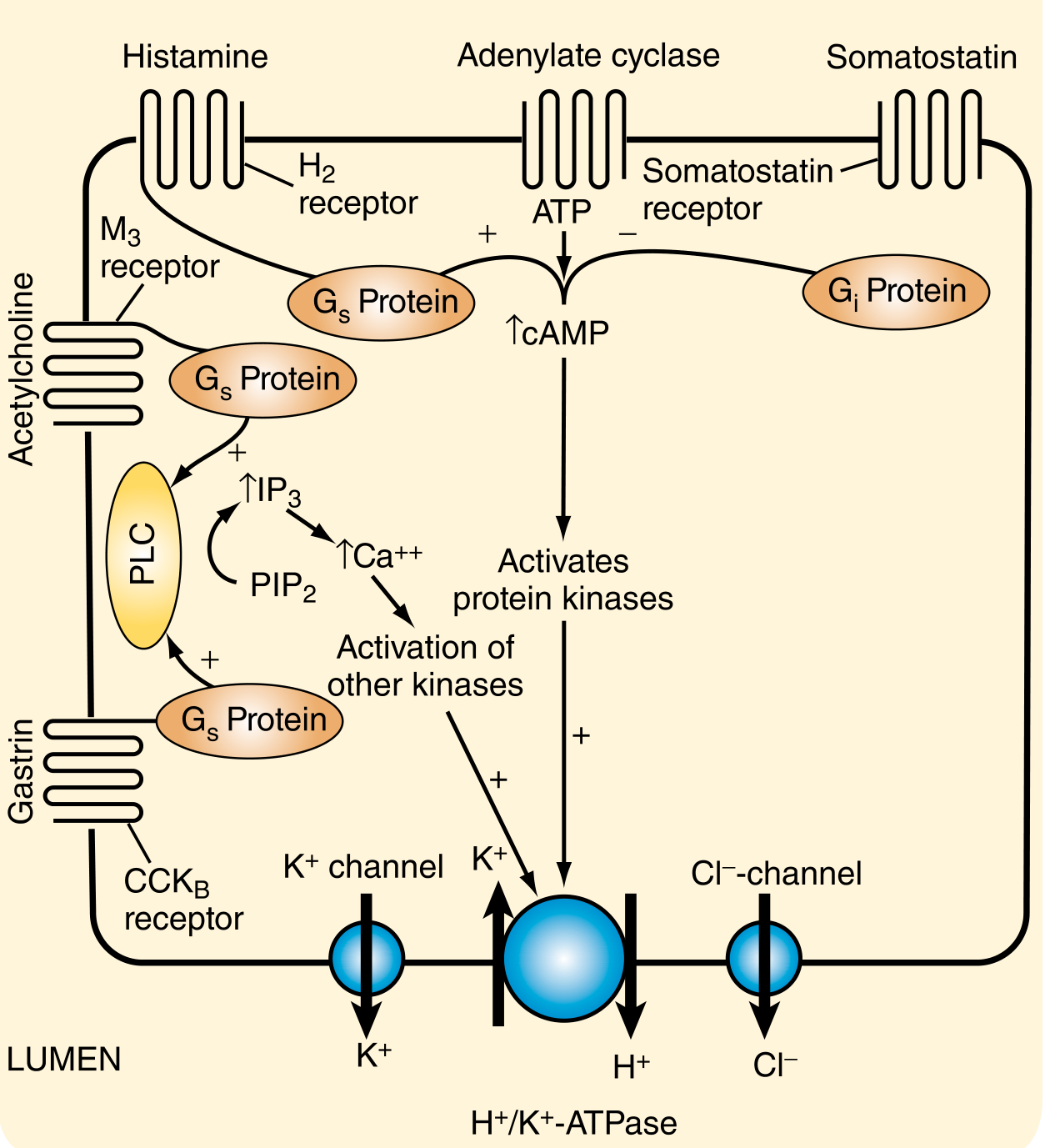
- Sabiston Textbook of Surgery, 11th ed.
3. Intracellular Signal Transduction Pathways
| Stimulant | Receptor | 2nd Messenger | Effector |
|---|---|---|---|
| Histamine | H2 receptor | cAMP (via adenylate cyclase/Gs protein) | Protein kinase A → activates H+/K+-ATPase |
| Gastrin | CCK-B (CCK2) receptor | IP3/Ca2+ (via PLC/Gs protein) | Protein kinase C → activates H+/K+-ATPase |
| Acetylcholine | M3 muscarinic receptor | IP3/Ca2+ (via phospholipase C) | Protein kinase C → activates H+/K+-ATPase |
- Yamada's Textbook of Gastroenterology, Sabiston Textbook of Surgery
4. Three Phases of Gastric Acid Secretion
| Phase | Trigger | Mechanism | % of Total |
|---|---|---|---|
| Cephalic | Sight, smell, taste, thought of food | Vagal stimulation → ACh release | ~30-50% |
| Gastric | Food entering stomach; gastric distension | G cells release gastrin; local ACh | ~40-50% |
| Intestinal | Digested protein in duodenum | Intestinal gastrin; enterogastrones | ~10% |
- Yamada's Textbook of Gastroenterology, 7th ed.
Factors Influencing HCl Formation
Stimulatory Factors
- Released from vagal and parasympathetic ganglion cells
- Acts directly on M3 receptors on parietal cells (via IP3/Ca2+ pathway)
- Also acts on M2/M4 receptors on D cells to inhibit somatostatin, removing the brake on acid secretion
- Central vagal activity (thought, smell, taste of food) accounts for approximately half of post-meal acid secretion
- Produced by G cells in the gastric antrum (also small intestine, pancreas)
- Active forms: G17 (dominant post-meal) and G34 (dominant during fasting)
- Acts directly on parietal cell CCK-B receptors and indirectly by stimulating histamine release from ECL cells
- Stimulated by: ACh, GRP, secretin, 5-HT, amino acids, proteins, calcium, capsaicin, fermented alcoholic drinks
- Stored in ECL cells (enterochromaffin-like cells) and mast cells in the oxyntic mucosa
- Acts via H2 receptors on parietal cells (cAMP pathway)
- H2 receptor antagonists almost completely abolish acid secretion in response to both gastrin and ACh, making histamine an obligate intermediary
- Histamine release from ECL cells is stimulated by gastrin, VIP, ghrelin, ACh, and epinephrine
- A 28-amino acid peptide from P/D1 cells of the fundal oxyntic glands
- Upregulated during fasting; increases gastric acid secretion via vagal and histamine-mediated mechanisms
- Orexin-A (via gastrin-mediated mechanism)
- PACAP (complex, ECL cell-mediated effects)
- b-adrenergic agonists
Inhibitory Factors
- Produced by D cells in the gastric antrum and corpus
- Acts via SSTR2 receptors (Gi protein) on G cells (inhibits gastrin), ECL cells (inhibits histamine), and parietal cells directly
- Release is stimulated by: luminal acidity, gastrin, CGRP, GRP, VIP, secretin, b-adrenergic agonists
- Represents the primary negative feedback - as luminal pH drops, somatostatin rises and shuts down further acid secretion
- Secretin - released in response to acid in the duodenum; stimulates somatostatin release
- CCK - inhibits acid by stimulating somatostatin release
- GLP-1, PYY, glucagon, neurotensin - various anti-secretory mechanisms
- ANP, EGF, leptin, TGF-a - additional inhibitory peptides
- Prostaglandins - inhibit histamine release from ECL cells
- When gastric pH falls below 3, direct stimulation of antral D cells releases somatostatin, which inhibits gastrin from G cells - classic negative feedback
- H2 receptor antagonists (famotidine, cimetidine) block the histamine pathway
- Proton pump inhibitors (omeprazole, lansoprazole) irreversibly block H+/K+-ATPase
- Potassium-competitive acid blockers (PCABs) - newer agents targeting the proton pump
Note on GERD (Gastroesophageal Reflux Disease)
Definition
- Mulholland and Greenfield's Surgery, 7th ed.; Robbins & Kumar Basic Pathology
Pathophysiology
- Adequate LES length, with sufficient intra-abdominal portion
- Adequate sphincter pressure (normal: 10-45 mmHg)
- Correct angle of His and normal crural anatomy
- Appropriate (but not excessive) LES relaxations during swallowing
- Normal esophageal motility
- Fischer's Mastery of Surgery, 8th ed.
Contributing Factors
| Factor | Mechanism |
|---|---|
| Obesity/abdominal fat | Increases intra-abdominal pressure, reduces LES pressure and intra-abdominal LES length; increases gastric acid production; may be mediated in part by elevated estrogen levels |
| Hiatal hernia | Disrupts the anatomical barrier - stomach herniates into thorax, eliminating the crural contribution to LES competence |
| Pregnancy | Progesterone reduces LES tone; growing uterus increases intra-abdominal pressure |
| Fatty foods, alcohol, chocolate, peppermint | Decrease LES tone |
| Smoking | Reduces LES pressure, impairs esophageal clearance |
| Lying supine/recumbent | Eliminates gravity assistance for esophageal clearance |
| Medications | Nitrates, calcium channel blockers, anticholinergics, theophylline reduce LES tone |
| Delayed gastric emptying | Increased gastric volume and pressure |
| Bile reflux | Can exacerbate mucosal damage beyond acid alone |
| Zollinger-Ellison syndrome | Markedly elevated gastrin causes excessive HCl output |
Clinical Features
- Heartburn (pyrosis) - the most common symptom; retrosternal burning
- Regurgitation - sour/bitter taste of gastric contents rising to the pharynx
- Dysphagia - difficulty swallowing (may suggest stricture)
- Chest pain - can mimic cardiac disease
- Extra-esophageal manifestations: chronic cough, asthma/wheeze (acid micro-aspiration or vagally mediated bronchospasm), hoarseness, laryngitis, dental enamel erosion (palatal surfaces of maxillary teeth)
- Robbins & Kumar; Sleisenger and Fordtran's GI and Liver Disease
Complications
| Complication | Notes |
|---|---|
| Erosive esophagitis | Endoscopic erythema; eosinophils then neutrophils in mucosa on histology |
| Esophageal ulceration | With risk of hematemesis and melena |
| Peptic stricture | From fibrosis; causes progressive dysphagia |
| Barrett's esophagus | Metaplasia of squamous to specialized intestinal columnar epithelium; precursor to esophageal adenocarcinoma |
| Esophageal adenocarcinoma | Obesity-GERD-Barrett's is the strongest risk pathway; RR 4.8 in some studies |
Histology of GERD
- Mild GERD: mucosa often unremarkable
- Established GERD: intraepithelial eosinophils (early), followed by neutrophil infiltration (more severe injury)
- Basal zone hyperplasia and elongation of lamina propria papillae
- Symptom severity does not correlate closely with histological severity
Treatment
-
Lifestyle modifications: Weight loss (proven to reduce GERD in RCTs), elevation of head of bed, avoiding trigger foods (fat, alcohol, chocolate, mint), not eating 2-3 hours before lying down, smoking cessation
-
Antacids: For intermittent mild symptoms; immediate but short-lived relief
-
H2 receptor antagonists (famotidine): Block the histamine pathway; moderate efficacy; tachyphylaxis develops with chronic use
-
Proton pump inhibitors (PPIs) (omeprazole, lansoprazole, esomeprazole): Most effective medical therapy; block the H+/K+-ATPase irreversibly; once-daily dosing heals erosive esophagitis and provides symptom relief in the vast majority
-
Surgical therapy (Nissen fundoplication, laparoscopic): For patients with refractory symptoms, large hiatal hernias, or Barrett's esophagus who fail or cannot tolerate medical therapy
- Robbins & Kumar Basic Pathology; Katzung's Basic and Clinical Pharmacology, 16th ed.; Fischer's Mastery of Surgery, 8th ed.; Yamada's Textbook of Gastroenterology, 7th ed.
Create a detailed flowchart diagram of HCl regulation and intracellular signaling
Detailed scientific flowchart diagram of gastric HCl regulation and intracellular signaling in the parietal cell. The diagram should show: TOP SECTION - Three stimulatory inputs with distinct colors: 1. ACETYLCHOLINE (ACh) - blue pathway: Vagus nerve → ACh → M3 muscarinic receptor → Gs protein → Phospholipase C (PLC) → PIP2 → IP3 + DAG → Ca2+ release from ER → Protein Kinase C activation 2. GASTRIN - green pathway: G cells (antrum) → Gastrin (G17/G34) → CCK-B receptor → Gs protein → PLC → IP3 → Ca2+ → Protein Kinase C activation 3. HISTAMINE - orange pathway: ECL cells → Histamine → H2 receptor → Gs protein → Adenylate Cyclase → ATP → cAMP ↑ → Protein Kinase A (PKA) activation CENTER - PARIETAL CELL box showing convergence of all three pathways onto the H+/K+-ATPase proton pump INHIBITORY PATHWAY - red: Somatostatin from D cells → SSTR2 receptor → Gi protein → inhibits Adenylate Cyclase → cAMP ↓ → INHIBITION of proton pump BOTTOM SECTION - Final effector mechanism: Tubulovesicles (resting) → Activation → Fusion with apical canaliculi → H+/K+-ATPase activated → H+ secreted into lumen (exchange for K+) → Cl- channel opens → Cl- enters lumen → H+ + Cl- = HCl formed Basolateral side: HCO3- exchanged for Cl- (alkaline tide) Three phases box on the side: Cephalic phase (vagus/CNS), Gastric phase (food/distension), Intestinal phase (enterogastrones) Style: Clean professional medical diagram, white background, color-coded pathways, bold arrows, labeled boxes with borders, clear hierarchy from top stimuli down to HCl production at the bottom
404 Not Found. {'message': '{\n "error": {\n "code": 404,\n "message": "Publisher model `projects/engaged-beaker-474810-u2/locations/global/publishers/google/models/gemini-3-pro-image-preview` was not found or your project does not have access to it. Ensure you are using a valid model name and that the model is available in the specified region. For more information, see: https://docs.cloud.google.com/gemini-enterprise-agent-platform/resources/locations.",\n "status": "NOT_FOUND"\n }\n}\n', 'status': 'Not Found'}
We encountered an error while processing your request. Please try again or reach out to us for help.