
Psoriasis
Reading File
Finding Sources
Searching PubMed
"psoriasis"[MeSH Terms] AND ("treatment"[MeSH Terms] OR "pathogenesis"[MeSH Terms])
Reading File
Finding Sources
Searching PubMed
psoriasis AND biologics
Reading File
Reading File
Reading File
Finding Sources
Reading File
Reading File
Reading File
Reading File
Reading File
Loading Image
Loading Image
Now I have comprehensive information to provide a thorough overview of psoriasis. Let me compile everything.
Psoriasis
Definition & Epidemiology
Psoriasis is a chronic, immune-mediated inflammatory disorder of the skin characterized by circumscribed, erythematous, dry, scaling plaques covered by silvery-white lamellar scales. It affects approximately 3% of the general population, with equal sex distribution. About one third of patients have a positive family history. Onset shows a bimodal distribution — peaks at age 22.5 years and again at 55 years.
Pathogenesis
Psoriasis involves both innate and adaptive immune systems, resulting in abnormal keratinocyte proliferation. The key cellular and molecular events:
- Antigen-presenting cells are activated, driving differentiation of T_H1 and T_H17 cells
- The T_H17/IL-17 pathway is now recognized as playing the most significant role (previously thought to be primarily T_H1-mediated)
- Key inflammatory mediators: IL-17, IL-23, TNF-α
- The dermal infiltrate consists predominantly of Th1- and Th17-polarized memory T cells, plus neutrophils, macrophages, and increased dendritic cells
- Chemokines recruit both neutrophils (forming Munro abscesses in the epidermis) and lymphocytes (epidermotropism)
- Vascular remodeling: capillary loops in papillary dermis elongate, "kiss" the epidermis, and remodel to resemble postcapillary venules, allowing leukocyte extravasation into papillary tips — the histological "squirting papillae" sign
Genetics: Polygenic inheritance; strongly associated with HLA-Cw6. Genome-wide studies have identified >85 non-MHC loci increasing psoriasis risk. A 2025 GWAS meta-analysis identified new susceptibility alleles impacting disease mechanisms and therapeutic targets (PMID: 40021644).
Clinical Forms
| Type | Features |
|---|---|
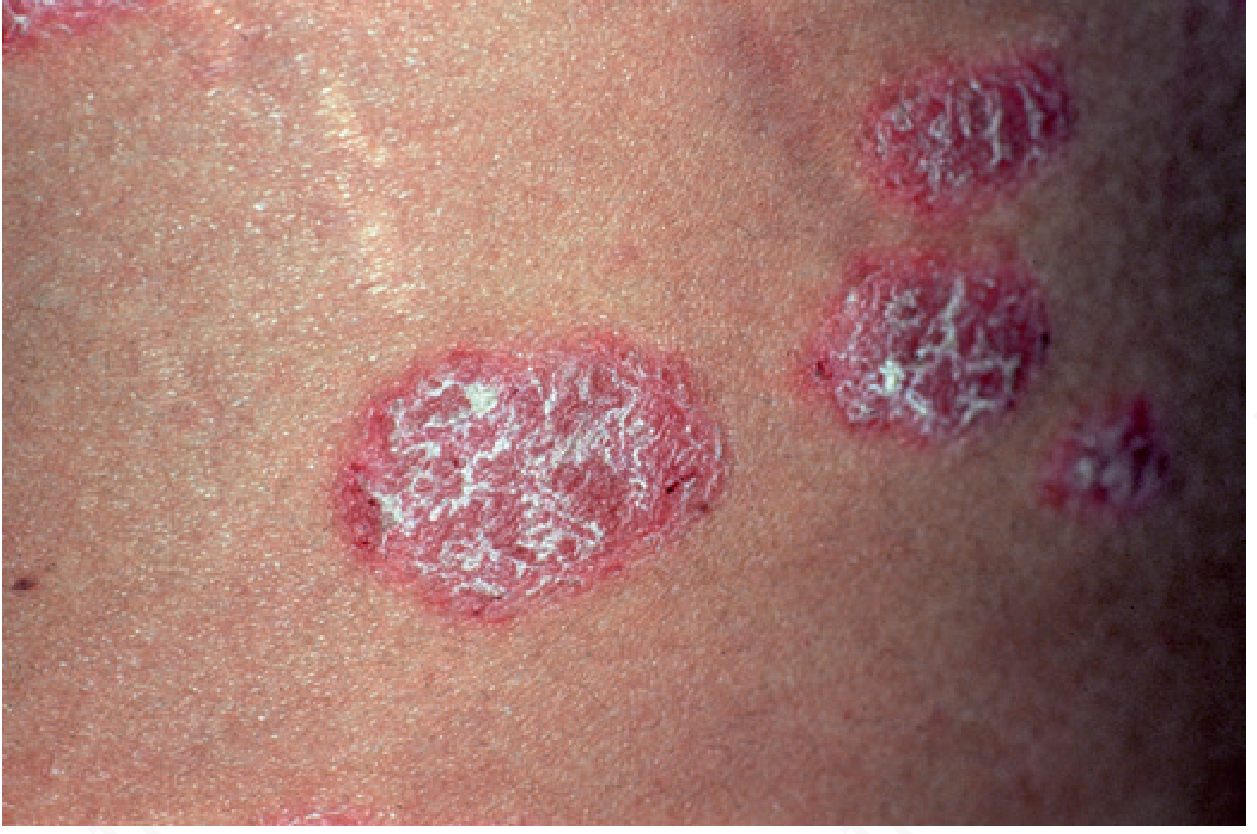
| Psoriasis vulgaris (most common) | Persistent erythematous plaques with silvery scales; predilection for elbows, knees, scalp, sacrum, umbilicus |
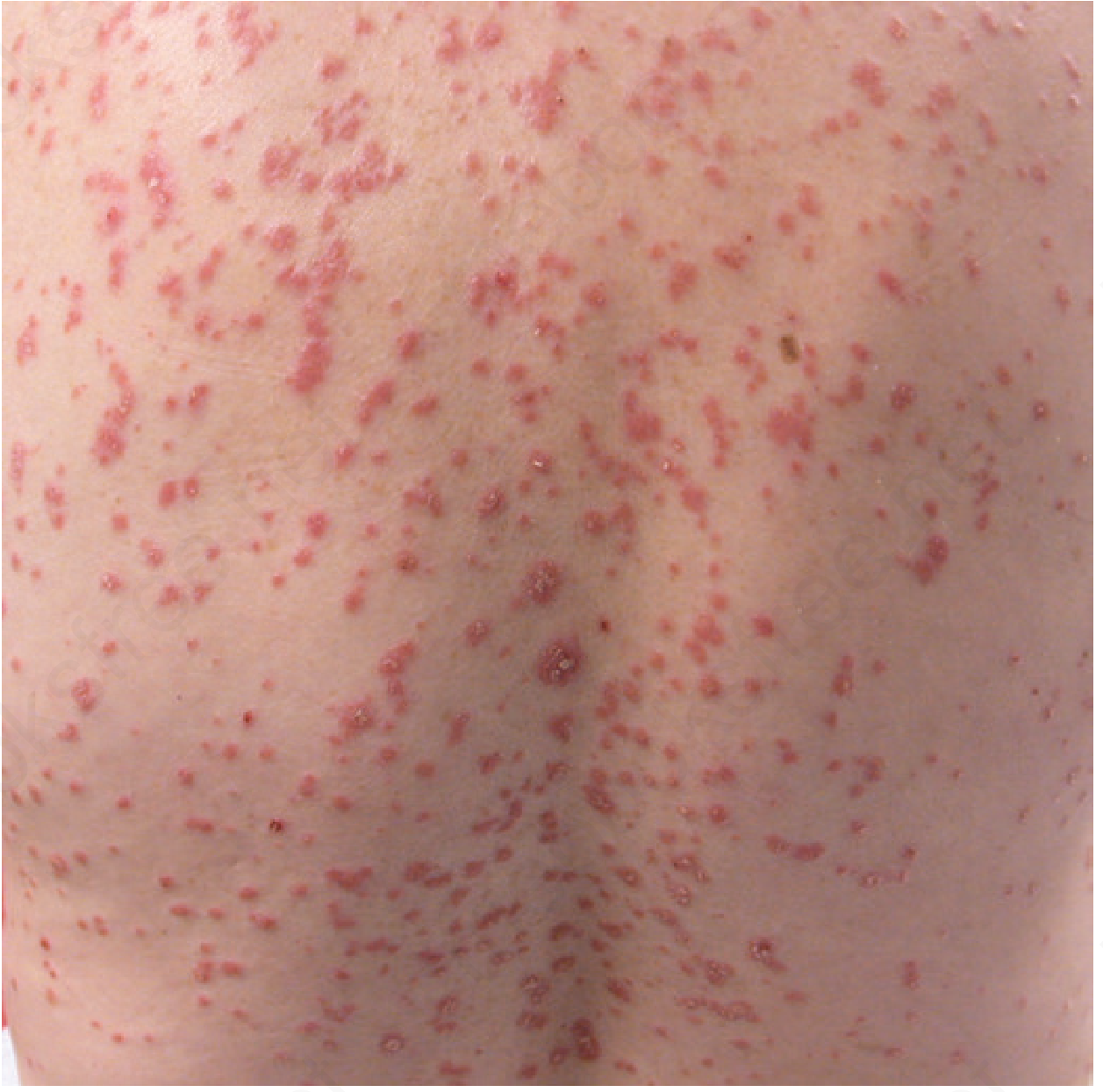
| Guttate psoriasis | Small droplike (2–10 mm) scaly papules scattered widely; triggered by streptococcal infection |
| Inverse psoriasis | Erythematous, shiny patches in skin folds (groin, axilla, inframammary); scales absent due to friction |
| Pustular psoriasis | Generalized (von Zumbusch) — 2–3 mm pustules with fever, hypocalcemia; palmoplantar (chronic) |
| Erythrodermic psoriasis | Widespread erythrodermia with fine silvery scales; systemic toxicity |
| Nail psoriasis | Pitting, "oil drop" / "oil spot" sign (salmon macule under nail plate), onycholysis, onychodystrophy |
| Palmoplantar psoriasis | Keratotic scaly patches on palms/soles, often with fissures |
Guttate psoriasis:
Plaque psoriasis (psoriasis vulgaris):
Key Clinical Signs
- Auspitz sign: pinpoint bleeding when scales are removed (exposure of dilated capillaries)
- Köbner (isomorphic) phenomenon: new psoriatic lesions at sites of skin trauma
- Auspitz sign and squirting papillae on histology
- Scales are micaceous — peel in layers, looser at periphery, adherent centrally
- Old thick plaques may resemble oyster shells (psoriasis ostracea)
Systemic Associations
- Psoriatic arthritis: 5–30% of patients; in ~20% it precedes skin lesions
- Chronic kidney disease
- Inflammatory bowel disease
- Hepatic disease
- Cardiovascular disease / metabolic syndrome
- Certain malignancies and infections
Treatment
Topical (mild–moderate)
- Corticosteroids (mainstay)
- Vitamin D analogues (calcipotriol/calcitriol)
- Calcineurin inhibitors (tacrolimus, pimecrolimus) — especially for inverse/facial psoriasis
- Keratolytics (salicylic acid, urea) — to reduce hyperkeratosis and scale
Phototherapy (moderate–severe)
- Narrowband UVB (NB-UVB) — 2–3 times/week
- PUVA (psoralen + UVA)
Conventional Systemic
- Methotrexate — folate antagonist; anti-proliferative and anti-inflammatory
- Cyclosporine — calcineurin inhibitor
- Acitretin — retinoid
- Apremilast — PDE4 inhibitor; reduces inflammatory cytokine expression
Biologics (moderate–severe; targeted immunotherapy)
Targets the specific pathogenic cytokines:
| Target | Drug Class | Examples |
|---|---|---|
| TNF-α | Anti-TNF | Etanercept, adalimumab, infliximab |
| IL-12/23 (p40) | Anti-IL-12/23 | Ustekinumab |
| IL-23 (p19) | Anti-IL-23 | Risankizumab, guselkumab, tildrakizumab |
| IL-17A | Anti-IL-17A | Secukinumab, ixekizumab |
| IL-17RA | Anti-IL-17 receptor | Brodalumab |
Small Molecules
- JAK inhibitors (deucravacitinib, tofacitinib) — block JAK-STAT signaling downstream of IL-17/IL-23
- PDE4 inhibitors (apremilast)
- S1PR1 modulators — under evaluation for lymphocyte trafficking regulation
A 2024 systematic review and meta-analysis confirmed efficacy of biologics for generalized pustular psoriasis (PMID: 39469713).
Histology
- Epidermal: acanthosis (epidermal hyperplasia), parakeratosis (retained nuclei in stratum corneum), hypogranulosis, Munro microabscesses (neutrophils in stratum corneum), spongiform pustules of Kogoj (in spinous layer)
- Dermal: elongated, clubbed rete ridges; thinning of suprapapillary plates; dilated, tortuous capillaries in papillary dermis; mixed lymphocytic and neutrophilic infiltrate
Sources: Andrews' Diseases of the Skin, Goldman-Cecil Medicine, Goodman & Gilman's Pharmacological Basis of Therapeutics, Fitzpatrick's Dermatology
This is a shared conversation. Sign in to Orris to start your own chat.