
Step wise general clinic management of melesma
melasma management treatment guidelines
melasma facial hyperpigmentation clinical appearance
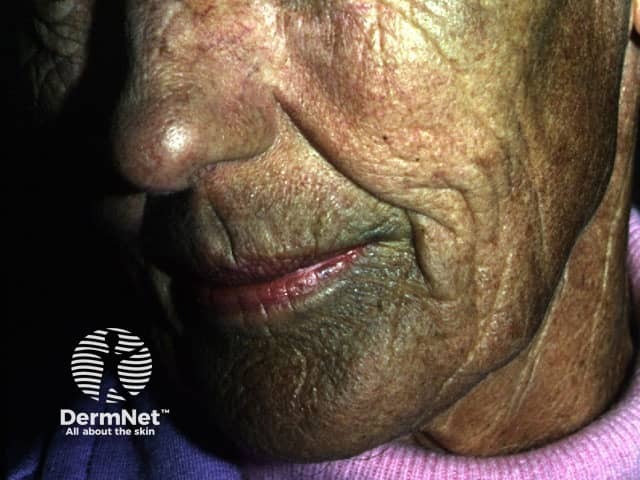
Clinical photograph showing diffuse facial hyperpigmentation in an older adult. The frontal/anterior view reveals slate-gray to brown pigmented patches across sun-exposed facial surfaces, including the cheeks, nasal bridge, perioral area, and forehead. The pigment is diffuse, bilateral, and relatively uniform in intensity, with mild textural roughness and signs of chronically sun-damaged skin but no acute edema or inflammation. The appearance is characteristic of phenothiazine drug-induced hyperpigmentation (notably chlorpromazine or related agents), in which dermal deposition of drug-derived pigment and increased melanin production produce a slate-gray hue. Ultraviolet exposure may accentuate color. Differential diagnoses include melasma, solar lentigines, post-inflammatory hyperpigmentation, and hemochromatosis pigments. Clinically, the finding correlates with long-term phenothiazine therapy and may improve after drug withdrawal, though persistence is common. Histology (if pursued) typically shows pigmented macrophages in the dermis with pigment incontinence; treatment emphasizes sun protection and cosmetic camouflage, with consideration of drug replacement if feasible. Relevance spans dermatology, psychopharmacology, and medical education for recognition, differential diagnosis, and management planning. This single frontal image provides a clear example of drug-related facial hyperpigmentation for teaching, case documentation, and research annotation. Clinical implication includes distinguishing drug-induced causes from pigmentary disorders and documenting onset, exposure duration, and pharmacotherapy.
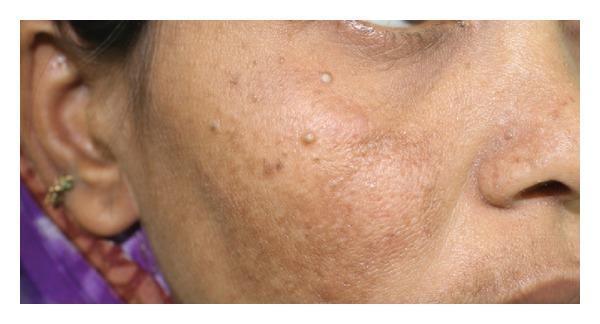
This clinical photograph displays a close-up view of the right mid-face, focusing on the malar region and nose. The image demonstrates multiple facial trichilemmomas, which present as small, discrete, flat-topped papules. These lesions range in size from approximately 1 to 5 mm in diameter. The distribution is clustered over the right malar bone, with additional smaller papules visible on the nasal ala. While most papules are skin-colored, several prominent lesions exhibit a paler, translucent, or pearly white appearance. The surrounding skin shows secondary features including fine textural irregularities and areas of hyperpigmentation (melasma-like patches). This visual is representative of the dermatological manifestations of Cowden syndrome, where multiple facial trichilemmomas serve as a key diagnostic indicator. The image is intended for medical education in dermatology and genetics to aid in the recognition of benign follicular neoplasia and its systemic associations.
Step-wise General Clinic Management of Melasma
Step 1 - Initial Assessment and Diagnosis
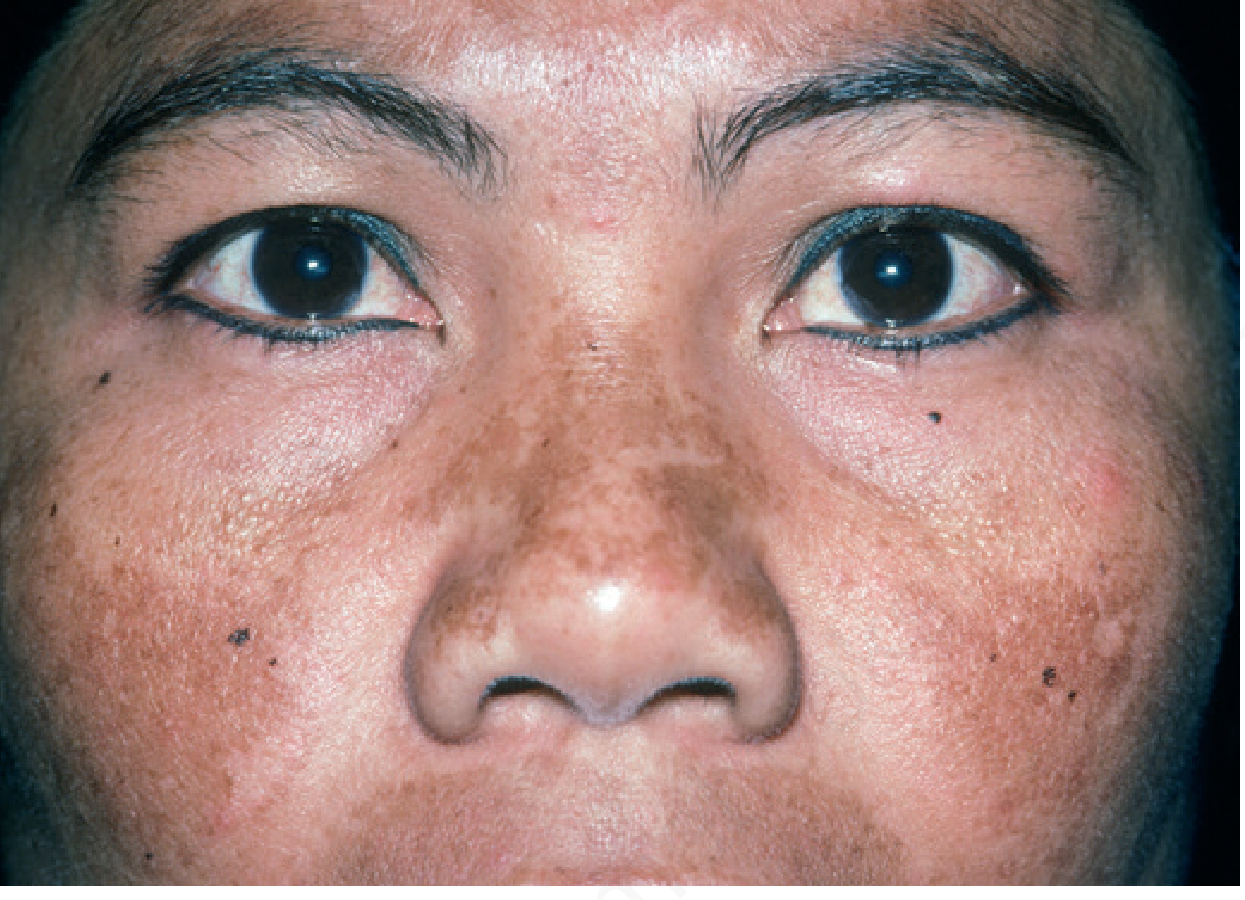
- Identify pattern: centrofacial (most common), malar, or mandibular
- Note skin phototype (Fitzpatrick I-VI) - types III-V most affected
- Wood's lamp examination: epidermal melasma shows accentuation; dermal melasma does not (though most cases are mixed)
- Document severity using the MASI (Melasma Area and Severity Index)
- Oral contraceptives (OCP) - discontinue if possible
- Hormone replacement therapy (HRT)
- Pregnancy ("mask of pregnancy" / chloasma)
- Phenytoin or finasteride therapy
- Sun exposure history
Note: Dermal melanin deposits respond poorly to topical agents - set realistic expectations with the patient.
Step 2 - Baseline Recommendations for ALL Patients
| Measure | Detail |
|---|---|
| Broad-spectrum sunscreen | SPF ≥30, ideally with physical blockers (zinc oxide, titanium dioxide); apply daily even on cloudy days; include iron oxide (blocks visible light, which also triggers melasma) |
| Sun-protective clothing | Wide-brimmed hats, UV-protective clothing |
| Avoid tanning beds | Complete avoidance |
| Camouflage makeup | With iron oxide component to block visible light |
| Discontinue hormonal triggers | Stop OCP/HRT if clinically feasible |
Step 3 - First-Line Active Topical Therapy
A. Triple Combination (Kligman's Formula) - Gold Standard
- Hydroquinone 4% + Tretinoin (retinoid) + mild topical corticosteroid (class 5-7, e.g., fluocinolone acetonide 0.01%)
- Applied at bedtime
- Use daily for 2-4 months, then taper to 1-2 times/week for maintenance
- Commercially available as Tri-Luma cream
- HQ: inhibits tyrosinase, blocking melanin synthesis
- Tretinoin: increases epidermal turnover, enhances HQ penetration
- Corticosteroid: reduces inflammation and irritation from the other two agents
- Perioral dermatitis and skin atrophy (steroid overuse)
- Exogenous ochronosis (HQ overuse - progressive darkening paradoxically)
- Fixed erythema, telangiectasias, acneiform eruptions, hypertrichosis
B. Hydroquinone Monotherapy (if triple combination not tolerated)
- 2% (OTC) to 4% (prescription) HQ applied once or twice daily
- Less effective than triple combination but still the monotherapy gold standard
- Tretinoin alone can reduce melasma but is less effective than HQ
C. Azelaic Acid (15-20%)
- Useful alternative, especially in pregnancy (pregnancy category B)
- Tyrosinase inhibitor; also has anti-inflammatory properties
Step 4 - Adjunctive Topical Therapies
| Agent | Concentration | Mechanism |
|---|---|---|
| L-ascorbic acid (Vitamin C) | 10-15% | Antioxidant, inhibits melanin polymerization |
| Kojic acid | 1-4% | Tyrosinase inhibitor |
| Tranexamic acid (topical) | 2-5% | Blocks plasminogen-keratinocyte interaction, reduces melanocyte stimulation |
| Niacinamide | 4% | Inhibits melanosome transfer to keratinocytes |
Step 5 - Adjunctive Oral Therapy
Oral Tranexamic Acid
- 250 mg twice daily for 8-12 weeks
- Inhibits UV-induced plasminogen activation in keratinocytes, reducing melanocyte stimulation
- Screen for thromboembolism risk factors before prescribing
- Recent systematic reviews (2024) confirm efficacy; tranexamic acid (oral and microneedling delivery) shows good safety and improvement in MASI scores
Step 6 - Second-Line Therapies (Chemical Peels)
- Glycolic acid peels: Start at 30%, increase as tolerated; every 4-6 weeks
- Salicylic acid peels: 20-30%; especially useful in oily/acne-prone skin
- TCA (trichloroacetic acid) peels: use with caution in darker skin types
- Tretinoin 1% peels: option in some protocols
Step 7 - Third-Line Therapies (Procedural / Light-Based)
| Procedure | Notes |
|---|---|
| Non-ablative fractional laser (e.g., Fraxel) | May create microchannels enhancing HQ absorption; 60% of skin types III-V showed 75-100% improvement in one study |
| Intense Pulsed Light (IPL) | Can improve melasma; high relapse rate |
| Low-fluence Q-switched Nd:YAG laser | Risk of increased pigmentation and punctate leucoderma; use cautiously |
| Picosecond lasers | Emerging option; less thermal damage |
| Er:YAG laser resurfacing | Temporary improvement, often followed by PIH |
Step 8 - Long-Term Maintenance (Mandatory)
- Daily SPF ≥30 broad-spectrum sunscreen - lifelong
- Topical retinoid (e.g., tretinoin 0.025-0.05%) - maintain collagen turnover
- Topical alpha-hydroxy acid (glycolic acid cream)
- Other depigmenting agents as tolerated: L-ascorbic acid, azelaic acid, kojic acid, tranexamic acid 2-5%
- Triple combination (HQ + retinoid + steroid) at reduced frequency: twice weekly
Summary Algorithm
ALL patients → Sun protection + eliminate triggers
          ↓
Step 3 → Triple combination (Kligman's formula) ± azelaic acid [2-6 months]
          ↓ (inadequate response)
Step 4+5 → Add adjunctive topicals + oral tranexamic acid
          ↓ (still inadequate)
Step 6 → Chemical peels (glycolic/salicylic acid)
          ↓ (refractory cases only)
Step 7 → Fractionated laser / IPL / picosecond laser (test spot first)
          ↓
Step 8 → Lifelong maintenance (sunscreen + retinoid + depigmenting agent)
Key Clinical Pearls
- Set realistic expectations - melasma is chronic and prone to relapse; improvement not cure is the goal
- Darker skin types (IV-VI) are at high risk for PIH from procedures - always test spot first
- Dermal melasma responds poorly to topical agents; procedures may be needed
- Pregnancy: avoid HQ and retinoids; azelaic acid is safe (category B)
- Exogenous ochronosis is a feared complication of prolonged HQ use (>2 years) - progressive paradoxical darkening; histology shows banana-shaped deposits
- Visible light triggers melasma just as UV does - iron oxide-containing sunscreens are preferred
What are the chances of recurrence
melasma recurrence relapse rate
melasma IPL laser recurrence relapse after treatment
PMID: 41378674
PMID: 36897459
melasma recurrence rate after treatment statistics percentage relapse
Recurrence of Melasma: What are the Chances?
The Bottom Line
Recurrence Rates by Treatment Type
| Treatment | Recurrence Rate | Timeframe |
|---|---|---|
| Topical (no maintenance) | 38-50% | Within 1 year |
| Triple combination cream (with maintenance) | ~47% | At 6 months (median relapse ~190 days) |
| IPL / Light-based therapy | ~50% | 3-6 months post-treatment |
| Q-switched Nd:YAG laser | Partial recurrence in nearly ALL cases | Within 12 weeks follow-up |
| Copper bromide laser | ~30% | At 6 months |
| Intradermal tranexamic acid injection | ~54-60% | At 24-48 weeks |
Key Statistics
- 50-70% of patients experience recurrence after treatment is stopped (if no maintenance is continued)
- Even with strict maintenance therapy (twice-weekly triple combination), only ~53% of patients remain relapse-free at 6 months - meaning nearly half relapse despite maintenance
- Recurrence can begin as early as 1-2 weeks after stopping triple combination therapy
- After IPL, approximately 50% relapse within 3-6 months - with one meta-analysis reporting 18.6% recurrence at 12 months for combination laser therapy (better, but still significant)
- After laser treatment, a 2025 meta-analysis (PMID 41378674) confirms significant MASI score improvements but notes recurrence as a consistent finding across 16 RCTs with 471 patients
Factors That Determine Recurrence Risk
High-risk factors (increases recurrence):
- Ongoing sun exposure - the single biggest driver; even incidental UV re-triggers melanogenesis
- Visible light exposure - often underestimated; penetrates ordinary sunscreens
- Continued hormonal triggers - ongoing OCP use, pregnancy, HRT
- Darker skin phototypes (IV-VI) - higher basal melanocyte activity
- Severe melasma at baseline - a key predictor; severe cases relapse earlier and more completely (relapse rate significantly higher than mild cases even with maintenance, per Arellano et al.)
- Dermal melasma - dermal melanophages are not cleared by topical agents and persist; these cases relapse faster
- Genetic predisposition - family history of melasma
- Non-compliance with maintenance - stopping sunscreen or depigmenting agents abruptly
Protective factors (reduces recurrence risk):
- Daily broad-spectrum SPF ≥30 with iron oxide (blocks visible light too)
- Strict sun avoidance, hats, UV-protective clothing
- Maintenance retinoid + depigmenting topical
- Eliminating hormonal triggers (stopping OCP)
Why Melasma Recurs So Readily
- Wnt pathway upregulation in melasma-affected skin remains after clinical clearing, keeping melanocytes primed
- Dermal melanophages persist after topical treatment and act as a reservoir
- Reduced WIF-1 expression (Wnt antagonist) is intrinsic, not corrected by treatment
- UV/visible light re-exposure continuously re-stimulates the hyperactive melanocytes that were never truly eliminated - only suppressed
- Hormonal influences are often ongoing and unavoidable (e.g., natural estrogen cycling)
Practical Implication for Clinic
"Recurrence is the norm despite recommended measures such as strict sun protection." - Dermatology 2-Volume Set 5e
- Counsel patients upfront - frame treatment as ongoing management, not a cure
- Lifelong photoprotection is non-negotiable, even after clearing
- Maintenance therapy (retinoid + depigmenting agent) reduces but does not eliminate relapse risk
- Seasonal variation is common - melasma worsens every summer, even in treated patients
- Avoid over-treating with procedures in dark skin types - PIH from aggressive laser/peels can be harder to treat than the original melasma
Melesma with acne management step wise
melasma acne coexisting treatment management
azelaic acid acne hyperpigmentation dual treatment
melasma with acne vulgaris concurrent management treatment protocol dermatology 2024
Step-wise General Clinic Management of Melasma with Acne
Understanding the Clinical Challenge
| Standard Melasma Rx | Problem with Acne |
|---|---|
| Topical corticosteroid (Kligman's formula) | Worsens acne - comedogenic, induces perioral dermatitis, steroid acne |
| Hydroquinone (HQ) | Can cause irritant dermatitis - triggers PIH if acne flares |
| IPL / laser procedures | Contraindicated over active inflamed acne - risk of PIH |
| Occlusive moisturizers | Can block pores and worsen acne |
| Standard Acne Rx | Problem with Melasma |
|---|---|
| Benzoyl peroxide (BPO) | Oxidising agent - can bleach/fade fabric; causes irritation triggering PIH |
| Topical antibiotics alone | Does not address pigment; may worsen PIH if not paired correctly |
| Heavy sunscreens | Some chemical sunscreens are comedogenic |
Key principle: Acne must be controlled FIRST (or simultaneously with gentle agents) before aggressively treating melasma - active acne causes PIH which worsens pigmentation.
Step 1 - Full Initial Assessment
- Acne severity: Mild / Moderate / Severe (comedonal, inflammatory, nodulocystic)
- Melasma severity: MASI score, distribution (centrofacial / malar / mandibular)
- Skin phototype (Fitzpatrick I-VI) - darker types have higher PIH risk
- Hormonal history: OCP use, menstrual irregularity, PCOS
- Current medications: anything comedogenic or photosensitising
- Wood's lamp: epidermal vs dermal vs mixed melasma
Step 2 - Universal Baseline Measures (ALL patients, Day 1)
Photoprotection - Non-negotiable
- Broad-spectrum SPF ≥30 with physical blockers (zinc oxide / titanium dioxide) - choose non-comedogenic formulations (gel-based or fluid textures, not cream-based)
- Add iron oxide component to block visible light
- Wide-brimmed hat, sun-protective clothing
- Avoid tanning beds
Skin Care Hygiene
- Gentle, non-comedogenic, non-soap cleanser (foam or gel) twice daily
- Avoid heavy, occlusive moisturizers - use lightweight, oil-free, non-comedogenic options
- No scrubbing or mechanical exfoliation over active acne
- Discontinue OCP if feasible (reduces both hormonal acne and melasma triggers)
Step 3 - First-Line Active Treatment (Weeks 1-12)
Choose agents that address BOTH conditions simultaneously - the "dual-duty" approach
3A. AZELAIC ACID - the ANCHOR agent in this combination
| Property | Benefit |
|---|---|
| Inhibits tyrosinase | Treats melasma directly |
| Selective cytotoxic effect on hyperactive melanocytes | Reduces pigmentation without bleaching normal skin |
| Antimicrobial against Cutibacterium acnes and S. epidermidis | Treats inflammatory acne |
| Anticomedogenic (modifies epidermal keratinization) | Reduces comedones |
| Anti-inflammatory (reduces neutrophil free radical production) | Reduces PIH from acne lesions |
| Safe in pregnancy (Category B) | Suitable for pregnant patients with melasma + acne |
3B. TOPICAL RETINOID - the "two-for-one" agent
- Treats acne by normalizing follicular keratinization and reducing comedones
- Treats melasma by increasing epidermal turnover and enhancing depigmenting agent penetration
- Reduces PIH from existing acne scars
- Use adapalene gel if irritation is a concern (better tolerability than tretinoin, especially in darker skin types)
- Start low and slow (every other night for 2 weeks, then nightly) to avoid retinoid dermatitis - which itself can trigger PIH
Note: Do NOT combine tretinoin with a topical steroid as in classic Kligman's formula - the steroid component must be dropped when acne is present.
3C. BENZOYL PEROXIDE (BPO) - use cautiously, strategically
- BPO 2.5-5% wash or leave-on gel for acne
- Do NOT apply over melasma areas - can cause irritation and paradoxical PIH in darker skin types
- If using: apply only to acne-predominant areas (e.g. forehead, jawline), avoid malar/centrofacial melasma zones
- Wash-off formulations preferred over leave-on in darker skin types
- Combine with topical antibiotic (clindamycin or erythromycin) to prevent antibiotic resistance per AAD 2024 guidelines
3D. TOPICAL ANTIBIOTICS
- Clindamycin 1% gel or lotion - for inflammatory acne over non-melasma zones
- Never as monotherapy (antibiotic resistance) - always combine with BPO or retinoid
- Clindamycin has mild anti-inflammatory effect that may reduce PIH indirectly
- Apply in AM; retinoid / azelaic acid at night
Sample AM/PM Routine at Step 3
| Time | Product |
|---|---|
| Morning | Gentle cleanser → Azelaic acid 15% gel (all face) → Non-comedogenic SPF ≥30 sunscreen |
| Evening | Gentle cleanser → Tretinoin 0.025-0.05% or Adapalene 0.1% (all face) → Azelaic acid (optional, can use once daily if retinoid irritation) |
| Acne-prone zones only (if needed) | BPO 2.5-5% wash in AM |
Step 4 - Add Adjunctive Depigmenting Agents (Weeks 4-12, once acne is controlled)
| Agent | Dose | Role |
|---|---|---|
| Hydroquinone 4% | Once daily (evening, after retinoid is tolerated) | Melasma; use WITHOUT steroid component |
| Topical Tranexamic acid 2-5% | AM or PM | Melasma + reduces inflammation-driven pigmentation; no acne interaction |
| Niacinamide 4-5% | AM | Inhibits melanosome transfer; also reduces sebum production (helps acne); anti-inflammatory |
| Vitamin C (L-ascorbic acid) 10-15% | AM (under sunscreen) | Melasma + antioxidant; can reduce PIH from acne |
| Kojic acid 1-4% | PM | Tyrosinase inhibitor for melasma |
Step 5 - Systemic Therapy (Moderate-Severe Acne, or Inadequate Topical Response)
5A. Oral Antibiotics (for moderate-severe inflammatory acne)
- Doxycycline 100mg once or twice daily - first choice (AAD 2024 guideline)
- Limit to 3 months maximum to minimize resistance
- Always combine with topical BPO to prevent resistance
- Photosensitizing effect of doxycycline - counsel patient to be especially strict with SPF; can worsen melasma if sun protection is lax
- Avoid tetracyclines if patient is pregnant or <12 years
5B. Oral Tranexamic Acid (for melasma component)
- 250 mg twice daily for 8-12 weeks
- Screen for thromboembolism risk before prescribing
- No interaction with acne treatments
- Systematic reviews (2024, PMID 38843906) confirm efficacy for melasma
5C. Hormonal therapy (if hormonal acne + melasma in women)
- Oral contraceptives (combined): Paradox - can help hormonal acne but may worsen melasma
- Prefer spironolactone 50-100mg/day (anti-androgen) for hormonal acne in women - does not directly worsen melasma and may help by reducing inflammation and PIH
- Avoid OCP if melasma is predominant concern; use spironolactone instead
5D. Isotretinoin (severe/nodulocystic acne)
- 20-40mg/day (weight-based) for severe acne failing topical + oral antibiotics
- Excellent choice when both conditions coexist in severe acne because:
- Clears acne completely, eliminating PIH trigger
- Reduces sebum - prevents new melasma-triggering inflammation
- Allows melasma treatment to work on a "clean slate"
- Counsel: isotretinoin causes photosensitivity - strict SPF is mandatory during therapy
- After isotretinoin course, melasma can be treated more aggressively
- REMS program enrollment mandatory (iPLEDGE in USA)
Step 6 - Procedures (After Active Acne is Controlled)
| Procedure | Role | Caution |
|---|---|---|
| Salicylic acid peels 20-30% | Beta-hydroxy acid; comedolytic (treats acne) + mild depigmenting effect | Every 4-6 weeks; best for acne + PIH; safe in skin types III-V with test spot |
| Glycolic acid peels 30-50% | Exfoliates comedones; reduces melasma | Risk of PIH in darker skin; start low (30%) |
| Microneedling | Enhances topical depigmenting agent penetration; minimal risk of PIH compared to lasers | Systematic review 2024 (PMID 39298769) supports microneedling + tranexamic acid for melasma |
| Non-ablative fractional laser | Refractory melasma; only after acne is fully cleared | Risk of triggering acne flare; high PIH risk in dark skin types |
| IPL | Melasma in lighter skin types | Absolute contraindication over active acne |
Step 7 - Long-Term Maintenance
- Daily non-comedogenic SPF ≥30 - lifelong
- Topical retinoid (adapalene 0.1%) - maintains both acne control and melasma prevention
- Azelaic acid twice weekly - prevents both pigment recurrence and comedone formation
- Niacinamide or vitamin C - ongoing depigmenting and anti-inflammatory maintenance
- Review and reassess every 3-6 months
- If OCP was continued for contraception, monitor melasma closely and consider switching to non-hormonal or progesterone-only options
Summary Algorithm
ASSESS: Acne severity + Melasma severity + Skin type
         ↓
STEP 2: Non-comedogenic SPF + gentle cleanser (ALL patients, Day 1)
         ↓
STEP 3: Azelaic acid 15-20% (dual-duty) + Retinoid PM + BPO (acne zones only)
         ↓ (4-6 weeks - acne inflammation controlled)
STEP 4: Add HQ 4% (no steroid) + Niacinamide + Tranexamic acid topical
         ↓ (moderate-severe acne or inadequate response)
STEP 5: Doxycycline (acne) + Oral tranexamic acid (melasma) ± Spironolactone (hormonal acne in women)
         Severe acne: consider isotretinoin - clears acne, enables aggressive melasma Rx after
         ↓ (acne cleared, only after active lesions resolved)
STEP 6: Salicylic acid peels / Microneedling + tranexamic acid
         ↓
STEP 7: Maintenance retinoid + azelaic acid + SPF (lifelong)
Key Clinical Pearls
- Avoid topical steroids in this combination - they worsen acne, cause steroid rosacea and perioral dermatitis, and lead to more PIH
- Azelaic acid is the cornerstone - the only single agent that treats acne, melasma, AND PIH simultaneously
- Control acne first, then address melasma - every active acne lesion is a PIH risk that undermines melasma treatment
- Doxycycline = photosensitiser - if prescribing for acne, redouble the emphasis on sun protection or melasma will worsen
- Spironolactone over OCP for hormonal acne in melasma patients - avoids the hormonal melasma trigger
- Gel/foam/fluid formulations preferred over creams - less comedogenic for acne-prone skin
- PIH from acne is epidermal and responds well to retinoids + azelaic acid - do not rush to add HQ until acne is controlled