
Teach me all types of hypersensitivity microbiology for university exam purposes
No need this much just flow chart
A clean educational flowchart titled "Hypersensitivity Reactions (Gell & Coombs Classification)" for university microbiology exam. Four branches flowing down from the main title: TYPE I - Immediate/Anaphylactic: Allergen → IgE on Mast Cells → Degranulation → Histamine, Leukotrienes → Examples: Anaphylaxis, Asthma, Hay Fever. Onset: Minutes. TYPE II - Cytotoxic: Antigen on Cell Surface → IgG/IgM binds → Complement activation + ADCC → Cell lysis/destruction → Examples: Hemolytic anemia, Transfusion reactions, Goodpasture syndrome. Onset: Hours. TYPE III - Immune Complex: Soluble Antigen + IgG → Immune Complex formation → Complement activation → Neutrophil recruitment → Tissue inflammation → Examples: Serum sickness, SLE, Post-streptococcal glomerulonephritis, Arthus reaction. Onset: Hours. TYPE IV - Delayed/Cell-mediated: Antigen → T-cell sensitization → Re-exposure → Th1/CD8+ T-cell activation → Cytokines/Cytotoxicity → Examples: Contact dermatitis, TB skin test (Mantoux), Transplant rejection. Onset: 24-72 hours. Color-coded boxes: Type I in orange, Type II in blue, Type III in purple, Type IV in green. Clear arrows, bold labels, white background, professional medical diagram style.
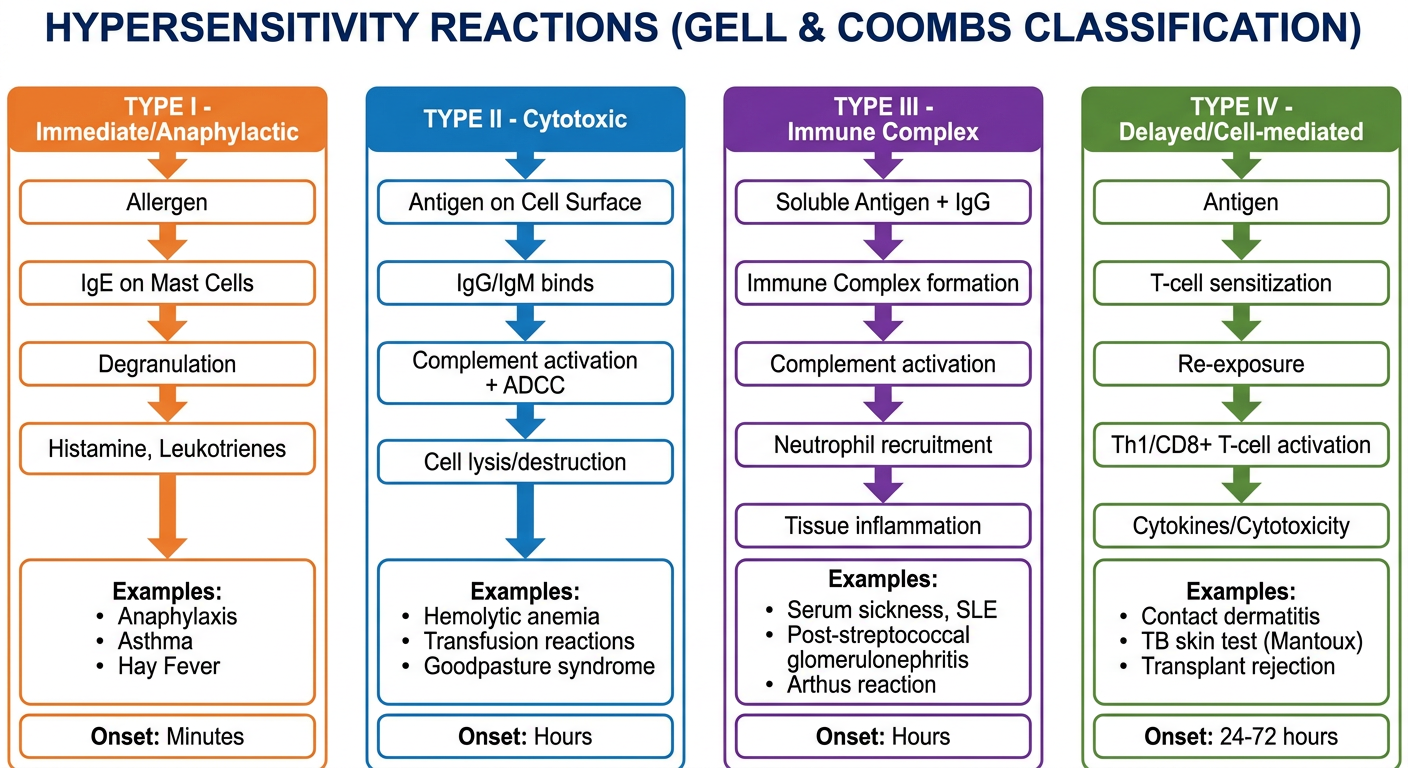
| Type | Name | Antibody/Cell | Onset |
|---|---|---|---|
| I | Anaphylactic | IgE | Minutes |
| II | Cytotoxic | IgG/IgM | Hours |
| III | Immune Complex | IgG complexes | Hours |
| IV | Delayed (DTH) | T-cells (no antibody) | 24-72 hrs |