
120/90 hypertension management
I'll check the medical library skill first before answering this clinical question.
Reading File
Now let me search the medical library and PubMed in parallel for hypertension management content.
Finding Sources
Searching PubMed
"hypertension" AND "management" AND "guidelines"
Let me search more specifically for hypertension content in the textbooks.
Finding Sources
Finding Sources
Reading File
Finding Sources
Reading File
Finding Sources
Finding Sources
Finding Sources
Reading File
Reading File
I now have rich content from multiple authoritative textbooks. Let me fetch the key management flowchart image and also get the pharmacology drug selection data.
Loading Image
Reading File
I now have comprehensive information from multiple authoritative textbooks plus the management flowchart. Let me compile the full answer.
Hypertension Management: BP 120/90 mmHg
Classification First
A reading of 120/90 mmHg is classified as Stage 1 Hypertension under ACC/AHA 2017 guidelines (SBP 130-139 or DBP 80-89 mmHg). Wait - 120 systolic is actually in the Elevated category (120-129), but 90 diastolic alone pushes it to Stage 1 Hypertension (DBP 80-89 mmHg). The higher category is always used when systolic and diastolic fall in different classes.
| Category | Systolic (mmHg) | Diastolic (mmHg) | |
|---|---|---|---|
| Normal | <120 | and | <80 |
| Elevated BP | 120-129 | or | <80 |
| Stage 1 HTN | 130-139 | or | 80-89 |
| Stage 2 HTN | ≥140 | or | ≥90 |
So 120/90 = Stage 1 Hypertension (driven by the diastolic of 90).
Management Flowchart (Harrison's 22e)
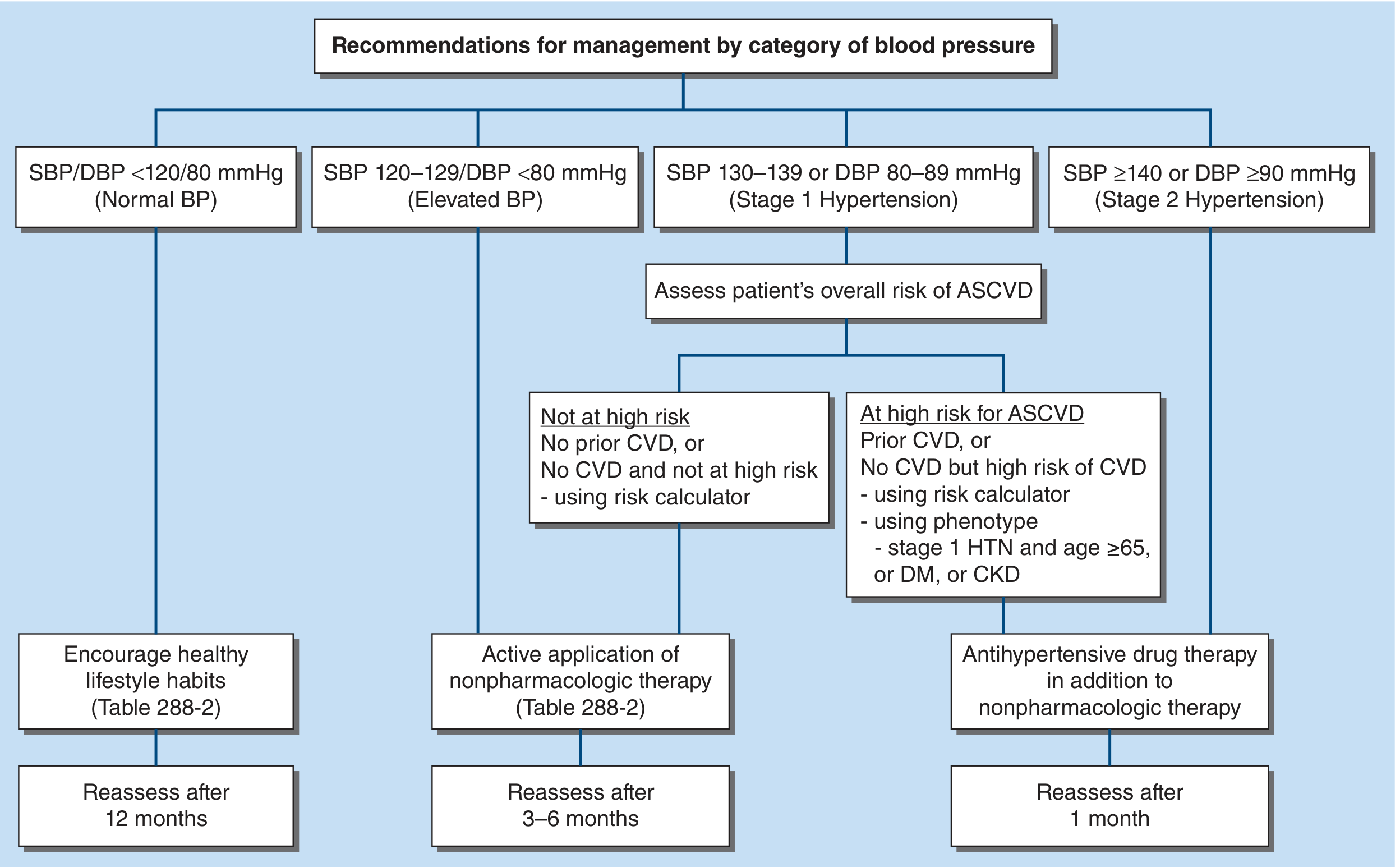
Step 1: Assess ASCVD Risk
The decision to start drug therapy at Stage 1 depends on 10-year ASCVD cardiovascular risk:
| Risk Profile | Action |
|---|---|
| Low risk (no prior CVD, 10-yr risk <10%) | Nonpharmacologic (lifestyle) therapy; reassess in 3-6 months |
| High risk (prior CVD, 10-yr risk ≥10%, age ≥65, DM, or CKD) | Lifestyle + antihypertensive drug therapy; reassess in 1 month |
- Lippincott Pharmacology, p. 288; Harrison's 22e, p. 2184; Fuster & Hurst's The Heart, p. 250
Step 2: Lifestyle (Nonpharmacologic) Interventions
These apply to ALL patients regardless of drug therapy decision:
| Modification | Recommendation | Approximate SBP Reduction |
|---|---|---|
| Weight reduction | Maintain BMI 18.5-24.9 | 5-20 mmHg per 10 kg lost |
| DASH diet | High fruits/vegetables/whole grains, low fat/sodium | ~5 mmHg (SBP) |
| Sodium restriction | <2.4 g/day sodium | 2-8 mmHg |
| Physical activity | Aerobic exercise 30 min/day, most days | 4-9 mmHg |
| Alcohol moderation | ≤2 drinks/day (men), ≤1 drink/day (women) | 2-4 mmHg |
The DASH diet combined with sodium restriction and weight loss can achieve reductions comparable to a single antihypertensive drug in motivated patients. - Harrison's 22e, p. 2184; Park's Preventive Medicine; NKF Primer on Kidney Disease, p. 2528
Step 3: Pharmacotherapy
When to start drugs at Stage 1:
- 10-year ASCVD risk ≥10%
- Established CVD
- Diabetes mellitus
- CKD
- Age ≥65 years
- Failure to achieve BP control after 3-6 months of lifestyle therapy
First-Line Drug Classes (no compelling indication):
| Class | Examples | Notes |
|---|---|---|
| Thiazide/thiazide-like diuretics | Chlorthalidone (preferred), hydrochlorothiazide | Chlorthalidone preferred over HCTZ (longer-acting, better CV evidence) |
| Dihydropyridine CCBs | Amlodipine, nifedipine | Especially effective in Black patients and elderly |
| ACE Inhibitors | Lisinopril, enalapril | Avoid in pregnancy; preferred in CKD/DM with proteinuria |
| ARBs | Losartan, valsartan | Use if ACE inhibitor not tolerated (cough) |
- Beta-blockers are not recommended as first-line unless there is a compelling indication (e.g., heart failure, post-MI, angina). - Swanson's Family Medicine Review; Fuster & Hurst's The Heart
Two-drug combinations (when monotherapy is insufficient, or SBP ≥150/DBP ≥90):
- Diuretic + ACE inhibitor/ARB
- CCB + ACE inhibitor/ARB
- Avoid: ACE inhibitor + ARB combination (increases harm without added benefit)
Triple therapy: Diuretic + CCB + ACE inhibitor or ARB
Step 4: Treatment Targets
| Guideline | Target |
|---|---|
| ACC/AHA 2017 | <130/80 mmHg (most patients) |
| ESC/ESH | <140/90 mmHg initially, then <130/80 mmHg if tolerated; SBP not below 120 |
| Elderly (≥65, ambulatory) | SBP <130 mmHg (ACC/AHA); ESC: <140/80 but not below 130 |
| With CKD, DM, or stroke history | <130/80 mmHg if tolerated |
- Fuster & Hurst's The Heart, p. 250
Special Considerations
Compelling Indications - Drug of Choice:
| Condition | Preferred Agent |
|---|---|
| Heart failure / post-MI | Beta-blocker + ACE inhibitor/ARB + diuretic |
| CKD with proteinuria | ACE inhibitor or ARB |
| Diabetes mellitus | ACE inhibitor or ARB (renoprotective) |
| Angina | Beta-blocker or CCB |
| Pregnancy | Labetalol, nifedipine, methyldopa (avoid ACEi/ARBs) |
| Isolated systolic HTN (elderly) | Thiazide diuretic or dihydropyridine CCB |
| Benign prostatic hypertrophy | Alpha-blocker (doxazosin) |
When BP Is Urgently Elevated (SBP >180 or DBP >120)
- With target organ damage (papilledema, acute renal injury, heart failure): admission to ICU, parenteral therapy (e.g., IV labetalol, IV nicardipine)
- Without target organ damage: oral outpatient therapy; initial goal SBP/DBP <160/100 mmHg over several hours, then titrate to target
Recent Evidence Update
A 2025 systematic review (PMID 41390616) confirms current guideline-based management remains valid, with particular emphasis on individualized risk assessment for treatment initiation. A 2024 systematic review (PMID 38560900) highlights that inpatient elevated BPs are frequently undertreated and guidance varies across guidelines.
Bottom line for 120/90: This is Stage 1 Hypertension. Start with aggressive lifestyle modification. Add pharmacotherapy if ASCVD risk is high (≥10%), if the patient has DM/CKD/CVD/age ≥65, or if lifestyle alone fails after 3-6 months. Target BP <130/80 mmHg. First-line drugs: thiazide diuretic, CCB, ACE inhibitor, or ARB based on comorbidities and patient profile.
This is a shared conversation. Sign in to Orris to start your own chat.