
Short bowel syndrome full details
Reading File
Short Bowel Syndrome (SBS) results from extensive surgical resection of the small intestine, leaving insufficient absorptive surface area. It causes malabsorption, diarrhea, malnutrition, and dependence on parenteral nutrition. The clinical course depends heavily on the length and site of remaining bowel (ileum vs. jejunum), the ileocecal valve, and colon continuity.
Searching sources...
Finding Sources
Searching PubMed
"short bowel syndrome"[MeSH Terms] AND management
Searching Images
short bowel syndrome intestinal anatomy absorption diagram
Good - multiple authoritative sources found. Let me now read the key sections in parallel.
Reading File
Reading File
Reading File
Good content from multiple textbooks. Let me now get Harrison's and Schwartz's sections plus the bowel-lengthening procedure image.
Reading File
Reading File
Loading Image
Excellent content from Harrison's and Schwartz's. I also have the Sabiston/Fischer data from earlier. I now have everything needed for a comprehensive answer.
Short Bowel Syndrome (SBS) - Comprehensive Overview
Definition
Short Bowel Syndrome is a state of significant malabsorption resulting from extensive small bowel resection or bypass, leaving insufficient functional intestinal length. The anatomical threshold is generally <200 cm of residual small bowel in adults. Intestinal failure - the most severe form, requiring persistent parenteral nutrition (PN) dependence - is typically defined functionally as <100 cm of remaining small bowel with no colon in continuity, or <60 cm with an intact colon.
- Harrison's Principles of Internal Medicine 22E, p. 2591
- Schwartz's Principles of Surgery 11E, p. (block 14)
Etiology / Causes
Adults (most common):
- Acute mesenteric ischemia (arterial or venous thrombosis, infarction)
- Crohn's disease (cumulative repeated resections - 25% of adult SBS cases)
- Malignancy with extensive bowel involvement
- Trauma, volvulus, internal herniation
- Radiation enteritis
Pediatric:
- Necrotizing enterocolitis (NEC) - 35%
- Intestinal atresia - 25%
- Gastroschisis - 18%
- Midgut volvulus - 14%
75% of adult SBS cases result from a single large resection (e.g., mesenteric ischemia); 25% from cumulative multi-operative resections (typical in Crohn's disease).
- Goldman-Cecil Medicine International Edition, p. (block 17)
- Sabiston Textbook of Surgery, p. 2686
Pathophysiology
Mechanisms of Malabsorption
- Decreased absorptive surface area - the primary mechanism
- Decreased luminal bile salt concentration - especially after ileal resection
- Rapid intestinal transit - reduced contact time between nutrients and mucosa
- Bacterial overgrowth - due to motility changes, structural abnormalities, or loss of the ileocecal valve
- Gastric acid hypersecretion (hypergastrinemia) - persists for 1-2 years post-resection; inactivates pancreatic enzymes and damages mucosal surfaces
Site-Specific Consequences
| Resected Segment | Consequences |
|---|---|
| Jejunum (limited) | Best tolerated; bile salt and B12 absorption preserved (both ileal functions) |
| Ileum (<100 cm) | Bile salt wasting → colonic secretory diarrhea; bile acid binder may help |
| Ileum (>100 cm) | Severe bile salt depletion → hepatic synthesis cannot compensate → fat malabsorption + fat-soluble vitamin deficiency (A, D, E, K) |
| Ileum + B12 | Loss of intrinsic factor receptor → B12 deficiency (requires parenteral replacement) |
| Colon | Loss of fluid/electrolyte reabsorption and short-chain fatty acid absorption (several hundred extra kcal/day when intact) |
Ileocecal valve: Long thought essential for slowing transit. More recent literature suggests the terminal ileum itself has the greatest adaptive capacity; the valve's benefit may be a surrogate marker for terminal ileal preservation.
Colon Compensation
When <100 cm of jejunum remains, the colon plays a critical role. Malabsorbed carbohydrates are fermented by colonic bacteria into short-chain fatty acids (SCFAs) which are absorbed, providing significant caloric salvage.
- Schwartz's Principles of Surgery 11E
- Yamada's Textbook of Gastroenterology 7E, p. 726
Intestinal Adaptation
After massive resection, the residual bowel undergoes a compensatory adaptive process driven by:
- Luminal nutrients (enteral feeding stimulates trophic signals)
- Endogenous secretions (pancreatic juice, bile)
- Growth factors: EGF, IGF-1, TGF-α, IL-11, trefoil peptides, polyamines
- GLP-2 (produced in L-cells of terminal ileum and colon): the most potent stimulant of jejunal adaptive hyperplasia in response to feeding
Timeline: Massive diarrhea peaks in the first 3 months. Adaptation continues for up to 2 years, with some improvements reported up to 3-5 years after surgery. Morphologically, adaptation involves increased crypt cell proliferation, villous hyperplasia, bowel dilation, and elongation.
Probability of enteral autonomy: Patients with 35-40 cm of residual small bowel have a ~50% chance of weaning from TPN; each additional centimeter increases that probability by ~4%.
- Harrison's Principles of Internal Medicine 22E, p. 2591
- Sabiston Textbook of Surgery, p. 2686
Clinical Features
Phases
| Phase | Timing | Features |
|---|---|---|
| Acute/early | First 1-3 months | Massive diarrhea, dehydration, electrolyte imbalances, gastric acid hypersecretion |
| Adaptation | Months 3-24 | Gradual improvement in absorptive capacity, reduced diarrhea volume |
| Stabilization | After 2 years | Plateau of function; some patients achieve TPN independence |
Key Symptoms
- Severe, high-volume diarrhea
- Weight loss and malnutrition
- Dehydration
- Electrolyte disturbances: Na, K, Cl, Mg, Zn, bicarbonate loss (especially in high-output jejunostomy)
Deficiency Patterns
- Fat-soluble vitamins (A, D, E, K) - from fat malabsorption and ileal loss
- Vitamin B12 - requires parenteral replacement after ileal resection
- Magnesium - particularly difficult to replenish orally (osmotic effect)
- Calcium and oxalate - calcium saponification frees oxalate for colonic absorption → calcium oxalate renal stones (in patients with intact colon)
- Zinc - lost in ostomy output
Long-Term Complications
- Osteoporosis / metabolic bone disease - from vitamin D deficiency (resistant to oral supplementation)
- Nephrolithiasis (calcium oxalate stones) - in patients with colon in continuity
- Small intestinal bacterial overgrowth (SIBO) - from dysmotility, strictures, blind loops
- TPN-related complications:
- Catheter-related bloodstream infections
- Central line thrombosis
- Cholestatic liver disease / intestinal failure-associated liver disease (IFALD)
- Adhesive disease with abnormal motility and recurrent obstruction
Management
1. Nutritional Support
With intact colon:
- High-complex-carbohydrate diet (carbs fermented to SCFAs by colon)
- Small, frequent meals
- Oral rehydration solution (ORS) with sodium 75-90 mEq/L
- Parenteral nutrition may be avoidable
Without colon (high-output jejunostomy):
- High-salt, nutrient-rich diet
- Often require IV fluids or PN to survive
- Significant losses of Na, Cl, HCO3, Mg, Zn, water
TPN indications:
- <60 cm residual small bowel with intact colon
- <100 cm residual small bowel without colon
2. Pharmacological Management
| Drug | Dose | Mechanism/Use |
|---|---|---|
| Loperamide | 2-8 mg PO up to 4x/day | Antidiarrheal (opioid receptor agonist) - first line |
| Diphenoxylate + atropine | 1-2 tabs PO up to 4x/day | Antidiarrheal |
| Codeine | 15-60 mg PO up to 4x/day | Antidiarrheal |
| Tincture of opium | 0.3-1 mL PO 4x/day | Potent antimotility for refractory cases |
| Liquid morphine | 1 mL (20 mg/mL) PO 4x/day | Potent antimotility |
| Omeprazole | 40 mg PO daily | Acid suppression (gastric hypersecretion) |
| Lansoprazole | 30 mg PO daily | Acid suppression |
| Octreotide | 100-250 μg SC 3x/day | Inhibits secretions; for output >3 L/day; convert to long-acting monthly formulation |
| Bile acid resins | Variable | Only for ileal resection <100 cm (where bile acids reach colon) |
| Antibiotics | Variable (e.g., rifaximin) | For SIBO when suspected |
| Vitamin B12 | 500-1000 μg IM/SC monthly | After ileal resection |
3. GLP-2 Analog Therapy (Key Recent Advance)
Teduglutide (Gattex/Revestive) is a GLP-2 analog FDA-approved for SBS. It exerts trophic effects on intestinal villi (increases villous height and crypt depth), thereby increasing luminal absorption and reducing TPN requirements.
Multiple recent meta-analyses (2024-2026) confirm its efficacy:
- A 2026 systematic review and meta-analysis confirmed GLP-2 analogues reduce PN requirements in SBS [PMID: 41421446]
- A 2026 meta-analysis on intestinal failure broadly confirms positive outcomes with GLP-2 analogues [PMID: 41344401]
- A 2024 network meta-analysis found teduglutide superior to native GLP-2 and placebo for PN reduction [PMID: 38663565]
Exenatide (GLP-1 agonist, delays gastric emptying) has shown promising results in reducing PN dependence and small bowel transplant need.
- Yamada's Textbook of Gastroenterology 7E, p. 726
- Goldman-Cecil Medicine International Edition
Surgical Management
1. Bowel-Lengthening Procedures
Currently two procedures are in clinical use for patients with massively dilated residual bowel:
A. Bianchi Procedure (LILT - Longitudinal Intestinal Lengthening and Tailoring)
- The dilated bowel mesentery is separated into two vascular planes
- The bowel is stapled longitudinally into two parallel segments, each with its own blood supply
- The segments are anastomosed end-to-end
- Result: 50% decrease in diameter, 100% increase in length
- Limitation: technically demanding, risk of vascular injury
B. Serial Transverse Enteroplasty (STEP)
- Dilated bowel is serially stapled in transverse fashion in a V-shape on alternating sides
- Decreases bowel caliber while increasing effective length
- Simpler technically; has largely replaced Bianchi in most centers
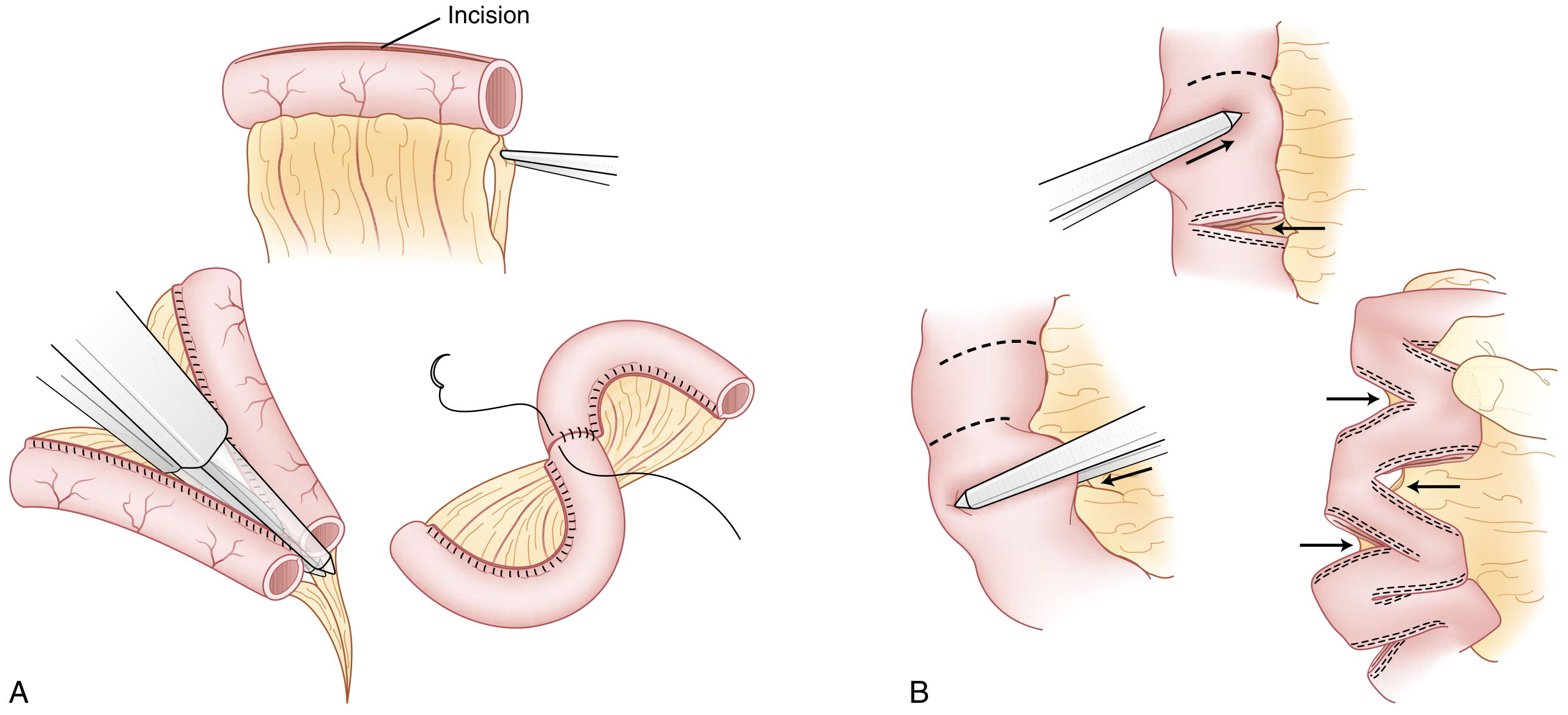
Sabiston Textbook of Surgery - Figure 117.11
Older procedures (reversed intestinal segment, recirculating loop, colon interposition, intestinal pacing) have largely fallen out of favor due to poor efficacy.
2. Small Bowel Transplantation
Reserved for patients requiring lifelong TPN who develop one or more of:
- Inability to maintain adequate hydration despite PN
- Catheter-related recurrent bloodstream infections
- Central vein thrombosis (loss of central venous access)
- TPN-associated cholestatic liver disease (IFALD)
Summary: Prognostic Factors for Enteral Autonomy
| Factor | Better Prognosis | Worse Prognosis |
|---|---|---|
| Residual bowel length | >60-100 cm | <60 cm (with colon) or <100 cm (no colon) |
| Colon continuity | Intact colon | End-jejunostomy |
| Ileocecal valve | Preserved | Resected |
| Bowel health | Healthy mucosa | Diseased (Crohn's, radiation) |
| Age | Pediatric (greater adaptive potential) | Adult |
| Resected segment | Jejunum | Ileum |
Sources:
- Goldman-Cecil Medicine International Edition (2-vol set) - block 17
- Harrison's Principles of Internal Medicine 22E (2025) - p. 2591
- Schwartz's Principles of Surgery 11E - block 14
- Sabiston Textbook of Surgery (8th/current ed.) - blocks 21, 28
- Yamada's Textbook of Gastroenterology 7E - p. 726
- GLP-2 meta-analyses: PMID 41421446, PMID 41344401, PMID 38663565
This is a shared conversation. Sign in to Orris to start your own chat.