
Classification of heartfailure
Reading File
Now let me search the medical library for heart failure classification content.
Finding Sources
Finding Sources
Excellent results. Now let me read the most authoritative sources - Braunwald's and Fuster's classification sections in parallel.
Reading File
Reading File
Reading File
Now let me get the Fuster's detailed classification table and the Forrester/hemodynamic classification content.
Reading File
Finding Sources
Now let me also fetch the Goldman-Cecil content on the stages figure and the Forrester hemodynamic classification, plus fetch the stages diagram image.
Reading File
Finding Sources
Loading Image
Now let me get the Forrester hemodynamic classification (bedside clinical classification) and also the acute HF classification from Tintinalli's.
Reading File
Reading File
I now have rich, comprehensive content from multiple authoritative sources. Let me compile the full answer.
Classification of Heart Failure
Heart failure (HF) is not a single entity but a clinical syndrome classified through several overlapping frameworks. The major classification systems are outlined below.
1. By Disease Stage: ACC/AHA Staging (A-B-C-D)
Introduced by the American College of Cardiology/American Heart Association, this staging system emphasizes the progression and development of disease - not just symptom severity. Stages are unidirectional; patients can only advance, not regress.
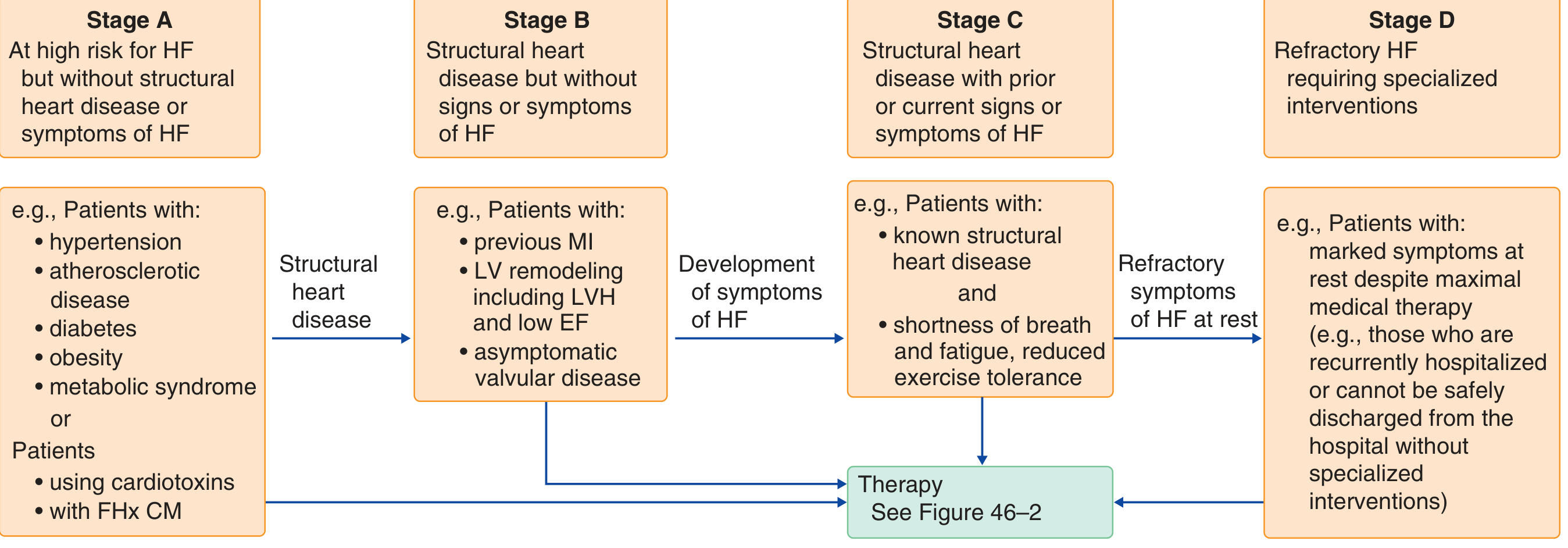
| ACC/AHA Stage | Description | Examples |
|---|---|---|
| A | At high risk for HF, no structural disease or symptoms | Hypertension, DM, atherosclerosis, obesity, cardiotoxin users |
| B | Structural heart disease, no signs/symptoms of HF | Previous MI, LV remodeling/LVH, low EF, asymptomatic valvular disease |
| C | Structural heart disease with prior or current symptoms of HF | Known structural disease + SOB, fatigue, reduced exercise tolerance |
| D | Refractory HF requiring specialized interventions | Marked symptoms at rest despite maximal therapy; recurrently hospitalized |
The interventions also follow the stages: modifying risk factors (Stage A), treating structural heart disease (Stage B), and reducing morbidity/mortality (Stages C and D).
- Braunwald's Heart Disease, p. 934; Goldman-Cecil Medicine; Fuster and Hurst's The Heart, 15th ed.
2. By Functional Capacity: NYHA Classification
First introduced in 1928, this is the most widely used clinical classification, chosen as the entry criterion for nearly all HF randomized clinical trials. It focuses on exercise tolerance and symptom burden in established HF.
| NYHA Class | Description |
|---|---|
| Class I | No limitation of physical activity. Ordinary activity does not cause HF symptoms. |
| Class II | Slight limitation. Comfortable at rest, but ordinary physical activity results in symptoms (fatigue, palpitation, dyspnea). |
| Class III | Marked limitation. Comfortable at rest, but less than ordinary activity causes symptoms. |
| Class IV | Unable to carry on any physical activity without symptoms; symptoms may be present at rest. |
Important limitations of NYHA classification:
- Correlates poorly with objective measures of HF severity
- Not a static measure - can fluctuate
- Significant intra-observer variability in class assignment
How NYHA maps to ACC/AHA stages:
-
Stage A: No NYHA class (pre-disease)
-
Stage B: NYHA Class I
-
Stage C: NYHA Classes I, II, or III
-
Stage D: NYHA Class IV
-
Fuster and Hurst's The Heart, 15th ed., p. 1510; Braunwald's Heart Disease, p. 934
3. By Ejection Fraction
This is one of the most clinically important classifications because it guides therapeutic decisions and reflects distinct pathophysiology. It is based on left ventricular ejection fraction (LVEF), measured as LV stroke volume / end-diastolic volume.
| Type | Abbreviation | LVEF Cutoff | Pathophysiology |
|---|---|---|---|
| HF with Reduced EF | HFrEF | < 40% | Systolic dysfunction - impaired LV contraction/emptying; larger EDV and ESV |
| HF with Mildly Reduced EF | HFmrEF | 40-49% | Intermediate phenotype; shares features of both |
| HF with Preserved EF | HFpEF | ≥ 50% | Impaired LV relaxation/diastolic filling; LVH, increased LV wall thickness, elevated LA pressure |
| HF with Recovered EF | HFrecEF | Previously low, now > 40% | HFrEF that has improved with treatment; but many relapse after therapy withdrawal |
The prevalence of HFrEF and HFpEF is approximately 50% each.
Note: "Systolic" and "diastolic" dysfunction are often used loosely for HFrEF and HFpEF respectively, but this is technically imprecise - both systolic and diastolic dysfunction coexist in most patients regardless of EF.
- Fuster and Hurst's The Heart, 15th ed., p. 1511-1512; Goldman-Cecil Medicine
4. By Temporal Pattern (Acute vs. Chronic)
| Type | Description |
|---|---|
| Acute HF (AHF) | New onset or rapid deterioration of symptoms, requiring urgent evaluation and treatment |
| Chronic stable HF | Established HF with symptoms unchanged over time |
| Acute-on-chronic HF | Acute decompensation in a patient with pre-existing chronic HF |
| Worsening HF | Gradual clinical decline in a chronic HF patient |
- Fuster and Hurst's The Heart, 15th ed., p. 1512
5. Acute HF Phenotypes (Clinical Bedside Classification)
For acute presentations, Tintinalli's Emergency Medicine describes six phenotypes useful for directing initial therapy:
| AHF Phenotype | Key Features |
|---|---|
| Hypertensive AHF | SBP >140 mmHg, relatively preserved LVEF, pulmonary edema, onset <48 h; due to fluid redistribution more than overload |
| Pulmonary edema | Respiratory distress, rales, reduced SpO2; verified by CXR |
| Cardiogenic shock | Tissue hypoperfusion, SBP typically <90 mmHg; often needs inotropes + invasive monitoring |
| Acute-on-chronic HF | Mild-moderate AHF; SBP 90-140 mmHg; peripheral edema; gradual onset over days |
| High-output failure | Normal/elevated EF; tachycardia, warm extremities, pulmonary congestion; causes include anemia, thyrotoxicosis |
| Right heart failure | JVD, hepatomegaly, hypotension, little/no pulmonary congestion; causes include pulmonary disease, tricuspid regurgitation, OSA |
- Tintinalli's Emergency Medicine, p. 778-787
6. Hemodynamic/Bedside Clinical Classification (Perfusion-Congestion)
Based on bedside assessment of congestion (wet vs. dry) and perfusion (warm vs. cold), this 2×2 matrix is used in acute and advanced HF:
| No Congestion (Dry) | Congestion (Wet) | |
|---|---|---|
| Adequate Perfusion (Warm) | Warm & Dry (compensated) | Warm & Wet (most common) |
| Poor Perfusion (Cold) | Cold & Dry (hypovolemia) | Cold & Wet (cardiogenic shock) |
Indicators of congestion: orthopnea, JVD, rales, peripheral edema, ascites, hepatojugular reflux, square-wave BP response to Valsalva.
Indicators of hypoperfusion: narrow proportional pulse pressure (<25%), pulsus alternans, symptomatic hypotension, cool extremities, impaired mentation.
- Fuster and Hurst's The Heart, 15th ed., p. 1510-1511
7. By Etiology
| Category | Examples |
|---|---|
| Ischemic | Coronary artery disease, prior MI (~70% of HF in developed countries) |
| Non-ischemic | Hypertension, cardiomyopathy (dilated, hypertrophic, restrictive), valvular disease, arrhythmia, toxins, infection |
- Goldman-Cecil Medicine
Summary: Classification Frameworks at a Glance
| Framework | Purpose |
|---|---|
| ACC/AHA Stages A-D | Disease progression; prevention to end-stage |
| NYHA Classes I-IV | Functional severity; symptom-based; guides eligibility for therapies (MRA, CRT) |
| EF-based (HFrEF/HFmrEF/HFpEF/HFrecEF) | Pathophysiology; guides pharmacotherapy |
| Acute AHF phenotypes | Emergency triage and immediate treatment direction |
| Wet/Dry & Warm/Cold | Hemodynamic profile; guides diuresis vs. inotropes |
| Ischemic vs. Non-ischemic | Etiology; guides diagnostic workup and targeted treatment |
This is a shared conversation. Sign in to Orris to start your own chat.