
Barium Meal pad sign , reverse 3 sign , frostberg reverse 3 sign , rose thorn duodenum with images
Reading File
These are classic barium meal radiology signs - let me search the library and web simultaneously for text and images.
Searching sources...
Finding Sources
Searching the Web
barium meal pad sign reverse 3 sign Frostberg inverted 3 rose thorn duodenum radiology images
Let me fetch the key images and extract content from the Applied Radiology article simultaneously.
Loading Image
Loading Image
Loading Image
Reading Web Page
https://appliedradiology.com/articles/part-1-classic-signs-i…
Let me fetch more specific images for each sign.
Loading Image
Loading Image
Searching the Web
pad sign barium meal pancreatic carcinoma duodenum "widening of C loop" rose thorn ulcer duodenum radiology image
Loading Image
Loading Image
Searching the Web
rose thorn sign duodenum barium tuberculosis Crohn's duodenal ulcer radiology image site:radiopaedia.org OR site:radiopedia.org
Loading Image
Searching the Web
antral pad sign barium meal pancreatic head mass stomach impression radiology
Loading Image
Loading Image
Now I have enough information to compile a thorough, well-illustrated answer. Here is a complete breakdown of all four classic barium meal signs:
Classic Barium Meal Signs: Duodenum & Stomach
1. Antral Pad Sign (Pad Sign)
What it is:
An extrinsic impression or indentation on the posteroinferior aspect of the gastric antrum seen on barium meal study. The impression is typically arcuate, smooth, and well-defined.
Mechanism:
A mass in the head of the pancreas (or, more commonly in everyday practice, the gallbladder) pushes up against the posterior wall of the gastric antrum from below, creating a smooth "pad-like" indentation.
Causes (most to least common):
| Cause | Notes |
|---|---|
| Gallbladder enlargement (Courvoisier) | Most common cause of antral impression |
| Carcinoma of pancreatic head | Classic teaching cause |
| Pancreatic pseudocyst | Smooth extrinsic compression |
| Duodenal lymphadenopathy | |
| Aortic aneurysm | Posterior compression |
Key features on barium meal:
- Smooth, extrinsic indentation on the posterior/inferior wall of the antrum
- Intact overlying mucosa (mucosa rides over the impression without destruction)
- Associated with widening of the duodenal C-loop in pancreatic head masses
Appearance: The antrum appears "padded" or elevated from below, like a thumb pressing up into a balloon.
2. Reverse 3 Sign (Frostberg's Inverted 3 / Epsilon Sign)
This is the most examined sign in the duodenum for pancreatic pathology.
What it is:
A deformity of the medial wall of the second part of the duodenum (D2) on barium meal, where the duodenal contour takes on the shape of a reversed/inverted number "3" (or the Greek letter epsilon "ε").
First described by: Nils Frostberg (1938) - hence "Frostberg's inverted 3 sign."
Mechanism:
A mass at or around the head of pancreas / ampulla of Vater creates two concave indentations on the medial wall of D2:
- Upper concavity - above the ampulla, from the pancreatic head mass
- Lower concavity - below the ampulla, from the pancreatic head mass
- The ampulla itself (or the area at the level of the major papilla) forms the central convex point between the two concavities
This produces the reversed "3" or epsilon shape.
Here is the actual barium image showing Frostberg's sign:
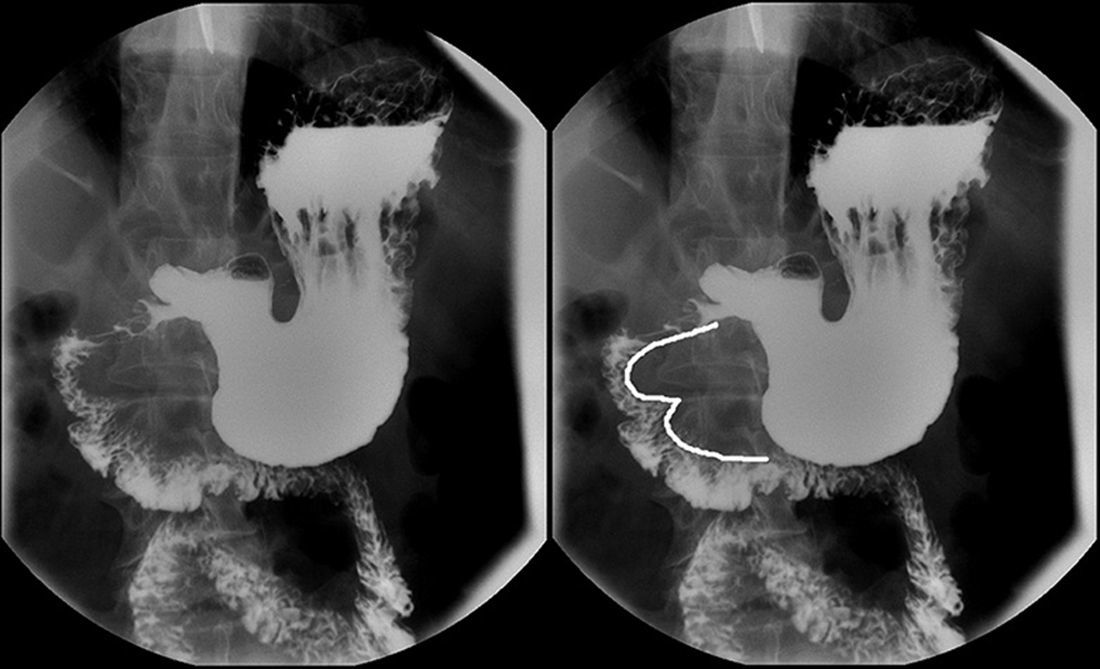
Left: raw barium image. Right: same image with white line tracing the reversed-3 (epsilon) contour on the medial wall of D2. - from Ruiz-Pardo et al., Cir Esp 2015
Here is a teaching slide showing the sign with its causes:
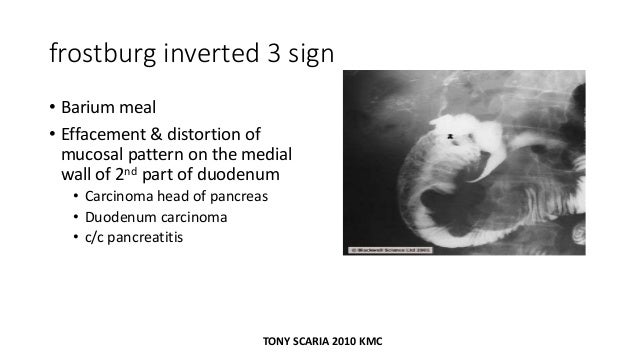
Causes:
- Carcinoma of the head of pancreas (most important)
- Periampullary carcinoma (carcinoma of the ampulla of Vater)
- Chronic pancreatitis with inflammatory mass
- Cystic/pseudocystic enlargement of the pancreatic head
- Duodenal carcinoma
Key distinction:
- In malignancy, the reversed-3 is often associated with mucosal destruction, rigidity, and spiculation of the duodenal folds
- In pancreatitis, the indentation may be smoother with intact mucosa
Medscape note: "The medial margin of the descending duodenum may be pulled medially at the level of the ampulla, forming a reversed-3 appearance. This is known as the Frostberg 3 sign."
3. Frostberg Reverse 3 Sign - Detailed Anatomy
To be precise about nomenclature (this trips up many exam candidates):
| Term | Meaning |
|---|---|
| "Reverse 3 sign" | Same as Frostberg's inverted 3 sign - the medial wall of D2 looks like a backwards "3" or "ε" |
| "Frostberg's sign" | Original description (1938) of the epsilon-shaped deformity |
| "Epsilon sign" | Another name for the same finding |
| "Inverted 3 sign" | Viewed differently depending on orientation - all refer to the same finding |
The "3" is formed because the duodenal wall is indented both above AND below the ampulla, with the ampulla forming the central point - creating two concavities that together look like the number 3 (reversed/mirrored).
The Radiopaedia article on pancreatic ductal adenocarcinoma confirms: "If large enough, may demonstrate a reverse impression on the duodenum: Frostberg inverted 3 sign or a wide duodenal sweep."
4. Rose Thorn Sign (Rose Thorn Ulcers)
What it is:
Deep, linear ulcers that fill with barium and project outward sharply from the bowel lumen, resembling the thorns of a rose stem when viewed in profile on barium studies.
Classic location: Terminal ileum and small bowel (Crohn's disease), but also seen in the duodenum in Crohn's duodenitis.
Mechanism:
In Crohn's disease, transmural inflammation leads to deep, knife-like fissuring ulcers that penetrate through the full thickness of the bowel wall. When barium fills these ulcers and they are viewed in profile, they project outward as sharp spike-like projections - the "rose thorns."
Key features on barium study:
- Deep linear/fissuring ulcers perpendicular to the bowel wall
- Sharp, spiculated projections filled with barium
- Project beyond the normal bowel wall contour
- Associated with: cobblestoning, skip lesions, strictures, fistulas, "string sign" (Kantor's string sign in terminal ileum)
- When circumferential - creates the "cobblestone pattern"
Causes:
| Cause | Notes |
|---|---|
| Crohn's disease | Classic - transmural deep linear ulcers |
| Duodenal tuberculosis | Deep penetrating ulcers in D2/D3 |
| Behcet's disease | Deep punched-out ulcers |
| Ischemia (late) |
Distinction from superficial ulcers (UC):
- Rose thorn ulcers are DEEP (transmural, Crohn's) vs. the collar-button ulcers of UC (which are also deep but have a different collar-button morphology)
- UC ulcers remain mucosal/submucosal; Crohn's ulcers penetrate to serosa
Radiopaedia on Crohn's disease lists "rose-thorn ulcers" as a defining barium feature.
Summary Table
| Sign | Location | Appearance | Classic Cause |
|---|---|---|---|
| Pad Sign | Posteroinferior gastric antrum | Smooth extrinsic arcuate impression | Pancreatic head mass / Courvoisier gallbladder |
| Reverse 3 / Frostberg Sign | Medial wall D2 | Reversed "3" or "ε" shape - 2 concavities flanking the ampulla | Ca head of pancreas / Periampullary ca / Chronic pancreatitis |
| Rose Thorn Sign | Terminal ileum / duodenum | Sharp, spike-like projections of barium into deep fissuring ulcers | Crohn's disease / Intestinal tuberculosis |
Associated Signs to Know (Exam Mnemonics)
For pancreatic head Ca on barium meal - triad:
- Pad sign (antral impression)
- Frostberg's reverse 3 (D2 medial wall deformity)
- Widened duodenal C-loop (>9 cm loop diameter)
For Crohn's disease on barium:
- Rose thorn ulcers → Cobblestoning → String sign (Kantor's) → Skip lesions → Fistulae
This is a shared conversation. Sign in to Orris to start your own chat.