
Determinant of health
The determinants of health are the broad range of personal, social, economic, and environmental factors that influence health status. They fall into several categories:
- Biological/genetic factors: age, sex, heredity
- Behavioral factors: diet, physical activity, smoking, alcohol use
- Social/economic factors: income, education, employment, social support
- Environmental factors: housing, air/water quality, neighborhood safety
- Health services: access to and quality of care
Searching sources...
Reading File
Searching the Web
determinants of health definition categories WHO
Finding Sources
Reading File
Reading File
Reading File
Loading Image
Reading File
Reading File
Here is a comprehensive overview of the Determinants of Health, drawn primarily from Park's Textbook of Preventive and Social Medicine and supplemented by Harrison's Principles of Internal Medicine (22e).
Determinants of Health
Health is multifactorial. The factors that influence health lie both within the individual and externally in the society in which they live. As a concept, every individual's health can be viewed as the product of continuous interactions between genetic factors and the environmental factors to which they are exposed - these interactions can be health-promoting or deleterious.
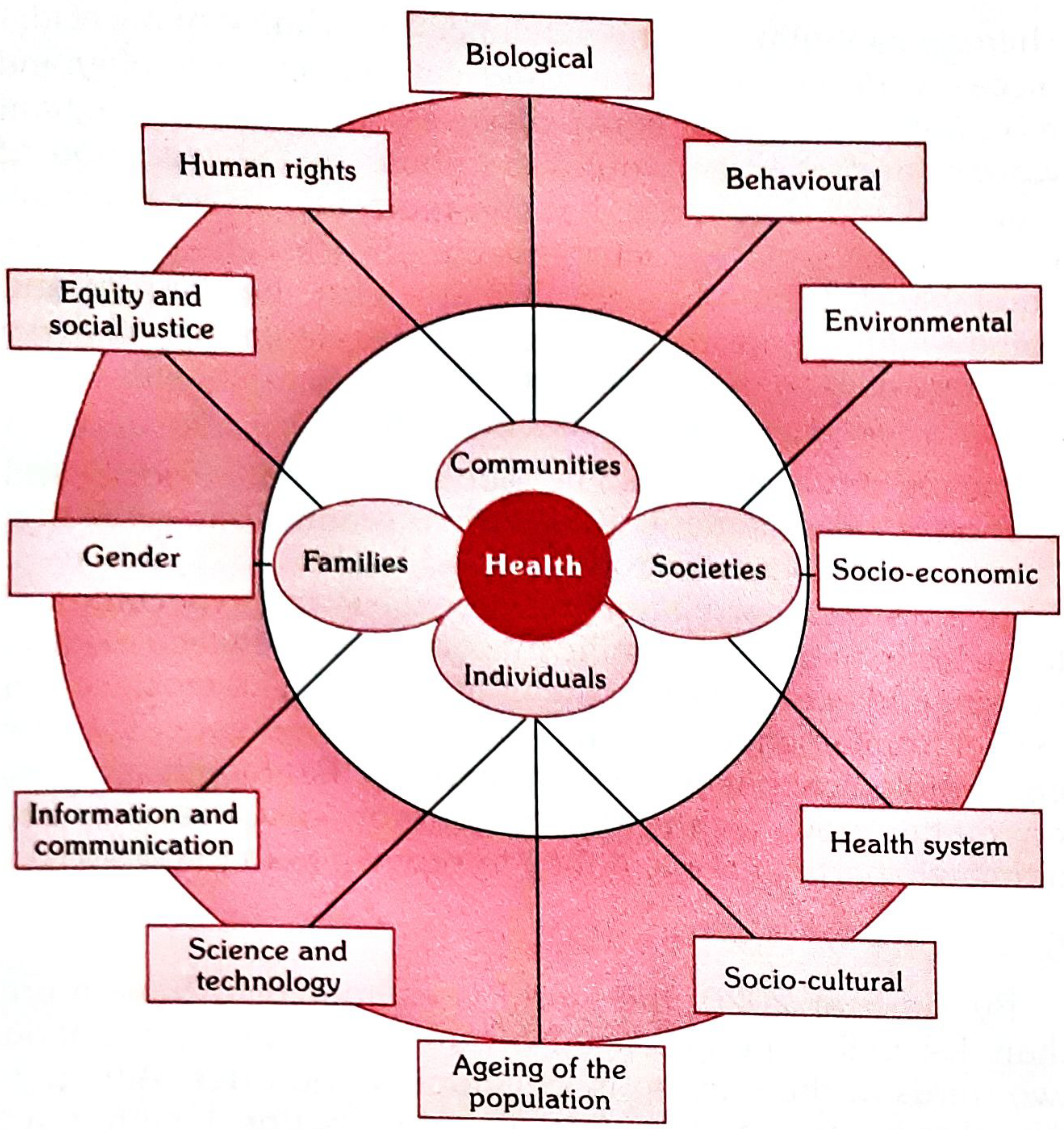
The diagram below (from Park's Textbook) captures the key determinants visually:
1. Biological Determinants
The physical and mental traits of every human being are, to some extent, determined by their genetic make-up at conception. The genetic constitution cannot be altered after conception and plays a fundamental role in health.
- A number of diseases are of genetic origin: chromosomal anomalies, inborn errors of metabolism, mental retardation, some types of diabetes
- WHO's concept of "positive health" implies that a person should be able to express as completely as possible the potentialities of their genetic heritage - achievable only when the person lives in a healthy relationship with their environment
- Fields like genetic screening and gene therapy are expanding the possibilities for prevention and treatment
2. Behavioural and Socio-cultural Conditions (Lifestyle)
"Lifestyle" denotes the way people live - a reflection of social values, attitudes, and activities. It is composed of cultural and behavioural patterns and lifelong personal habits developed through socialization with family, peers, and media.
- Harmful lifestyle factors: smoking, alcoholism, physical inactivity, poor nutrition, drug addiction
- Protective lifestyle factors: adequate nutrition, sufficient sleep, regular physical activity
- In developed countries: lifestyle-related diseases dominate (coronary heart disease, obesity, lung cancer)
- In developing countries: risks are connected to lack of sanitation, poor nutrition, and inadequate personal hygiene
- Health is both a consequence of an individual's lifestyle and a factor in determining it
3. Environment
Hippocrates first related disease to environment (climate, water, air). The environment is classified as:
- Internal environment: every tissue, organ, and organ-system functioning within the body
- External (macro) environment: everything external to the individual after conception - divided into:
- Physical (climate, geography, housing, sanitation)
- Biological (bacteria, viruses, vectors, plants)
- Psychosocial (mental stress, social relationships)
- Micro-environment (domestic environment, eating habits, personal habits)
- Occupational environment
Environmental factors exert a direct impact on physical, mental, and social well-being. Physical, biological, and psychosocial components are inextricably linked and must be viewed as a whole.
4. Socio-economic Conditions
For the majority of the world's people, health status is determined primarily by their level of socio-economic development. Key factors include:
| Factor | Health Impact |
|---|---|
| Economic status (per capita GNP) | Determines purchasing power, standard of living, family size, disease patterns; affluence may also cause illness (CHD, diabetes, obesity) |
| Education (especially female education) | The world map of illiteracy coincides with maps of poverty, malnutrition, and high infant mortality. Kerala's literacy rate explains its low infant mortality (IMR 10 vs. India's 34 in 2016) |
| Occupation/Employment | Being employed promotes health; unemployment is associated with higher incidence of illness, death, and psychosocial damage |
| Political system | Resource allocation, health policy decisions, and percentage of GNP spent on health (WHO target: ≥5% of GNP) shape community health profoundly |
5. Health Services
Health and family welfare services cover a wide spectrum - treatment of disease, prevention of illness, and promotion of health. The purpose of health services is to improve the health status of the population.
- Immunization, safe motherhood programs, and primary care access are key interventions
- Access, affordability, and quality of care directly affect outcomes
- Health system factors (complexity, language barriers, geographic distribution of providers) contribute to health disparities, especially for minorities and low-income populations
6. Social Determinants of Health (SDOH) - The Broader Framework
Per the WHO, SDOH are "the conditions in which people are born, grow, live, work, and age" along with access to power, money, and resources. These drive health inequities - unfair, avoidable differences in health status within and between countries.
Harrison's (22e) highlights the biopsychosocial model integrating:
- Domains of influence: biological, behavioral, physical/built environment, sociocultural environment, health care system
- Levels of influence: individual → interpersonal → community → societal
Key SDOH include:
- Housing stability and transportation
- Food security and nutrition
- Social support networks
- Race/ethnicity and experiences of racism
- Health literacy and language
- Income inequality
7. Additional Determinants (from the WHO Wheel)
| Determinant | Significance |
|---|---|
| Gender | Men and women differ in exposure, response to illness, and healthcare access |
| Human rights | The enjoyment of the highest attainable standard of health is a fundamental human right (WHO Constitution) |
| Equity and social justice | Inequitable distribution of resources drives health disparities |
| Ageing of the population | Demographic change increases burden of non-communicable diseases |
| Science and technology | New diagnostics, vaccines, and treatments alter health outcomes |
| Information and communication | Health literacy, media, and access to information shape health behaviors |
Key Takeaway
No single determinant acts alone. Health is the product of interactions among all these factors operating at multiple levels - individual, family, community, and society. Addressing upstream social and structural determinants is as important as medical care itself in improving population health and reducing inequities.
Sources: Park's Textbook of Preventive and Social Medicine, pp. 23-26; Harrison's Principles of Internal Medicine 22e, Ch. 11; WHO - Social Determinants of Health
This is a shared conversation. Sign in to Orris to start your own chat.