
Rapid and slow sand filter from spm standard textbook for university exams
Reading File
The topic is about water treatment/filtration - this falls under Community Medicine / SPM (Social and Preventive Medicine). Let me search the library for this content.
Finding Sources
Finding Sources
Park's Textbook of Preventive and Social Medicine is available. Let me get a broad section on sand filters.
Finding Sources
Reading File
Excellent content found. Let me read more of this section which was truncated.
Reading File
I need the section between 3250-3400 which was truncated. Let me get the full content of the slow and rapid sand filter sections.
Reading File
I have all the content needed. Let me fetch the key diagrams and also get the comparison table section.
Loading Image
Loading Image
Finding Sources
Both diagrams are retrieved. Now let me get the rest of the content including the rapid sand filter section and comparison table.
Reading File
I now have all the content I need. Let me compile the comprehensive answer from Park's SPM textbook.
Rapid and Slow Sand Filters
From Park's Textbook of Preventive and Social Medicine
Introduction
Filtration is the second stage in water purification. 98-99% of bacteria are removed by filtration, apart from other impurities. Two types of filters are in use:
- Slow sand filters (biological filters)
- Rapid sand filters (mechanical filters)
I. SLOW SAND FILTER (Biological Filter)
Slow sand filters were first used in 1804 in Scotland, then in London. During the 19th century their use spread worldwide. They are generally accepted as the standard method of water purification.
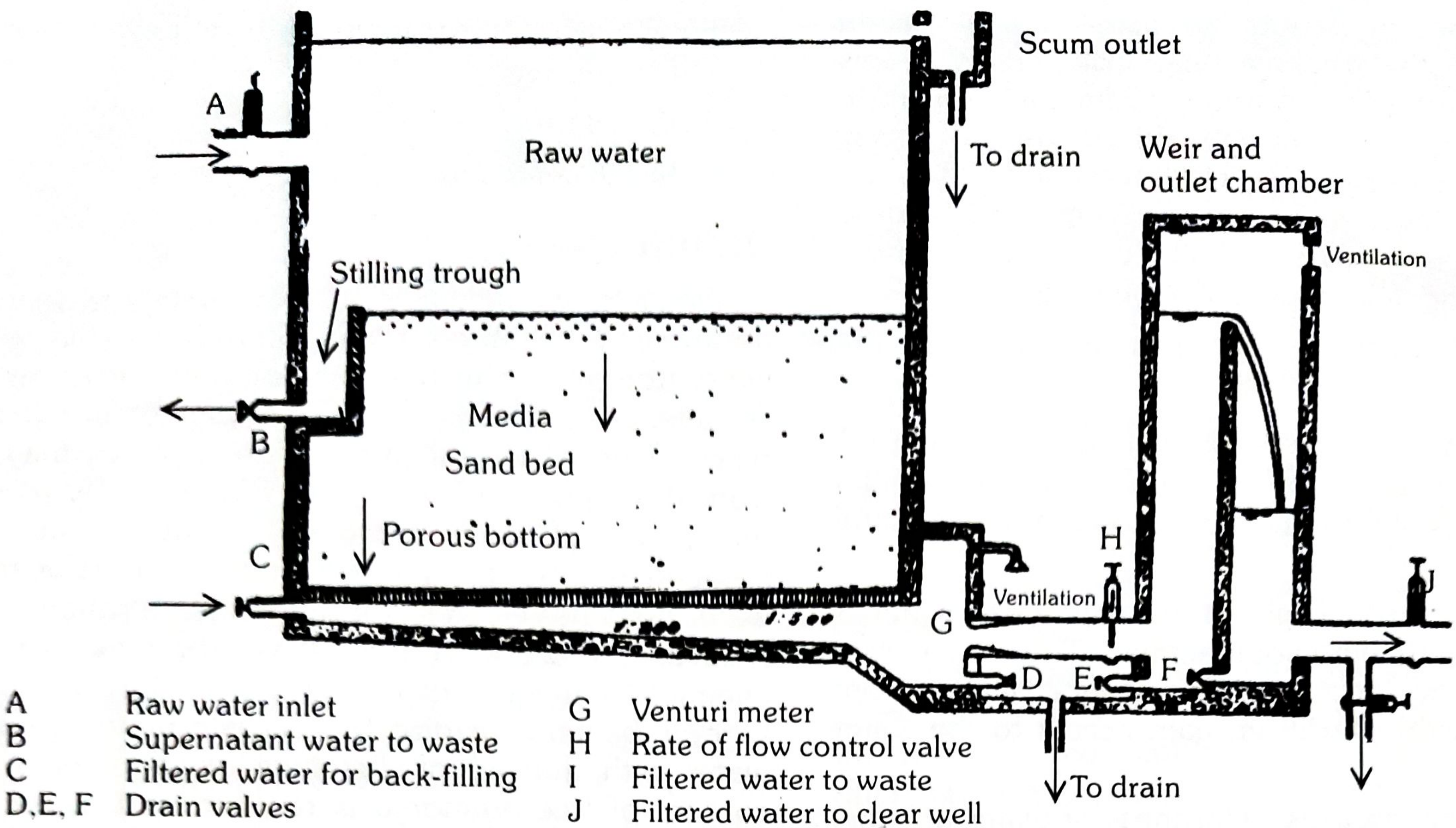
Fig. 4 - Slow sand filter (Park's SPM)
Elements of a Slow Sand Filter
(1) Supernatant Water
- Depth: 1 to 1.5 metres above the sand bed
- Provides a constant head of water to overcome resistance of the filter bed and promote downward flow
- Provides a waiting period of 3 to 12 hours for partial purification by sedimentation, oxidation and particle agglomeration
- The level of supernatant water is always kept constant
(2) Sand Bed
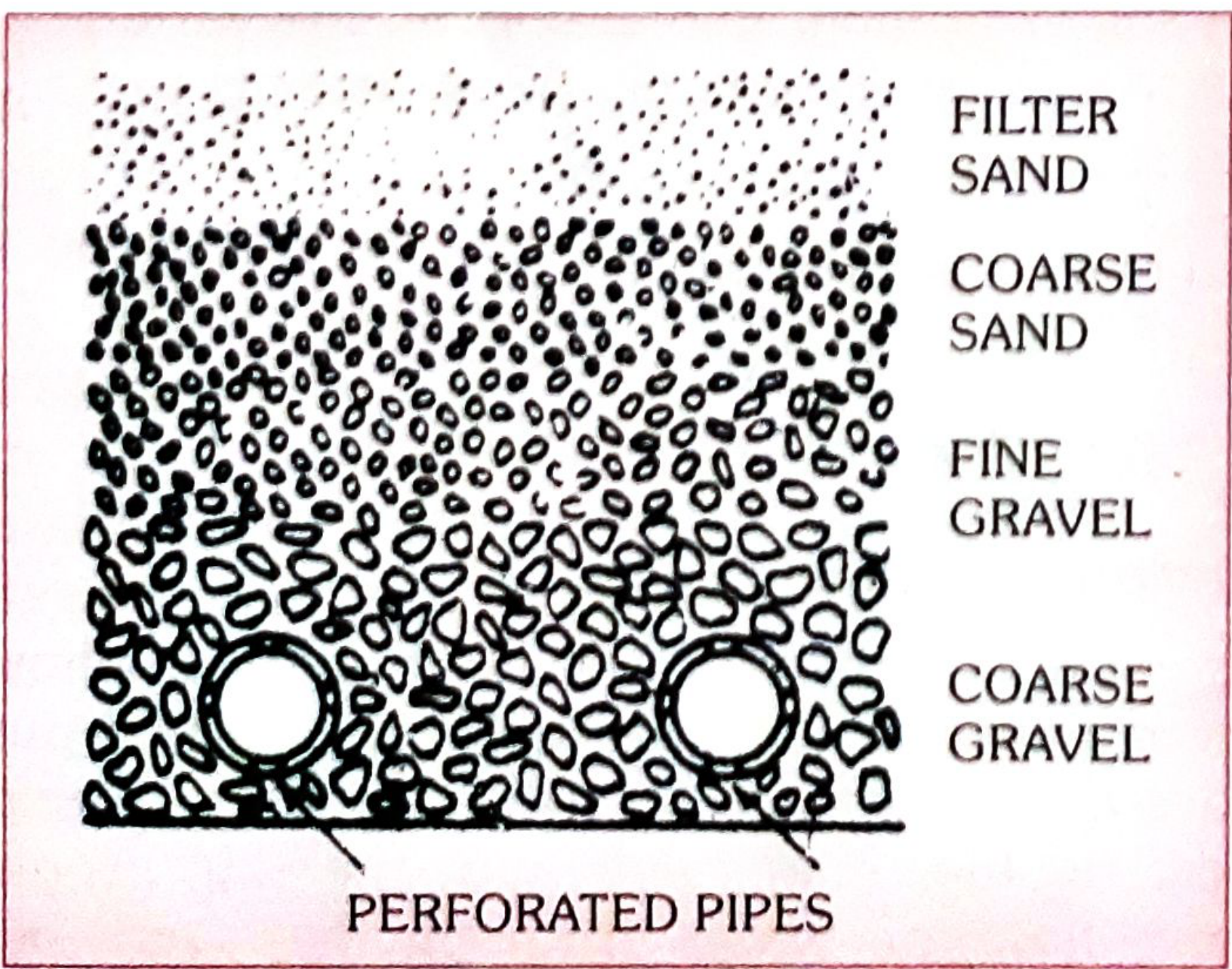
Fig. 5 - Section of filter bed showing layers (Park's SPM)
- Thickness of sand bed: ~1 metre
- Sand grains: preferably rounded, effective diameter 0.2 to 0.3 mm
- Sand must be clean, free from clay and organic matter
- Supported by a layer of graded gravel 30-40 cm deep (prevents fine grains from entering drainage pipes)
- 1 cubic metre of filter sand presents ~15,000 sq. metres of surface area
- Rate of filtration: 0.1 to 0.4 m³/hour/sq. metre of sand bed surface
- Water percolates through sand very slowly (taking 2 hours or more)
Purification processes in the sand bed:
- Mechanical straining
- Sedimentation
- Adsorption
- Oxidation
- Bacterial action
The Vital Layer (Schmutzdecke)
When a filter is newly laid, it acts only as a mechanical strainer. Very soon, the surface gets covered by a slimy layer called the "Schmutzdecke" (also called vital layer, zoogleal layer, or biological layer).
- Slimy and gelatinous in nature
- Consists of: threadlike algae, plankton, diatoms, and bacteria
- Formation of this layer = "ripening" of the filter
- Takes several days to form fully; when formed, extends 2 to 3 cm into top of sand bed
- The vital layer is the "heart" of the slow sand filter
- Functions: removes organic matter, holds back bacteria, oxidizes ammoniacal nitrogen into nitrates
- First few days' filtrate is run to waste until vital layer is fully formed
(3) Under-Drainage System
- Located at the bottom of the filter bed
- Consists of porous or perforated pipes
- Dual purpose: provides outlet for filtered water + supports the filter medium above
(4) Filter Control
- Equipped with valves and devices to maintain a constant rate of filtration
- Venturi meter measures bed resistance ("loss of head")
- When resistance builds up, the regulating valve is opened
- When "loss of head" exceeds 1.3 metre - uneconomical to run the filter
Filter box dimensions (top to bottom):
| Component | Depth |
|---|---|
| Supernatant water | 1 to 1.5 metres |
| Sand bed | 1.2 metres |
| Gravel support | 0.30 metres |
| Filter bottom | 0.16 metres |
Total depth of filter box: 2.5 to 4 metres; usually rectangular; built wholly or partly below ground.
Filter Cleaning
- Filter may run for weeks or even months without cleaning
- When bed resistance is too high and regulating valve is fully open - time to clean
- Method: Scraping off the top 1-2 cm of sand layer, washing the sand, and returning it
- After cleaning, the filter must re-ripen (re-form the vital layer) before returning to service
- First filtrate is again run to waste
II. RAPID SAND FILTER (Mechanical Filter)
Construction
The construction of a rapid sand filter is essentially the same as the slow sand filter with these differences:
- Sand grain size: effective diameter 0.4 to 0.7 mm (coarser than slow sand filter)
- Gravel bed below the sand
- Rate of filtration: up to 5-15 m³/hour/sq. metre - i.e., 40 to 50 times faster
Pre-treatment Required
Before the water enters a rapid sand filter, it must be pre-treated with:
- Coagulation - addition of alum (aluminium sulphate)
- Flocculation - formation of "floc" from suspended particles
- Sedimentation - settling of floc in settling tanks
This pre-treatment is essential because rapid sand filters do NOT develop a vital layer (Schmutzdecke) the way slow sand filters do.
Filter Cleaning - Backwashing
Rapid sand filters clog up quickly and must be cleaned every 24-48 hours. Cleaning is done by backwashing - reversing the flow of water through the sand bed:
- Dislodges impurities and cleans the sand bed
- Washing is stopped when clear sand is visible and wash water is clear
- The whole process takes about 15 minutes
- In some filters, compressed air is used as part of the backwashing process
Advantages of Rapid Sand Filter Over Slow Sand Filter
- Can deal with raw water directly - no preliminary storage needed
- Filter beds occupy less space
- Filtration is rapid (40-50 times) that of a slow sand filter
- Washing of the filter is easy (backwashing takes only 15 min)
- More flexibility in operation
III. COMPARISON TABLE: Rapid vs. Slow Sand Filter
(Park's Textbook, Table 3)
| Feature | Slow Sand Filter | Rapid Sand Filter |
|---|---|---|
| Also called | Biological filter | Mechanical filter |
| First used | 1804, Scotland | Later development |
| Sand grain size (effective diameter) | 0.2 - 0.3 mm | 0.4 - 0.7 mm |
| Rate of filtration | 0.1 - 0.4 m³/hr/m² | 5 - 15 m³/hr/m² (40-50x faster) |
| Vital layer (Schmutzdecke) | Present - essential | Absent |
| Pre-treatment | Not required (storage only) | Coagulation + flocculation + sedimentation required |
| Bacteria removal | ~98-99% | Less efficient (depends on pre-treatment) |
| Filter cleaning | Scraping (every weeks/months) | Backwashing (every 24-48 hours) |
| Cleaning time | Hours | ~15 minutes |
| Space required | More | Less |
| Cost | Lower running cost | Higher (pre-treatment needed) |
| Suitable for | Low turbidity water | High turbidity water |
| Flexibility | Less | More |
Key One-Liners for Exams
- Slow sand filter was first used in 1804 in Scotland
- Filtration removes 98-99% of bacteria
- Vital layer = Schmutzdecke = heart of slow sand filter; takes several days to form ("ripening")
- First filtrate of a newly cleaned/new filter is run to waste
- Rapid sand filter is 40-50 times faster than slow sand filter
- Rapid sand filter cleaned by backwashing (~15 min)
- Slow sand filter cleaned by scraping (runs for weeks/months before cleaning needed)
- Loss of head exceeding 1.3 metre - filter should be taken off service
Source: Park's Textbook of Preventive and Social Medicine, Chapter on Water Supply - pp. 812-813
This is a shared conversation. Sign in to Orris to start your own chat.