
Status epilepticus
"status epilepticus" management treatment
cd /home/daytona/workspace/attachments/458bfdac-69b4-4493-a572-497687f39c98/ && python3 -c " import pdfplumber with pdfplumber.open('Part XXV -The Nervous System - Nelson 2024.pdf') as pdf: print(f'Total pages: {len(pdf.pages)}') # Search for status epilepticus for i, page in enumerate(pdf.pages): text = page.extract_text() or '' if 'status epilepticus' in text.lower() or 'Status Epilepticus' in text: print(f'Page {i+1}: found status epilepticus') " 2>&1 | head -40
python3 -c " import pdfplumber with pdfplumber.open('/home/daytona/workspace/attachments/458bfdac-69b4-4493-a572-497687f39c98/Part XXV -The Nervous System - Nelson 2024.pdf') as pdf: print(f'Total pages: {len(pdf.pages)}') for i, page in enumerate(pdf.pages[:5]): text = page.extract_text() or '' print(f'--- Page {i+1} ---') print(text[:300]) " 2>&1
python3 -c " import pdfplumber with pdfplumber.open('/home/daytona/workspace/attachments/458bfdac-69b4-4493-a572-497687f39c98/Part XXV -The Nervous System - Nelson 2024.pdf') as pdf: print(f'Total pages: {len(pdf.pages)}') results = [] for i, page in enumerate(pdf.pages): text = page.extract_text() or '' tl = text.lower() if 'status epilepticus' in tl or 'seizure' in tl: results.append(i+1) print('Pages with seizure/status epilepticus content:', results[:30]) " 2>&1
python3 -c " import pdfplumber, sys with pdfplumber.open('/home/daytona/workspace/attachments/458bfdac-69b4-4493-a572-497687f39c98/Part XXV -The Nervous System - Nelson 2024.pdf') as pdf: total = len(pdf.pages) print(f'Total: {total} pages') # Search first 50 pages for status epilepticus for i in range(min(50, total)): text = pdf.pages[i].extract_text() or '' if 'epilepticus' in text.lower(): print(f'--- Page {i+1} ---') print(text[:1500]) print() " 2>&1 | head -200
python3 -c " import pdfplumber with pdfplumber.open('/home/daytona/workspace/attachments/458bfdac-69b4-4493-a572-497687f39c98/Part XXV -The Nervous System - Nelson 2024.pdf') as pdf: total = len(pdf.pages) for i in range(50, total): text = pdf.pages[i].extract_text() or '' if 'epilepticus' in text.lower(): print(f'--- Page {i+1} ---') print(text[:2000]) print() " 2>&1 | head -300
Status Epilepticus
Definition
- Less likely to terminate spontaneously
- Less likely to respond to antiepileptic drugs
- More likely to cause neuronal damage
| Type | Duration |
|---|---|
| Established SE | ≥5 min |
| Refractory SE | Persists despite 2 appropriately dosed anti-seizure therapies |
| Super-refractory SE | Persists ≥24 hours despite anesthetic coma (including when seizures recur on anesthetic withdrawal) |
SE is a neurologic emergency — treatment must begin within 5 minutes of onset. — Tintinalli's Emergency Medicine
Etiology
- Subtherapeutic antiepileptic drug (AED) levels (most common in known epileptics)
- Acute stroke / anoxia / hypoxia
- CNS infection (bacterial meningitis, viral encephalitis)
- Metabolic disturbances (hypoglycemia, hyponatremia, hypocalcemia, hypomagnesemia)
- Head trauma
- Alcohol or drug intoxication/withdrawal
- Autoimmune encephalitis (e.g., NMDA receptor antibody)
- Eclampsia / posterior reversible encephalopathy syndrome (PRES)
- Cortical venous thrombosis
Pathophysiology
- ≥5 minutes: Internalization/decreased expression of GABA-A receptors + upregulation of glutamate/NMDA receptors → markedly reduced seizure threshold and pharmacoresistance
- Blood-brain barrier breakdown: CNS penetration of potassium and albumin (both hyperexcitatory)
- Hypotension, hypoxia
- Metabolic acidosis
- Hyperthermia
- Hypoglycemia
- Cardiac dysrhythmias
- Pulmonary edema
Nonconvulsive SE (NCSE)
- Patient is comatose or has fluctuating/altered mental status — no overt convulsions
- Subtle signs: eye deviation, blinking, twitching
- Diagnosis requires EEG (often continuous)
- Suspect in: prolonged postictal period, unexplained stupor/confusion
- Delays in diagnosis worsen mortality, especially in patients >60 years or without prior seizure disorder
Initial Stabilization (0–5 minutes)
- Position to maximize ventilation, prevent aspiration; immobilize cervical spine if trauma suspected
- Airway: Nasopharyngeal airway preferred (oral airway provokes vomiting on seizure resolution); bag-valve-mask if ventilation inadequate
- Oxygen via nasal cannula or face mask
- Large-bore IV access (or IO if IV unavailable within 1–2 min)
- Cardiac monitor, pulse oximetry, continuous temperature monitoring
- Bedside glucose — administer D50W (adults) or D10W (children, 5 mL/kg) if glucose <60 mg/dL; give thiamine 100 mg IV first in adults at risk
- Treat hyperthermia (antipyretics + cooling blankets)
Treatment Algorithm
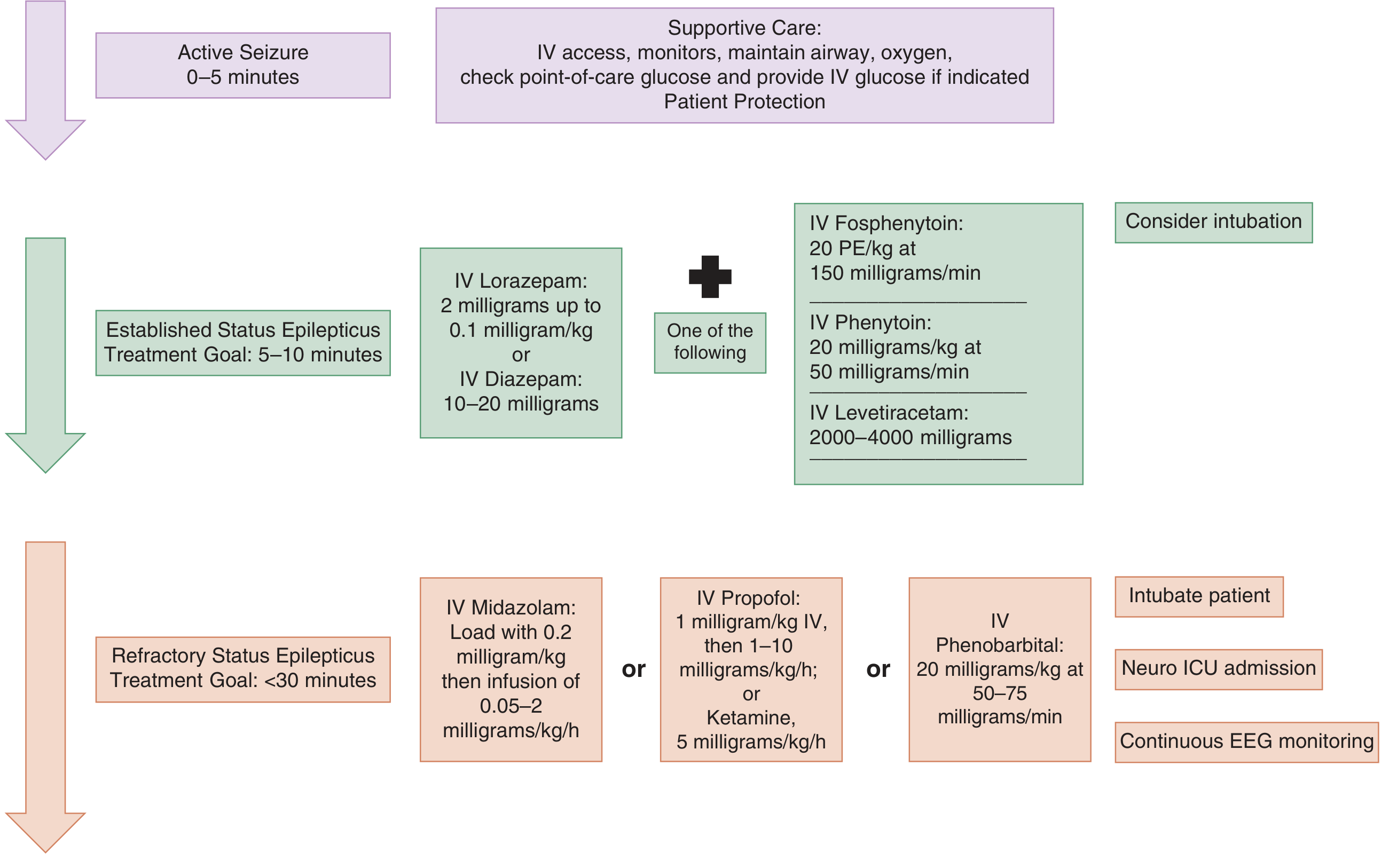
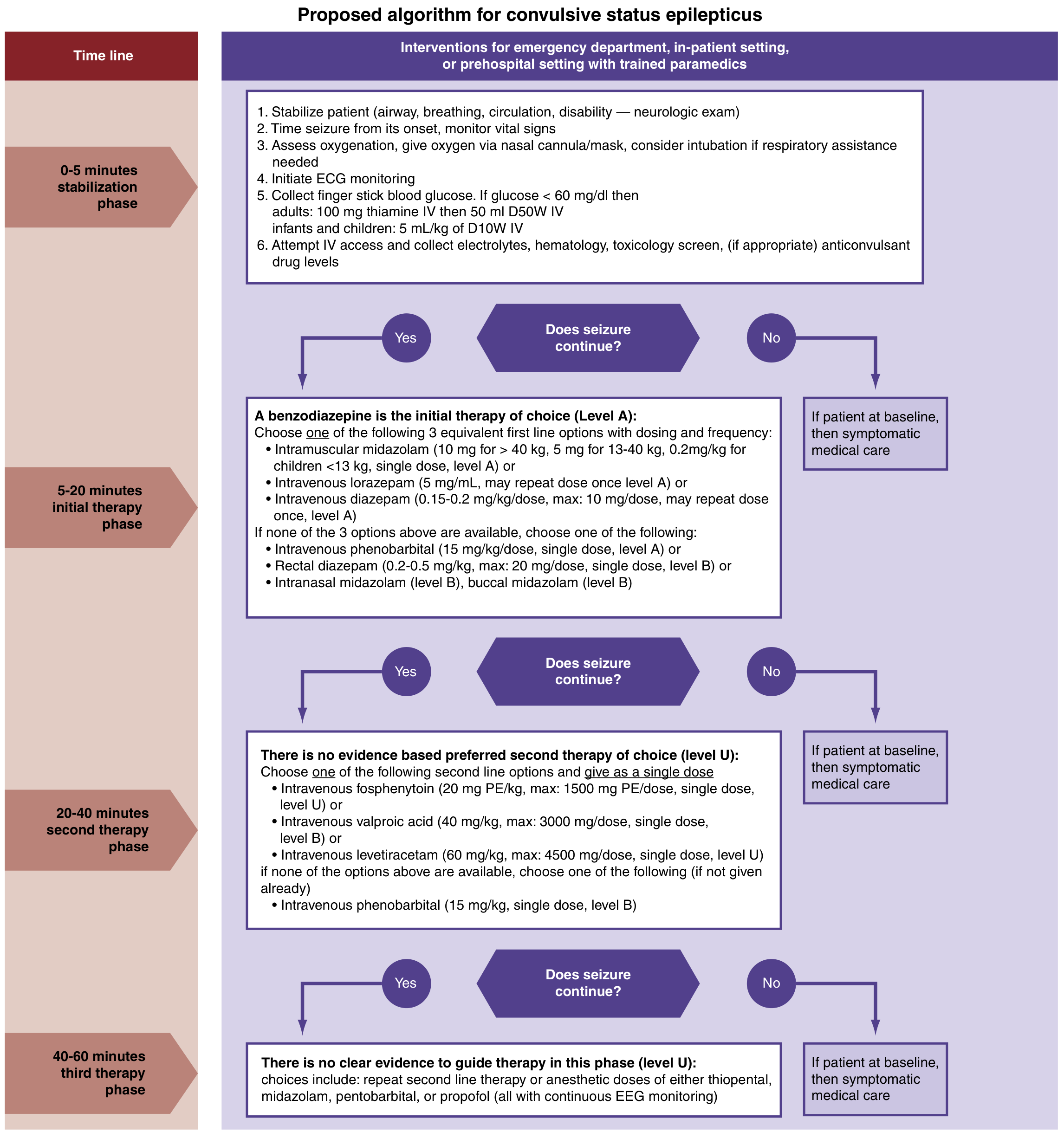
Phase 1: Initial Therapy (5–20 min) — Benzodiazepines (Level A)
Delays in benzodiazepine initiation >10 minutes are associated with higher mortality, longer seizure duration, and more complications. — Rosen's Emergency Medicine
| Drug | Route | Adult dose | Pediatric dose |
|---|---|---|---|
| Lorazepam (preferred if IV available) | IV | 2–4 mg (0.1 mg/kg) | 0.1 mg/kg IV (max 4 mg) |
| Midazolam (preferred if no IV) | IM | 10 mg (>40 kg) | 0.2 mg/kg (<13 kg); 5 mg (13–40 kg) |
| Diazepam | IV | 5–10 mg (0.15–0.2 mg/kg) | 0.2–0.5 mg/dose (< 5 yr); 1 mg/dose (≥5 yr) |
| Diazepam | Rectal | — | 0.5 mg/kg (max 20 mg) |
| Midazolam | Intranasal/buccal | — | Level B evidence |
| Phenobarbital | IV | — | 15 mg/kg single dose (if above unavailable) |
- A second dose of benzodiazepine may be given after 5 minutes of continued seizure activity
- Lorazepam vs. diazepam: Lorazepam has a slightly slower onset (3 vs. 2 min) but dramatically longer duration (12–24 h vs. 15–60 min) and fewer recurrences
- IM midazolam was non-inferior to IV lorazepam in prehospital trials — preferred when no IV access
Phase 2: Second-Line Therapy (20–40 min) — No evidence-based preference among agents (Level U)
| Drug | Dose | Notes |
|---|---|---|
| Fosphenytoin (preferred over phenytoin) | 20 PE/kg IV at 150 PE/min (max 1500 PE) | Water-soluble phenytoin prodrug; can give IM; less cardiotoxic; infuses 3× faster |
| Levetiracetam | 60 mg/kg IV (max 4500 mg) | Fewer adverse events vs. phenytoin in some trials; no significant difference in seizure termination in controlled trials |
| Valproic acid | 40 mg/kg IV (max 3000 mg) | Contraindicated in liver disease, thrombocytopenia, suspected metabolic disease |
| Phenytoin | 20 mg/kg IV at ≤50 mg/min | Cardiotoxic; infusion-site reactions; not compatible with glucose solutions |
| Phenobarbital | 15 mg/kg IV | Alternative if others unavailable |
Current consensus guidelines do not recommend one second-line agent over the others. If seizures persist after first second-line agent, a second second-line agent may be tried before escalating to anesthetic therapy. — Tintinalli's/Rosen's
Phase 3: Refractory SE (40–60 min) — Anesthetic / Third-Line (Level U)
| Drug | Dose |
|---|---|
| Midazolam infusion | Load 0.2 mg/kg IV, then 0.05–2 mg/kg/h infusion |
| Propofol infusion | 1 mg/kg IV bolus, then 1–10 mg/kg/h |
| Phenobarbital | 20 mg/kg IV at 50–75 mg/min |
| Ketamine | 5 mg/kg/h (adjunct; evidence limited to case reports) |
All third-line agents cause apnea, depressed consciousness, and hypotension — effects more pronounced in the presence of benzodiazepines. Continuous cardiorespiratory monitoring is mandatory. — Rosen's Emergency Medicine
Super-Refractory SE (≥24 h despite anesthetics)
- Repeat/titrate second-line agents
- Pentobarbital coma
- Thiopental
- Inhalant anesthetics
- Plasmapheresis (scoping review data only)
- Electroconvulsive therapy (ECT)
- Ketogenic diet
Post-Seizure Workup (after SE terminated)
- Neuroimaging (CT or MRI) to identify structural cause
- Lumbar puncture if CNS infection or autoimmune encephalitis suspected
- Continuous EEG — especially after neuromuscular blockade to detect ongoing nonconvulsive SE
- Identify and correct the underlying etiology
Special Populations
Pediatric SE
- Benzodiazepine protocol is the same; weight-based dosing critical
- Buccal midazolam is more effective than rectal diazepam in children
- Valproic acid contraindicated if possible metabolic disease (mitochondrial disorders)
- Neurology consultation strongly recommended for refractory pediatric SE
- Harriet Lane Handbook diazepam rectal dosing: 0.5 mg/kg (2–5 yr), doses rounded to nearest 2.5 mg increment
Pregnancy (eclampsia-associated SE)
- Magnesium sulfate is first-line for eclamptic SE (not a standard AED — acts via NMDA receptor antagonism)
- Phenobarbital or lorazepam/midazolam acceptable for non-eclamptic SE in pregnancy
- Avoid valproic acid (teratogenic, especially first trimester)
- Common causes in pregnancy: eclampsia, PRES, cortical venous thrombosis, NMDA-receptor encephalitis
Prognosis
- Outcome strongly determined by underlying etiology and duration before treatment
- Mortality dramatically increases with delayed diagnosis/treatment
- Worst prognosis: no prior seizure disorder, age >60, nonconvulsive SE
- ~60% good outcome in refractory SE in pregnancy; ~50% fetal survival (retrospective data) — Bradley & Daroff's Neurology
Recent Evidence
- Stiripentol for prevention/cessation of SE — systematic review (Specchio et al., Epilepsia Open 2024; PMID 39360600)
- Clinical practice guidelines for SE management in adults — systematic review of guidelines (Vignatelli et al., Epilepsia 2024; PMID 38606469)
- Surgical management of SE — systematic review (Jha et al., Epilepsia Open 2024; PMID 38456595)