
Ceohalosporin pharmacology details
I'll start with a quick overview while I consult the medical library for detailed pharmacology.
Cephalosporins are beta-lactam antibiotics that inhibit bacterial cell wall synthesis by binding to penicillin-binding proteins (PBPs). They are classified into generations (1st-5th), each with progressively broader gram-negative coverage. They are bactericidal, time-dependent killers, and widely used for infections ranging from skin/soft tissue to meningitis and sepsis.
Searching sources...
Reading File
Now let me search the library with parallel queries covering all key aspects of cephalosporin pharmacology.
Finding Sources
Finding Sources
Finding Sources
Finding Sources
The best source is Katzung's and Lippincott's. Let me read those sections directly.
Reading File
Reading File
Excellent! I found great content in Lippincott's. Let me read the earlier parts of that section (generations 1-3, mechanism of action) and also get the Katzung cephalosporin section.
Reading File
Reading File
I have detailed content from both Lippincott's and Katzung's. Let me now read the earlier Lippincott sections covering mechanism of action and first/second generation cephalosporins, and also fetch the pharmacokinetics diagram.
Reading File
Reading File
I now have comprehensive content from both Katzung's and Lippincott's. Let me fetch the key pharmacology diagram and read the remaining Katzung sections (3rd gen, clinical uses).
Reading File
Loading Image
I now have comprehensive content from both Katzung's and Lippincott's. Let me compile the full detailed answer.
Cephalosporin Pharmacology
Sources: Katzung's Basic and Clinical Pharmacology, 16th Ed.; Lippincott Illustrated Reviews: Pharmacology
1. Structure & Classification
Cephalosporins are semi-synthetic beta-lactam antibiotics derived from 7-aminocephalosporanic acid. The core bicyclic structure consists of a beta-lactam ring fused to a dihydrothiazine ring (vs. the thiazolidine ring in penicillins).
- Position 7 (acyl side chain): determines antibacterial spectrum and beta-lactamase stability
- Position 3: determines pharmacokinetic profile (half-life, protein binding, route)
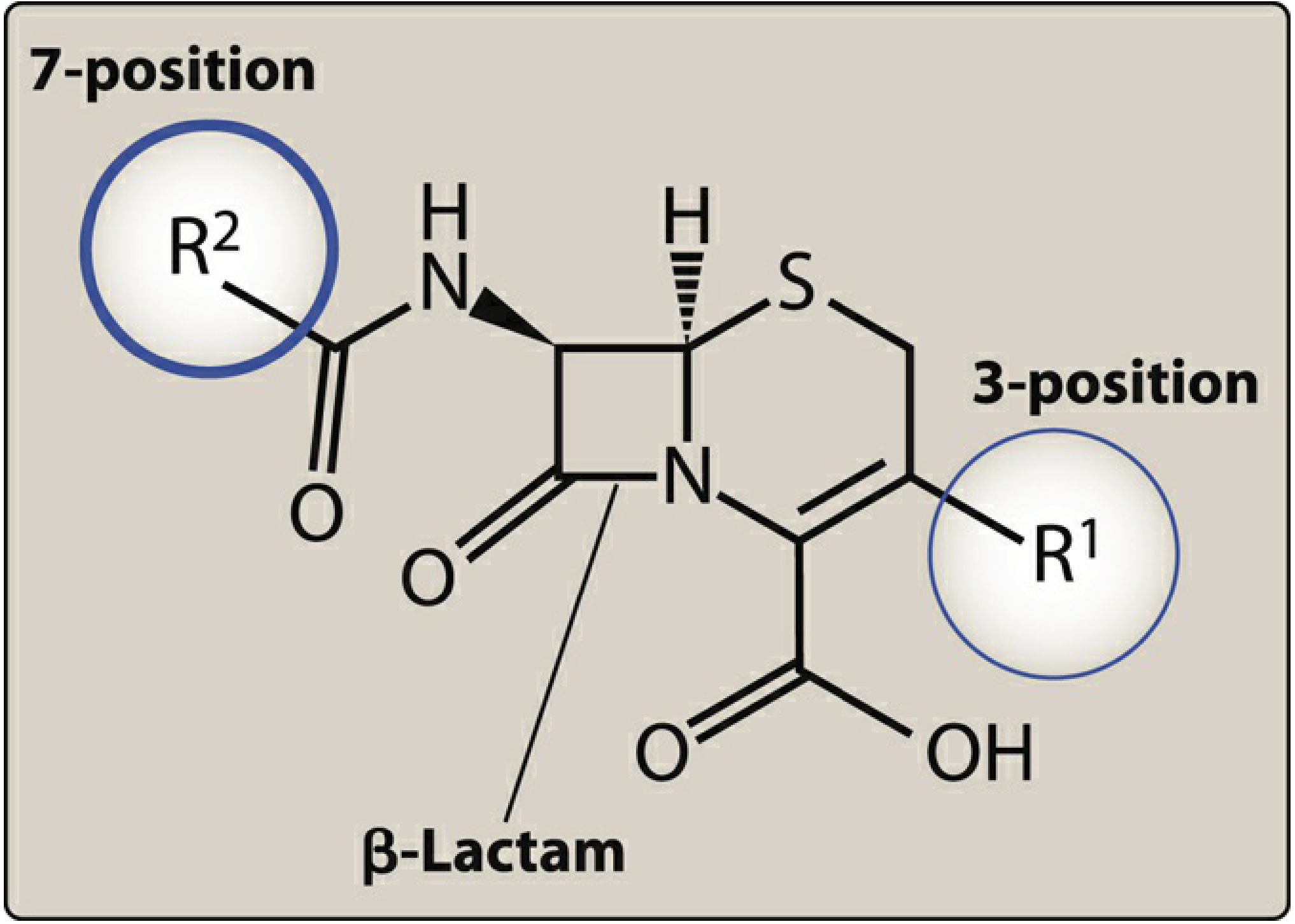
Figure: Structural features of cephalosporin antibiotics - the 7-position side chain governs activity, the 3-position governs PK (Lippincott Illustrated Reviews: Pharmacology)
2. Mechanism of Action
Same as all beta-lactams:
- Bind penicillin-binding proteins (PBPs) - bacterial enzymes (transpeptidases, carboxypeptidases) involved in cross-linking the peptidoglycan cell wall
- Inhibit transpeptidation - the final cross-linking step of peptidoglycan synthesis
- Result: structural weakening of the cell wall → bactericidal (cell lysis via autolysins)
- Activity is time-dependent: efficacy correlates with time the free drug concentration exceeds the MIC (fT > MIC)
3. Resistance Mechanisms
Three major mechanisms (Lippincott):
| Mechanism | Details |
|---|---|
| Beta-lactamase production | Enzymes hydrolyze the beta-lactam ring. Gram-positives secrete them extracellularly; gram-negatives hydrolyze in the periplasmic space. Includes chromosomal (AmpC, often inducible by 2nd/3rd gen agents) and plasmid-mediated (ESBLs, KPC, MBL) enzymes |
| Decreased permeability | Reduced or absent outer membrane porins (especially in gram-negatives like P. aeruginosa). Efflux pumps (e.g., in K. pneumoniae) actively remove drug |
| Altered PBPs | Modified PBPs have lower affinity for beta-lactams. Classic example: MRSA - mecA gene produces PBP2a, which is resistant to most commercially available beta-lactams |
4. Generations: Spectrum and Key Agents
First Generation
Drugs: Cefazolin (IV), Cephalexin (PO), Cefadroxil (PO)
Spectrum:
- Excellent gram-positive coverage: S. aureus (MSSA), S. epidermidis, S. pneumoniae, S. pyogenes, anaerobic streptococci
- Limited gram-negative: E. coli, K. pneumoniae, Proteus mirabilis (the "3 EKPs")
- No activity against MRSA, enterococci, Pseudomonas, Enterobacter, Serratia, B. fragilis
Key uses:
- Cefazolin: surgical prophylaxis (drug of choice), MSSA bacteremia, soft tissue infections
- Cephalexin: oral UTIs, cellulitis, minor skin/soft tissue infections
Dosing (Katzung):
- Cephalexin: 0.25-0.5 g PO q.i.d.; peak serum 15-20 mcg/mL
- Cefazolin: 0.5-2 g IV q8h; peak serum ~185 mcg/mL after 1 g IV
Second Generation
Drugs: Cefuroxime, Cefaclor, Cefprozil (oral); Cefoxitin, Cefotetan (parenteral cephamycins)
Spectrum:
- Retains gram-positive coverage of 1st gen
- Extended gram-negative: adds H. influenzae, Moraxella, Klebsiella (including 1st-gen resistant strains), Neisseria
- Cephamycins (cefoxitin, cefotetan): add Bacteroides fragilis and anaerobic coverage
- None active against enterococci or Pseudomonas
Key uses:
- Cefuroxime: respiratory tract infections, sinusitis, otitis media
- Cefoxitin/cefotetan: intra-abdominal, pelvic infections (anaerobic coverage); surgical prophylaxis for colorectal procedures
- Caution: Do NOT use for Enterobacter infections - chromosomal AmpC beta-lactamase readily selects resistant mutants
Dosing:
- Cefuroxime oral: 250-500 mg twice daily
- Cefuroxime IV: 75-125 mcg/mL after 1 g infusion
Third Generation
Drugs: Ceftriaxone, Cefotaxime (parenteral); Cefdinir, Cefixime, Cefpodoxime (oral); Ceftazidime (anti-pseudomonal)
Spectrum:
- Markedly expanded gram-negative coverage, including Enterobacterales
- CSF penetration: therapeutic levels achieved (used for meningitis)
- Ceftazidime and ceftizoxime: active against P. aeruginosa
- Reduced gram-positive coverage compared to 1st gen
- Not active against MRSA, L. monocytogenes, C. difficile, enterococci
Key uses (Katzung):
- Ceftriaxone: meningitis (N. meningitidis, S. pneumoniae, H. influenzae), gonorrhea, community-acquired pneumonia, Lyme disease (disseminated), empiric sepsis coverage; unique biliary excretion
- Cefotaxime: meningitis, sepsis, serious gram-negative infections; metabolized by liver (useful in renal impairment)
- Ceftazidime: Pseudomonas infections (pneumonia, bacteremia)
- Oral 3rd gen (cefdinir, cefpodoxime): otitis media, community respiratory infections
Half-life: Ceftriaxone has a long half-life (~8 hours), allowing once-daily dosing
Fourth Generation
Drug: Cefepime (IV/IM only)
Spectrum:
- Wide spectrum: gram-positives (streptococci, MSSA - NOT MRSA) + extensive gram-negatives including Enterobacter species and P. aeruginosa
- More stable to chromosomal AmpC beta-lactamases than 3rd gen (zwitterionic structure allows rapid outer membrane penetration)
- E. coli, K. pneumoniae, P. mirabilis, Enterobacter spp., P. aeruginosa
Key uses: Febrile neutropenia, nosocomial pneumonia, complicated UTIs, Pseudomonas infections, Enterobacter infections where 3rd gen may fail
Advanced Generation (5th Generation)
Drugs: Ceftaroline, Cefiderocol
Ceftaroline
- Only beta-lactam in the US with activity against MRSA
- Binds PBP2a (the modified PBP that confers MRSA resistance) and PBP of penicillin-resistant S. pneumoniae
- Gram-negative coverage similar to ceftriaxone
- Gaps: No Pseudomonas, ESBL-producers, Acinetobacter
- Indications: complicated skin/soft tissue infections (cSSTI), community-acquired pneumonia (CAP)
- Twice-daily dosing limits outpatient use
Cefiderocol (Siderophore Cephalosporin)
- Novel mechanism: acts as a siderophore - binds extracellular ferric iron (Fe³+), then enters gram-negative bacteria via the iron uptake (active transport) pathway in addition to passive diffusion through porins
- Achieves high intracellular concentrations
- Active against multidrug-resistant gram-negatives, including those with KPC, OXA-type, and metallo-beta-lactamases (MBL)
- Active against: MDR Enterobacterales, P. aeruginosa, Acinetobacter baumannii
- No gram-positive or anaerobic activity
- Indications: complicated UTIs (including pyelonephritis), hospital-acquired and ventilator-associated pneumonia
- Warning: Associated with increased mortality in some carbapenem-resistant infections in one trial - reserve for limited/no alternative situations
- Dose adjustment for augmented renal clearance (may need 4x daily dosing)
5. Pharmacokinetics
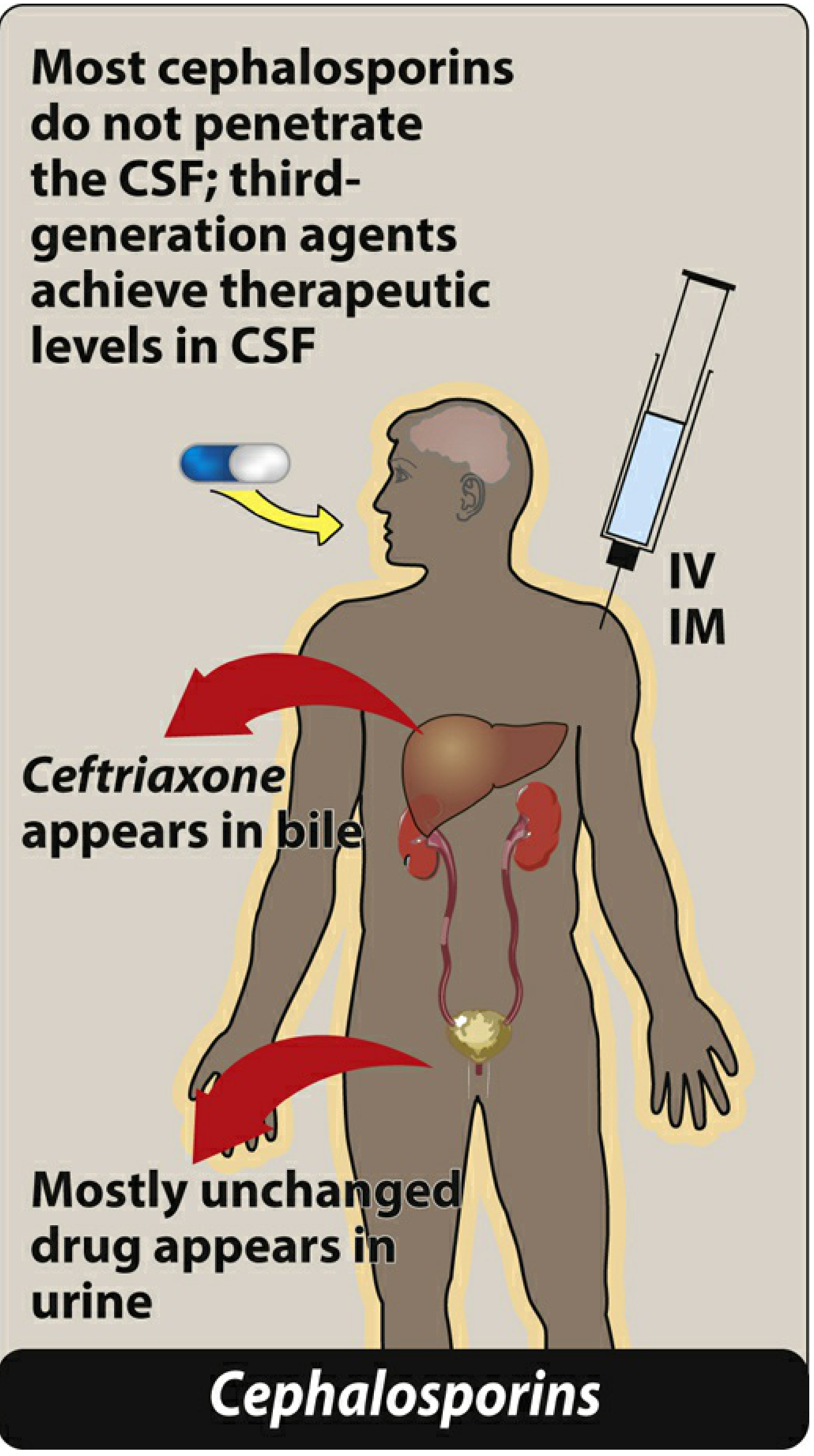
Figure: Administration and fate of the cephalosporins - most excreted unchanged in urine; ceftriaxone eliminated in bile (Lippincott Illustrated Reviews: Pharmacology)
| Parameter | Details |
|---|---|
| Route | Most require IV/IM (poor oral absorption). Oral agents: 1st gen (cephalexin), some 2nd gen (cefuroxime, cefaclor), oral 3rd gen (cefdinir, cefixime) |
| Distribution | Distribute widely into most tissues. Most do NOT penetrate CSF except 3rd gen and cefepime |
| Elimination | Primarily renal (glomerular filtration + tubular secretion). Probenecid blocks tubular secretion, raising serum levels |
| Exceptions | Ceftriaxone: biliary elimination (~40%); Cefotaxime: hepatic metabolism to active desacetylcefotaxime |
| Half-lives | Variable: cephalexin ~1h; cefazolin ~1.8h; ceftriaxone ~8h (once daily dosing possible) |
| Renal adjustment | Required for most agents when CrCl is impaired (except ceftriaxone). See table below |
Dosage adjustment for renal impairment (Katzung):
| Drug | Normal dose | CrCl ~50 mL/min | CrCl ~10 mL/min |
|---|---|---|---|
| Cephalexin PO | 0.25-0.5 g q6h | 50% | 25% |
| Cefazolin IV | 0.5-2 g q8h | 50% | 25% |
| Ceftriaxone IV | 1-2 g q12-24h | 100% | 100% |
6. Adverse Effects
Allergy & Cross-reactivity
- Hypersensitivity reactions (anaphylaxis, urticaria, fever, rashes, nephritis, granulocytopenia, hemolytic anemia) - similar to penicillins
- Cross-allergenicity with penicillins is low (1-2%) overall - the beta-lactam nucleus differs enough
- Cross-reactivity is most common when cephalosporins share identical R-side chains with penicillins (particularly 1st/2nd gen with aminopenicillins)
- Patients with penicillin anaphylaxis should NOT receive 1st or 2nd gen cephalosporins; use 3rd/4th gen with caution in a monitored setting (Katzung)
Toxicity
| Toxicity | Details |
|---|---|
| Local irritation | Pain at IM site; thrombophlebitis with IV infusion |
| Renal toxicity | Interstitial nephritis, tubular necrosis (uncommon) |
| Hypoprothrombinemia/Bleeding | Agents with methylthiotetrazole (MTT) group - cefotetan is the relevant current US agent. Prevented by vitamin K 10 mg PO twice weekly |
| Disulfiram-like reaction | MTT-containing agents (cefotetan) cause severe reaction with alcohol - alcohol must be avoided |
| Diarrhea / C. difficile | Disruption of gut flora; broad-spectrum agents are higher risk |
7. Important Coverage Gaps (All Generations)
Cephalosporins as a class are NOT active against:
- MRSA (except ceftaroline, cefiderocol has no gram-positive activity either)
- Enterococci (inherent resistance)
- Listeria monocytogenes
- Clostridioides difficile
- Atypicals (Mycoplasma, Chlamydia, Legionella - no cell wall)
8. Key Clinical Pearls
| Clinical Scenario | Drug of Choice |
|---|---|
| Surgical prophylaxis | Cefazolin (1st gen) |
| MSSA bacteremia | Cefazolin (superior to antistaphylococcal PCN in tolerability) |
| Bacterial meningitis (community) | Ceftriaxone + vancomycin (empiric) |
| Gonorrhea (uncomplicated) | Ceftriaxone IM |
| Lyme disease (disseminated/CNS) | Ceftriaxone IV |
| Pseudomonas infection | Ceftazidime, cefepime, or cefiderocol (MDR) |
| MRSA infection | Ceftaroline (only beta-lactam option) |
| Febrile neutropenia | Cefepime |
| Intra-abdominal (anaerobes) | Cefoxitin or cefotetan (2nd gen cephamycins) |
| MDR gram-negative (last resort) | Cefiderocol |
- Katzung's Basic and Clinical Pharmacology, 16th Ed., pp. 1247-1253
- Lippincott Illustrated Reviews: Pharmacology, pp. 955-962
This is a shared conversation. Sign in to Orris to start your own chat.