
What are the vegetative functions of hypothalamus
The hypothalamus controls several key vegetative (autonomic/visceral) functions: it regulates body temperature, hunger and satiety, thirst and water balance, sleep-wake cycles, circadian rhythms, and cardiovascular/autonomic tone. It also integrates endocrine control via the pituitary gland.
Searching sources...
Reading File
Finding Sources
Finding Sources
The exact section is in Guyton and Hall. Let me read it fully.
Reading File
Reading File
Loading Image
Now I have everything needed for a thorough, well-sourced answer. Let me also get the truncated portion of the first read (lines 1955-2000).
Reading File
I now have all the content needed for a complete answer. Here is the full breakdown:
Vegetative Functions of the Hypothalamus
The hypothalamus is a small but extremely powerful structure that acts as the master integrator of the body's internal environment. Its vegetative (autonomic/visceral) and endocrine control functions are organized by distinct nuclei and areas.
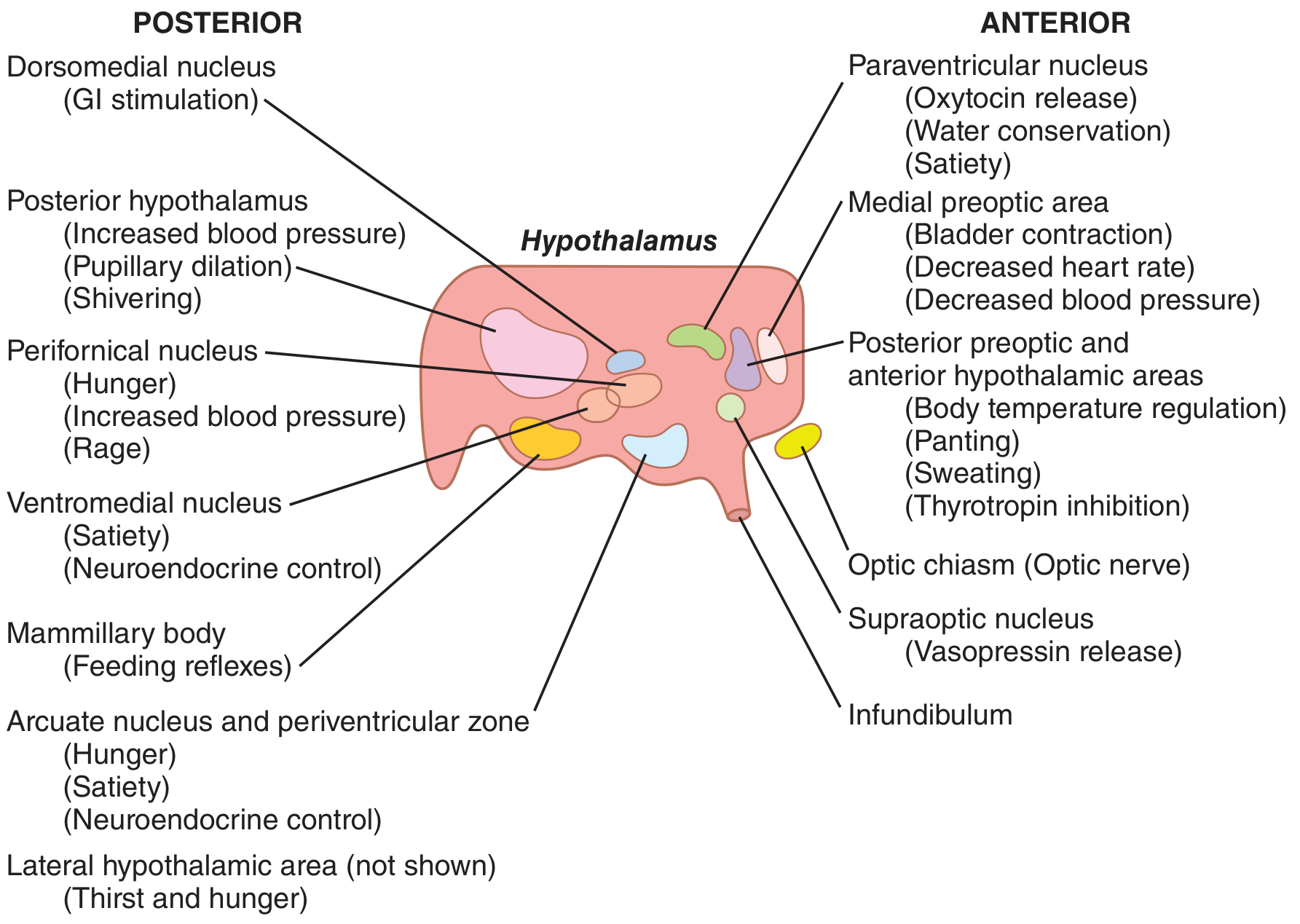
1. Cardiovascular Regulation
Stimulation of the posterior and lateral hypothalamus increases arterial pressure and heart rate (sympathetic drive). Stimulation of the preoptic area has the opposite effect - it decreases heart rate and blood pressure. These effects are relayed through cardiovascular control centers in the reticular regions of the pons and medulla.
- Perifornical nucleus: hunger, increased BP, rage
- Medial preoptic area: bladder contraction, decreased HR and BP
- Posterior hypothalamus: increased BP, pupillary dilation, shivering
2. Body Temperature Regulation
The anterior hypothalamus (preoptic area) is the body's thermostat. Temperature-sensitive neurons here detect blood temperature and regulate heat-dissipating mechanisms (sweating, panting) and heat-generating mechanisms (shivering, vasoconstriction). The posterior preoptic and anterior hypothalamic areas specifically control body temperature, panting, sweating, and thyrotropin inhibition.
3. Body Water Regulation (Thirst and ADH)
The hypothalamus regulates body water through two mechanisms:
- Thirst: A thirst center in the lateral hypothalamus responds to increased electrolyte concentration in body fluids, creating the conscious urge to drink.
- Renal water excretion: The supraoptic nuclei sense hyperosmolarity and cause secretion of antidiuretic hormone (ADH/vasopressin) into the posterior pituitary, which acts on the renal collecting tubules to reabsorb water and reduce urine output.
The paraventricular nucleus also contributes to water conservation (alongside oxytocin release).
4. Uterine Contractility and Milk Ejection (Oxytocin)
The paraventricular nuclei secrete oxytocin, which:
- Increases uterine contractility during labor
- Contracts the myoepithelial cells around breast alveoli to eject milk through the nipples
This is a classic neuroendocrine reflex: suckling at the breast triggers a reflex arc to the posterior hypothalamus, stimulating oxytocin release.
5. Gastrointestinal and Feeding Regulation
| Area | Effect |
|---|---|
| Lateral hypothalamic area (perifornical nucleus) | Hunger, appetite, voracious eating; if destroyed - lethal starvation and passivity |
| Ventromedial nucleus | Satiety center; if destroyed bilaterally - hyperphagia and obesity |
| Arcuate nucleus | Contains two neuron types that increase or decrease appetite |
| Mammillary bodies | Control feeding reflexes (licking lips, swallowing) |
| Dorsomedial nucleus | GI stimulation |
6. Hypothalamic Control of Anterior Pituitary (Neuroendocrine)
Specific hypothalamic nuclei secrete releasing and inhibiting hormones into the hypothalamo-hypophyseal portal blood, which flows directly to the anterior pituitary. This controls secretion of:
- Growth hormone (GHRH / somatostatin)
- TSH (TRH / thyrotropin inhibition from anterior hypothalamic area)
- ACTH (CRH)
- FSH and LH (GnRH)
- Prolactin (dopamine as inhibitor)
7. Behavioral and Emotional Drives
Though technically limbic in character, these overlap significantly with vegetative control:
- Lateral hypothalamus stimulation: increased general activity, rage, fighting
- Ventromedial nucleus stimulation: tranquility, satiety
- Periventricular nuclei stimulation: fear and punishment reactions
- Anterior and posterior hypothalamus: sexual drive
Lesions produce the opposite - lateral lesions cause passivity and starvation; ventromedial lesions cause rage and hyperphagia.
Summary Table by Nucleus
| Nucleus / Area | Vegetative Function |
|---|---|
| Supraoptic nucleus | Vasopressin (ADH) release |
| Paraventricular nucleus | Oxytocin release, water conservation, satiety |
| Preoptic area (medial) | Bladder contraction, decreased HR and BP |
| Anterior hypothalamic area | Temperature regulation, sweating, panting |
| Lateral hypothalamic area | Thirst, hunger, increased BP |
| Ventromedial nucleus | Satiety, neuroendocrine control |
| Dorsomedial nucleus | GI stimulation |
| Perifornical nucleus | Hunger, increased BP, rage |
| Posterior hypothalamus | Increased BP, pupillary dilation, shivering |
| Arcuate + periventricular zone | Hunger/satiety, neuroendocrine control |
| Mammillary bodies | Feeding reflexes |
Source: Guyton and Hall Textbook of Medical Physiology, Chapter 59 - "Vegetative and Endocrine Control Functions of the Hypothalamus," pp. 734-735
This is a shared conversation. Sign in to Orris to start your own chat.