
3 year old boy fall down from bed on floor and on head left side this type swelling occur what to do , what management
I'll read the medical library skill first, then research this topic in parallel.
Reading File
Now I'll search the medical library and web in parallel for this pediatric head injury case.
Finding Sources
Finding Sources
Searching the Web
3 year old child fall from bed head injury left side swelling management pediatric
Finding Sources
Finding Sources
Searching Images
scalp hematoma child head injury swelling types
Reading File
Finding Sources
I found the PECARN flowchart image. Let me fetch it and also read more details.
Loading Image
Reading File
I now have excellent information. Let me compile a comprehensive, practical answer.
Pediatric Head Injury: 3-Year-Old Fall from Bed with Left-Side Head Swelling
What is That Swelling?
A localized swelling on the side of the head after a fall is most commonly a scalp hematoma (also called a "goose egg" or "lump"). Blood collects in the soft tissue layers of the scalp just under the skin. In a 3-year-old, this is a very common result of a fall from bed height (typically 1-2 feet). It looks alarming but is usually benign.
The swelling can be:
- Subgaleal hematoma - blood under the scalp's tough fibrous layer; can spread across the whole scalp
- Cephalhematoma - blood between the periosteum and skull bone; feels firm, does not cross suture lines
- Simple scalp bruise/contusion - superficial soft tissue swelling
IMMEDIATE FIRST AID (At Home)
- Apply a cold pack / ice wrapped in a cloth to the swelling for 20 minutes. Repeat after 1 hour, then as needed. This reduces swelling and pain.
- Keep the child calm and lying down for the first 1-2 hours.
- Offer only clear fluids initially (in case of vomiting). Resume normal diet after 2 hours if no vomiting.
- Pain relief: Paracetamol (Acetaminophen/Crocin) can be given after 2 hours from injury if no vomiting. Never give Aspirin to children.
- Watch closely for 2 hours - allow sleep but check every 2 hours to ensure child wakes, recognizes you, and talks normally.
TAKE TO HOSPITAL / EMERGENCY IMMEDIATELY IF:
These are RED FLAG signs - do not wait:
| Red Flag | Why Dangerous |
|---|---|
| Loss of consciousness (even brief) | Suggests significant brain injury |
| Repeated vomiting (more than 1-2 times) | Raised intracranial pressure |
| Child cannot be awakened / very drowsy | Brain involvement |
| Seizure / convulsion | Serious |
| Unequal pupils | Brain compression |
| Bleeding from ear or nose | Basilar skull fracture |
| Child not recognizing parents / confusion | Altered consciousness |
| Severe or worsening headache | ICP rising |
| Difficulty walking, weakness in limbs | Neurological deficit |
| Swelling is rapidly enlarging | Expanding hematoma |
| Palpable depression in skull under swelling | Depressed skull fracture |
PECARN Decision Rule (Clinical Guide for Doctors)
This 3-year-old falls in the age ≥2 years category (Panel B of the PECARN algorithm):
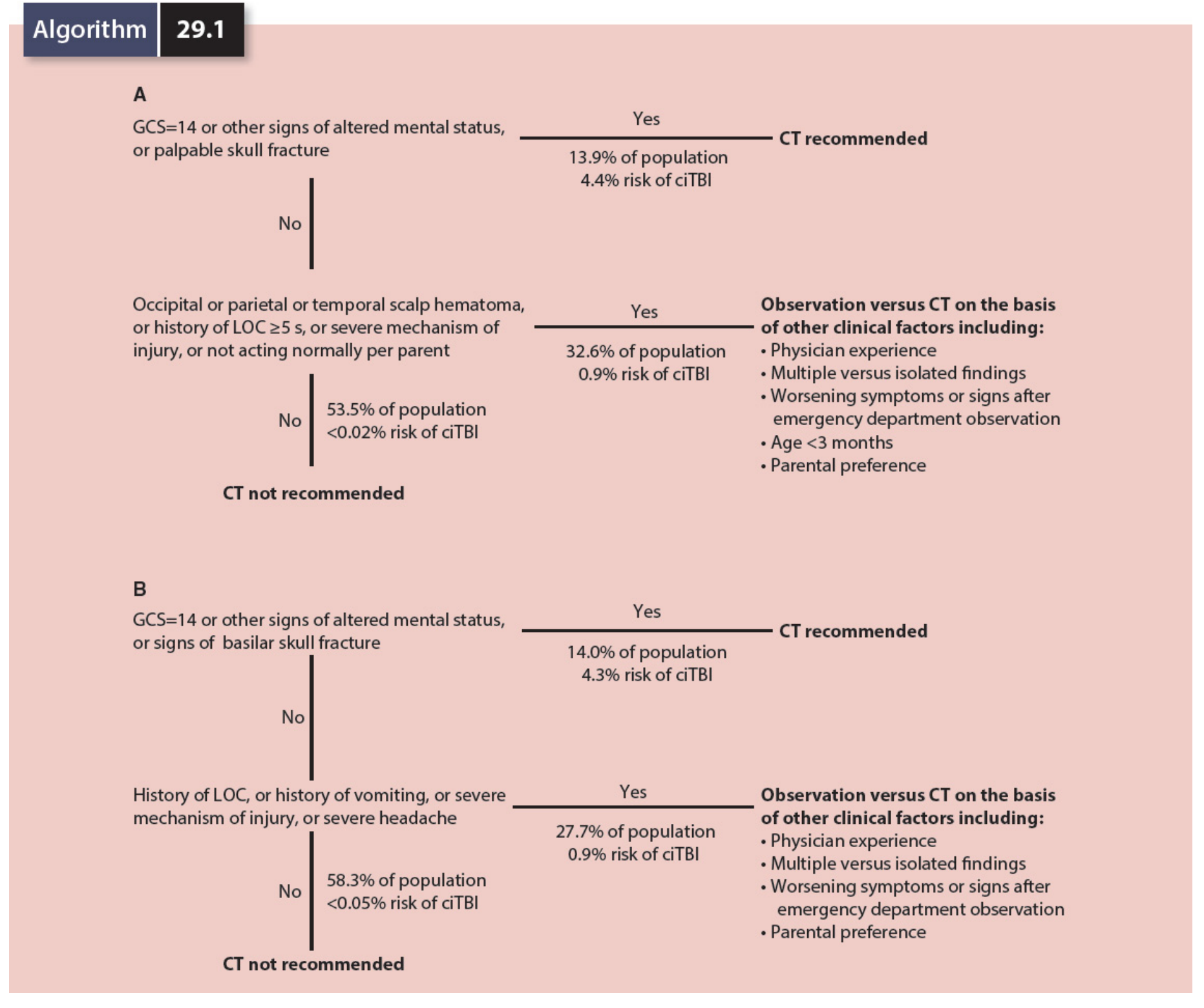
For a child ≥2 years:
- CT recommended if: GCS ≤14, altered mental status, or signs of basilar skull fracture
- CT vs. observation (doctor's discretion): history of LOC, vomiting, severe mechanism, severe headache
- CT NOT needed / safe for discharge: if GCS 15, no LOC, no vomiting, no severe mechanism, acting normally → risk of serious TBI is <0.05%
A simple fall from a bed (low mechanism) in an alert, playful 3-year-old with only a scalp bump and GCS 15 = very low risk. CT is generally NOT needed in this scenario unless red flags are present.
(Mulholland and Greenfield's Surgery, 7e, p. 1438-1439)
Hospital Management (If Child is Brought In)
Assessment:
- GCS scoring (modified for children)
- Careful palpation of skull for step-off deformity (depressed fracture)
- Neurological examination
- Assess pupil size and reactivity
If no red flags (most common scenario):
- Observation in ED for 4-6 hours
- Reassurance and discharge with written instructions
- Parents asked to return if any red flags develop
If CT done and normal:
- Safe discharge home even with isolated skull fracture
- Strict written return precautions given to parents
If CT shows intracranial injury (rare from bed fall):
- Neurosurgical consultation
- ICU monitoring, ICP management if severe
Home Observation After Discharge (First 24 Hours)
- Sleep in the same room as the child tonight
- Wake child once during the night - check that he responds normally, walks and talks normally
- Continue cold pack on swelling
- Normal diet can resume after 2 hours if no vomiting
- The swelling/lump may take 1-2 weeks to fully resolve - this is normal
- After 24 hours, a warm compress can help reabsorb the remaining swelling
Summary
Most falls from bed in a 3-year-old with a scalp "goose egg" are minor injuries. The child should be watched closely at home with cold compress applied. Go to the hospital immediately if the child loses consciousness, has repeated vomiting, seizure, extreme drowsiness, or worsening symptoms. A CT scan is only needed when clinical red flags are present - not routinely for every head bump.
Sources: Mulholland and Greenfield's Surgery, 7e; Seattle Children's Hospital guidelines; Monadnock Community Hospital pediatric head injury guidelines
This is a shared conversation. Sign in to Orris to start your own chat.