
Functions of plasma proteins
Reading File
Finding Sources
Finding Sources
Reading File
Reading File
Reading File
Reading File
Finding Sources
Reading File
Loading Image
I now have comprehensive information from multiple authoritative textbooks. Here is a complete, well-organized answer.
Functions of Plasma Proteins
Plasma proteins are a heterogeneous group of proteins dissolved in plasma at a normal concentration of ~7 g/dL. They are broadly classified into albumin, globulins (α, β, γ), and fibrinogen.
Origin / Synthesis
- ~70-80% are synthesized in the liver - this includes albumin, fibrinogen, transferrin, most complement proteins, and coagulation factors. (Harper's Illustrated Biochemistry, 32nd Ed)
- γ-globulins (antibodies) are synthesized by lymphocytes
- von Willebrand factor is an exception, synthesized in vascular endothelium
- The liver can produce up to 30 g/day of plasma proteins when needed (Guyton & Hall)
Functions
1. Maintenance of Colloid Osmotic (Oncotic) Pressure
The most important function of albumin. Capillary walls are relatively impermeable to proteins, so plasma proteins exert an osmotic force of about 25 mm Hg across the capillary wall, keeping fluid within the vasculature. This prevents edema. Loss of albumin (nephrotic syndrome, cirrhosis, malnutrition) reduces oncotic pressure and leads to edema and ascites.
- Ganong's Review of Medical Physiology, 26th Ed, p. 563
- Guyton & Hall Textbook of Medical Physiology, p. 856
2. Transport / Carrier Function
Many plasma proteins act as specific or nonspecific carriers:
| Protein | What it transports |
|---|---|
| Albumin | Fatty acids, bilirubin, bile salts, hormones, drugs, Ca²⁺, Mg²⁺ |
| Transferrin | Iron (2 atoms/molecule) |
| Ceruloplasmin | Copper (6 atoms/molecule) |
| Haptoglobin | Free hemoglobin (1:1 binding) |
| Hemopexin | Heme / porphyrins (for recycling) |
| Thyroxine-binding globulin (TBG) | Thyroid hormones (T₃, T₄) |
| Transthyretin (prealbumin) | Thyroid hormones |
| Steroid hormone-binding globulin (SHBG) | Testosterone, estradiol |
| Apolipoprotein B | Lipids (as lipoprotein particles) |
- Ganong's Review of Medical Physiology, Table 31-5
3. Immunity and Defense
- γ-globulins (immunoglobulins / antibodies) mediate both natural and acquired immunity against invading microorganisms
- Complement proteins (C1-C9, synthesized in liver) form the complement cascade, enabling opsonization, lysis of pathogens, and inflammation
- C-reactive protein (CRP) rises in inflammation and plays a role in tissue defense
- Guyton & Hall, p. 856
4. Blood Coagulation (Hemostasis)
- Fibrinogen polymerizes into fibrin threads to form clots at sites of vascular injury
- Coagulation factors II, VII, IX, X (liver-synthesized, vitamin K-dependent) drive the coagulation cascade
- Anticoagulant proteins (Antithrombin III, Protein C, Protein S) keep clotting in check
- Activated Protein C inhibits coagulation by inactivating factors V and VIII
- Tietz Textbook of Laboratory Medicine, 7th Ed
5. Buffering (Acid-Base Balance)
Plasma proteins contribute approximately 15% of the buffering capacity of blood (along with hemoglobin). At normal plasma pH of 7.40, they exist mostly in the anionic form, and their ionizable COOH and NH₂ groups act as weak acid-base buffers.
- Ganong's Review of Medical Physiology, 26th Ed, p. 563
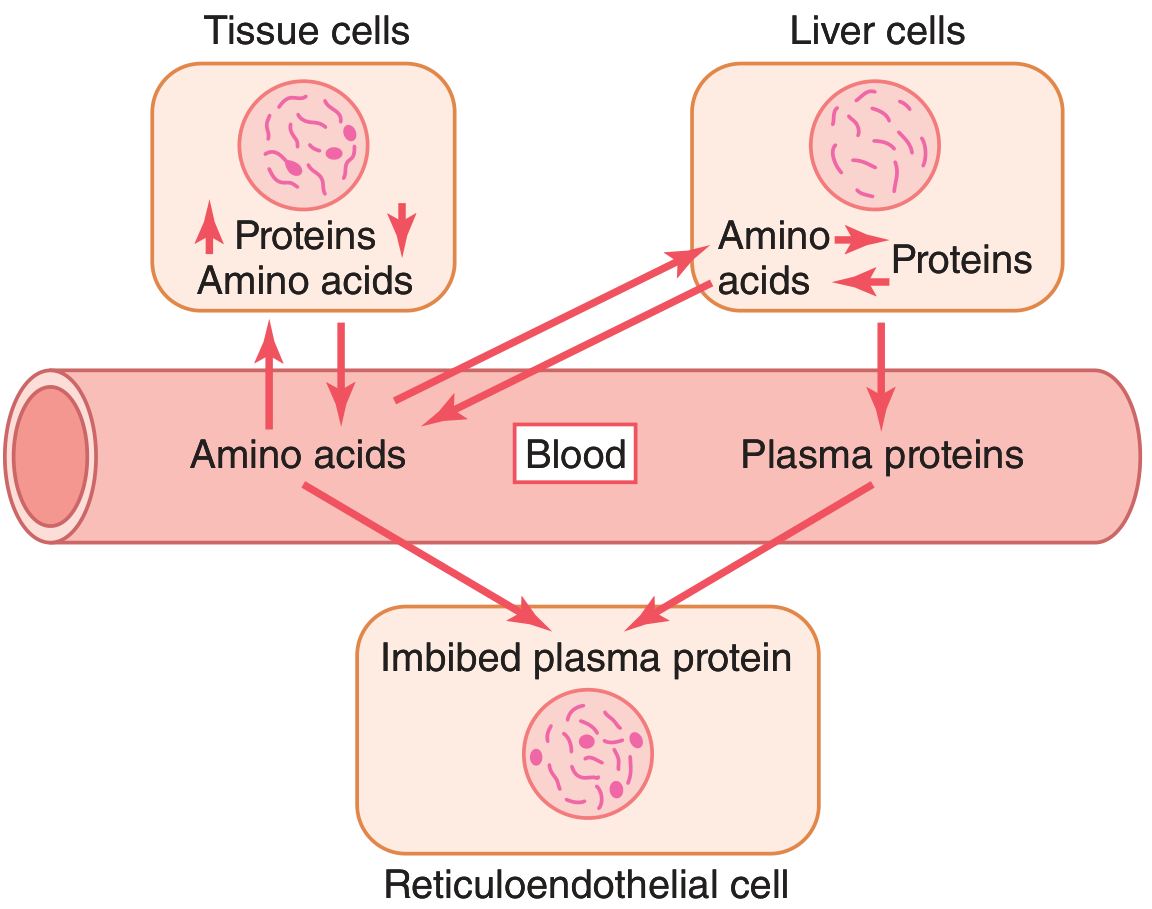
6. Reservoir of Amino Acids
Plasma proteins serve as a labile protein reserve. When tissues are depleted of protein, tissue macrophages can imbibe whole plasma proteins via pinocytosis, cleave them into amino acids, and redistribute them to tissues for new protein synthesis. There is a constant reversible equilibrium between plasma proteins, plasma amino acids, and tissue proteins (~400 g of body protein synthesized and degraded daily).
- Guyton & Hall, p. 856
7. Enzymatic Functions
Some globulins exert enzymatic activity in plasma (e.g., angiotensin-converting enzyme, lipoprotein lipase interactions).
8. Acute-Phase Response
Several plasma proteins increase dramatically during inflammation or tissue injury - these are called acute-phase proteins:
- Increased (positive acute-phase): CRP, fibrinogen, haptoglobin, α₁-antitrypsin (α-antiprotease), ceruloplasmin, ferritin, complement proteins
- Decreased (negative acute-phase): Albumin, transthyretin (prealbumin)
- Synthesis is triggered by IL-6 from macrophages. This response helps limit infection and repair tissue damage.
- Harper's Illustrated Biochemistry, 32nd Ed
9. Regulation of Vascular/Hormonal Precursors
- Angiotensinogen (synthesized in liver) is cleaved by renin to form angiotensin I, the precursor to angiotensin II - a key regulator of blood pressure and fluid balance
10. Protease Inhibition
- α₁-Antitrypsin (major serine protease inhibitor / serpin) protects tissues from excessive proteolysis by trypsin and other serine proteases. Deficiency leads to pulmonary emphysema and liver disease.
- α₂-Macroglobulin inhibits endoproteases in serum
11. Lipid Metabolism
- Apolipoproteins (ApoA, ApoB, ApoC, ApoE) are essential for the assembly, structural integrity, and receptor-mediated uptake of lipoprotein particles (chylomicrons, VLDL, LDL, HDL)
Summary Table
| Function | Key Protein(s) |
|---|---|
| Oncotic pressure | Albumin |
| Immunity / defense | γ-globulins, complement |
| Coagulation | Fibrinogen, factors II, VII, IX, X; Protein C/S |
| Transport | Albumin, transferrin, haptoglobin, TBG, ceruloplasmin |
| Buffering | All plasma proteins (15% of blood buffer) |
| Amino acid reserve | Albumin (principal labile pool) |
| Acute-phase response | CRP, fibrinogen, α₁-antitrypsin |
| BP regulation | Angiotensinogen |
| Protease inhibition | α₁-Antitrypsin, antithrombin III |
| Lipid metabolism | Apolipoproteins |
Sources: Guyton and Hall Textbook of Medical Physiology; Ganong's Review of Medical Physiology, 26th Ed; Harper's Illustrated Biochemistry, 32nd Ed; Tietz Textbook of Laboratory Medicine, 7th Ed.
This is a shared conversation. Sign in to Orris to start your own chat.