
Tell me the difference between glycolysis, glycogenesis , gluconeogenesis , glycogenolysis and what are there function and where did it occur ?
Here's a quick overview before I pull in the textbooks:
Glycolysis - breakdown of glucose to pyruvate (cytoplasm, all cells).
Glycogenesis - synthesis of glycogen from glucose (liver + muscle).
Glycogenolysis - breakdown of glycogen back to glucose (liver + muscle).
Gluconeogenesis - synthesis of new glucose from non-carb precursors (mainly liver, some kidney).
These are the four central pathways of glucose/glycogen metabolism, each triggered by different hormonal and energy signals.
Searching sources...
Reading File
Now let me search the medical library for all five pathways in parallel.
Finding Sources
Finding Sources
Finding Sources
Now let me read the key sections from the best biochemistry sources in parallel.
Reading File
Reading File
Reading File
Excellent - I have rich content. Let me read the glycogenolysis section and the gluconeogenesis details now.
Reading File
Reading File
Reading File
I now have comprehensive information from the textbooks. Let me fetch the key diagram images and compile the full answer.
Loading Image
Loading Image
I now have all the information needed for a comprehensive answer. Here is the full breakdown:
Glucose Metabolism: The Five Core Pathways
These five pathways are all interconnected parts of carbohydrate metabolism. They differ in direction (anabolic vs. catabolic), location, substrates, and the hormonal signals that trigger them.
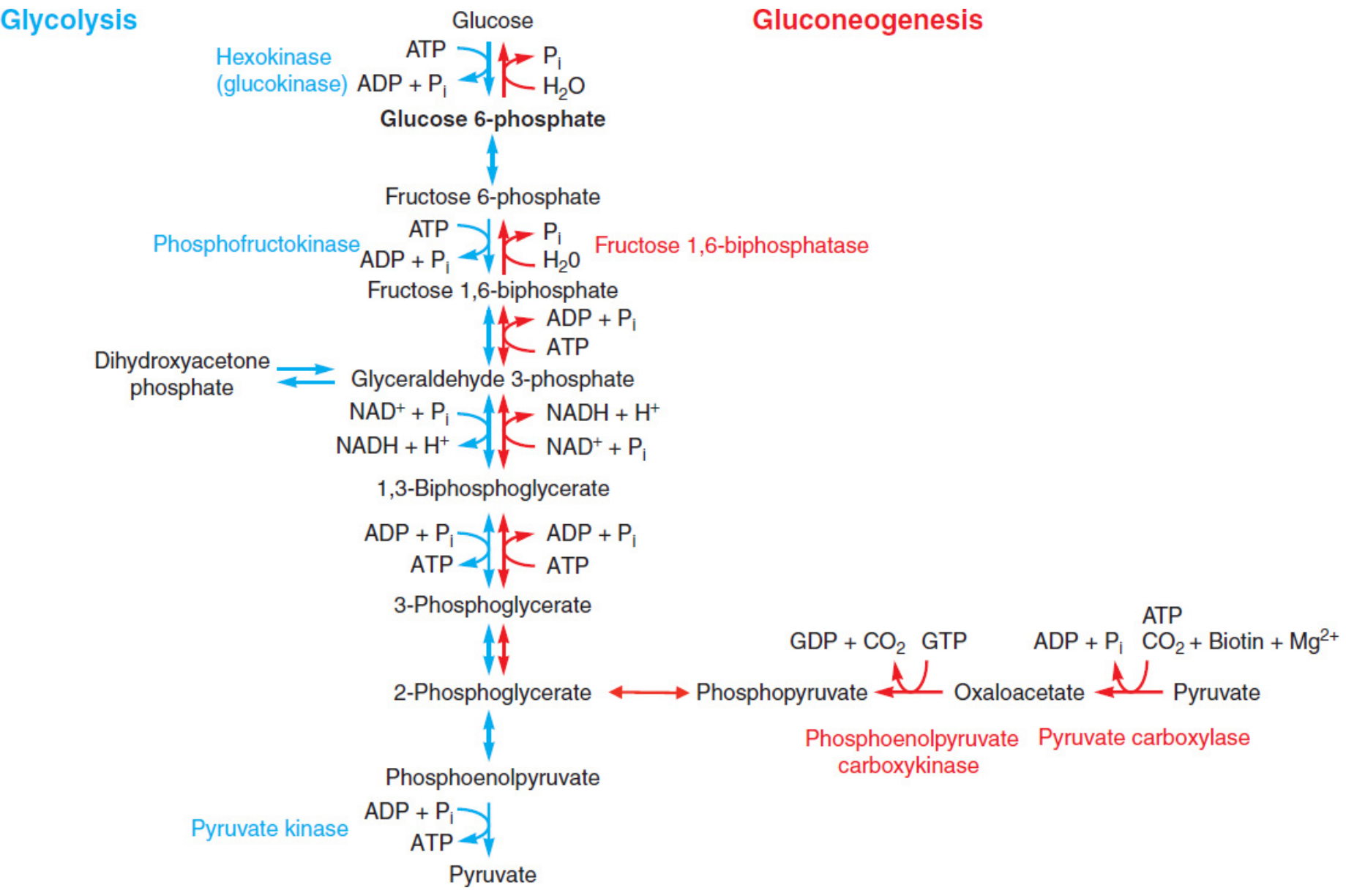
1. Glycolysis - "Breaking Down Glucose"
What it is: The pathway that converts one molecule of glucose (6-carbon) into two molecules of pyruvate (3-carbon).
Function:
- Primary method of generating ATP from glucose
- Provides pyruvate for the TCA (Krebs) cycle under aerobic conditions
- Provides intermediates for other biosynthetic pathways
- Net yield: 2 ATP + 2 NADH + 2 pyruvate per glucose
Location: Cytoplasm (cytosol) of virtually all cells - this is universal
Key Equation:
Glucose + 2 NAD⁺ + 2 ADP + 2Pᵢ → 2 Pyruvate + 2 NADH + 2H⁺ + 2 ATP
Key Enzymes (rate-limiting steps):
- Hexokinase (Glucokinase in liver) - traps glucose inside the cell
- Phosphofructokinase-1 (PFK-1) - the main regulatory enzyme
- Pyruvate kinase
What happens to pyruvate after?
- With oxygen (aerobic): Pyruvate → Acetyl-CoA → Krebs cycle → 36-38 ATP total
- Without oxygen (anaerobic): Pyruvate → Lactate (lactic acid fermentation) - regenerates NAD⁺ to keep glycolysis running
Stimulated by: Insulin, high glucose, high AMP/ADP (low energy state)
2. Glycogenesis - "Making Glycogen"
What it is: The synthesis of glycogen (a branched glucose polymer) from glucose-6-phosphate.
Function:
- Stores excess glucose after a meal as glycogen for later use
- Prevents hyperglycemia post-meal
- Storage efficiency is remarkable: ~97% (creating G6P costs 1 ATP, but its complete oxidation yields 37 ATP)
Location:
- Liver (primary) - stores ~100-120 g glycogen; releases glucose to blood
- Skeletal muscle - stores ~300-400 g; used locally for muscle contraction only (cannot release free glucose to blood)
Key Steps:
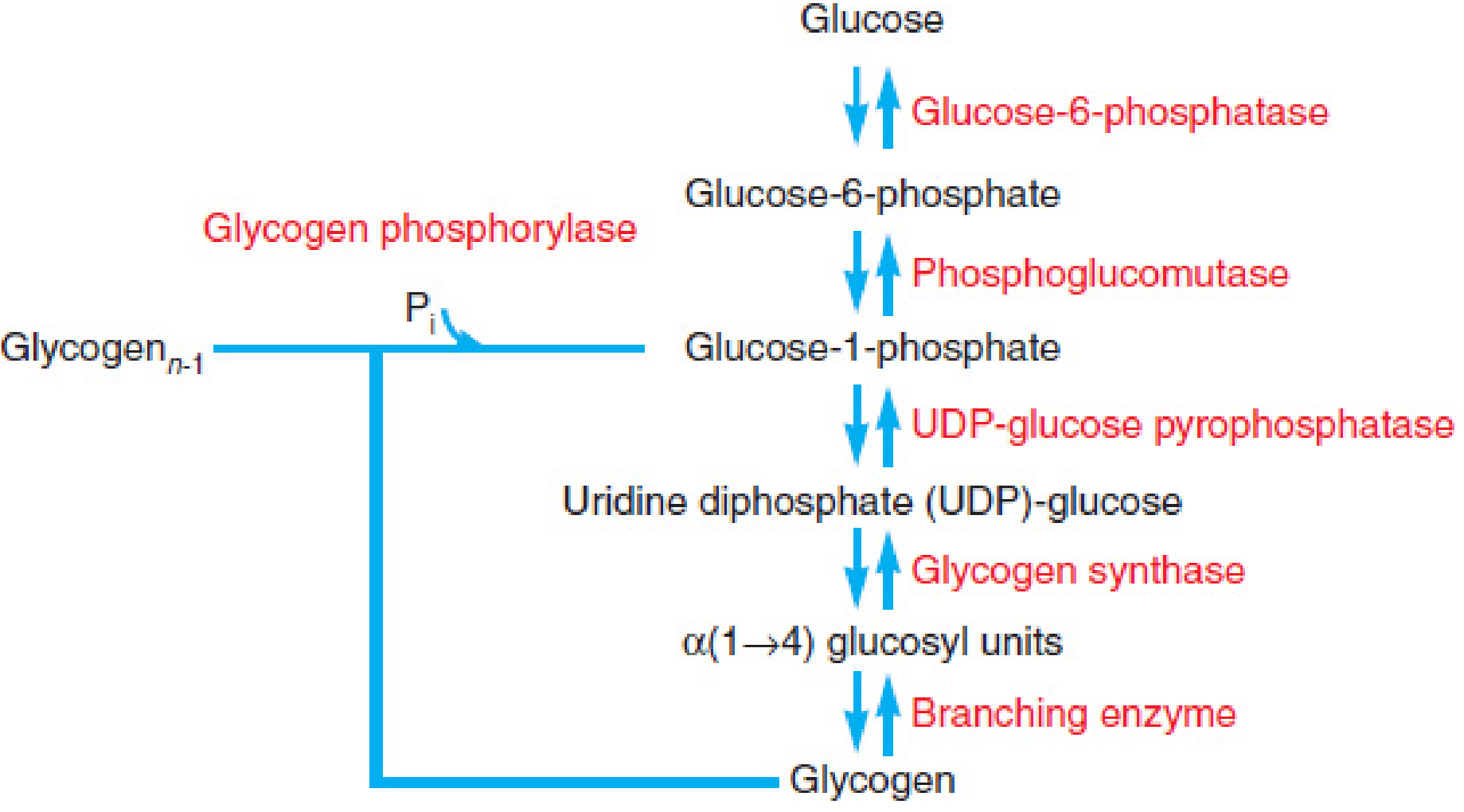
- Glucose → Glucose-6-phosphate (by hexokinase; uses 1 ATP)
- Glucose-6-P → Glucose-1-phosphate (by phosphoglucomutase)
- Glucose-1-P + UTP → UDP-glucose (activated glucose donor; by UDP-glucose pyrophosphorylase)
- UDP-glucose added to growing chain by glycogen synthase (forms α-1,4 bonds)
- Branching enzyme creates α-1,6 branch points every 8-12 residues
Stimulated by: Insulin (after a meal), high glucose
3. Glycogenolysis - "Breaking Down Glycogen"
What it is: The degradation of stored glycogen back into glucose (or glucose-6-phosphate). This is NOT a simple reversal of glycogenesis - it uses a completely separate set of enzymes.
Function:
- Rapidly mobilizes glucose between meals or during exercise/stress
- Liver glycogenolysis maintains blood glucose levels (for the brain and other tissues)
- Muscle glycogenolysis provides fuel for the contracting muscle itself
Location:
- Liver - glucose released into bloodstream
- Skeletal muscle - glucose used locally (cannot export to blood because muscle lacks glucose-6-phosphatase)
Key Steps:
- Glycogen phosphorylase cleaves α-1,4 bonds by phosphorolysis → produces glucose-1-phosphate
- Requires pyridoxal phosphate (Vitamin B6) as coenzyme
- Stops 4 residues before a branch point (produces "limit dextrin")
- Debranching enzyme (bifunctional):
- Transferase activity moves 3 of the 4 remaining residues to another chain
- Glucosidase activity releases the branch-point glucose as free glucose
- Glucose-1-P → Glucose-6-P (by phosphoglucomutase)
- In liver only: Glucose-6-P → Free glucose (by glucose-6-phosphatase in the ER) → released into blood
Key point: Glucose-6-phosphatase exists only in hepatocytes, kidney, and intestinal epithelial cells. That is why only the liver (and kidney) can release free glucose to the blood, not muscle.
Stimulated by: Glucagon (liver), Epinephrine (both liver and muscle), low blood glucose
4. Gluconeogenesis - "Making New Glucose"
What it is: The synthesis of glucose from non-carbohydrate precursors. It is NOT simply the reverse of glycolysis - three irreversible steps of glycolysis must be bypassed by unique enzymes.
Function:
- Maintains blood glucose during fasting, starvation, or intense exercise when glycogen stores are depleted
- The brain and red blood cells depend almost entirely on glucose and cannot use fatty acids for fuel
- Over 90% of new glucose comes from lactate, glycerol, alanine, and glutamine
Location:
- Liver (primary site; ~90% of gluconeogenesis)
- Kidney cortex (becomes important during prolonged fasting, starvation, DKA, and critical illness - important in diabetics)
Gluconeogenic Precursors:
| Precursor | Source |
|---|---|
| Lactate | Anaerobic muscle, RBCs (via the Cori Cycle) |
| Alanine & Glutamine | Muscle protein breakdown |
| Glycerol | Fat (triglyceride) breakdown |
| Odd-chain fatty acids | Fat breakdown (via propionyl-CoA) |
| Glucogenic amino acids | Protein catabolism |
The 3 Bypass Reactions (these differ from glycolysis):
| Glycolysis Step | Glycolysis Enzyme | Gluconeogenesis Bypass Enzyme | Location |
|---|---|---|---|
| Pyruvate → PEP | Pyruvate kinase | Pyruvate carboxylase (Pyruvate → OAA, mitochondria) then PEPCK (OAA → PEP, cytosol) | Mitochondria + Cytosol |
| Fructose-1,6-BP → Fructose-6-P | PFK-1 | Fructose-1,6-bisphosphatase | Cytosol |
| Glucose-6-P → Glucose | Hexokinase | Glucose-6-phosphatase (in ER) | ER / Cytosol |
Stimulated by: Glucagon, cortisol, epinephrine; high acetyl-CoA (activates pyruvate carboxylase)
Inhibited by: Insulin, high ADP, high glucose
5. Summary Comparison Table
| Feature | Glycolysis | Glycogenesis | Glycogenolysis | Gluconeogenesis |
|---|---|---|---|---|
| Type | Catabolic | Anabolic | Catabolic | Anabolic |
| Substrate | Glucose | Glucose-6-P / UDP-glucose | Glycogen | Lactate, AA, glycerol |
| Product | Pyruvate (+ ATP) | Glycogen | Glucose / G6P | Glucose |
| Location | Cytosol (all cells) | Cytosol (liver, muscle) | Cytosol (liver, muscle) | Cytosol + Mitochondria (liver, kidney) |
| Key Hormone (ON) | Insulin | Insulin | Glucagon, Epinephrine | Glucagon, Cortisol |
| Key Hormone (OFF) | Glucagon | Glucagon | Insulin | Insulin |
| Energy | Produces ATP | Consumes ATP | Consumes no net ATP | Consumes ATP (energy costly) |
| When active | Fed state / exercise | Fed state (post-meal) | Fasting / exercise | Prolonged fasting / starvation |
How They Connect
Dietary Glucose
      ↓ (post-meal, insulin ↑)
  GLYCOLYSIS ──→ Pyruvate ──→ Krebs Cycle / Lipogenesis
      ↓ (glucose excess)
  GLYCOGENESIS ──→ Glycogen stored in liver/muscle
      ↓ (fasting/exercise, glucagon/epinephrine ↑)
  GLYCOGENOLYSIS ──→ Glycogen → Glucose back to blood
      ↓ (prolonged fasting, glycogen depleted)
  GLUCONEOGENESIS ──→ Lactate/AA/Glycerol → New Glucose
"Glucose-6-phosphate plays a central role in carbohydrate metabolism" - it is the intersection of all four pathways and can feed into glycolysis, glycogen synthesis, or the pentose phosphate pathway depending on the cell's needs. - Mulholland and Greenfield's Surgery, p. 75
Sources: Basic Medical Biochemistry: A Clinical Approach, 6e | Biochemistry, Lippincott Illustrated Reviews, 8e | Mulholland and Greenfield's Surgery, 7e | Guyton and Hall Textbook of Medical Physiology
This is a shared conversation. Sign in to Orris to start your own chat.