
Gastrointestinal bleeding classification
Reading File
Finding Sources
Finding Sources
The most comprehensive sources are Sleisenger & Fordtran's and the Sabiston Surgery textbook. Let me read both in parallel.
Reading File
Reading File
Reading File
Reading File
I have good content from the Sabiston textbook. Let me now read the full GI bleeding section from Sabiston which had the most comprehensive listing, and also check the Goldman-Cecil and Rosen's Emergency Medicine for classification schemes.
Reading File
Reading File
Now let me get the Forrest classification and the scoring systems (Rockall, Glasgow-Blatchford) which are key to GI bleeding classification:
Finding Sources
Finding Sources
Reading File
Reading File
Reading File
Finding Sources
Reading File
Loading Image
I now have comprehensive material to construct a thorough answer on GI bleeding classification. Let me compile it.
Gastrointestinal Bleeding: Classification
1. Classification by Acuity
| Type | Definition |
|---|---|
| Overt (acute) | Clinically apparent blood loss — hematemesis, melena, or hematochezia |
| Occult | Slow, low-volume loss not visible to the patient; detectable only by fecal occult blood testing; may cause iron deficiency anemia |
| Obscure | Recurrent bleeding with no source identified on upper and lower endoscopy; requires capsule endoscopy, CT enterography, or enteroscopy to identify a small bowel source |
— Goldman-Cecil Medicine, p. 1374
2. Classification by Anatomical Location
The ligament of Treitz (distal duodenum) divides GI bleeding into upper and lower, with a third category — small bowel (mid-GI) — now recognized separately.
Upper GI Bleeding (UGIB)
Source is proximal to the ligament of Treitz. UGIB is approximately 3× more common than LGIB.
Presentation: Hematemesis (red blood or coffee-ground emesis), melena. Hematochezia can occur with massive UGIB.
Causes:
- Peptic ulcer disease (excess gastric acid, H. pylori, NSAIDs, physiologic stress) — most common
- Esophagitis
- Gastritis and duodenitis
- Esophagogastric varices
- Portal hypertensive gastropathy
- Angiodysplasia / vascular ectasias
- Dieulafoy lesion (dilated submucosal artery eroding through epithelium without primary ulceration)
- Gastric antral vascular ectasia (GAVE/"watermelon stomach")
- Mallory-Weiss tears
- Cameron lesions (ulcers at a hiatal hernia)
- Aortoenteric fistulas
- Upper GI tumors
- Hemobilia (bleeding from the biliary tract)
- Hemosuccus pancreaticus (bleeding from the pancreatic duct)
- Postsurgical bleeds (anastomotic, post-polypectomy, post-sphincterotomy)
Lower GI Bleeding (LGIB)
Source is distal to the ligament of Treitz; ~95% arises from the colon, ~5% from the small intestine.
Presentation: Hematochezia (bright red or maroon blood per rectum). ~80–90% of hematochezia is from a lower source; massive UGIB can also cause hematochezia.
Causes:
- Diverticulosis — accounts for 60% of LGIB in patients >50 years
- Angiodysplasia
- Infectious colitis
- Ischemic colitis
- Inflammatory bowel disease
- Colorectal cancer
- Hemorrhoids
- Anal fissures
- Rectal varices
- Radiation-induced damage
- Postsurgical (post-polypectomy, post-biopsy)
In patients <50 years, IBD, hemorrhoids, and infectious colitis predominate; however, colonic neoplasia is increasingly seen in the 40–50 age group.
Small Bowel (Mid-GI) Bleeding
Accounts for approximately 5% of all GI bleeding. Sources include vascular ectasias, ulcers (NSAIDs, Crohn's), and neoplasms.
— Sabiston Textbook of Surgery, pp. 2183–2185; Goldman-Cecil Medicine, p. 1374
3. Endoscopic Classification — Forrest Classification (for Peptic Ulcer Bleeding)
Used in Europe, the UK, Asia, and internationally to stratify the risk of rebleeding from peptic ulcers. Interobserver agreement is only fair-to-moderate for some categories.
| Class | Description | Risk of Rebleeding (no treatment) |
|---|---|---|
| Ia | Spurting (active arterial) hemorrhage | ~90% |
| Ib | Oozing hemorrhage | ~10–27% |
| IIa | Non-bleeding visible vessel (NBVV) | ~50% |
| IIb | Adherent clot | ~33% |
| IIc | Flat pigmented spot | ~7–10% |
| III | Clean-based ulcer | ~3–5% |
High-risk stigmata (classes Ia, Ib, IIa, IIb) — benefit from endoscopic hemostasis.
Low-risk stigmata (classes IIc, III) — do not require endoscopic therapy.
A translucent NBVV carries a higher rebleeding risk than a darkly pigmented protuberance because it likely represents exposed arterial wall rather than a clot.
— Sleisenger and Fordtran's Gastrointestinal and Liver Disease, p. 1580; Yamada's Textbook of Gastroenterology; Sabiston Textbook of Surgery, p. 2186
4. Clinical Severity / Risk Stratification Scores
Rockall Score (Nonvariceal UGIB)
A pre- and post-endoscopy scoring system predicting rebleeding and mortality. Maximum score = 11.
| Variable | Score 0 | Score 1 | Score 2 | Score 3 |
|---|---|---|---|---|
| Age | <60 yr | 60–79 yr | ≥80 yr | — |
| Shock | None | HR >100 bpm | SBP <100 mmHg | — |
| Comorbidity | None | — | CHF, IHD, other major illness | Renal failure, liver failure, metastatic cancer |
| Endoscopic diagnosis | Mallory-Weiss / no lesion | Peptic ulcer, esophagitis, erosions | UGI malignancy | — |
| Stigmata of hemorrhage | Clean base / flat spot | — | Blood in tract, active bleeding, visible vessel, adherent clot | — |
- Clinical Rockall score = 0 (pre-endoscopy: age, shock, comorbidity only) → low risk; consider outpatient management
- Complete Rockall score ≤ 2 → low risk of rebleeding
Glasgow-Blatchford Score (GBS)
A pre-endoscopy triage tool; incorporates BUN, hemoglobin, SBP, heart rate, presence of melena, syncope, hepatic disease, and cardiac failure.
- Score of 0 identifies patients safe for outpatient management
- Higher scores predict need for intervention (transfusion, endoscopy, surgery)
— Yamada's Textbook of Gastroenterology, p. 780; Goldman-Cecil Medicine
5. Classification by Clinical Presentation
| Presentation | Likely Source |
|---|---|
| Hematemesis (red blood or coffee-ground) | Proximal to ligament of Treitz |
| Melena (black, tarry stool) | Usually proximal (upper GI or small bowel); requires as little as 50 mL blood |
| Hematochezia (bright red/maroon rectal blood) | Usually distal colon; massive UGIB if accompanied by hemodynamic instability |
Blood clots in stool make an upper GI source less likely (LR 0.05), whereas melenic stool on examination makes it more likely (LR 25).
— Sabiston Textbook of Surgery, p. 2183
Management Algorithm
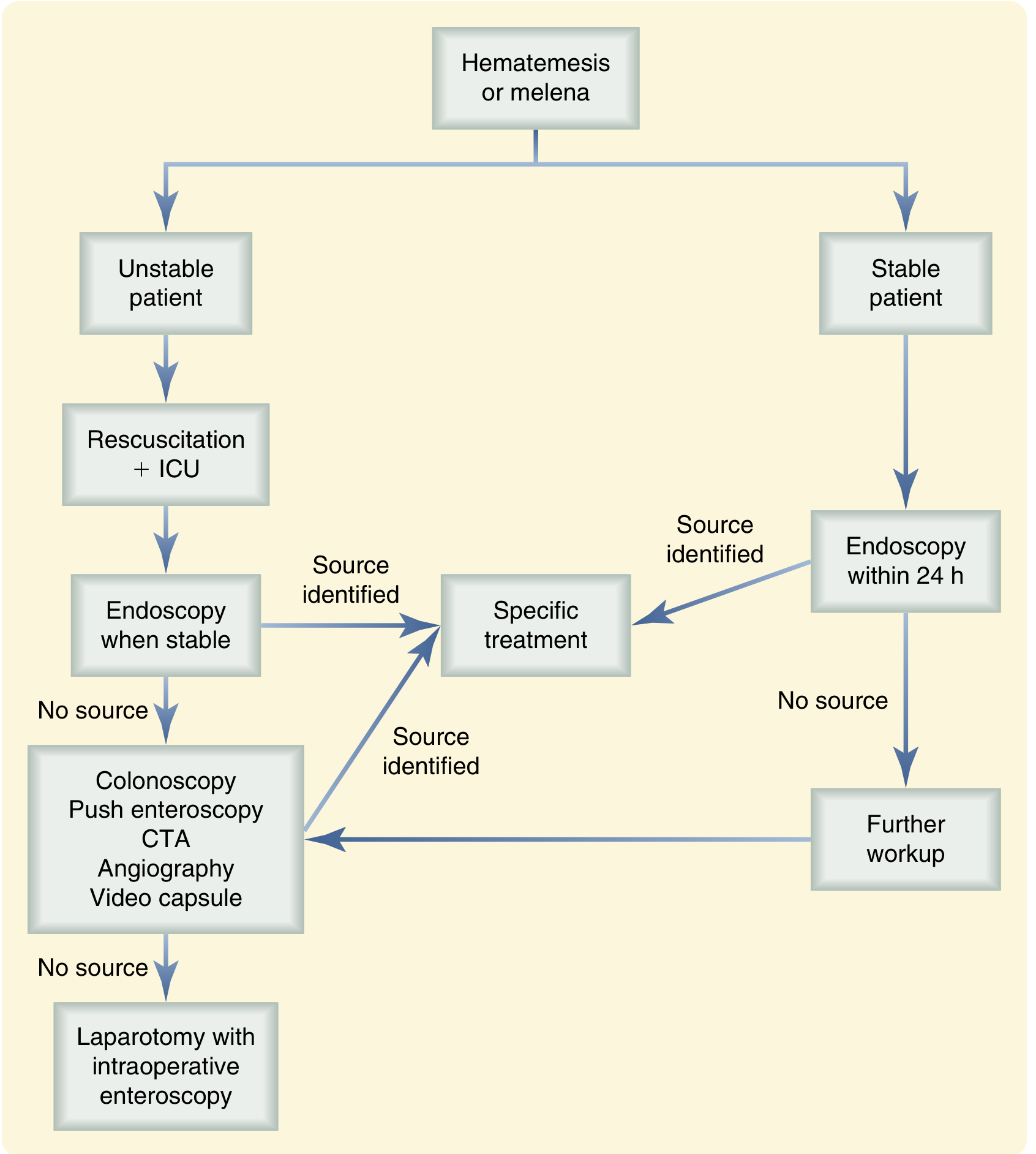
Diagnostic and management algorithm for hematemesis or melena — Sabiston Textbook of Surgery
Summary
| Classification Dimension | Categories |
|---|---|
| Acuity | Overt / Occult / Obscure |
| Location | Upper GI / Small bowel (mid-GI) / Lower GI |
| Endoscopic appearance (ulcer) | Forrest Ia → III |
| Risk stratification | Rockall Score / Glasgow-Blatchford Score |
| Hemodynamic severity | Class I (<15% volume loss) → Class IV (>40% volume loss) |
This is a shared conversation. Sign in to Orris to start your own chat.