
How to depotash a patient
I'll read the medical library skill first, then research this topic.
Searching sources...
Reading File
Now let me search the medical library and PubMed in parallel for hyperkalemia management.
Finding Sources
Searching PubMed
hyperkalemia management treatment
Good results. Let me read the key sections from Brenner & Rector and the NKF Primer in parallel.
Reading File
Reading File
Reading File
Let me fetch the treatment flowchart image and read the potassium binders section.
Loading Image
Reading File
Reading File
I now have comprehensive information to give a complete answer.
How to "De-potash" a Patient (Treatment of Hyperkalemia)
"Depotashing" refers to lowering an elevated serum potassium (hyperkalemia, K+ > 5.0 mEq/L). Management follows three sequential pillars:
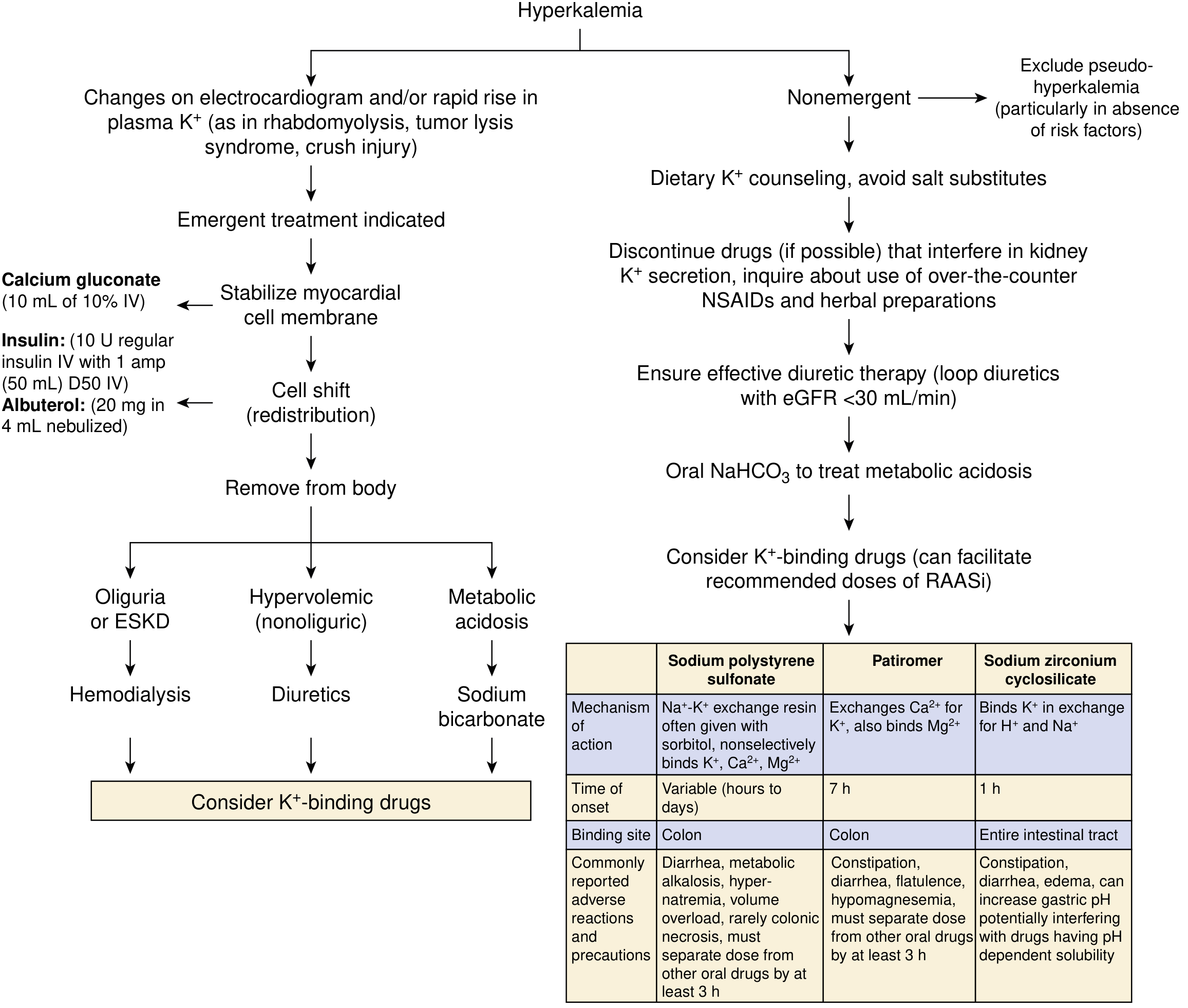
Step 0 - Immediate Assessment
- 12-lead ECG immediately - look for peaked T waves, prolonged PR, wide QRS, sine wave pattern, or VF.
- Any ECG change OR K+ ≥ 6.5-7.0 mEq/L = medical emergency requiring admission and continuous cardiac monitoring.
- Exclude pseudo-hyperkalemia (hemolyzed sample, extreme leukocytosis/thrombocytosis).
Pillar 1 - Stabilize the Heart (Membrane Protection)
Intravenous Calcium - does NOT lower K+, but protects the myocardium immediately.
| Preparation | Dose | Route | Onset | Duration |
|---|---|---|---|---|
| Calcium gluconate 10% | 10 mL (repeat if needed) | IV over 2-3 min | 1-3 min | 30-60 min |
| Calcium chloride 10% | 3-4 mL | IV over 2-3 min | 1-3 min | 30-60 min |
- Repeat if ECG changes persist or recur after initial improvement.
- Caution in digoxin toxicity: hypercalcemia potentiates digoxin toxicity. If needed, dilute in 100 mL D5W and infuse over 20-30 min.
- Do NOT mix calcium with bicarbonate (precipitates calcium carbonate).
Pillar 2 - Shift K+ Into Cells (Temporizing)
These buy time; they do not remove K+ from the body.
A. Insulin + Glucose (most reliable)
- 10 units regular insulin IV + 50 mL of 50% dextrose (D50) bolus immediately.
- Effect: starts in 10-20 min, peaks at 30-60 min, lasts 4-6 hours. Drops K+ by ~0.5-1.2 mEq/L.
- Follow with 5-10% dextrose infusion at 50-100 mL/hr to prevent hypoglycemia (occurs in up to 75% without ongoing glucose).
- If blood glucose > 200-250 mg/dL: give insulin alone, monitor glucose closely.
- Never give dextrose without insulin - may paradoxically worsen hyperkalemia in insulin-deficient patients.
B. Beta-2 Agonists (additive to insulin)
- Albuterol (salbutamol) 20 mg nebulized over 10 minutes.
- Onset ~30 min; effect is additive to insulin and also reduces risk of hypoglycemia.
- Note: the dose for hyperkalemia is far higher than asthma dosing.
- IV albuterol 0.5 mg is equivalent (available in Europe, not the US).
C. Sodium Bicarbonate (controversial)
- Useful only if severe metabolic acidosis is present (HCO3 < 10 mmol/L) or in patients with residual kidney function.
- Does NOT enhance the K+-lowering effect of insulin or albuterol.
- Little benefit in ESKD/dialysis patients without residual renal function.
- Do not give in same IV line as calcium.
Pillar 3 - Remove K+ from the Body (Definitive)
A. Loop Diuretics
- Furosemide (or bumetanide): effective if patient has adequate residual kidney function.
- Useful for hypervolemic, non-oliguric patients.
B. Dialysis
- Most effective method but cannot usually be initiated fast enough to skip the above steps.
- Indications: severe AKI, ESKD, oliguric hyperkalemia unresponsive to medical management.
- Hemodialysis preferred over peritoneal dialysis for speed.
C. Potassium Binders (adjuncts, not emergency monotherapy)
| Drug | Mechanism | Onset | Dose | Key Adverse Effects |
|---|---|---|---|---|
| Sodium polystyrene sulfonate (SPS / Kayexalate) | Na+-K+ exchange resin | Hours to days | 50 g PO or PR in sorbitol | Diarrhea, metabolic alkalosis, rare colonic necrosis (FDA black box) |
| Patiromer (Veltassa) | Binds K+ in exchange for Ca2+ in colon | ~7 hours | 8.4 g once daily PO | Constipation, hypomagnesemia; separate from other oral meds by 3 h |
| Sodium zirconium cyclosilicate (Lokelma) | Binds K+ in exchange for H+/Na+ across entire GI tract | ~1 hour | 10 g TID x 48h, then 5 g daily | Constipation, edema (high sodium content); raises gastric pH |
Patiromer and zirconium cyclosilicate are approved for chronic management and are the preferred binders for long-term use. SPS is not approved for chronic use.
Non-Emergent / Chronic Hyperkalemia Management
- Dietary counseling: restrict K+ to ~60 mEq/day; avoid salt substitutes (KCl).
- Medication review: stop/reduce ACE inhibitors, ARBs, NSAIDs, potassium-sparing diuretics, heparin if possible.
- Ensure effective diuretic therapy: loop diuretics are especially important when eGFR < 30 mL/min.
- Oral NaHCO3: corrects metabolic acidosis, enhances renal K+ excretion in patients with residual kidney function.
- Potassium binders (patiromer or zirconium cyclosilicate): can also facilitate continued use of RAASi at recommended doses in CKD/heart failure patients.
Quick Reference Summary
| Intervention | Goal | K+ Drop | Onset | Duration |
|---|---|---|---|---|
| IV Calcium | Membrane stabilization | None | 1-3 min | 30-60 min |
| Insulin + Glucose | Cell shift | 0.5-1.2 mEq/L | 10-20 min | 4-6 h |
| Nebulized Albuterol 20 mg | Cell shift | 0.5-1.0 mEq/L | 30 min | 2-4 h |
| NaHCO3 | Cell shift (+ renal excretion) | Variable | 30-60 min | Variable |
| Loop diuretics | Removal | Variable | 30-60 min | Hours |
| Dialysis | Removal | 1-2+ mEq/L/session | 1-2 h setup | Rapid |
| K+ binders | Removal (GI) | 0.5-1.0 mEq/L | Hours-days | Chronic |
Sources: Brenner & Rector's The Kidney (9th ed.), p. 773-774 | NKF Primer on Kidney Diseases, 8e, p. 128-129 | Fischer's Mastery of Surgery, 8th ed., p. 218
Recent evidence note: A 2025 network meta-analysis (PMID 40542996) confirms novel K+ binders (patiromer and zirconium cyclosilicate) are superior to SPS in CKD/heart failure patients needing RAASi, reinforcing the current shift away from SPS for chronic management.
This is a shared conversation. Sign in to Orris to start your own chat.