
A note on dengue
Reading File
Now let me search the medical library and PubMed in parallel for a comprehensive dengue note.
Finding Sources
Searching PubMed
dengue fever
Good. Now let me read the most comprehensive sources in parallel - Harrison's (gold standard for internal medicine), Robbins (pathology), and Red Book (detailed clinical content).
Reading File
Reading File
Reading File
Excellent content. Let me now read more of the Red Book (which has detailed management, diagnosis, and prevention) and also the Andrews' dermatology section for the rash description.
Reading File
Reading File
Excellent. I now have very rich content. Let me fetch the dengue rash image and also get the vaccination/prevention section from Red Book.
Loading Image
Reading File
I now have comprehensive content from multiple authoritative sources. Let me compile the full note on dengue.
Dengue - A Clinical Note
Pathogen & Epidemiology
Dengue is caused by four closely related RNA flaviviruses (DENV-1, DENV-2, DENV-3, DENV-4), transmitted primarily through the bite of Aedes aegypti mosquitoes (and less commonly Aedes albopictus or Aedes polynesiensis). Humans are the main amplifying host and the main source of virus for mosquitoes.
- An estimated 400 million infections occur per year worldwide, of which ~100 million are symptomatic and ~40,000 die from severe dengue
- Endemic across tropical and subtropical zones - most heavily in Southeast Asia, the Western Pacific, South and Central America, and India
- Persons of African ancestry appear to be at significantly lower risk of clinical disease
- Climate change has expanded the Aedes range, including into parts of southern continental North America and southern Europe (France, Italy, Spain)
- Leading cause of febrile illness in travelers returning from Southeast Asia, the Caribbean, and South Asia
- A novel control strategy - intentional release of Wolbachia-infected Aedes mosquitoes (which reduce viral replication) - has achieved a 95-97% reduction in dengue in densely populated areas in Colombia
- Robbins Pathologic Basis of Disease, p. 336; Andrews' Diseases of the Skin, p. ch. 19
Transmission
| Route | Notes |
|---|---|
| Mosquito bite | Primary route - both symptomatic and asymptomatic people are viremic 1-2 days before symptoms and for ~7 days of illness |
| Vertical (mother to fetus) | ~20% rate; higher when maternal infection occurs near delivery |
| Blood/organ donation | Rare |
| Breastfeeding | Rare |
| Needlestick / mucocutaneous | Healthcare-associated; rare |
| Sexual | Possible but rare |
Incubation period: 3-14 days in humans (intrinsic); 8-12 days in the mosquito (extrinsic). The mosquito remains infectious for the rest of its life cycle.
- Red Book 2021, p. 521-522
Immunology and the Antibody-Dependent Enhancement (ADE) Mechanism
Infection with one serotype produces lifelong immunity against that serotype and a period of cross-protection (typically 1-3 years) against the other three. After this, infection with a different serotype markedly increases the risk of severe disease.
The mechanism is antibody-dependent enhancement (ADE): cross-reactive antibodies from the first infection cannot neutralize the new serotype's virus but instead bind to it and facilitate uptake into macrophages via Fc receptors, dramatically increasing intracellular viral load and triggering a cytokine storm. This explains why:
- Severe dengue (DHF/DSS) predominantly occurs with the second heterologous infection
- DENV-2 secondary infections carry the highest risk
- Infants with passively acquired maternal anti-dengue antibodies are also at risk
- Each person has a lifetime risk of up to 4 dengue infections
- Robbins Pathologic Basis of Disease, p. 336
Clinical Phases (2009 WHO Classification)
Phase 1: Febrile Phase (Days 1-3)
Abrupt-onset high fever with:
- Severe myalgias, arthralgias, bone pain - hence the nickname "breakbone fever"
- Headache, retro-orbital pain
- Facial erythema, injected oropharynx
- Macular/maculopapular rash (see below)
- Leukopenia, mild thrombocytopenia, elevated liver enzymes (~3x normal)
- Minor bleeding: petechiae, positive tourniquet test
Phase 2: Critical Phase (Days 3-7, around defervescence)
- Plasma leakage due to increased vascular permeability - lasts 24-48 hours
- Rising hematocrit (hemoconcentration) is a key early sign
- Warning signs requiring urgent evaluation:
- Abdominal pain or tenderness
- Persistent vomiting
- Clinical fluid accumulation (ascites, pleural effusion)
- Mucosal bleeding
- Lethargy or restlessness
- Liver enlargement >2 cm
- Rapid decline in platelet count with rising hematocrit
Phase 3: Convalescent Phase
Gradual reabsorption of leaked fluid, hemodynamic stabilization, and recovery over 7-10 days total.
- Red Book 2021, p. 520-521
WHO Severity Classification
| Grade | Definition |
|---|---|
| Dengue without warning signs | Fever + ≥2 of: nausea/vomiting, rash, aches/pains, leukopenia, positive tourniquet test |
| Dengue with warning signs | Above + any warning sign (see Phase 2 above) |
| Severe dengue | Severe plasma leakage leading to shock or respiratory distress, severe bleeding (clinician-assessed), or severe organ involvement (AST/ALT ≥1000 IU/L, impaired consciousness, cardiac or other organ failure) |
Skin Manifestations
About 50% of patients develop a characteristic rash, appearing in 90% of cases between days 3-5 (often as fever defervesces):
- Distribution: generalized (50%), extremities only (30%), trunk only (20%)
- Morphology: macular or morbilliform, usually confluent - classically described as "islands of white in a sea of red" (sparing small patches of normal skin)
- Usually asymptomatic or mildly pruritic
- Petechiae may be present; frank cutaneous hemorrhage suggests DHF/DSS
Tourniquet test (Rumpel-Leede test): inflate BP cuff to midpoint between systolic and diastolic for 5 minutes, wait 2 min - ≥10 petechiae per square inch is positive, a useful bedside clue to dengue.
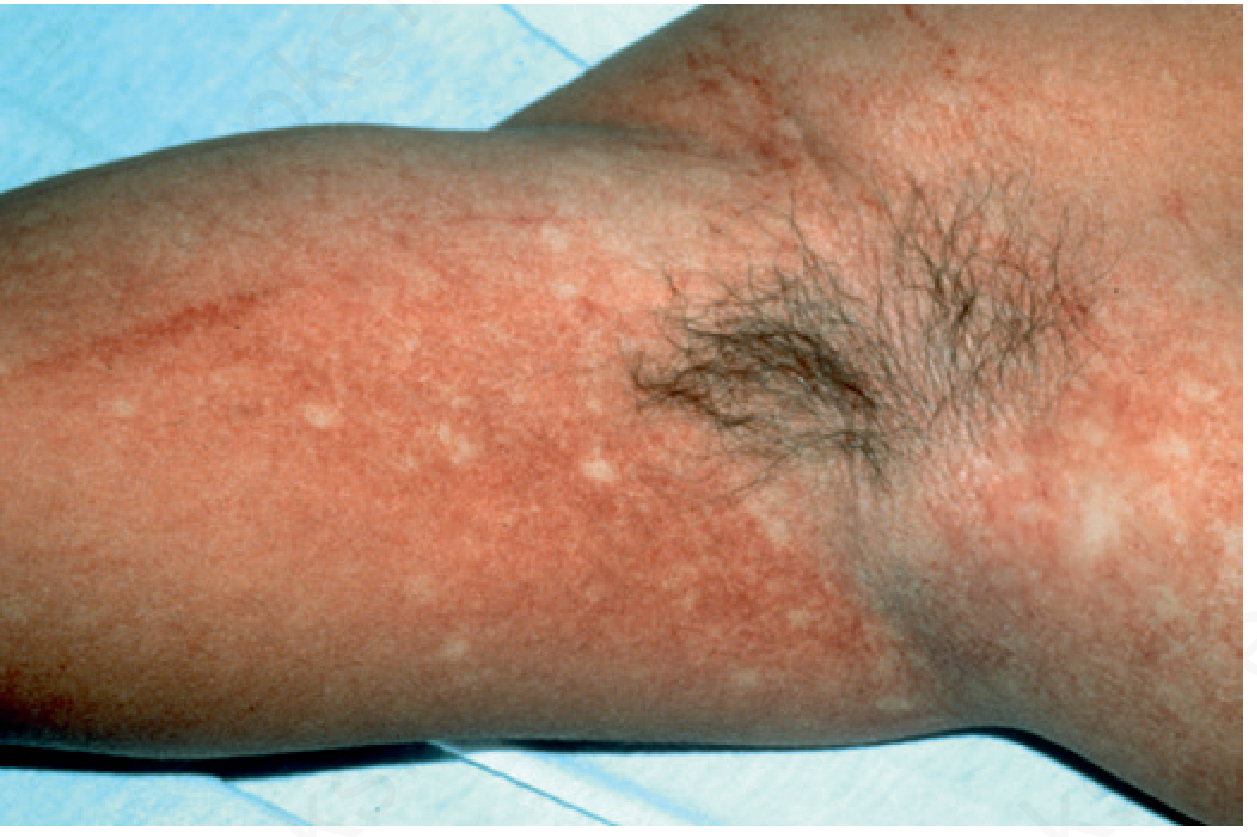
- Andrews' Diseases of the Skin, Fig. 19.42
Less Common Manifestations
- Myocarditis
- Pancreatitis
- Hepatitis
- Hemophagocytic lymphohistiocytosis (HLH)
- Neurological: acute meningoencephalitis, post-dengue ADEM
Pathology (Severe Dengue)
- Widespread hemorrhages throughout the body
- Hepatitis
- Diffuse alveolar damage with hyaline membrane formation
- Hypovolemic shock from massive plasma extravasation into tissues
- Robbins Pathologic Basis of Disease, p. 336
Diagnosis
Testing strategy depends on timing:
| Test | Window | Notes |
|---|---|---|
| RT-PCR (dengue RNA) | Days 1-7 | Highly specific; detects all serotypes |
| NS-1 antigen EIA | Days 1-7 (to day 10) | Rapid; good sensitivity in early disease |
| IgM antibody (EIA) | From day 3-5; 99% positive by day 10 | Peaks at 2 weeks; wanes over 2-3 months; cross-reacts with Zika, other flaviviruses |
| IgG antibody | Persists lifelong | ≥4-fold rise between acute and convalescent samples confirms recent infection; false positives with prior flavivirus vaccination |
Testing NS-1 antigen + IgM together on a single specimen in the first 10 days identifies ≥90% of primary and secondary cases. Cross-reactivity with West Nile, Japanese encephalitis, yellow fever, and Zika must be considered.
- Red Book 2021, p. 522-523
Treatment
No specific antiviral therapy exists. Management is entirely supportive.
Febrile phase:
- Maintain hydration (oral rehydration preferred)
- Avoid aspirin, salicylates, NSAIDs (e.g. ibuprofen) - increase bleeding risk
- Paracetamol/acetaminophen for fever and pain
Critical phase (warning signs or severe dengue):
- IV fluid resuscitation - careful titration to avoid both shock and fluid overload
- Monitor hematocrit, platelet count, hemodynamics, urine output closely
- Watch for occult bleeding and plasma leakage signs
- Platelet transfusions: for significant spontaneous bleeding or very low counts pre-procedure (thresholds vary)
- Refractory shock: may require vasopressors
With early recognition and intensive supportive care, mortality from severe dengue falls from ~5-10% to <1%.
- Red Book 2021, p. 523
High-Risk Groups
- Infants (maternal ADE)
- Pregnant women
- Patients with chronic diseases (asthma, sickle cell anemia, diabetes mellitus)
- Individuals with prior dengue infection (secondary heterologous serotype infection)
Prevention
Vector control:
- Elimination of peridomestic standing water (mosquito breeding sites)
- Window screens, air conditioning
- Insecticide-treated bed nets, repellents (DEET)
- Community mosquito surveillance
Vaccines:
- Dengvaxia (CYD-TDV, Sanofi Pasteur): approved in some countries for seropositive individuals aged 9-45. Contraindicated in seronegative persons - prior seronegative vaccination followed by first natural infection results in severe disease (vaccine acts like a first "infection," making the natural infection the pathogenic "second" hit via ADE)
- Qdenga (TAK-003, Takeda): newer live-attenuated tetravalent vaccine with improved safety profile; approved in several countries as of 2023-2024 for children and adults regardless of serostatus
- Fear of vaccine-potentiated severe disease remains a significant public health concern
- Harrison's Principles 22E, p. 3901; Red Book 2021, p. 523-525
Key Facts to Remember
| Feature | Detail |
|---|---|
| Virus family | Flaviviridae |
| Serotypes | 4 (DENV 1-4) |
| Vector | Aedes aegypti (primary), A. albopictus, A. polynesiensis |
| Incubation | 3-14 days |
| Annual infections | ~400 million |
| Classic triad | Fever + breakbone pain + rash |
| Pathognomonic rash sign | "Islands of white in a sea of red" |
| Severe disease mechanism | ADE on second heterologous serotype infection |
| Treatment | Supportive; avoid ASA/NSAIDs |
| Vaccine caution | Dengvaxia contraindicated in seronegative individuals |
Recent literature note: A 2025 systematic review (PMID 41037858) on dengue pathogenesis, diagnosis, and management is available and may update specific management details, particularly around newer vaccine data. No major contradictions to the above were identified in the available abstracts.
This is a shared conversation. Sign in to Orris to start your own chat.