
Technique of insertion of gum elastic bougie , give in flow chart References - all anesthesia standard textbooks
Technique of Insertion of Gum Elastic Bougie (GEB) - Flowchart
┌─────────────────────────────────────────────────────────────────┐
│                    PREPARATION (Pre-step)                       │
│  • Patient: Sniffing/ramped position, preoxygenated             │
│  • Equipment ready: Laryngoscope, styleted ETT, GEB             │
│  • GEB: Shape distal 5 cm to 60° bend (if difficult airway)     │
│  • Ideally a TWO-PERSON procedure                               │
│  • Assistant holds both styleted ETT + GEB, ready to hand over  │
└────────────────────────┬────────────────────────────────────────┘
                         │
                         ▼
┌─────────────────────────────────────────────────────────────────┐
│            STEP 1: PERFORM DIRECT LARYNGOSCOPY                  │
│  • Insert laryngoscope (Macintosh / Miller blade)               │
│  • Obtain BEST POSSIBLE view of larynx                          │
│  • Grade the Cormack-Lehane view                                │
└──────────┬──────────────────────────────────┬───────────────────┘
           │                                  │
    Grade I/II                         Grade III/IV
  (Cords fully visible)            (Only epiglottis or
           │                        no glottis visible)
           │                                  │
           ▼                                  ▼
┌─────────────────────┐      ┌────────────────────────────────────┐
│ Intubate directly   │      │ STEP 2: PASS GEB INTO AIRWAY       │
│ with styleted ETT   │      │ • Coude (angled) tip directed       │
│ (no bougie needed)  │      │   ANTERIORLY                        │
└─────────────────────┘      │                                     │
                             │  Grade II (partial cord view):      │
                             │  → Advance through glottic opening  │
                             │    anterior to arytenoids           │
                             │                                     │
                             │  Grade III (epiglottis only):       │
                             │  → Pass bougie (60° bent tip)       │
                             │    BLINDLY under epiglottis,        │
                             │    directed anteriorly              │
                             └─────────────────┬──────────────────┘
                                               │
                                               ▼
                   ┌───────────────────────────────────────────────┐
                   │       STEP 3: CONFIRM TRACHEAL PLACEMENT      │
                   │                                               │
                   │  POSITIVE signs (any of these = trachea):    │
                   │  ✓ "Clicks" felt as coude tip rides over      │
                   │    tracheal rings (felt in ~90% of cases)     │
                   │  ✓ "Hold-up" / resistance felt at ~25–40 cm  │
                   │    (bougie enters a bronchus / carina)        │
                   │  ✓ Visible passage anterior to arytenoids     │
                   │  ✓ Palpable neck movement felt by assistant   │
                   │                                               │
                   │  NEGATIVE signs (= esophagus → withdraw):    │
                   │  ✗ No clicks felt                             │
                   │  ✗ Bougie advances >40 cm without resistance  │
                   │    (passed into stomach)                      │
                   └─────────────────┬─────────────────────────────┘
                                     │
                              Confirmed in trachea?
                         ┌──────────┴──────────┐
                        YES                   NO
                         │                    │
                         │             ← Withdraw GEB
                         │               Reattempt
                         ▼
          ┌──────────────────────────────────────────────┐
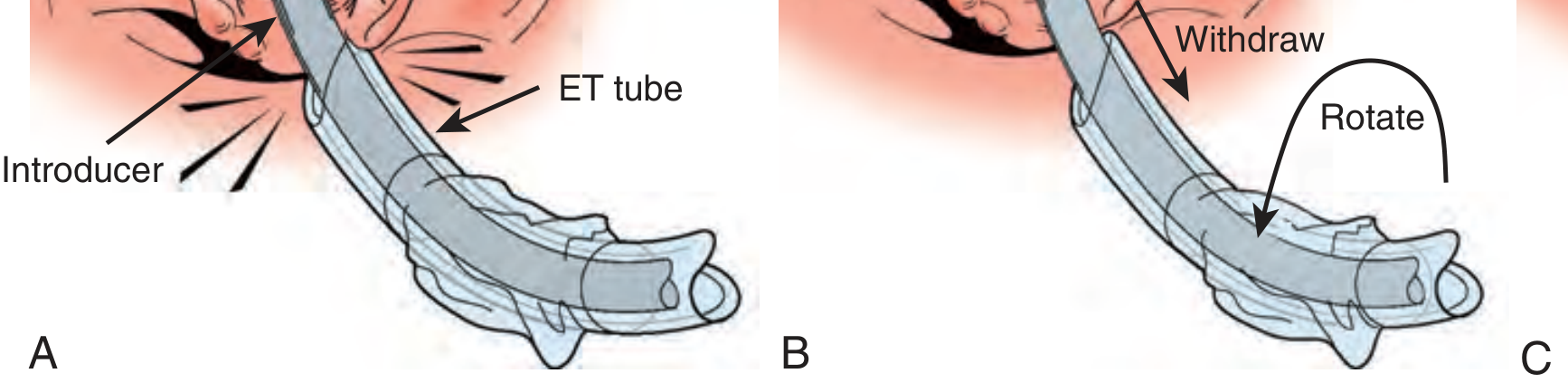
          │    STEP 4: RAILROAD ETT OVER BOUGIE          │
          │  • Laryngoscope REMAINS IN PLACE             │
          │  • Assistant threads ETT over proximal end   │
          │    of bougie (or operator threads ETT)       │
          │  • Advance ETT down over bougie toward glottis│
          │  • Just before entering larynx:              │
          │    → ROTATE ETT 90° COUNTER-CLOCKWISE        │
          │      (prevents tip catching on right         │
          │       arytenoid / anterior commissure)       │
          └──────────────────┬───────────────────────────┘
                             │
                             ▼
          ┌──────────────────────────────────────────────┐
          │    STEP 5: ADVANCE ETT THROUGH GLOTTIS       │
          │  • Advance until cuff is 2–3 cm past cords   │
          │  • Operator holds bougie steady throughout   │
          │  • Inflate cuff                              │
          └──────────────────┬───────────────────────────┘
                             │
                             ▼
          ┌──────────────────────────────────────────────┐
          │    STEP 6: WITHDRAW LARYNGOSCOPE             │
          │  • Remove laryngoscope                       │
          │  • Continue holding ETT in place             │
          └──────────────────┬───────────────────────────┘
                             │
                             ▼
          ┌──────────────────────────────────────────────┐
          │    STEP 7: REMOVE BOUGIE                     │
          │  • Assistant withdraws bougie while operator │
          │    holds ETT securely at lips                │
          └──────────────────┬───────────────────────────┘
                             │
                             ▼
          ┌──────────────────────────────────────────────┐
          │    STEP 8: CONFIRM ETT PLACEMENT             │
          │  • Capnography (ETCO₂) - gold standard       │
          │  • Bilateral equal chest rise                │
          │  • Equal breath sounds bilaterally           │
          │  • Absence of epigastric sounds              │
          │  • SpO₂ maintained                           │
          │  • CXR: tip at T3-T4, 3-7 cm above carina   │
          └──────────────────┬───────────────────────────┘
                             │
                             ▼
          ┌──────────────────────────────────────────────┐
          │    STEP 9: SECURE THE ETT                    │
          │  • Fix at 21-23 cm at lips (adult)           │
          │  • Tape / tie securely                       │
          └──────────────────────────────────────────────┘
Key Technical Points (from standard textbooks)
- Adult curved-tip: 60 cm, 15 Fr, 40° coude tip (Eschmann/Portex)
- Adult straight: 70 cm
- Pediatric: 70 cm, 10 Fr, straight (accommodates ≥4.0 mm ETT)
- Adult version accommodates ETT ≥5.5 mm
- Clicks (coude tip striking tracheal rings) - present ~90% of cases
- Hold-up at ~25-40 cm (carina / bronchus)
- Visible passage anterior to arytenoids
References
- Roberts and Hedges' Clinical Procedures in Emergency Medicine - "Tracheal Tube Introducer (Bougie)" - detailed step-by-step two-person technique, confirmation signs, troubleshooting
- Miller's Anesthesia, 2-Volume Set, 10th Ed. - "Endotracheal Tube Introducers" (Ch. 40) and "Adjuncts to Endotracheal Intubation" - coudé tip mechanics, clicks, hold-up
- Miller's Anesthesia, 2-Volume Set, 10th Ed. - "Airway Management in Otolaryngology" (Ch. 65) - Grade II/III DL use, railroading technique
- Washington Manual of Medical Therapeutics - "Emergent Airway Adjuncts" - blind esophageal vs tracheal confirmation
- Tintinalli's Emergency Medicine: A Comprehensive Study - GEB in difficult airway algorithm and SGA conversion
- Rosen's Emergency Medicine: Concepts and Clinical Practice - bougie for ETT placement confirmation
- Scott-Brown's Otorhinolaryngology, Head and Neck Surgery, Vol. 1 - hold-up sign at 25 cm, direct laryngoscopy use
- Current Surgical Therapy, 14th Ed. - GEB specifications (60 cm, 15 Fr, 40° coude tip)
- Barash, Cullen and Stoelting's Clinical Anesthesia, 9th Ed. - bougie-guided cricothyrotomy, comparative RCT data
Give in handwritten notes for my assignment
How would you like the handwritten notes delivered? · How many pages/sheets?
Handwritten medical student assignment notes on ruled paper with a slight yellowish tinge, written in blue ink in neat handwriting. Title at top in bold underlined: "Gum Elastic Bougie (GEB) - Technique of Insertion". Subtitle underlined: "Page 1 of 2" Section heading (underlined, bold): "What is GEB?" - Long, semirigid introducer, 60 cm, 15 Fr (adult curved-tip) - Coude (hockey-stick) tip angled at 40° → 3.5 cm from distal end - Used to facilitate intubation when laryngeal view is suboptimal Section heading (underlined, bold): "Indications" - Cormack-Lehane Grade II, III or IV view - Anticipated / unanticipated difficult airway - Cervical spine immobilization (trauma) - Blood / vomitus obscuring view Section heading (underlined, bold): "Equipment Checklist" (with small checkbox bullets drawn) ☐ Laryngoscope (Mac / Miller blade) ☐ GEB (shaped to 60° distally if Grade III/IV) ☐ Styleted ETT (appropriate size ≥ 5.5 mm for adult) ☐ 10 mL syringe (cuff inflation) ☐ Suction ready ☐ Assistant (ideally 2-person procedure) Section heading (underlined, bold): "Step-by-Step Technique" "STEP 1 - Patient Position & Preoxygenation" → Sniffing / ramped position → 100% O₂ pre-oxygenation (3–5 min) → RSI drugs given as appropriate "STEP 2 - Perform Direct Laryngoscopy" → Insert laryngoscope, obtain BEST possible view → Grade the Cormack-Lehane view Grade I/II → vocal cords visible → intubate directly with styleted ETT Grade III/IV → only epiglottis / no glottis → proceed with GEB ↓ "STEP 3 - Shape & Introduce the GEB" → Create 60° bend in distal bougie (for Grade III/IV) → Assistant hands bougie to intubator → Coude tip directed ANTERIORLY under epiglottis → Advance gently into laryngeal inlet • Grade II: pass anterior to arytenoids into glottis • Grade III: pass blindly under epiglottis → directed anteriorly "STEP 4 - Confirm Tracheal Placement" → ✓ "CLICKS" felt — coude tip strikes tracheal rings (~90% cases) → ✓ "HOLD-UP" at 25–40 cm — bougie enters bronchus / carina → ✓ Visible passage anterior to arytenoids → ✓ Palpable neck movement (assistant feels larynx) → ✗ No clicks + bougie passes >40 cm freely = ESOPHAGUS → withdraw & retry Small margin note with arrow: "Hold-up = distal resistance when bougie hits carina/bronchus" At bottom: page number "1" in a small circle. Neat ruled lines visible throughout. Paper has slight shadow on left margin as if in a notebook.