
Elaborate. About. Rima Glottidis with respect to... KNR UHS VSAQ pattern.
Reading File
Now let me search the medical library for Rima Glottidis content in parallel.
Finding Sources
Finding Sources
Searching the Web
Rima Glottidis anatomy VSAQ KNR UHS exam important questions
Good. Now let me read the dedicated section from Gray's Anatomy for Students and the Color Atlas content in parallel.
Reading File
Reading File
Now let me read more content - the function of the larynx section (respiration, phonation, effort closure) and more from the Color Atlas on glottis/rima shape changes.
Reading File
Reading File
Now let me get the full intrinsic muscles table and phonation/effort closure content, plus fetch the key diagrams.
Reading File
Loading Image
I now have all the information needed for a thorough VSAQ-pattern answer. Let me compile the complete response.
Rima Glottidis - KNR UHS VSAQ Pattern
Definition
The rima glottidis is the narrowest part of the laryngeal cavity - a triangular slit-like opening between the two vocal folds (true vocal cords) and the adjacent mucosa-covered parts of the arytenoid cartilages. It separates the middle chamber of the laryngeal cavity (above) from the infraglottic cavity (below).
- It is narrower than the rima vestibuli (the opening between the vestibular/false folds above it)
- The apex of the triangular opening is anterior; the base is formed by the interarytenoid fold at the bottom of the interarytenoid notch
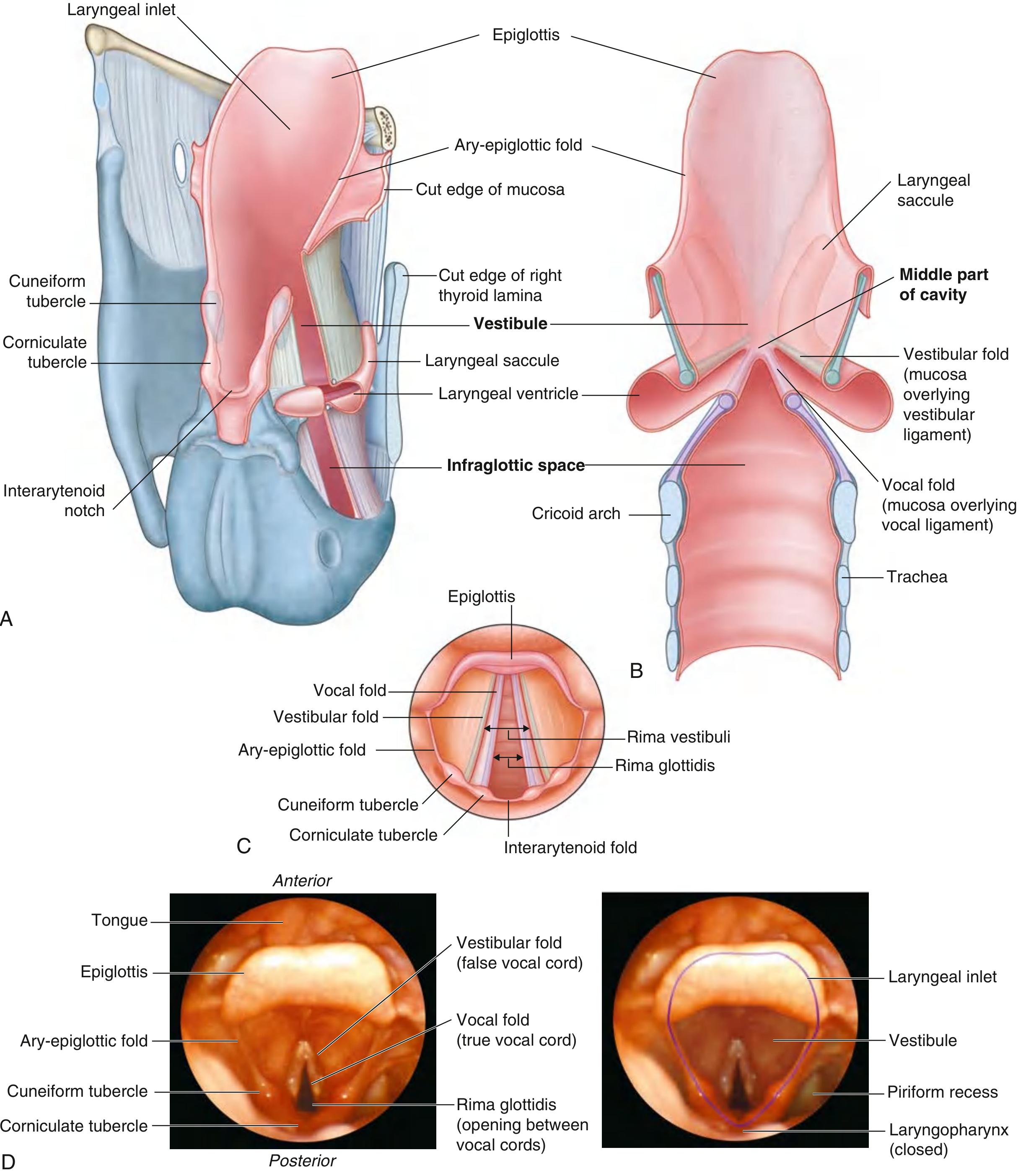
Parts of the Rima Glottidis
The rima glottidis has two distinct parts:
| Part | Also Called | Location | Bounded By |
|---|---|---|---|
| Anterior (longer) | Intermembranous part | Lies over the vocal ligament | Between the two vocal folds |
| Posterior (shorter) | Intercartilaginous part | Between the arytenoid cartilages | Between the vocal processes/bodies of the arytenoids |
Both portions can be opened to varying degrees independently.
Dimensions (Clinically Important)
- The rima glottidis is the narrowest part of the larynx in adults
- It is approximately 23 mm long in males and shorter in females
- In children, the narrowest point of the larynx is actually the subglottic region (cricoid ring level) - this is a frequently tested distinction
Shape Changes with Function
The shape of the rima glottidis changes according to functional state - this is a high-yield VSAQ topic:
| Functional State | Shape of Rima Glottidis | Mechanism |
|---|---|---|
| Quiet respiration | Triangular (narrow) - only intercartilaginous part open | Arytenoids slightly abducted |
| Forced inspiration | Wide rhomboid/diamond shape | Posterior cricoarytenoid (PCA) rotates arytenoids laterally, widely abducting vocal folds |
| Whispering | Intermembranous part closed; intercartilaginous part open as a triangle | Lateral cricoarytenoid adducts vocal processes; transverse arytenoid leaves posterior gap |
| Phonation | Closed (adducted) - then opened by expiratory airstream causing vibration | Lateral cricoarytenoid + transverse arytenoid + vocalis |
| Effort closure | Completely closed | All adductors active; rima vestibuli also closed |
| Swallowing | Completely closed | Same as effort closure; larynx also moves up and forward |
| Coughing | First closed, then opens explosively | Rima closes against high subglottic pressure, then bursts open |
Muscles Acting on the Rima Glottidis
Abductors (Open the rima glottidis)
- Posterior cricoarytenoid (PCA) - the only abductor; draws the muscular process posteriorly, rotating the vocal process laterally, widening the rima glottidis. Innervated by the recurrent laryngeal nerve (RLN)
Adductors (Close the rima glottidis)
| Muscle | Action | Nerve |
|---|---|---|
| Lateral cricoarytenoid | Rotates vocal process medially | RLN |
| Transverse (interarytenoid) | Approximates arytenoid bodies | RLN |
| Oblique arytenoid | Assists transverse arytenoid | RLN |
| Thyroarytenoid/Vocalis | Fine tension adjustment of vocal folds | RLN |
Key mnemonic: "PCA is the only Abductor" - always asked in exams. All other intrinsic muscles are adductors or tension-adjusters.
Nerve Supply (High-Yield)
- Above vocal folds (rima glottidis level): mucosa innervated by internal branch of superior laryngeal nerve (SLN) - sensory
- Below vocal folds: recurrent laryngeal nerve (RLN) - sensory
- All intrinsic muscles (including those acting on rima): RLN (recurrent laryngeal nerve, branch of vagus [CN X])
- Exception - cricothyroid: external branch of SLN (tensor of vocal fold, indirectly affects pitch)
Clinical Correlates (VSAQ favourites)
1. Cricothyrotomy
If there is life-threatening closure of the rima glottidis (e.g., laryngospasm, severe edema, foreign body), an emergency airway is established by incising through the median cricothyroid ligament - which lies below the level of the rima glottidis. The median cricothyroid ligament is subcutaneous, avascular, and readily accessible.
2. RLN Paralysis
- Unilateral RLN injury: all intrinsic muscles on that side are paralyzed. The affected vocal fold lies in a paramedian (adducted) position - voice is hoarse/breathy. The PCA is paralyzed, so the fold cannot abduct.
- Bilateral acute RLN injury: both folds lie in paramedian position, causing respiratory obstruction (life-threatening); the rima glottidis is dangerously narrowed.
3. Narrowest Part of the Airway
- Adults: rima glottidis is the narrowest part of the larynx
- Children: subglottic region (cricoid ring) is the narrowest - relevant in croup, endotracheal tube sizing
4. Foreign Body Aspiration
Involuntary closure of the rima glottidis occurs when a foreign body enters the airway (protective reflex). The cough reflex then causes it to reopen explosively.
5. Laryngoscopy
During laryngoscopy, the image is inverted - anterior areas of the laryngeal inlet appear at the top of the image and posterior at the bottom.
Summary Box (Quick Revision)
| Feature | Detail |
|---|---|
| Definition | Opening between vocal folds + arytenoids |
| Parts | Intermembranous (anterior) + Intercartilaginous (posterior) |
| Shape at rest | Triangular |
| Shape forced inspiration | Rhomboid/wide diamond |
| Only abductor | Posterior cricoarytenoid (PCA) |
| Muscle nerve supply | Recurrent laryngeal nerve (all except cricothyroid) |
| Narrowest part in adults | Rima glottidis |
| Narrowest part in children | Subglottic (cricoid ring) |
| Emergency airway below it | Cricothyrotomy via median cricothyroid ligament |
Sources: Gray's Anatomy for Students, p. 1199-1204; Color Atlas of Human Anatomy Vol. 2 (Internal Organs), p. 194-202
This is a shared conversation. Sign in to Orris to start your own chat.