
What does unwanted 72 contain and its work
Unwanted 72 is an emergency contraceptive pill containing Levonorgestrel 1.5 mg (a synthetic progestogen). It works primarily by delaying or inhibiting ovulation, and may also prevent fertilization or implantation. It must be taken within 72 hours of unprotected sex - the sooner, the more effective.
Searching sources...
Reading File
Searching the Web
Unwanted 72 levonorgestrel emergency contraceptive composition mechanism
Finding Sources
Reading File
Reading File
Here is a complete, textbook-backed breakdown of Unwanted 72:
Unwanted 72 - Complete Guide
What It Contains
Active ingredient: Levonorgestrel 1.5 mg (single tablet)
Levonorgestrel is a second-generation synthetic progestogen (progestin-only pill). It is the active component of the racemic mixture of norgestrel. Unwanted 72 is manufactured by Mankind Pharma Ltd.
How It Works (Mechanism of Action)
Levonorgestrel works through three possible mechanisms, though the primary one is ovulation inhibition:
-
Delays or inhibits ovulation (PRIMARY mechanism)
- It binds to progesterone and androgen receptors, blunting the LH (luteinizing hormone) surge that triggers ovulation
- This is why taking it sooner is more effective - if you take it after ovulation has already occurred, its effect is reduced
-
Prevents fertilization
- By altering cervical mucus (making it thicker), it reduces sperm motility and penetration
-
May affect implantation (debated)
- Older labeling suggested it could prevent implantation of a fertilized egg; however, the FDA's current position is that the scientific evidence does not support a direct effect on post-ovulatory processes (fertilization or implantation)
Important: Emergency contraception is NOT an abortifacient. It does not terminate an existing pregnancy. If taken during an established pregnancy, it has no adverse effects on the developing fetus.
Dosing & Timing
| Time after unprotected sex | Effectiveness |
|---|---|
| Within 24 hours | Highest (~95%) |
| 24-48 hours | ~85% |
| 48-72 hours | ~58% |
| After 72 hours | Significantly reduced |
- Dose: 1.5 mg as a single tablet (can also be taken as two 0.75 mg doses 12 hours apart - equally effective)
- Can be taken with or without food
- If vomiting occurs within 2 hours of taking it, a repeat dose may be needed
Side Effects
Common side effects include:
- Nausea (less than with estrogen-progestin combinations)
- Headache
- Irregular menstrual bleeding (within 1 week to 1 month - resolves on its own)
- Breast tenderness
- Dizziness or fatigue
Important Things to Know
- NOT for regular use - it is for emergency situations only, not routine contraception
- Does NOT protect against STIs (HIV, chlamydia, etc.)
- Less effective in obese/overweight women - studies show higher BMI is associated with decreased effectiveness; a higher dose or copper IUD may be considered
- If on CYP3A4-inducing drugs (e.g., rifampicin, some anticonvulsants), a 3 mg dose may be needed
- Next period may be early or late - if period is delayed by more than 3 weeks, take a pregnancy test
- After taking Unwanted 72, start a regular contraceptive method immediately
Unwanted 72 vs. Alternatives
| Option | Window | Prescription needed |
|---|---|---|
| Unwanted 72 (Levonorgestrel 1.5 mg) | Up to 72 hours | No (OTC) |
| Ulipristal acetate (EllaOne) | Up to 120 hours | Yes |
| Copper IUD | Up to 5-10 days | Yes (insertion needed) |
The copper IUD is the most effective emergency contraceptive (>99%), but requires clinic insertion.
Sources: Lippincott Illustrated Reviews: Pharmacology, p. 849-850; Rosen's Emergency Medicine, p. 1422; NCBI StatPearls - Levonorgestrel
What if taken on 4 thnday
If Unwanted 72 is taken on the 4th day (73-96 hours) after unprotected sex, its effectiveness drops significantly - but it is not completely useless.
Searching sources...
Finding Sources
Searching the Web
levonorgestrel emergency contraceptive taken after 72 hours 96 hours effectiveness
Here is a clear answer:
Unwanted 72 Taken on Day 4 (73-96 Hours After Sex)
Short Answer
Unwanted 72 is officially labeled for use within 72 hours only, so taking it on the 4th day (after that window) means it is past its recommended time frame and much less effective - but research shows it may still offer some protection.
What the Evidence Says
| Time window | Estimated effectiveness |
|---|---|
| Within 24 hours | ~94-95% |
| 24-48 hours | ~85% |
| 48-72 hours | ~58% |
| 72-96 hours (Day 4) | ~72-87% (reduced, off-label) |
| After 120 hours (Day 5+) | Not recommended |
A published observational study on PubMed found that emergency contraceptive pills taken between 72-120 hours still had a pregnancy rate of only 1.8% (vs 0.8% within 72 hours), with effectiveness of 72-87% - still meaningful, but lower.
The StatPearls review on levonorgestrel also notes off-label efficacy for up to 96 hours - meaning on the 4th day, it may still reduce pregnancy risk.
What You Should Do Instead - On the 4th Day
If you are past 72 hours, a better option is:
- Ulipristal acetate (EllaOne) - effective up to 120 hours (5 days), and is more effective than levonorgestrel in the 72-120 hour window. Requires a prescription.
- Copper IUD insertion - the most effective option (>99%), works up to 5-10 days after unprotected sex, and also provides long-term contraception. Requires a clinic visit.
The WHO states that ulipristal acetate (UPA) is specifically more effective than levonorgestrel between 72-120 hours.
Key Takeaways
- Taking Unwanted 72 on Day 4 is better than not taking anything, but its effectiveness is reduced
- The sooner you take any emergency contraceptive, the better
- On Day 4, ulipristal acetate is a superior choice if available
- If your period is delayed by more than 3 weeks after taking it, do a pregnancy test
- Consider starting a regular contraceptive method going forward
When the HCG hormones starts to release on women body
hCG (human Chorionic Gonadotropin) starts to be released after a fertilized egg implants in the uterus - around 6-10 days after fertilization. It doubles roughly every 48 hours in early pregnancy and is the hormone detected by pregnancy tests.
Searching sources...
Finding Sources
Searching the Web
when does hCG start to be released in women body after fertilization days
Finding Sources
Reading File
Loading Image
Here is a complete, textbook-backed explanation:
When Does hCG Start to Release in a Woman's Body?
The Source of hCG
hCG is produced by the trophoblast - the outer cell layer of the embryo that eventually becomes the placenta. It is NOT produced before fertilization.
The Timeline
| Event | Days after ovulation / fertilization |
|---|---|
| Ovulation | Day 0 |
| Fertilization (if sperm meets egg) | Day 0-1 |
| Embryo divides and travels to uterus | Days 1-5 |
| Embryo begins secreting tiny amounts of hCG (8-cell stage) | ~Day 3-4 after fertilization |
| Implantation occurs (embryo attaches to uterus wall) | Days 6-12 after ovulation |
| hCG rises significantly after implantation | ~Day 8 after ovulation/fertilization |
| hCG detectable in blood | ~8-11 days after fertilization |
| hCG detectable in urine (pregnancy test) | ~9-14 days after ovulation (around missed period) |
| hCG peaks | Week 8-10 of pregnancy |
| hCG declines after peak | Weeks 11-20 |
According to Costanzo Physiology (7th Ed.):
"The trophoblast begins secreting HCG approximately 8 days after ovulation. HCG is detectable in maternal urine 9 days after ovulation, even before the next expected menses."
Why Does hCG Matter?
hCG has one critical job in early pregnancy - it "rescues" the corpus luteum:
- Normally after ovulation, the corpus luteum (the structure left behind after the egg is released) lasts only ~12 days, then degenerates - causing your period
- When pregnancy occurs, hCG acts like LH and tells the corpus luteum to keep producing progesterone and estrogen
- This maintains the uterine lining (endometrium) so the embryo is not shed
- After week 10, the placenta itself takes over hormone production and hCG is no longer needed for this role
hCG Hormones of Pregnancy Chart
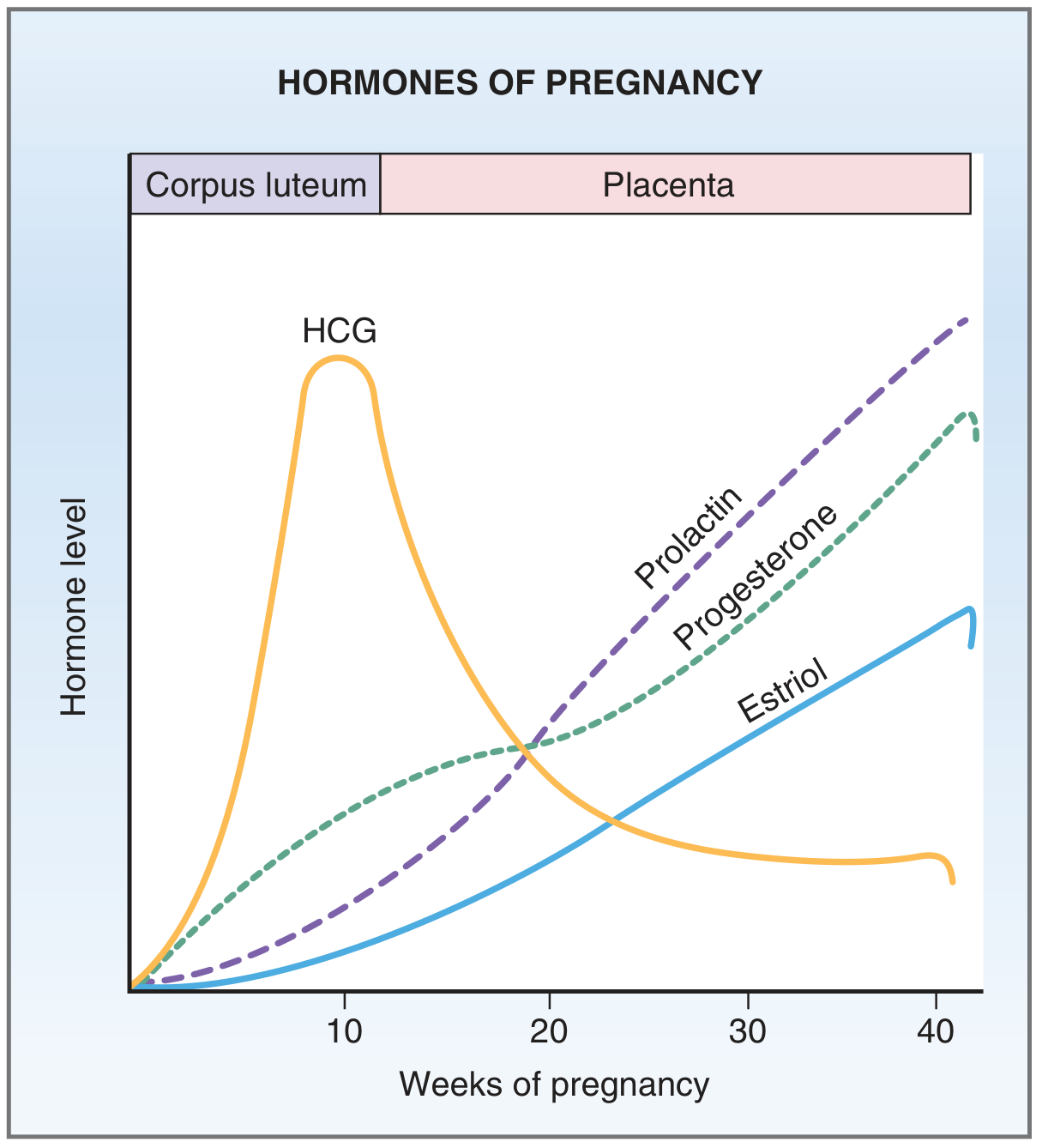
From Costanzo Physiology - hCG spikes dramatically in the first trimester (peak ~week 9), then falls as the placenta takes over. Progesterone and estriol continue rising throughout pregnancy.
hCG Normal Levels by Week
| Pregnancy Week | hCG Level (mIU/mL) |
|---|---|
| 3 weeks | 5-50 |
| 4 weeks | 5-426 |
| 5 weeks | 18-7,340 |
| 6 weeks | 1,080-56,500 |
| 7-8 weeks | 7,650-229,000 |
| 9-12 weeks (peak) | 25,700-288,000 |
| 13-16 weeks | 13,300-254,000 |
| 17-24 weeks | 4,060-165,400 |
| 25-40 weeks | 3,640-117,000 |
Key Points to Remember
- hCG starts ~8 days after fertilization (by the trophoblast)
- It becomes detectable in blood around 8-11 days, and in urine around 12-14 days after fertilization
- This is why pregnancy tests work best from the day of your missed period (about 14 days after ovulation)
- hCG doubles every 48-72 hours in a healthy early pregnancy
- hCG is what pregnancy tests detect - home urine tests and blood tests both measure it
- The high levels of hCG in the first trimester are also responsible for morning sickness (nausea and vomiting)
Source: Costanzo Physiology, 7th Edition, p. 482; Clearblue - hCG levels
This is a shared conversation. Sign in to Orris to start your own chat.