
Can you tell me about vericouse vein how to diagnose it investigation and genuine treatment
I'll start with a quick answer, then consult the medical library for detailed, authoritative information.
Quick answer: Varicose veins are dilated, tortuous superficial veins caused by valvular incompetence, most commonly in the lower limbs. Diagnosis is primarily clinical, confirmed with duplex ultrasound. Treatment ranges from conservative (compression stockings, lifestyle changes) to interventional (endovenous thermal ablation, sclerotherapy, or surgery).
Searching sources...
Reading File
Now let me search the medical library and PubMed in parallel for comprehensive information on varicose veins.
Finding Sources
Searching PubMed
"varicose veins"[MeSH Terms] AND treatment
Excellent results. Now let me read the most comprehensive sections - Bailey & Love's Surgery, Schwartz's Surgery, and Pfenninger's Procedures, all in parallel.
Reading File
Reading File
Reading File
Good content so far. Let me read the Bailey & Love section more comprehensively and get the Schwartz's section on investigations/treatment, and fetch the clinical image.
Reading File
Reading File
Loading Image
I now have enough comprehensive information from Bailey & Love's, Schwartz's Principles of Surgery, and Pfenninger's Procedures to compile a detailed answer. Let me also read the Bailey & Love investigation/diagnosis section more specifically.
Reading File
I now have rich, comprehensive information from multiple authoritative textbooks. Let me compile the full detailed answer.
Varicose Veins - Complete Clinical Guide
What Are Varicose Veins?
Varicose veins are dilated, tortuous, elongated subcutaneous veins, most commonly affecting the lower limbs. They result from valvular incompetence, which causes retrograde blood flow (reflux), leading to elevated venous pressure that progressively dilates the vein wall and renders distal valves incompetent in a cascading fashion.
- Adult prevalence: 30-50% of the population
- More common in women, elderly, and those with obesity, pregnancy, tall stature, or family history
- The Great Saphenous Vein (GSV) is affected in ~60% of cases, and the Small Saphenous Vein (SSV) in ~20%
(Bailey and Love's Short Practice of Surgery, 28th Ed.)
Classification
| Type | Description |
|---|---|
| Primary | Intrinsic venous wall weakness, valvular defect without underlying deep vein disease |
| Secondary | Caused by deep vein thrombosis (DVT), obstruction, or deep venous insufficiency |
| Uncomplicated | Asymptomatic or symptomatic only, no skin changes |
| Complicated | Skin changes, lipodermatosclerosis, ulceration, thrombophlebitis, or bleeding |
Symptoms
Patients typically describe:
- Aching, heaviness, throbbing, burning or bursting over affected areas
- Symptoms worsen throughout the day and with prolonged standing or sitting
- Symptoms relieved by leg elevation or compression hosiery
- Itching, ankle swelling, early fatigue of the leg
- More severe: hyperpigmentation, lipodermatosclerosis, venous ulceration, superficial thrombophlebitis, bleeding from attenuated vein clusters
(Schwartz's Principles of Surgery, 11th Ed.; Bailey and Love, 28th Ed.)
Clinical Signs
Here is what varicose veins look like on examination - the tortuous dilated veins are pre-marked for intervention:
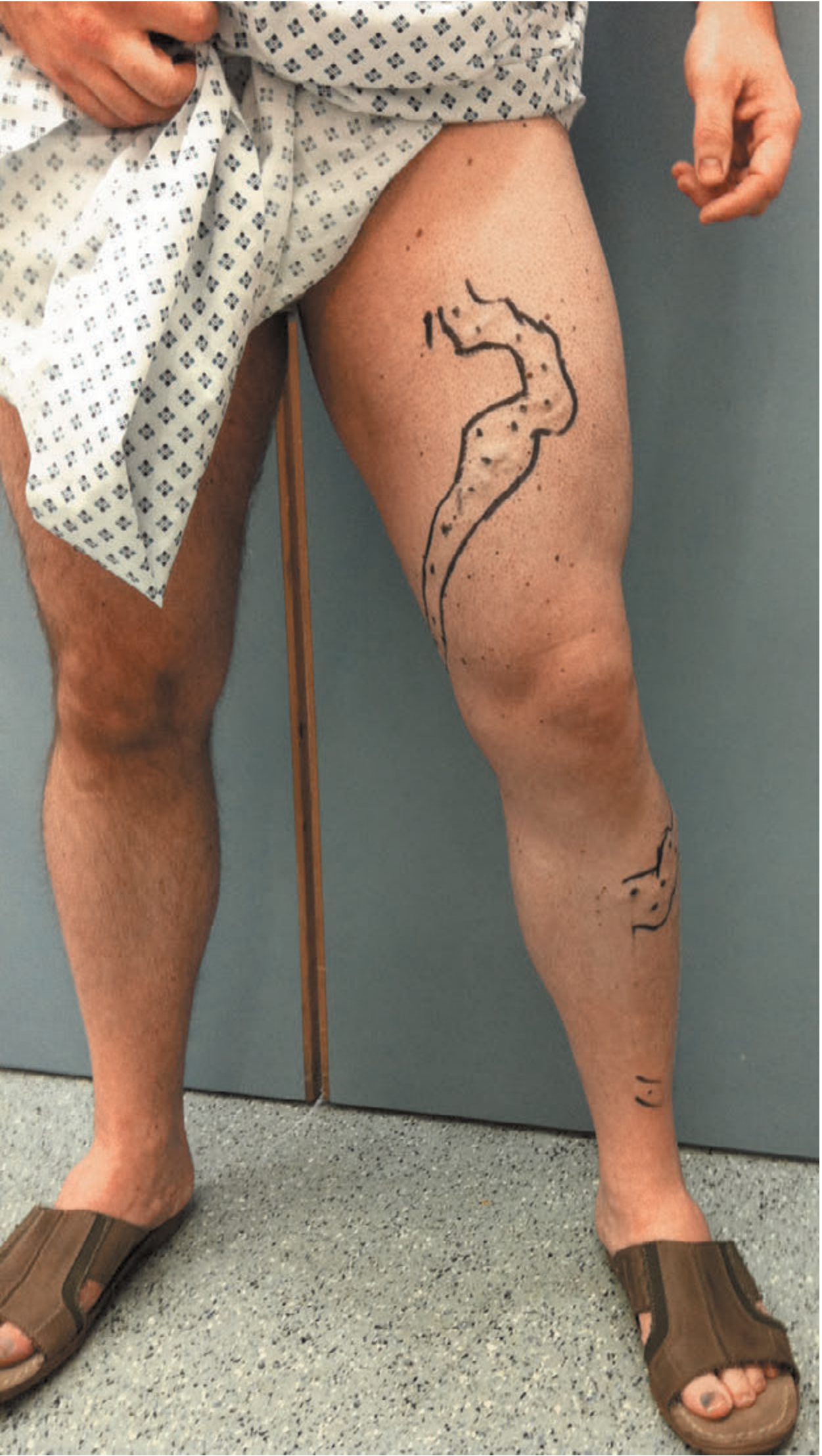
Varicose veins of the thigh and calf, marked for surgical planning - Bailey and Love's Surgery, 28th Ed.
Clinical examination findings:
- Visible tortuous, dilated subcutaneous veins
- Medial thigh/calf varices: suggest GSV incompetence at the saphenofemoral junction (SFJ)
- Posterolateral calf varices: suggest SSV incompetence at the saphenopopliteal junction (SPJ)
- Anterolateral thigh/calf varices: may indicate anterior accessory GSV (AAGSV) incompetence
- Saphena varix: a painless lump at the groin (dilated SFJ), disappears when recumbent, and has a cough impulse - can be mistaken for an inguinal hernia
Diagnosis
Clinical Assessment
The history and physical examination remain the starting point. A trial of compression hosiery can help confirm symptoms are venous in origin if they improve.
Investigation: Duplex Ultrasound (Gold Standard)
"Tourniquet tests and the use of hand-held Doppler have now been abandoned. There is good evidence to support the policy of duplex ultrasound scanning for all patients with varicose veins prior to any intervention."
- Bailey and Love's Short Practice of Surgery, 28th Ed.
Why duplex ultrasound?
- Combines B-mode imaging with colour/spectral Doppler
- Transducer: 7.5-13 MHz linear array
- Patient is examined standing (to open the valves and demonstrate reflux)
What the scan establishes:
- Presence of reflux in the deep and superficial venous systems
- Exact distribution of reflux - which junctions (SFJ, SPJ) and perforators are incompetent
- Presence of deep vein obstruction (e.g., from prior DVT)
- Suitability of incompetent veins for different treatments (diameter, tortuosity, varix)
- Presence of thrombus in superficial veins
- Possible pelvic source of reflux
Diagnostic thresholds for reflux:
- Superficial/crural veins: retrograde flow lasting ≥ 0.5 seconds
- Proximal deep veins: retrograde flow lasting ≥ 1.0 second
- Reflux is elicited by Valsalva, calf squeeze release, or pneumatic cuff deflation
Other Investigations (selected cases)
| Investigation | Indication |
|---|---|
| CT/MR venography | Suspected pelvic vein reflux or obstruction, May-Thurner syndrome |
| Venous plethysmography | Functional assessment of venous return (rarely needed) |
| ABPI (Ankle-Brachial Pressure Index) | Before prescribing compression, to exclude arterial disease (must be >0.8) |
| Coagulation screen / thrombophilia testing | Recurrent thrombophlebitis or DVT |
Treatment
Treatment is indicated when:
- Symptoms worsen or are unrelieved by compression therapy
- Complications develop: lipodermatosclerosis, venous ulcer, recurrent thrombophlebitis, bleeding
1. Conservative Management
- Compression stockings: 20-30 mmHg or 30-40 mmHg, knee-high to waist-high; should cover symptomatic varices. Provides adequate symptom relief in many patients.
- Lifestyle measures: weight loss, regular walking, avoid prolonged standing, leg elevation when resting
- Venotonics: (e.g., micronised purified flavonoid fraction, horse chestnut seed extract) - limited evidence, used as adjunct in some countries
2. Endovenous Thermal Ablation (First-line interventional)
Modern first-line treatments - performed under local tumescent anaesthesia as a day-case procedure.
| Technique | Mechanism | Notes |
|---|---|---|
| Endovenous Laser Ablation (EVLA/EVLT) | Laser energy heats and destroys vein wall | Equally effective to surgery; faster recovery |
| Radiofrequency Ablation (RFA) | Radiofrequency heat causes vein wall fibrosis | Slightly less post-procedure bruising vs. laser |
Procedure: GSV or SSV punctured under ultrasound guidance with a 21-gauge needle, sheath placed over a guidewire, laser fibre or RFA catheter advanced to just below the SFJ, tumescent anaesthetic infiltrated around the vein, then the catheter is withdrawn while delivering energy.
A 2024 meta-analysis (PMID: 38316290) comparing RFA vs. laser ablation found comparable efficacy for varicose vein treatment, with some differences in post-procedural pain and recurrence.
Risks: DVT, ecchymosis, saphenous nerve injury (particularly with SSV treatment)
3. Sclerotherapy
Destroys the venous endothelium by injection of a sclerosant agent.
| Agent | Concentration (telangiectasias) | Concentration (larger varices) |
|---|---|---|
| Hypertonic saline | 11.7-18.7% | 23.4% |
| Sodium tetradecyl sulfate (Sotradecol) | 0.125-0.25% | 0.5-1% |
| Polidocanol | 0.25-0.5% | 0.75-1.0% |
After injection: elastic bandages worn continuously for 3-5 days, then compression stockings for a minimum of 2 weeks.
Foam sclerotherapy (sclerosant mixed with air/CO2 to create foam) is used for larger veins and under ultrasound guidance (UGFS - Ultrasound-Guided Foam Sclerotherapy) - suitable when thermal ablation is not appropriate.
Complications: allergic reaction, local hyperpigmentation, thrombophlebitis, DVT, skin necrosis.
4. Mechanochemical Ablation (MOCA)
Newer non-thermal technique combining mechanical endoluminal injury (rotating wire catheter) with simultaneous sclerosant injection (e.g., ClariVein device). Avoids tumescent anaesthesia and risk of nerve thermal injury.
5. Cyanoacrylate Adhesive Closure
Non-thermal, non-sclerosant technique: medical-grade glue (cyanoacrylate) is injected to seal the vein lumen. Good early results reported; no tumescent anaesthesia required.
6. Surgical Treatment
Reserved for patients unsuitable for endovenous techniques, recurrent disease, or very large diameter GSV (>2 cm).
- High tie and stripping (Trendelenburg + Babcock): Ligation at the SFJ (groin) + stripping of GSV to just below the knee via a medial groin incision and a distal incision. Lower recurrence rate than SFJ ligation alone.
- Stab avulsions (phlebectomy): 2-mm incisions made directly over branch varicosities; the vein is dissected and avulsed through the small incision. Minimal scarring, effective for large tributaries.
- CHIVA (Conservative and Hemodynamic treatment of Insufficiency in Outpatients): Haemodynamics-based approach; a 2026 meta-analysis (PMID: 41707860) found comparable efficacy to conventional stripping/ablation techniques.
Complications of Varicose Veins
| Complication | Details |
|---|---|
| Superficial thrombophlebitis | Painful, hard, inflamed cord along the vein; treat with NSAIDs and compression |
| Bleeding | Acute rupture of a varix (especially at the ankle), can be life-threatening if not controlled by elevation + compression |
| Venous eczema | Itchy, eczematous skin over the varices |
| Hyperpigmentation | Haemosiderin deposition from red cell extravasation |
| Lipodermatosclerosis | Fibrosis and induration of the skin and subcutaneous tissue - precedes ulceration |
| Venous leg ulcer | End-stage; venous disease accounts for ~85% of all chronic lower limb ulcers |
Summary: Investigation & Treatment Pathway
Clinical presentation (symptoms + signs)
          ↓
ABPI to exclude arterial disease
          ↓
Duplex ultrasound (MANDATORY before any intervention)
          ↓
    ┌─────────────────────┐
    │  Incompetent GSV/SSV │
    └─────────────────────┘
          ↓
    Mild symptoms → Compression stockings + lifestyle
          ↓
    Worsening/complications → Interventional:
    • Endovenous thermal ablation (EVLA or RFA) - 1st line
    • Foam sclerotherapy (UGFS) - if unsuitable for thermal
    • MOCA / Cyanoacrylate - non-thermal alternatives
    • Surgery (stripping + stab avulsion) - large veins / recurrence
Sources:
- Bailey and Love's Short Practice of Surgery, 28th Ed. (Chapter 62)
- Schwartz's Principles of Surgery, 11th Ed. (Chapter 24)
- Pfenninger and Fowler's Procedures for Primary Care, 3rd Ed. (Chapter 92)
- PMID 38316290 - RFA vs. Laser Ablation meta-analysis (2024)
- PMID 41707860 - CHIVA vs. conventional techniques meta-analysis (2026)
This is a shared conversation. Sign in to Orris to start your own chat.