
15. Infusion pump for 3 Marks final year Allied Health Sciences exam Advance paper 3 Rajiv Gandhi University
infusion pump types working principle allied health sciences nursing
infusion pump IV drip medical device types
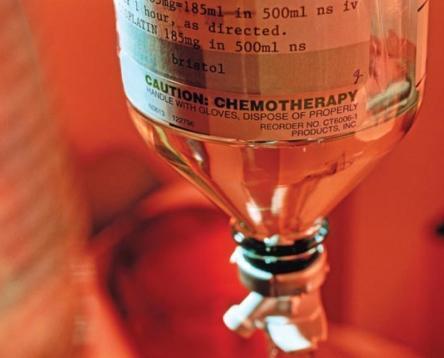
A close-up clinical photograph of a medical intravenous (IV) infusion bag and drip chamber containing a clear, amber-tinted fluid. The setup illustrates clinical oncology practices and chemotherapy administration. The IV bag features a highly visible warning label that reads 'CAUTION: CHEMOTHERAPY. HANDLE WITH GLOVES, DISPOSE OF PROPERLY,' highlighting critical safety protocols for handling cytotoxic agents. Hand-written and printed text on the bag specifies the medication as 'PLATIN 185mg in 500ml ns iv' (normal saline) and provides administration instructions to infuse over '1 hour, as directed.' This image serves as an educational tool for identifying chemotherapy drug preparations, medication labeling standards in a hospital pharmacy, and the necessary precautions taken to prevent healthcare provider exposure to hazardous pharmaceutical substances.
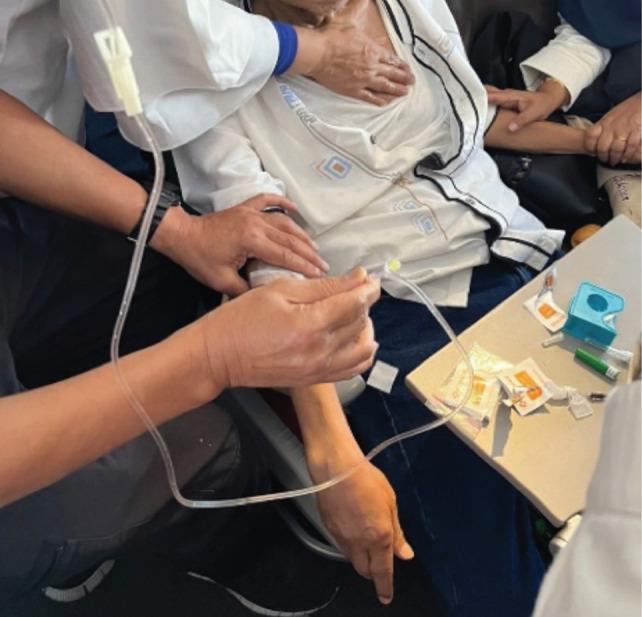
This clinical photograph captures a procedural scene of an intravenous (IV) cannulation and infusion being performed on a patient in a non-clinical environment, specifically an airplane cabin during a medical emergency. The image shows the insertion of an IV cannula into the patient's antecubital vein of the right arm, which is secured with white adhesive bandages. Clear plastic IV tubing with a visible drip chamber is connected to the cannula, facilitating the administration of normal saline and glucose. Two responders are visible: one in a white coat palpating the patient's upper chest/shoulder area, and another assisting by stabilizing the patient's arm and managing the infusion line. A small tray table in the foreground contains discarded medical supplies, including adhesive tape, alcohol swab wrappers, and a syringe. The photograph illustrates the clinical challenges of emergency medical intervention in confined spaces, emphasizing vascular access techniques for treating metabolic crises like diabetic emergencies in transit.
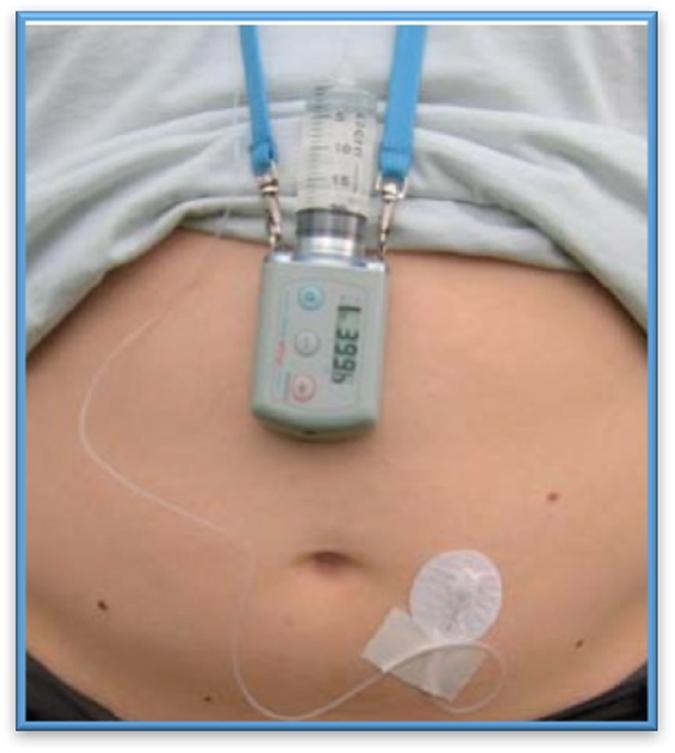
This clinical photograph demonstrates a continuous subcutaneous infusion system for medical therapy, specifically identified as an apomorphine pump for Parkinson's disease. The apparatus consists of a portable electronic infusion pump equipped with a digital display, attached to a 20 mL syringe containing a clear liquid medication. The device is suspended from the patient's neck by a blue lanyard. A thin, transparent infusion line extends from the pump and terminates at a subcutaneous insertion site on the lower right abdomen. The insertion site is secured with a specialized circular adhesive dressing featuring a white central stabilization component. This procedural image illustrates a non-oral delivery method used to manage motor fluctuations and 'off' periods in advanced Parkinson’s patients where gastrointestinal absorption of oral levodopa may be impaired. The image serves as an educational resource for medical students and clinicians specializing in neurology and movement disorders to understand the practical application of continuous subcutaneous drug delivery systems.
Infusion Pump
Definition
Working Principle
- Controllers regulate the rate of flow produced by gravity.
- Positive displacement pumps use active pumping mechanisms (most common in clinical use) to push fluid through the tubing independent of gravity.
- Miller's Anesthesia, 10e
Types of Infusion Pumps
| Type | Description |
|---|---|
| Large Volume Pump (LVP) | Delivers large amounts of IV fluids from bags/bottles; used for hydration, blood, antibiotics |
| Syringe Pump | Uses a syringe to deliver small, precise volumes; ideal for concentrated drugs (e.g., vasopressors, anaesthetics) |
| Patient-Controlled Analgesia (PCA) Pump | Allows patient to self-administer preset doses of analgesic; used postoperatively |
| Insulin Pump | Delivers subcutaneous insulin continuously; includes programmable basal and bolus doses |
| Enteral Pump | Delivers liquid nutrition directly into the GI tract via NG or PEG tube |
| Ambulatory Pump | Portable/wearable pump for home or outpatient use (e.g., chemotherapy) |
Key Features of Syringe Pumps (Most Used in Anesthesia & ICU)
- Automated syringe size recognition
- Drug library with suggested dosing schemes
- Maximum dose alerts (safety feature)
- Staged infusion: programs both initial loading dose and maintenance infusion
- Weight-based dosing: clinician inputs patient weight + drug concentration, pump calculates volume/time
- Miller's Anesthesia, 10e
Clinical Uses
- IV fluid replacement and blood transfusion
- Antibiotic and chemotherapy administration
- Continuous insulin infusion (diabetic emergencies)
- Epidural/spinal drug delivery (e.g., opioids, local anaesthetics)
- Postoperative analgesia (PCA pump)
- Subcutaneous drug delivery (e.g., apomorphine in Parkinson's disease)
- Total parenteral nutrition (TPN)
Advantages Over Manual Drip
- Precise control of flow rate (even in very small volumes)
- Automated delivery at programmed intervals
- Alarms for occlusion, air in line, low battery, and dose limit
- Reduces medication errors
- Allows continuous, uninterrupted drug delivery
Nursing Responsibilities
- Program the correct rate and dose before starting
- Check IV site for infiltration/phlebitis regularly
- Respond to pump alarms promptly
- Document infusion rate and fluid intake accurately
- Change infusion sets as per protocol (usually every 72 hours)