
hydatid cyst
Reading File
Finding Sources
Finding Sources
Searching PubMed
"hydatid cyst" OR "echinococcosis"
Now let me read the most comprehensive sources in parallel:
Reading File
Reading File
Reading File
Reading File
Reading File
Loading Image
Loading Image
Reading File
Loading Image
Loading Image
I now have comprehensive information to provide a thorough answer. Let me compile it.
Hydatid Cyst (Echinococcosis)
Definition & Causative Agent
A hydatid cyst is the larval stage of Echinococcus granulosus (a small, three-segmented tapeworm) found in the tissues of accidental intermediate hosts, including humans. Three species cause hydatid disease:
- E. granulosus — most common
- E. multilocularis — causes alveolar echinococcosis, more aggressive
- E. ligartus — rare
Epidemiology & Life Cycle
Definitive host: Dogs and other canids (adult tapeworm lives in the ileum, shedding thousands of ova daily in feces).
Natural intermediate host: Sheep (and other grazing animals).
Accidental intermediate host: Humans — an end stage to the parasite; no human-to-human transmission.
Endemic regions: Mediterranean, Middle East, Far East, South America, Australia, New Zealand, East Africa. Particularly associated with sheep-farming communities.
Infection in humans: Ingested ova hatch in the duodenum → oncosphere with hooklets penetrates the mucosa → enters portal bloodstream → settles in the liver (most common) or lungs. Within 3 weeks, a visible cyst develops and grows slowly and spherically (1–7 cm/year).
Cyst Structure
| Layer | Name | Origin | Function |
|---|---|---|---|
| Outer fibrous capsule | Pericyst | Host tissues | Host reaction |
| Outer cyst layer | Ectocyst (gelatinous) | Parasite | Structural |
| Inner cyst layer | Endocyst (germinal) | Parasite | Produces brood capsules |
- Brood capsules — intracystic masses containing developing scoleces (protoscolices)
- Hydatid sand — freed brood capsules + scoleces floating in hydatid fluid
- Daughter cysts — true replicas of the mother cyst, produced endogenously
- Calcification of the wall may occur but does not always mean the cyst is dead
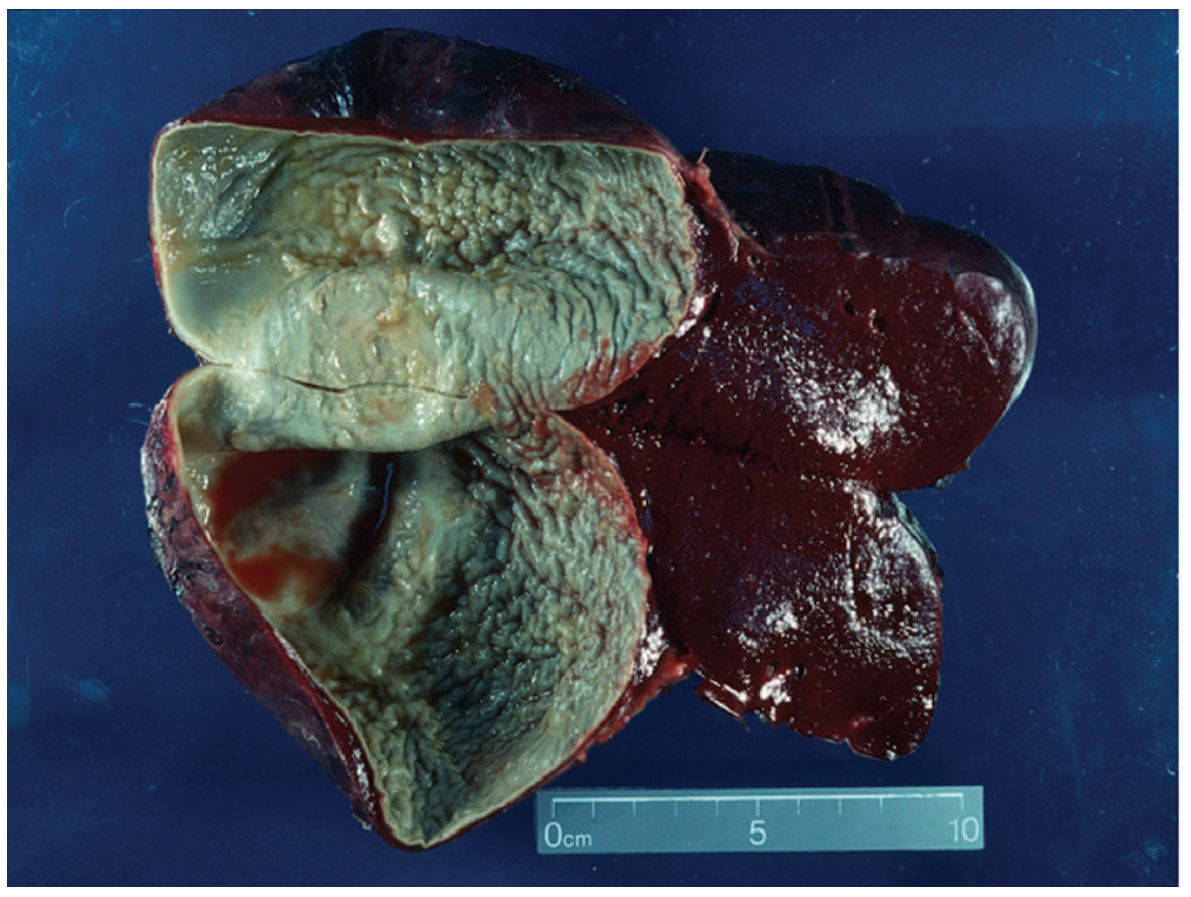
Gross pathology — 14 cm hydatid cyst from a splenectomized patient:
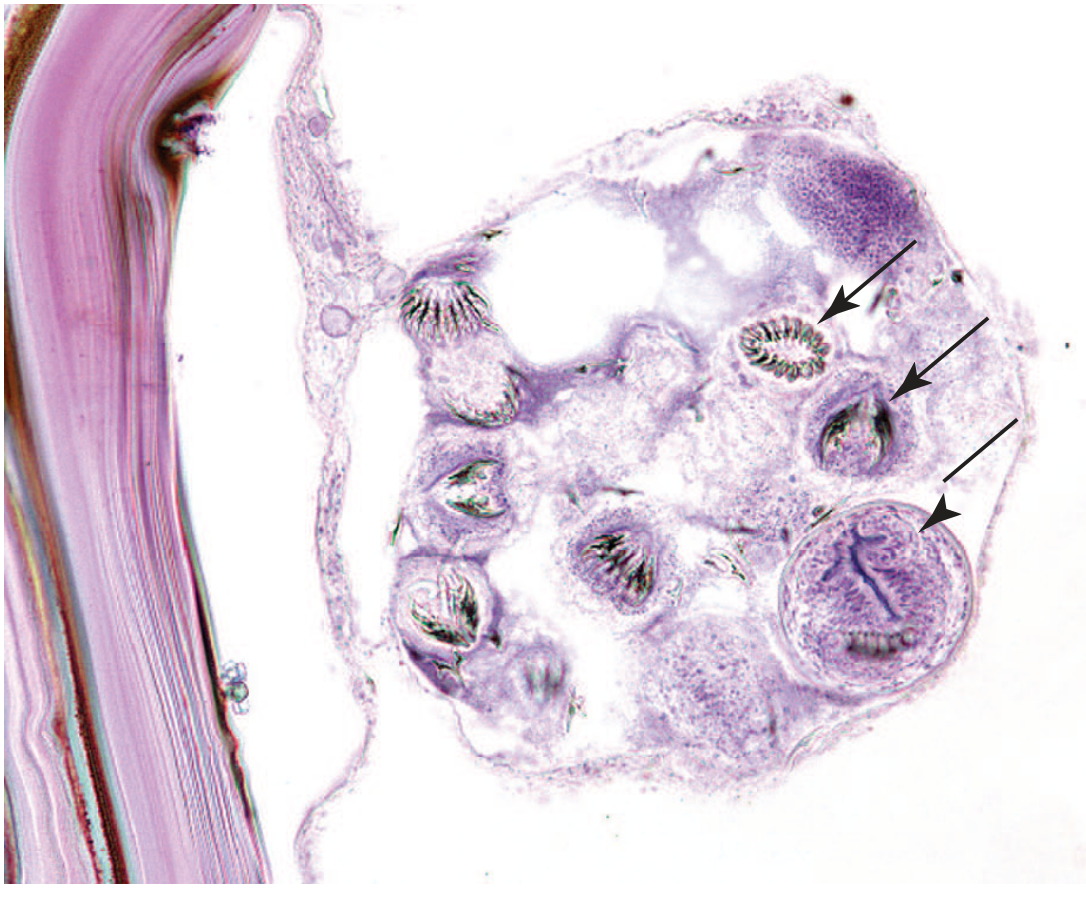
Histology — protoscolices within brood capsules:
Sites of Involvement
| Site | Frequency |
|---|---|
| Liver (right lobe, 75% solitary) | Most common |
| Lungs | 2nd most common |
| Spleen, kidney, pancreas, adrenal | Less common |
| Brain, bone, heart, pericardium | Rare |
Any organ can be involved. Multiple cysts in the same patient are possible.
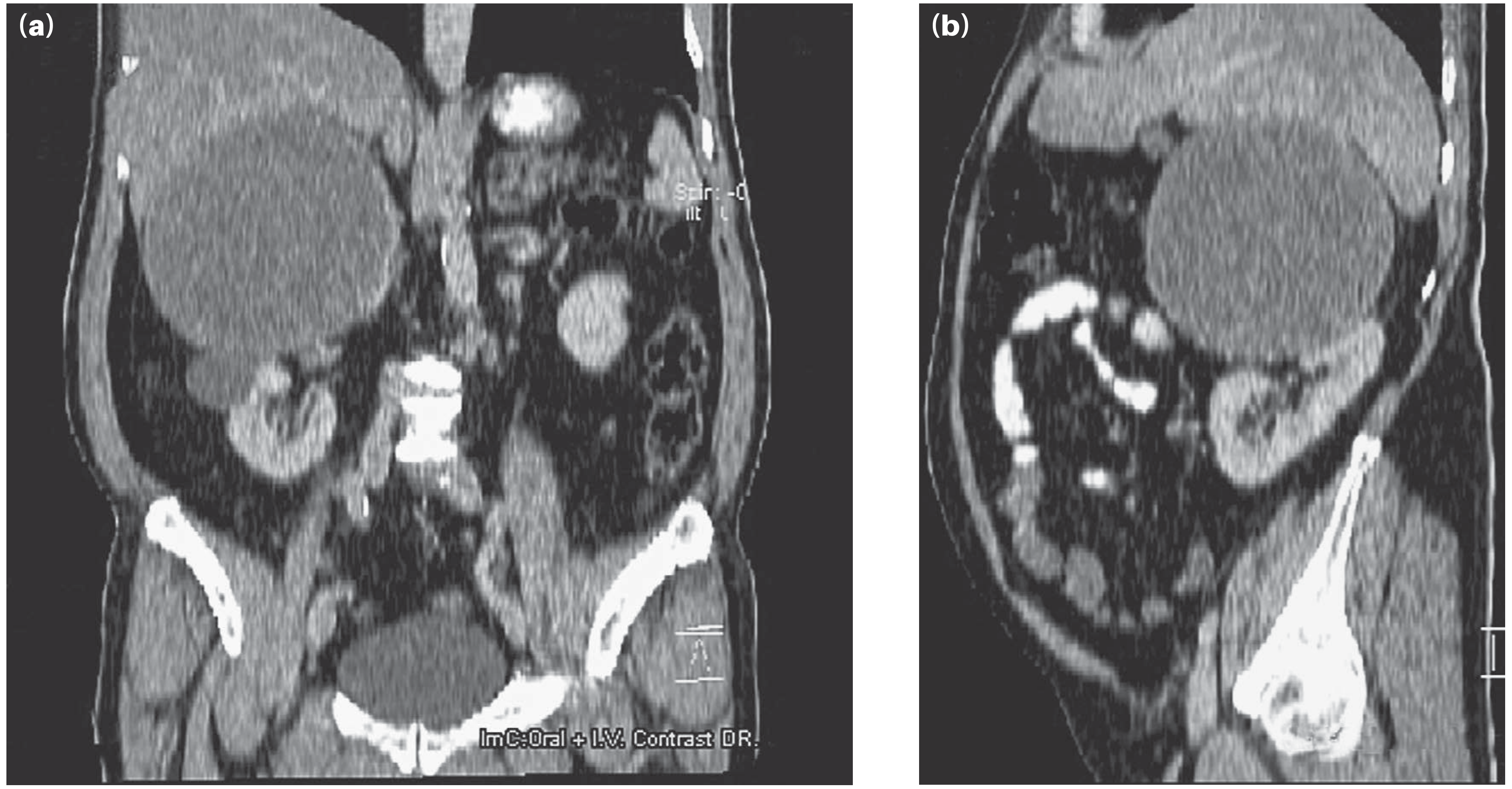
CT showing large hydatid cyst of the right adrenal gland:
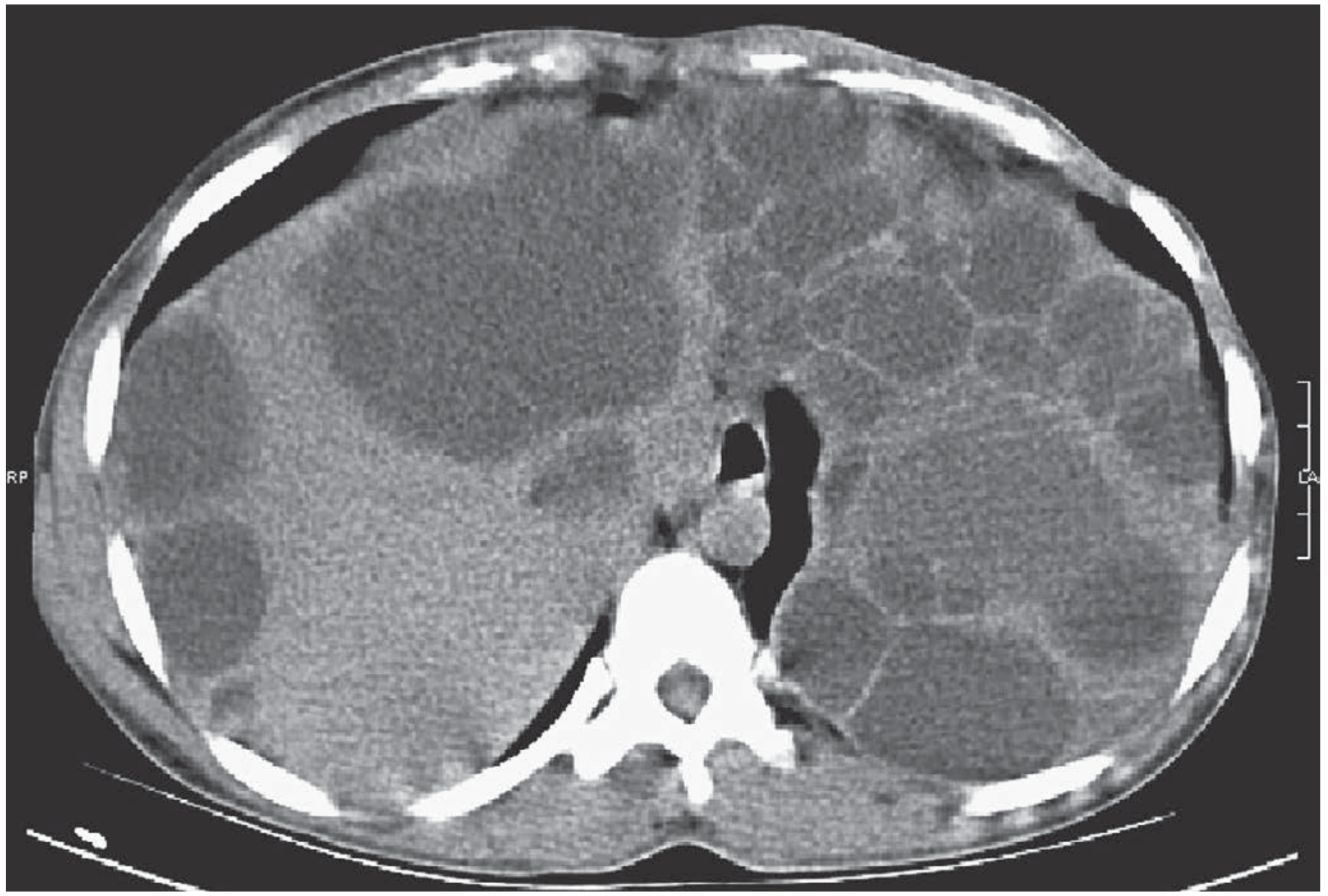
CT showing disseminated abdominal hydatid cysts:
Clinical Features
- Usually asymptomatic until complications occur or incidental discovery
- Right upper quadrant mass + hepatomegaly (most common presentation)
- Abdominal pain, dyspepsia, vomiting
- Jaundice (~8%) — biliary tree involvement
- Fever (~8%) — bacterial superinfection (mimics pyogenic abscess)
- Anaphylactic shock — rupture of cyst (life-threatening emergency)
- Dyspnoea — pulmonary cysts
- Raised ICP / headaches — cerebral cysts (rare, but must be suspected in sheep-farming communities)
Complications of Rupture
- Into biliary tree → obstructive jaundice, biliary colic, cholangitis
- Into bronchial tree → patient coughs up white material (scoleces)
- Into peritoneal/pleural/pericardial cavities → disseminated echinococcosis or fatal anaphylaxis
- Bacterial superinfection → pyogenic abscess picture
Diagnosis
Bloods
- Eosinophilia (raised eosinophil count)
- Serology: ELISA, immunoelectrophoresis — raise suspicion but plagued by low sensitivity and specificity
- LFTs abnormal if biliary involvement
Imaging (investigation of choice)
Ultrasound — most widely used (available, affordable, accurate). The WHO-IWGE classification (CE stages) is based on ultrasound:
| Stage | Finding |
|---|---|
| CL | Unilocular anechoic lesion, no internal echoes |
| CE1 | Anechoic cyst with "hydatid sand" (fine internal echoes) |
| CE2 | Multivesicular with daughter cysts; honeycomb/rosette appearance |
| CE3a | Detached laminated membrane ("water-lily" sign) |
| CE3b | Daughter cysts inside solid matrix |
| CE4 | Degenerative — no daughter cysts visible; "bag of wool" appearance |
| CE5 | Partial or complete wall calcification |
CT / MRI — better for extrahepatic disease, anatomical relationships, and surgical planning. CT: smooth space-occupying lesion with septa; calcification highly suggestive.
MRCP / ERCP — when biliary communication is suspected (multiple cysts communicating with bile ducts causing biliary obstruction and dilatation).
WHO Clinical Groups (for management decisions)
| Group | Activity |
|---|---|
| Group 1 (Active) | Cysts >2 cm, often fertile |
| Group 2 (Transitional) | Degenerating due to host resistance or treatment; may contain viable protoscolices |
| Group 3 (Inactive) | Degenerated, partially or totally calcified; unlikely to be viable |
Treatment
Management depends on group, number of cysts, anatomical location, and patient fitness. Best done in a tertiary unit with hepatobiliary surgery, hepatology, and interventional radiology.
1. Medical Therapy
- Albendazole — primary drug; used pre- and post-procedure to reduce recurrence
- Praziquantel — also used (both may be available on a "named patient" basis in some countries)
2. PAIR (minimally invasive)
Puncture → Aspiration → Injection (scolicidal agent) → Re-aspiration
Done under US/CT guidance after pre-treatment with albendazole.
3. Surgical Options
- Radical total pericystectomy with omentoplasty
- Partial pericystectomy
- Hepatic segmentectomy (for peripheral lesions)
- Laparoscopic approaches are increasingly used
Scolicidal agents used intraoperatively:
- Hypertonic saline (15–20%)
- Ethanol (75–95%)
- 5% povidone-iodine (10% also used)
⚠️ Scolicidal agents can cause sclerosing cholangitis if biliary radicals communicate with the cyst wall.
4. Watch and Wait
Asymptomatic, inactive (Group 3/CE4-5) cysts may be left alone with surveillance.
Key Dangers
- Rupture + anaphylaxis — medical emergency; potentially fatal
- Daughter cyst dissemination — if cyst ruptures, brood capsules can metastasize and form multiple new cysts throughout the body
- Incomplete surgery without scolicidal agents can lead to recurrence and dissemination
Sources: Sabiston Textbook of Surgery; Bailey and Love's Short Practice of Surgery, 28th ed.; Jawetz, Melnick & Adelberg's Medical Microbiology, 28th ed.
This is a shared conversation. Sign in to Orris to start your own chat.