
Retinoschisis
Reading File
Finding Sources
Finding Sources
Searching PubMed
retinoschisis
Reading File
Reading File
Reading File
Reading File
Reading File
Reading File
Loading Image
Loading Image
Here is a comprehensive overview of Retinoschisis — a splitting of the neurosensory retina — which exists in two distinct forms.
Retinoschisis
Retinoschisis is defined as a splitting (schisis) of the neurosensory retina (NSR) into inner and outer layers. It occurs in two fundamentally different forms: X-linked (juvenile) and age-related (degenerative).
1. X-Linked (Juvenile) Retinoschisis
Genetics & Pathophysiology
- Rare, X-linked recessive condition caused by mutations in the RS1 gene (Xp22.13), which encodes retinoschisin — a protein secreted by photoreceptors involved in intercellular adhesion
- The basic defect involves splitting of the retinal nerve fibre layer (NFL) from the rest of the sensory retina (though recent evidence shows outer plexiform layer separation is also frequent)
- Males are affected; female carriers are asymptomatic with no retinal changes
Clinical Features
Symptoms:
- Typically presents in boys aged 5–10 years with difficulty reading / reduced vision
- Less commonly: squint or nystagmus in infancy (associated with advanced peripheral retinoschisis + vitreous haemorrhage)
Signs:
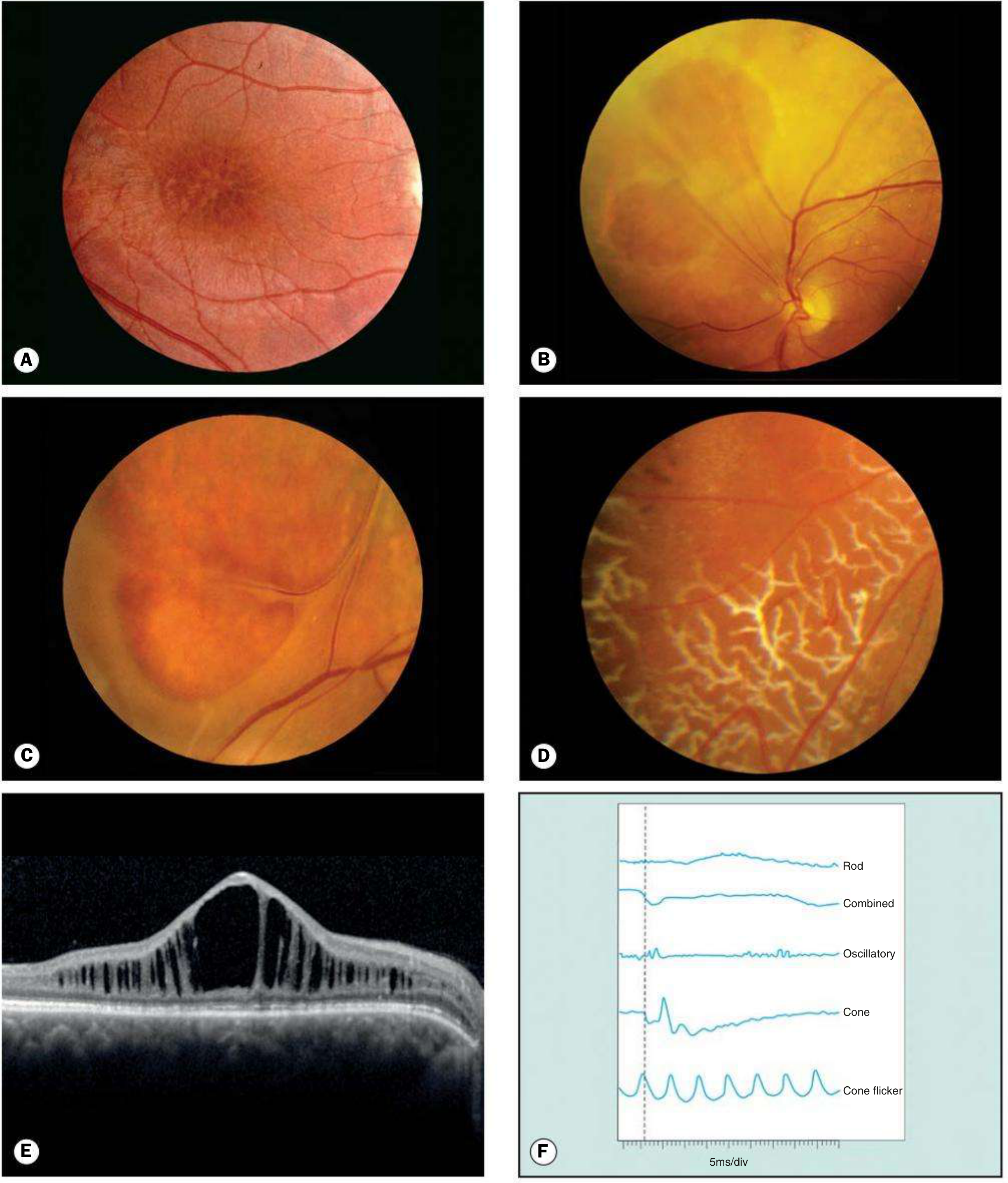
- Macular (foveal) schisis — the hallmark: spoke-like ("bicycle wheel" / petaloid) striae radiating from the foveola with underlying cystoid changes; the most common appearance
- Peripheral schisis (in ~50%): predominantly inferotemporal; inner layer (ILM + NFL only) can develop oval defects, and in extreme cases vessels float as "vitreous veils"
- Silvery peripheral dendritic figures, vascular sheathing, pigmentary changes, retinal flecks, nasal dragging of retinal vessels
- Drusen-like dots at the macula
Complications:
- Vitreous / intra-schisis haemorrhage
- Neovascularization
- Subretinal exudation
- Rhegmatogenous or tractional retinal detachment (uncommon)
- Visual acuity deteriorates during the first two decades, may then stabilize until the 5th–6th decade
Investigations
| Test | Finding |
|---|---|
| OCT | Cystic spaces in inner nuclear + outer plexiform layers; foveal disorganization |
| ERG | Characteristic electronegative ERG (selective ↓ b-wave amplitude with preserved a-wave) — occurs in eyes with peripheral schisis |
| IVFA | No leakage (unlike CMO) |
| FAF | Variable macular abnormality; spoke-like pattern; central hypoautofluorescence with surrounding hyperautofluorescence |
| Genetic testing | Mutations in RS1 gene |
Treatment
- Topical or oral carbonic anhydrase inhibitors (e.g. dorzolamide TDS, acetazolamide) — reduce foveal schisis and may improve visual acuity in some patients
- Vitrectomy for non-clearing vitreous haemorrhage or retinal detachment (technically challenging)
- Patching for superimposed amblyopia in children < 11 years
- Gene therapy under investigation (aiming to restore retinoschisin function)
- Follow-up: every 6 months (more frequently if treating amblyopia)
2. Age-Related (Degenerative) Retinoschisis
Epidemiology & Pathology
- Present in ~5% of the population over age 20; particularly prevalent in hypermetropes
- Develops from coalescence of microcystoid degeneration → splitting of NSR into inner and outer layers with permanent loss of visual function in the affected area
- Typical form: split at the outer plexiform layer (most common)
- Reticular form: split at the nerve fibre layer — rarer, more prone to complications
Clinical Features
Symptoms:
- Usually asymptomatic (photopsia and floaters absent — no vitreoretinal traction)
- Occasionally: decreased vision, vitreous haemorrhage, or progressive RD
Signs:
- Bilateral in up to 80%
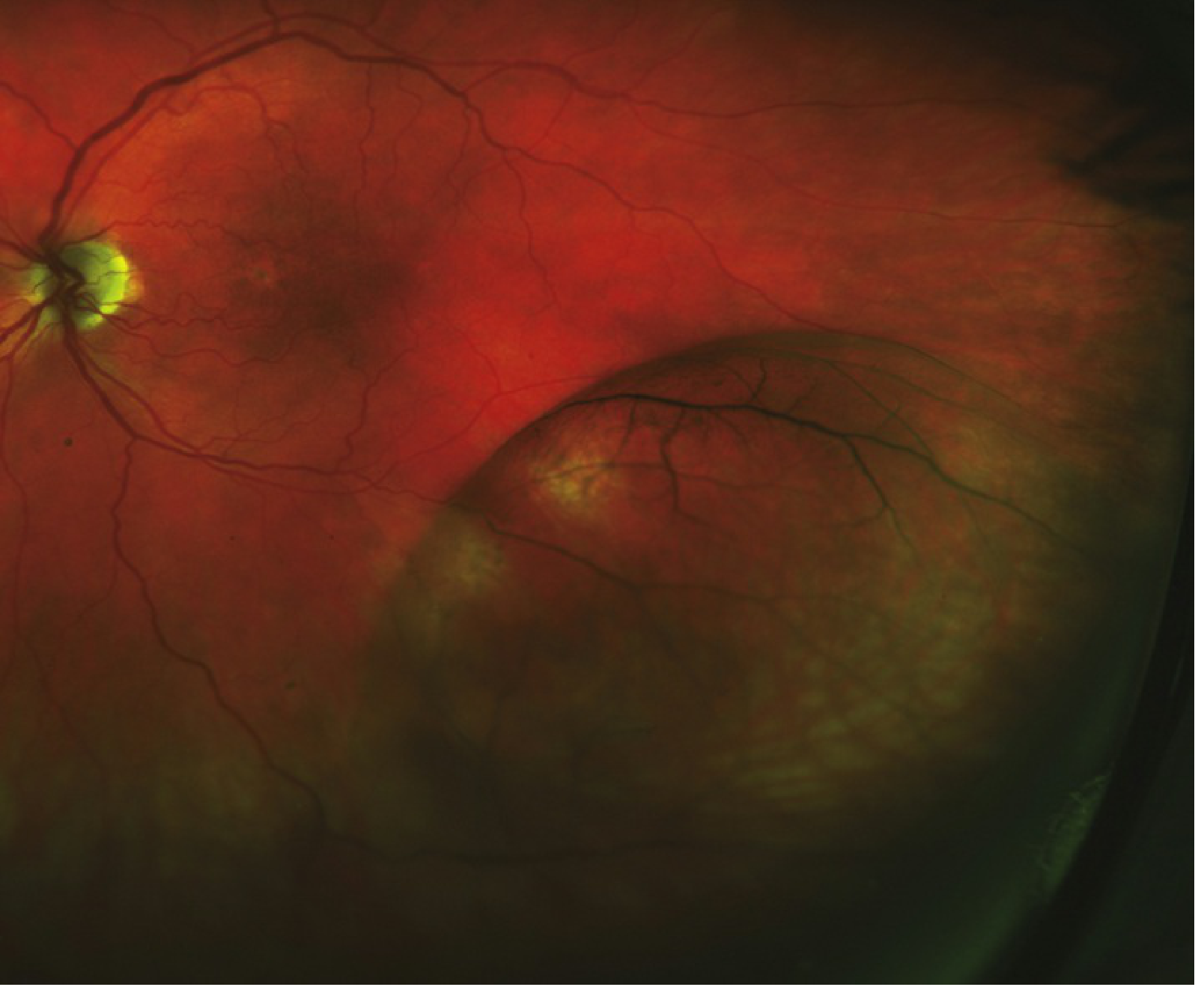
- Smooth, dome-shaped, convex, relatively immobile elevation — typically inferotemporally
- Inner leaf surface may show "snowflakes" (whitish Müller cell footplate remnants) and vascular sclerosis
- Bridging grey-white tissue strands across the schisis cavity
- Prominent cystoid degeneration near the ora serrata
- Inner leaf breaks: small and round
- Outer leaf breaks: larger, rolled edges, behind the equator — higher risk of RD
- Absolute scotoma corresponding to the schisis area (cf. relative scotoma in RRD)
- No pigment cells or haemorrhage in vitreous; no demarcation line (unless associated RD)
Complications:
- RD is rare (~1% even with breaks in both layers); usually asymptomatic and rarely progressive
- Posterior extension to involve fovea — very rare
Investigations
| Test | Finding |
|---|---|
| Slit lamp | No anterior chamber inflammation; no vitreous pigment |
| OCT | Confirms layer of retinal splitting; helps distinguish from RD |
| Visual fields | Absolute scotoma (vs. relative in RD) |
| Scleral depression | Rules out outer layer breaks and concomitant RD |
Treatment
- Usually observation — discuss RD symptoms with all patients; return if floaters, flashing lights, or visual curtain appear
- Surgery only when a clinically significant RD develops
- A small RD walled off by a demarcation line is typically not treated
- Follow-up: every 6 months
Key Differentiating Features
| Feature | X-linked Juvenile RS | Age-related Degenerative RS | RRD (for comparison) |
|---|---|---|---|
| Age | Boys 5–10 yrs | Adults >20 yrs | Any |
| Genetics | RS1 mutation (X-linked) | Acquired / sporadic | — |
| Laterality | Bilateral | Bilateral (80%) | Usually unilateral |
| Location | Macular + inferotemporal periphery | Inferotemporal periphery | Variable |
| Splitting level | NFL (and outer plexiform) | Outer plexiform layer | Sub-retinal space |
| Surface | Smooth | Smooth, immobile | Corrugated, mobile |
| Vitreous | VH may occur | Clear — no pigment cells | Pigmented cells (Shafer's) |
| Scotoma | Absolute | Absolute | Relative |
| IVFA | No leakage | — | Leakage possible |
| ERG | Electronegative (↓ b-wave) | Normal | — |
| Demarcation line | May be present (even without RD) | Absent (unless associated RD) | Present (old RD) |
Sources: Kanski's Clinical Ophthalmology: A Systematic Approach, 10th ed., pp. 670–671, 685–686 | Wills Eye Manual, pp. 772–776
Recent evidence note (PMID 41760155): A 2026 umbrella systematic review on inherited retinal diseases (including X-linked RS) highlights gene therapy as an emerging approach — consistent with the textbook note that RS1 gene replacement therapy is under active investigation.
B scan
Reading File
Given the prior context (retinoschisis / ophthalmology), the user is asking about B-scan ultrasonography in the context of ophthalmic evaluation.
Finding Sources
Finding Sources
Finding Sources
Finding Sources
Finding Sources
Finding Sources
Reading File
Reading File
Reading File
Finding Sources
Reading File
Loading Image
Loading Image
B-Scan Ultrasonography (Ophthalmic)
Principle
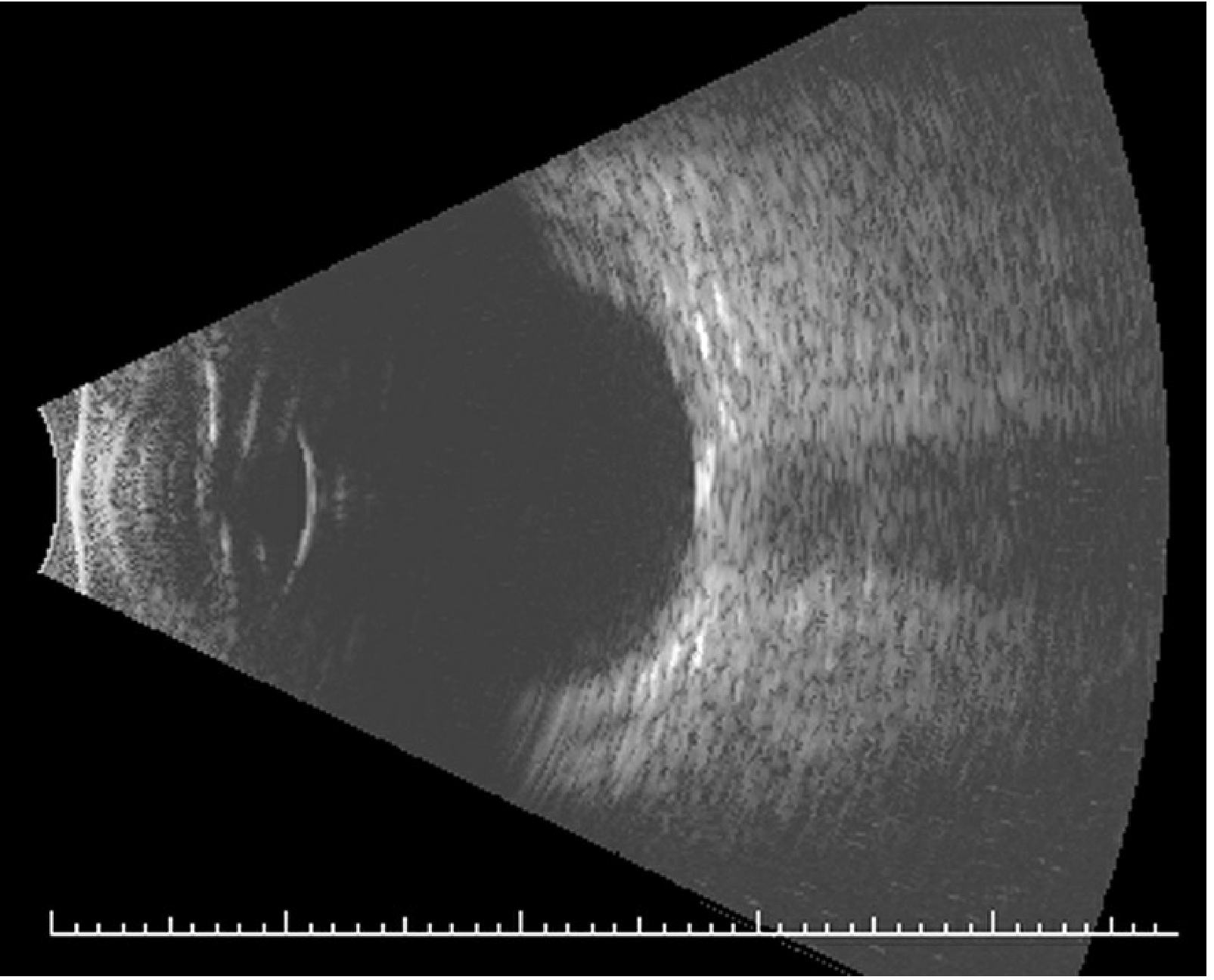
B-scan (brightness-modulated scan) uses high-frequency sound waves that produce echoes at interfaces between acoustically distinct structures. It provides real-time, two-dimensional (cross-sectional) images of the eye, spanning from the posterior aspect of the cornea to the posterior wall of the globe.
Probe Placement
The probe can be applied:
- Directly on the globe (topical anaesthetic applied) — preferred for locating specific pathology (e.g. retinal tear, tumour)
- Over the closed eyelid with sterile methylcellulose coupling gel — preferred in trauma or poorly cooperative patients (avoids pressure on the globe)
A coupling agent (methylcellulose or ophthalmic gel) is always used at the probe tip.
Technique
| Scan Type | Probe Marker Orientation |
|---|---|
| Vertical scan | Marker pointing superiorly (towards brow) |
| Horizontal scan | Marker pointing nasally (towards nose) |
- The eye is examined with the patient looking straight ahead, up, down, left, right
- The probe moves in the opposite direction to gaze — e.g., patient looks left → probe moves nasally to scan the nasal fundus
- Dynamic scanning: patient moves the eye while the probe is held still — critical for assessing membrane mobility
Gain:
- High gain → amplifies weak echoes (e.g., vitreous opacities, subtle haemorrhage)
- Low gain → shows only strong echoes (retina, sclera); improves resolution
Clinical Uses in Ophthalmology
| Indication | What B-Scan Shows |
|---|---|
| Opaque media (dense VH, mature cataract, corneal opacity, hyphema) | Evaluate posterior segment when not directly visible |
| Retinal detachment | Highly reflective, mobile membrane; "good mobility" on dynamic scan; SRF extends to ora serrata |
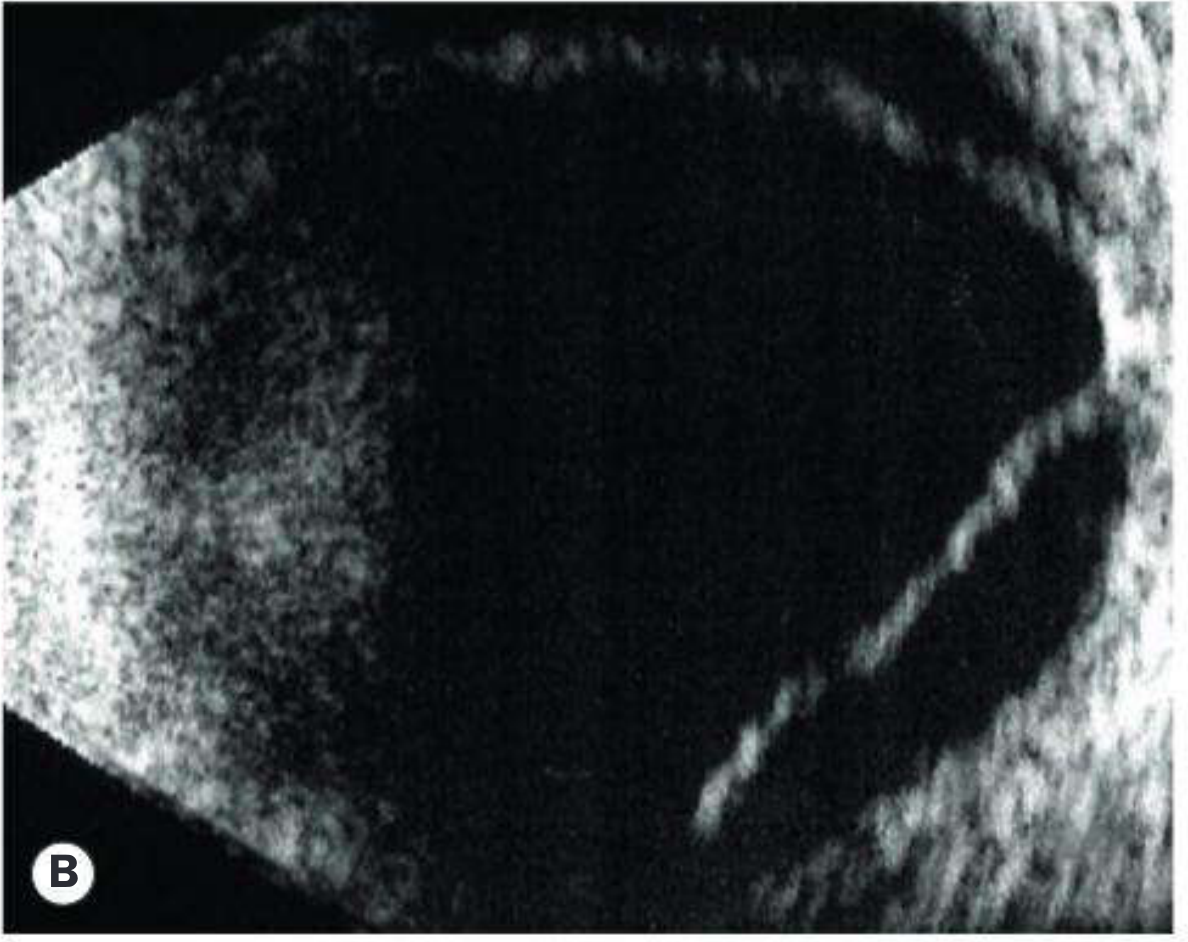
| Retinoschisis vs. RD | Schisis cavity: smooth, immobile, no mobility on dynamic scan; RD: mobile, corrugated |
| PVD | Incomplete PVD: relatively immobile membrane; complete PVD: highly mobile |
| Vitreous haemorrhage | Non-clotted: uniform appearance; clotted: small particulate echoes |
| Choroidal detachment | Differentiate serous vs. haemorrhagic; peripheral dome-shaped elevations that "kiss" anteriorly |
| Posterior scleritis | Scleral thickening + fluid in sub-Tenon space → characteristic "T-sign" |
| Intraocular tumour | Assess consistency, size, vascularity (e.g. choroidal melanoma — low internal reflectivity; retinoblastoma — calcification echoes) |
| Intraocular foreign body | Metallic/glass → strong echo with shadow; wood variable |
| Optic disc abnormalities | Optic disc drusen (buried), coloboma |
| Scleral rupture | Posterior to muscle insertions or when media opacities prevent direct view |
B-Scan Findings in Specific Conditions
Retinal Detachment (RRD)
- High-reflectivity membrane with good mobility of retina and vitreous on dynamic scan
- Subretinal fluid (SRF) extending to the ora serrata
- Membrane tethered at optic disc
Retinoschisis vs. RD
| Feature | Retinoschisis | RRD |
|---|---|---|
| Surface | Smooth, convex | Corrugated |
| Mobility (dynamic scan) | Immobile | Mobile |
| Extent | Usually anterior to equator | Can extend to posterior pole |
| After-movement | Absent | Present |
| Scotoma type | Absolute | Relative |
Vitreous Haemorrhage
- Non-clotted: uniform, low-level echoes filling vitreous cavity
- Clotted/organising: particulate echoes; may show strand formation
- Critical use: to exclude underlying RD or choroidal melanoma behind a dense haemorrhage — always perform B-scan in dense VH
Posterior Scleritis
- Scleral thickening with fluid in the sub-Tenon space posterior to the globe → "T-sign" (the fluid creates a perpendicular dark line alongside the optic nerve shadow)
Choroidal Detachment
- Serous: smooth, dome-shaped elevations, low internal reflectivity
- Haemorrhagic: higher internal reflectivity, less mobile, may "kiss" (touch each other) anteriorly
Limitations / Pitfalls
- Dense intraocular calcifications (e.g. phthisis bulbi) → poor image quality
- Silicone oil or intraocular gas → distorts image; scan the patient upright to improve quality
- Known ruptured globe → relative contraindication to direct probe placement on globe; use over closed lid with copious gel and no pressure
- Anterior orbit / retrobulbar structures → B-scan has limited anterior orbital penetration; CT/MRI preferred for deeper orbital pathology
Sources: Kanski's Clinical Ophthalmology: A Systematic Approach, 10th ed., pp. 683–684 | Wills Eye Manual, pp. 1093–1095
This is a shared conversation. Sign in to Orris to start your own chat.