
Supine hypotension syndrome from anaesthesia textbooks standard as an exam answer
Reading File
Finding Sources
Finding Sources
Good — the two key anaesthesia sources are Miller's Anesthesia and Morgan & Mikhail's. Let me pull the dedicated sections from both simultaneously.
Reading File
Reading File
Good. Now let me get the dedicated Aortocaval Compression section from Miller's and more detail from Morgan & Mikhail.
Reading File
Reading File
Excellent content from Miller's. Let me get the continuation from Miller's (left uterine displacement challenge, management) and Morgan & Mikhail's cardiovascular section on aortocaval compression.
Reading File
Finding Sources
Now let me get the Morgan & Mikhail cardiovascular section which will have the aortocaval compression detail and vasopressor management.
Finding Sources
Reading File
Finding Sources
I now have comprehensive content from both major anaesthesia textbooks. Let me fetch the anatomical diagram from Miller's.
Loading Image
I have everything needed for a comprehensive exam answer. Here it is:
Supine Hypotension Syndrome (Aortocaval Compression Syndrome)
Definition
Supine hypotension syndrome is defined as a decrease in mean arterial pressure of >15 mmHg with a compensatory increase in heart rate of >20 beats/min when a term parturient lies supine, caused by compression of the inferior vena cava (IVC) and aorta by the gravid uterus.
— Miller's Anesthesia 10e
Incidence
- IVC compression occurs in nearly all term parturients in the supine position
- Symptomatic supine hypotension syndrome occurs in only 8–10% of women (Miller's) — also quoted as ~5% (Morgan & Mikhail's)
- Significant aortoiliac artery compression occurs in 15–20% of pregnant patients
Mechanism / Pathophysiology
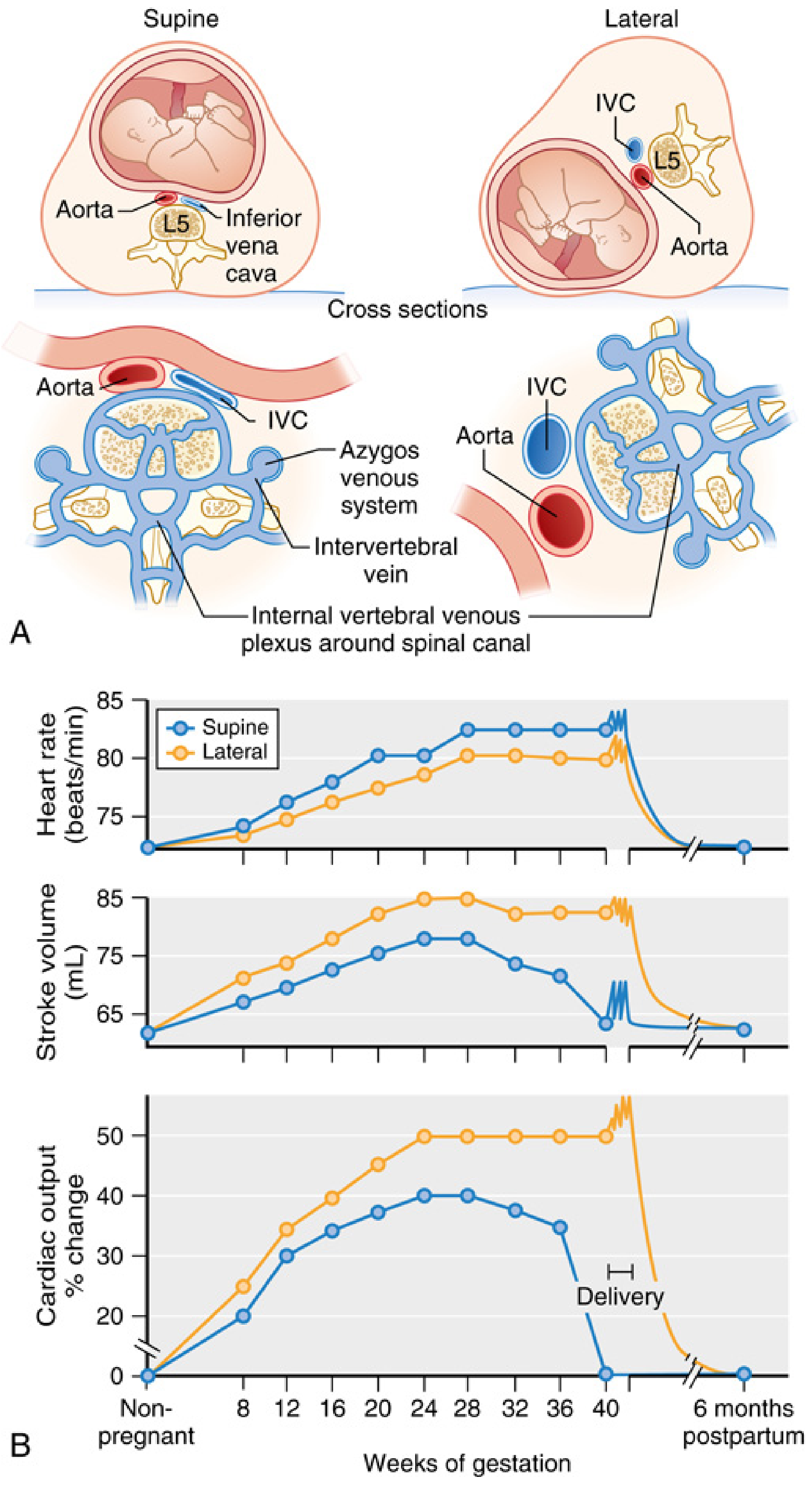
- IVC compression by the gravid uterus at L5 → ↓ venous return → ↓ preload → ↓ stroke volume → ↓ cardiac output (10–20% reduction vs upright position)
- Aortic compression → ↓ uteroplacental blood flow (independent of the BP at the brachial artery — femoral and uterine artery pressures may be critically low even when arm BP appears maintained)
- Collateral venous return: Blood from the lower extremities is diverted via the epidural venous plexus, azygos, and vertebral veins, which become engorged → contributes to distension of epidural veins (relevant to neuraxial blocks)
- Uterine contraction: Reduces caval compression but exacerbates aortic compression
Onset from approximately 20 weeks' gestation, worst at term.
Compensatory Responses
Most women do not become symptomatic because of intact compensatory mechanisms:
- Reflex sympathetic activation → ↑ systemic vascular resistance → maintains arterial blood pressure despite reduced cardiac output
- Therefore brachial artery BP may be falsely reassuring — uteroplacental flow can still be compromised
Key anaesthetic implication: Neuraxial and general anaesthesia abolish sympathetic compensation, unmasking the full haemodynamic effect of aortocaval compression. This is the principal reason supine positioning under anaesthesia is dangerous.
Clinical Features
- Hypotension
- Pallor
- Diaphoresis
- Nausea and vomiting
- Changes in mentation / dizziness
- Fetal bradycardia and acidosis (uteroplacental insufficiency)
Sequelae of Chronic Partial IVC Obstruction (Third Trimester)
- Venous stasis in lower limbs → oedema, varicosities, deep vein thrombosis
- Engorgement of epidural venous plexus → increased risk of intravascular injection during epidural placement; reduced epidural space volume → lower dose requirements for neuraxial blockade (30% reduction in local anaesthetic dose)
Prevention & Management
Positioning
- Avoid supine position whenever neuraxial blockade is used
- Left uterine displacement (LUD): Place a wedge or tilt table >15° under the right hip, displacing the uterus to the left
- Classic teaching: 15° tilt. This has been challenged — MRI studies show IVC volume is not significantly different between supine and 15° tilt; 30° tilt significantly increases IVC volume
- A randomised trial of spinal anaesthesia + phenylephrine infusion: no difference in neonatal acid-base status between supine and 15° tilt, but supine patients had lower cardiac output and required more phenylephrine
- Current recommendation (Miller's): Continue to use LUD during induction of neuraxial anaesthesia and during any episode of maternal hypotension or fetal compromise; further studies are needed to define optimal tilt angle
Vasopressors
- Phenylephrine (α-agonist): now preferred first-line vasopressor for neuraxial hypotension in obstetrics — more effective and associated with less fetal acidosis than ephedrine
- Ephedrine (mixed α/β): traditionally first-line but clinical evidence shows greater fetal acidosis (β-adrenergic effect increases fetal metabolism)
Morgan & Mikhail's Clinical Anesthesiology 7e, Key Concept 6
Immediate treatment of acute episode
- Turn patient to left lateral decubitus or full lateral position
- IV fluid bolus (co-load with spinal anaesthesia)
- Vasopressor (phenylephrine infusion preferred)
- Supplemental oxygen
- Assess fetal heart rate
Special Considerations Under Anaesthesia
| Anaesthetic type | Risk |
|---|---|
| Spinal (e.g., for LSCS) | Highest risk — sudden sympathectomy + aortocaval compression → precipitous hypotension |
| Epidural | Slower onset allows partial compensation; still significant |
| General anaesthesia | Volatile agents ↓ SVR; loss of sympathetic tone unmasks compression |
Exam Summary Points
- Mechanism = IVC + aorta compressed by gravid uterus at L5 after 20 weeks
- Incidence of symptomatic syndrome = ~5–10%; IVC compression = nearly all term patients
- Most women are asymptomatic because of intact sympathetic compensation — anaesthesia abolishes this
- CO drops 10–20% supine vs upright; aortic compression causes uteroplacental ischaemia even when arm BP is maintained
- Epidural vein engorgement (from IVC compression) = reduced epidural volume → lower LA doses needed + ↑ intravascular injection risk
- Treatment = LUD (>15–30°), lateral positioning, phenylephrine, IV fluid
- Left uterine displacement: 15° tilt is contested; 30° tilt is more effective; current practice maintains its use
Sources: Miller's Anesthesia 10e (Ch. 58 — Aortocaval Compression, pp. 8805–8809) | Morgan & Mikhail's Clinical Anesthesiology 7e (Ch. 40 — Maternal & Fetal Physiology, pp. 1571–1576)
This is a shared conversation. Sign in to Orris to start your own chat.