
Vision 2020
"Vision 2020" could refer to several different things. Let me make sure I point you in the right direction.
Asking for Preferences
Which 'Vision 2020' are you asking about?
VISION 2020: The Right to Sight is a WHO/IAPB global initiative to eliminate avoidable blindness. Let me pull detailed information from the medical library and current sources.
Searching sources...
Reading File
Finding Sources
Searching the Web
VISION 2020 Right to Sight WHO IAPB global initiative blindness prevention
Reading File
Searching PubMed
"VISION 2020" avoidable blindness elimination global
Reading File
Loading Image
Here is a complete overview of VISION 2020: The Right to Sight, drawn from Park's Textbook of Preventive and Social Medicine and corroborated by WHO/IAPB sources.
VISION 2020: The Right to Sight
Launch and Background
VISION 2020 was launched by the WHO on 18th February 1999 as a joint global initiative with the International Agency for the Prevention of Blindness (IAPB). It is a partnership between WHO and IAPB implemented through a legally adopted agreement for collaboration on the prevention of blindness.
One key distinction from previous blindness initiatives is its rights-based framework - it centres on the recognition of sight as a fundamental human right. This framing serves as a powerful catalyst for national action.
"Recognition of sight as a fundamental human right by all countries can be an important catalyst of initiatives for the prevention and control of blindness."
- Park's Textbook of Preventive and Social Medicine
Core Objective
To eliminate avoidable (preventable and curable) blindness from its major causes by the year 2020, and to assist member countries in developing sustainable national eye care systems.
Target Diseases (Priority Conditions)
| Disease | Category |
|---|---|
| Cataract | Leading cause of blindness worldwide |
| Refractive errors and low vision | Most common, highly treatable |
| Childhood blindness (including xerophthalmia) | Vitamin A deficiency, measles, etc. |
| Trachoma | Infectious cause of corneal blindness |
| Other corneal blindness | Infections, injuries |
| Glaucoma | Chronic, age-related |
| Diabetic retinopathy | NCD-related, rising burden |
Core Strategies
The initiative operates through five strategic pillars:
- Disease control - targeted control and treatment of priority blinding conditions
- Human resource development - training eye care professionals, especially in developing regions
- Infrastructure development - building capacity at all levels of the health system
- Technology - developing and disseminating appropriate, accessible technology
- Monitoring and evaluation - evidence-based tracking of progress
These strategies were remembered using the acronym ISEE (Infrastructure, Strategies, Evidence, Equity) by the American Academy of Ophthalmology.
India's Plan of Action Under VISION 2020
India committed to the initiative and developed a four-tier structural framework for eye care delivery:
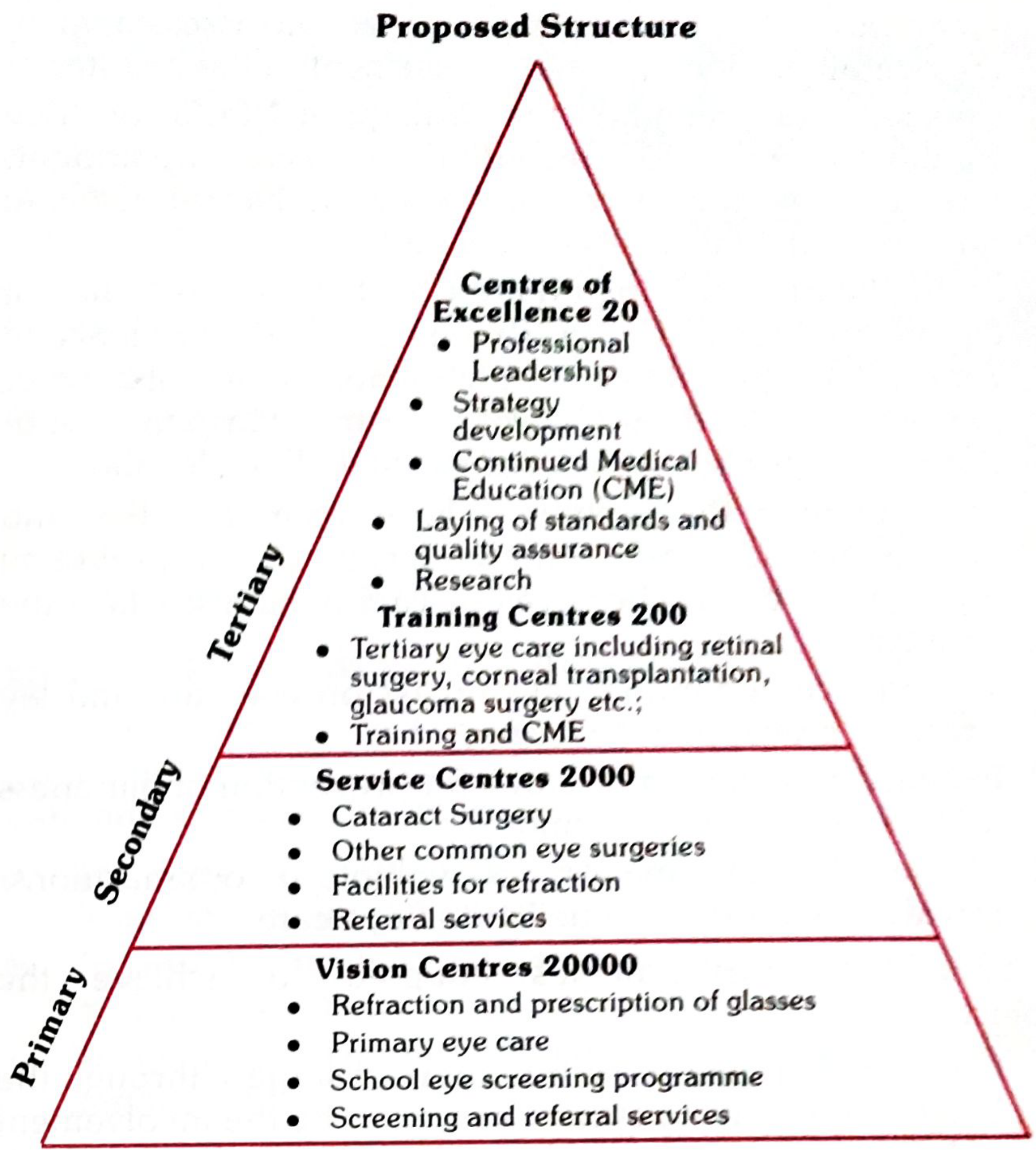
| Tier | Number | Level | Functions |
|---|---|---|---|
| Vision Centres | 20,000 | Primary | Refraction, prescription of glasses, school eye screening, screening and referral |
| Service Centres | 2,000 | Secondary | Cataract surgery, common eye surgeries, refraction facilities, referral |
| Training Centres | 200 | Tertiary | Retinal surgery, corneal transplantation, glaucoma surgery, training and CME |
| Centres of Excellence | 20 | Tertiary (apex) | Professional leadership, strategy development, CME, quality assurance, research |
WHO assistance to India under this initiative included: intra-country fellowships in corneal transplantation and vitreo-retinal surgery, training in district programme management, and situational analysis of eye care infrastructure.
- Park's Textbook of Preventive and Social Medicine
What Followed: Global Eye Health Action Plan 2014-2019
When VISION 2020 neared its deadline, the WHO Global Eye Health Action Plan 2014-2019 (also called "Universal Eye Health") built on its foundation with updated goals:
- Reduce the prevalence of avoidable visual impairment by 25% by 2019 (from the 2010 baseline)
- Address the shift toward chronic, age-related eye diseases (e.g., diabetic retinopathy, glaucoma, AMD)
- Integrate eye care into primary health care and broader NCD frameworks
- Based on five principles: universal access, equity, human rights, evidence-based practice, and a life-course approach
Three progress indicators at the national level:
- Prevalence and causes of visual impairment
- Number of eye care personnel
- Cataract surgery rate
After 2020: "2030 In Sight"
VISION 2020 was succeeded by the IAPB's 2030 In Sight initiative, with the WHO World Report on Vision (2019) laying the new roadmap. The initiative did not fully achieve its original 2020 goals - global blindness numbers did not double (a key achievement), but an estimated 1.1 billion people still live with preventable vision loss.
Key Facts at a Glance
| Item | Detail |
|---|---|
| Launched | 18 February 1999 |
| Partners | WHO + IAPB |
| Member states | 100+ WHO member states joined |
| Goal year | 2020 |
| Guiding principle | Sight as a fundamental human right |
| Successor | 2030 In Sight (IAPB) |
This is a shared conversation. Sign in to Orris to start your own chat.